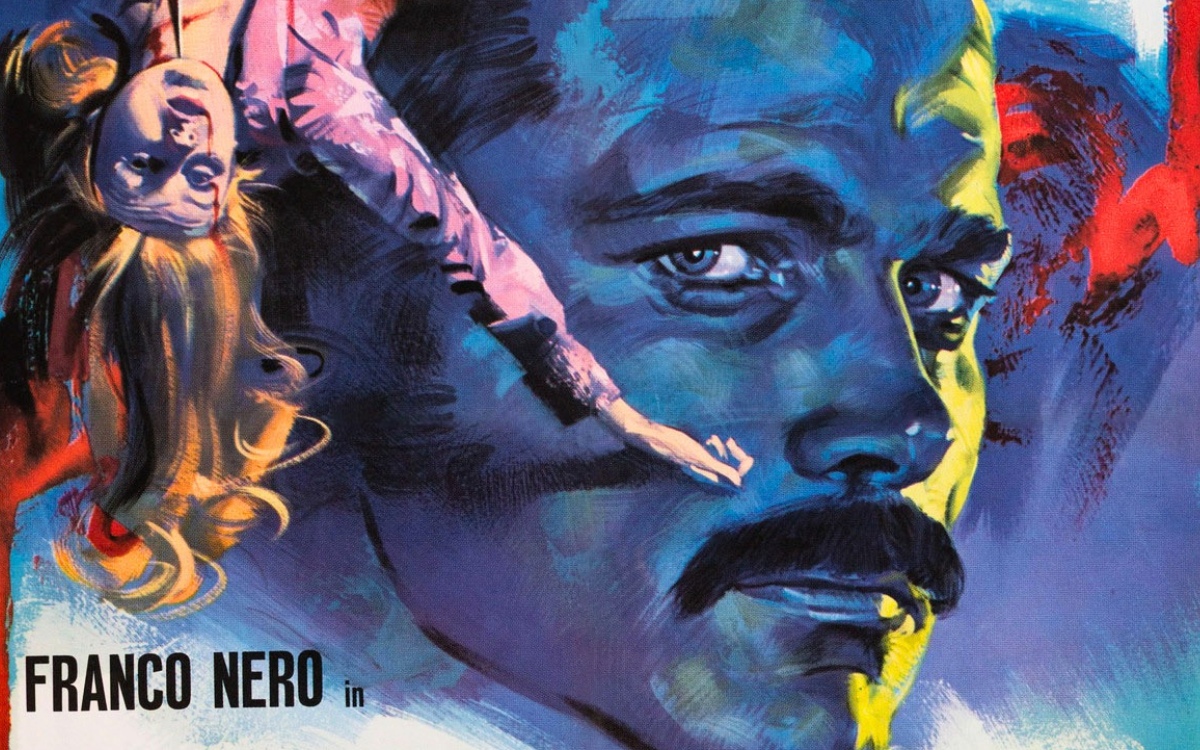
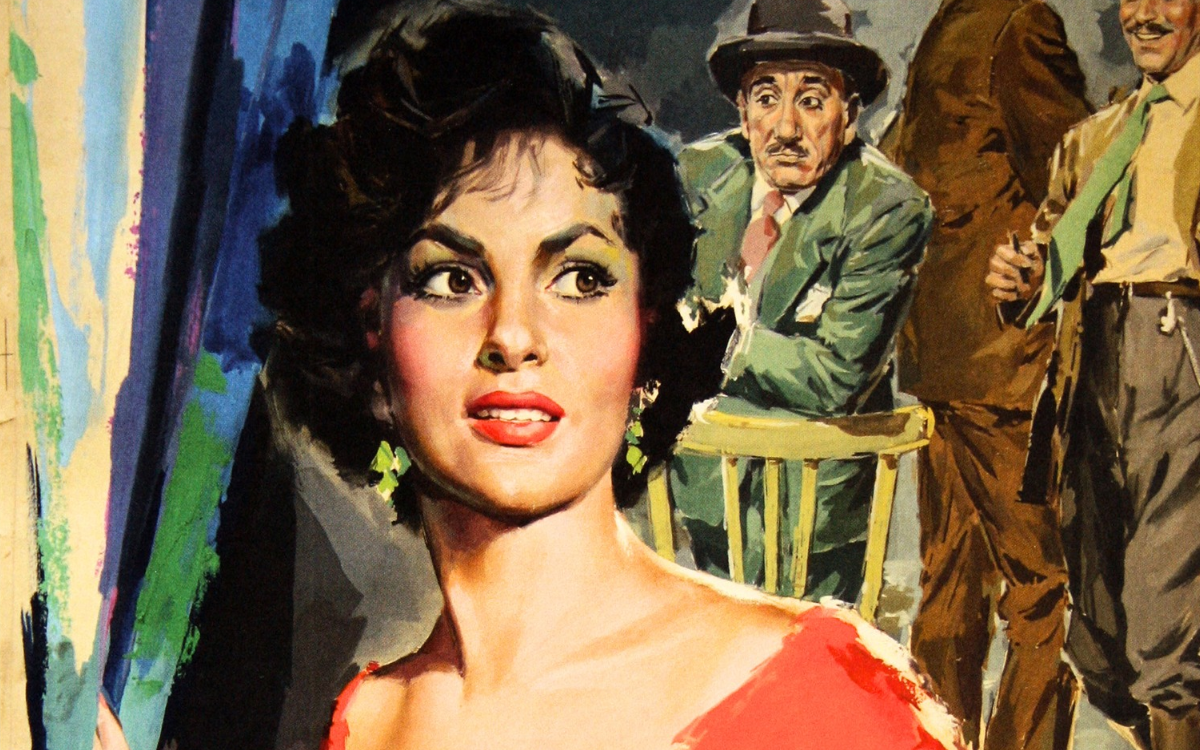
Gina Lollobrigida, the World's Most Beautiful Woman and the Men at Her Feet
By Movie.it Editorial Team
November 20, 2026
Who Was La Lollo
Luigia Lollobrigida, Gina to the world and simply “la Lollo” to Italians (faced with a six-syllable surname, a nation improvises), was born on 4 July 1927 in Subiaco, a hill town east of Rome, the second of four daughters of a furniture maker. After the war the family moved down to Rome, where she took singing lessons, posed for photo-story magazines under the name Diana Loris and, in 1947, came third in Miss Italia behind Lucia Bosè and Gianna Maria Canale. It is the only time anyone recalls seeing her on the bottom step of a podium.
Howard Hughes summoned her to Hollywood with a seven-year contract; she read the small print, said no thank you and went home. The billionaire took it personally and managed to keep her off American films shot in the United States until 1959. She coped. Bread, Love and Dreams made her a national sweetheart, and Beautiful but Dangerous won her the very first David di Donatello for Best Actress, along with a nickname she would never shake off: the most beautiful woman in the world. She shared the screen with Humphrey Bogart, Burt Lancaster, Tony Curtis, Anthony Quinn, Rock Hudson and Sean Connery, while her rivalry with Sophia Loren kept the gossip pages in business for decades, to the delight of all concerned, newsagents included.
In the 1970s, as the scripts thinned out, she simply strolled round to the other side of the camera. She became a photojournalist, published the collection Italia mia and, in 1974, landed an exclusive interview with Fidel Castro, who by most accounts was as jittery in her presence as a schoolboy before an exam. Sculpture followed, with exhibitions around the world. She died in Rome on 16 January 2023, aged 95, and is buried in Subiaco.
A Woman at the Centre of the Frame
Line up her posters and a rule emerges that no contract ever spelled out: standing or sitting, la Lollo is the centre of gravity, and the men fit in wherever they can. On their knees, clinging to her shoulders, dangling upside down from a trapeze, shrunk to a cavalry charge in miniature. Anyone who had to sell tickets with a single image soon realised that her face did all the heavy lifting, and that the rest of the cast could perch somewhere further down. Chivalry? Hardly. It looks more like a thesis. And the joy of it is that the films, more often than not, back her up.
Early Days: a Whip, a Plume and a Man on His Knees
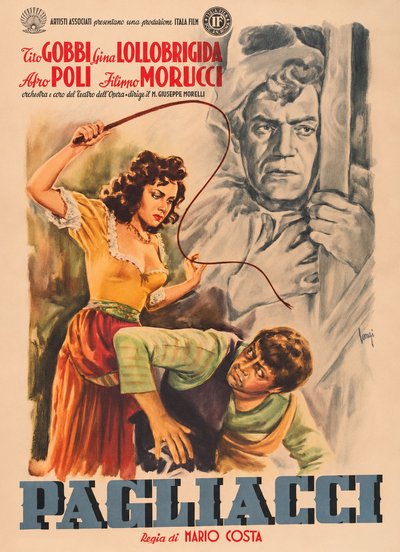
Carlantonio Longi's poster for Pagliacci (Mario Costa, 1948)
Barely twenty-one, a handful of films behind her and not even her own singing voice: her Nedda is dubbed by the soprano Onelia Fineschi. Longi could not care less. He hands her a whip and plants her in the middle, arm raised, blouse making a bid for freedom off one shoulder. At her feet writhes Tonio, the troupe's hunchback (Tito Gobbi, top of the bill and the only member of the cast who actually sang), guilty of trying his luck; behind her looms a huge grey male face, like a storm cloud with bad intentions. In Leoncavallo's opera it ends in tears, with a jealous Canio (Afro Poli) stabbing her. The poster freezes the action a moment earlier, at exactly the right point: passers-by in 1948 were being warned that men would not have an easy time with this girl. Sound advice, as it turned out.
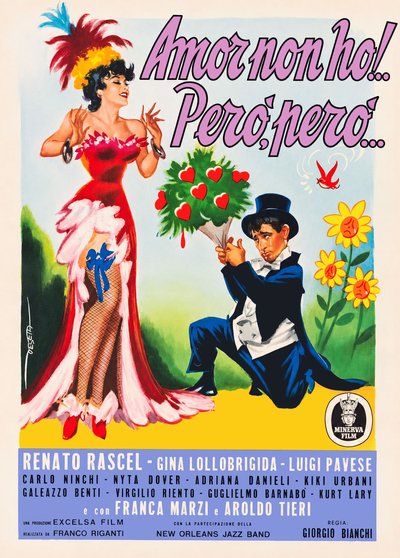
Enrico De Seta's poster for Love I Haven't... But... But (Giorgio Bianchi, 1951)
Renato Rascel, in morning coat and top hat, kneels with a bouquet of red hearts; la Lollo, a showgirl in fishnets with a scarlet plume, laughs with her hands to her face. Add smiling sunflowers and a little red bird and De Seta has a sentimental greetings card, but the proportions give the game away: she fills almost the full height of the poster, while he is tucked into a corner like an ornament on the mantelpiece. The film confirms it with some relish. Teodoro (Rascel) dives into the Tiber to save Gina from drowning herself and ends up being rescued himself; he then clears her fiancé, jailed for a crime he did not commit, puts everything right and trudges home still holding his flowers. To be fair, the title had been honest from its very first words: no love for him.
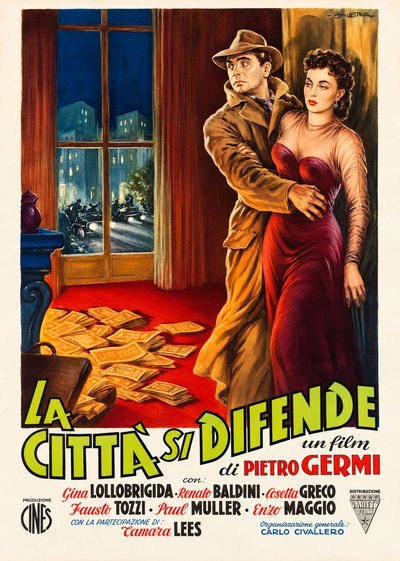
Anselmo Ballester's poster for The City Defends Itself (Pietro Germi, 1951)
Released in English as Four Ways Out, Germi's film is noir with all the trimmings: four men rob the takings of a football stadium and then scatter across the city. Ballester picks out just one, Paolo Leandri (Renato Baldini), a footballer whose career was cut short by injury, dresses him in trench coat and hat and has him clutching Daniela, la Lollo in red with sheer sleeves. On the carpet, banknotes drift like autumn leaves. But look at the eyes. He stares at the window like a man who can already hear the sirens; she gazes the other way, ice-cool, her mind elsewhere. Paolo thinks money might win her back; Daniela looks as though she has already made up her mind about that embrace. The hold is his; the last word, as usual, is hers.
Enter the “Maggiorata”
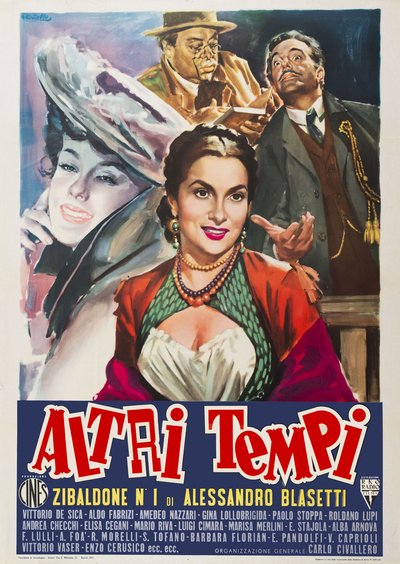
Averardo Ciriello's poster for Times Gone By (Alessandro Blasetti, 1952)
This is where the Italian language gained a word. In Il processo di Frine, an episode of this anthology film (known in English as In Olden Days), Mariantonia Desiderio (la Lollo) is on trial for murder, and her defence lawyer (Vittorio De Sica) plays the cheekiest card in legal history: if the courts acquit the mentally deficient, why not a woman of physical abundance, a “maggiorata fisica”? The term was born on the spot, and Italian actresses spent the next fifteen years trying to get it off their backs.
Ciriello puts the defendant centre stage, red shawl, coral necklace and a smile without a trace of remorse; to her right De Sica opens his palm towards her like a barrister unveiling Exhibit A. It is precisely the gesture of the speech: members of the jury, take a good look, then tell me I am wrong. The film's other faces, lady in an enormous hat included, provide the frame. Verdict: not guilty, on the grounds of overwhelming beauty. And already the leading lady of an era.
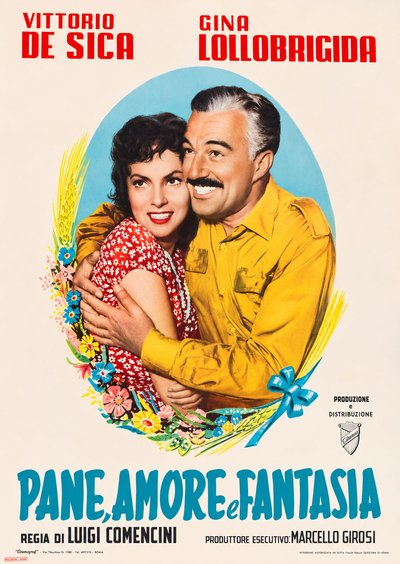
Maro's poster for Bread, Love and Dreams (Luigi Comencini, 1953)
The film that turned her into the Bersagliera, Maria De Ritis, a barefoot, penniless girl from a mountain village, has a poster that starts life as a photograph. Maro leaves la Lollo alone and works on everything else: he paints an oval of wild flowers, ears of wheat and a blue ribbon around her, turning the production still into a wedding favour, the kind of keepsake that sits on Nonna's sideboard for forty years. Marshal Antonio Carotenuto (Vittorio De Sica) hugs her and beams; she beams too. It is the couple audiences were longing for, and the poster serves it up with sugared almonds.
Shame the wedding never happens in Bread, Love and Dreams. The Bersagliera only has eyes for the young carabiniere Stelluti (Roberto Risso), and the marshal has to settle for the local midwife. Yet another man left empty-handed, this time caught grinning for posterity: humiliation, framed. The film took the Silver Bear in Berlin, she took the Nastro d'Argento, and De Sica, by way of consolation, got a sequel.
The Most Beautiful Woman in the World, by Decree
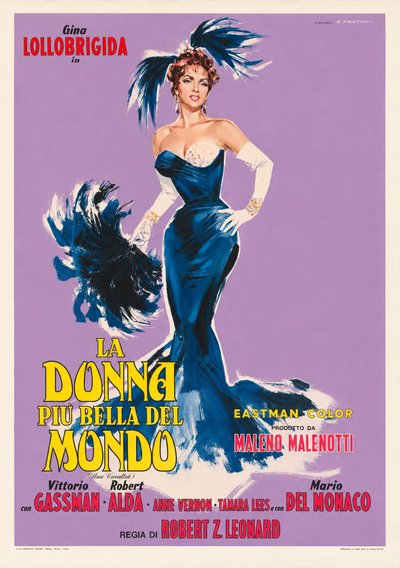
Renato Fratini's poster for Beautiful But Dangerous (Robert Z. Leonard, 1955)
With a title like The Most Beautiful Woman in the World (in English, more cautiously, Beautiful but Dangerous), the painter has no room for negotiation. Fratini paints la Lollo standing, full length, as the soprano Lina Cavalieri: midnight-blue mermaid gown, long gloves, black plumes in her hair and a feather fan in hand, against a lilac background with nothing else in it. No theatre, no scenery, no men. Vittorio Gassman, very much in the film, has been banished to the cast list in the company of a genuine tenor, Mario Del Monaco. The idea could not be clearer: beauty as an official certificate, signed, sealed and stamped. This time she supplied the voice as well, singing the arias herself, and in 1956 the very first David di Donatello for Best Actress went home with her.
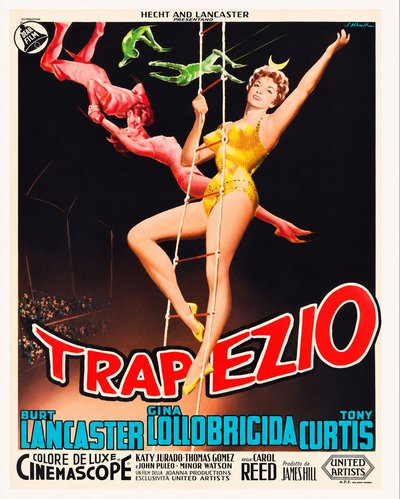
Giorgio Olivetti's poster for Trapeze (Carol Reed, 1956)
Burt Lancaster and Tony Curtis, two of Hollywood's heavyweights, end up on Olivetti's poster for Trapeze exactly where Lola would like them: upside down. Two red and green silhouettes whirl through the darkness of the big top, small as moths round a light bulb. The light bulb is her, in a gold leotard with a crescent moon in her hair, climbing the rope ladder with one arm flung up like someone who has just won. In the film Lola, an ambitious acrobat, wedges herself between Mike Ribble (Lancaster), a former star lamed by a fall, and young Tino Orsini (Curtis), playing one off against the other to get into their act. Even the billing puts her in the middle, Lancaster on the left, Curtis on the right. The men do the triple somersault; the act, however, is hers.
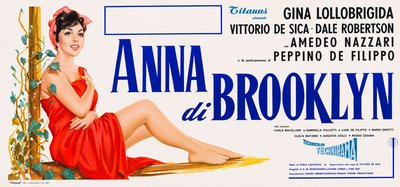
Unsigned poster for Fast and Sexy (Carlo Lastricati and Reginald Denham, 1958)
In Anna of Brooklyn a well-to-do widow returns from New York to the village where she was born to find herself a husband, and the local bachelors queue up in their Sunday best. The poster, a landscape format, has her sitting barefoot against a tree trunk, wrapped in a red towel, legs on show and the smile of a woman with the whole afternoon free. The men? All over on the right, reduced to typography: Vittorio De Sica, Dale Robertson, Amedeo Nazzari, Peppino De Filippo, a column of names that looks exactly like the queue of suitors. She does not spare them a glance. Among them is Raffaele (Robertson), the mechanic who seems determined not to join the contest. But you need not wait for the ending to see who makes the decisions in this village: Anna does, and she is in no rush.
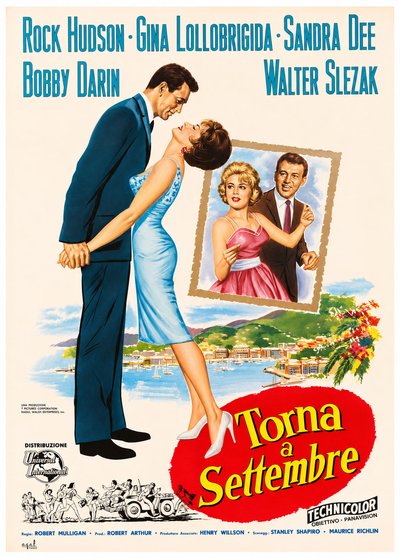
Unsigned poster for Come September (Robert Mulligan, 1961)
Hollywood at last, and Rock Hudson: getting on for six and a half feet of American. To kiss him in Come September, Lisa Fellini (la Lollo) has to rise onto the tips of her heels and stretch every inch of her pale-blue sheath dress. It is one of the very rare occasions when a poster places her lower than a man, and Robert Talbot (Hudson), the millionaire who joins her every September at his villa on the Ligurian coast, holds her hands as if to make sure she does not bolt. In the frame behind them, Sandra Dee and Bobby Darin, the film's young lovers, look like a holiday snap hung on the wall; below, the bay and a jeep crammed with teenagers. The film keeps them sparring and pursuing each other, but she sets the pace. The Golden Globe Henrietta Award, for the world's favourite star, went to her. He got to be tall.
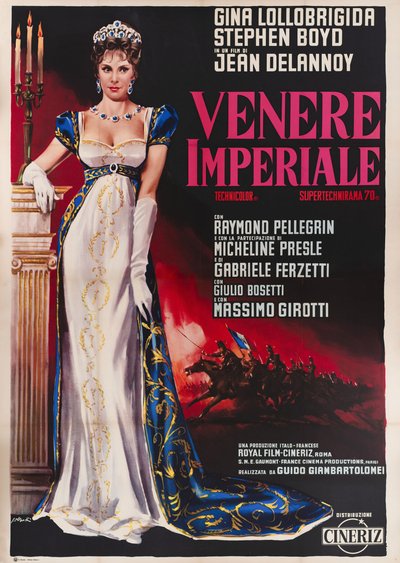
Giorgio Olivetti's poster for Imperial Venus (Jean Delannoy, 1962)
Pauline Bonaparte, Napoleon's favourite sister, is remembered chiefly because Canova sculpted her reclining and half-naked as Venus Victorious. In Imperial Venus Olivetti does the exact opposite and dresses her from head to toe: white Empire gown embroidered in gold, blue mantle, tiara and sapphire necklace, standing beside a column with a lit candelabrum. On the red background, small as a frieze, the cavalry charges. That is the whole idea, and it is irresistible: the armies that brought Europe to its knees reduced to trimming behind a woman's train. Napoleon (Raymond Pellegrin) and her lover Jules de Canouville (Stephen Boyd) are confined to the cast list. Six years earlier, in Trapeze, the same Olivetti had given Gina movement and vertigo; here he freezes her in the solemn pose of a state portrait. A different way of directing the eye, but the star remains in command. The role won her both the David di Donatello and the Nastro d'Argento. For once, somebody else got the Waterloo.
The Sixties: the Men Creep Back In (from Behind)
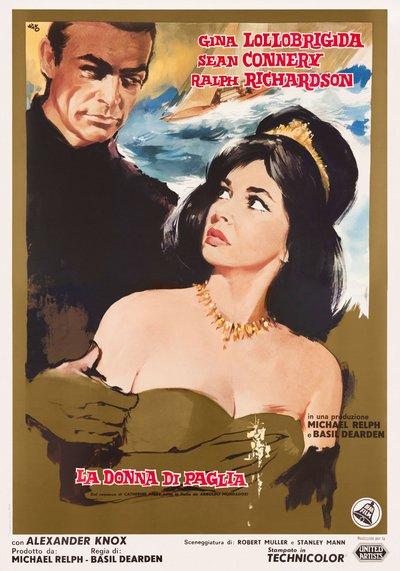
Silvano Campeggi “Nano”'s poster for Woman of Straw (Basil Dearden, 1964)
Sean Connery had just made the first two Bond films, and it shows: dark suit, regulation raised eyebrow, one hand resting on her shoulder. In Woman of Straw Campeggi stations him behind Maria Marcello (la Lollo), the Italian nurse hired to look after his fabulously rich and tyrannical uncle, Charles Richmond (Ralph Richardson). Wearing olive green and a tiara, she looks up at him, and it is not the look of a woman in love. It is the look of a woman keeping an eye on where his hands are. Behind them, a yacht tosses in a storm. The film plays on precisely that mistrust: Anthony Richmond (Connery) has plans for Maria that are rather less romantic than he pretends, and his uncle's fortune is very much part of them. Bond lurking behind; trouble ahead.
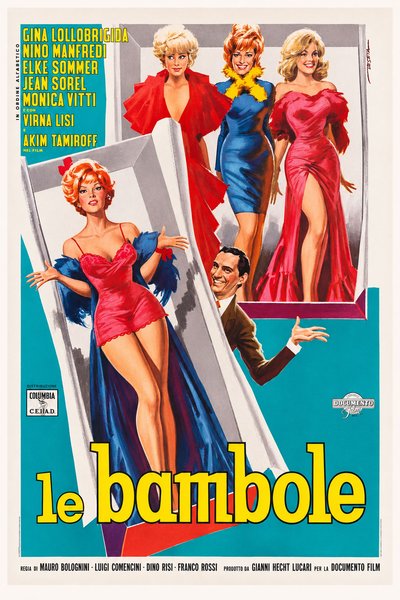
Enrico De Seta's poster for The Dolls (Mauro Bolognini, Luigi Comencini, Dino Risi, Franco Rossi, 1965)
Four episodes, four stars: Gina Lollobrigida, Elke Sommer, Monica Vitti and Virna Lisi. De Seta takes the title (released in Britain as Four Kinds of Love and in America as The Dolls) at its word and packages them like dolls in a shop window: three standing inside a large frame in evening dress, the fourth stepping out of another in the foreground in a red slip and feather boa. A grinning man in a dark jacket pops up behind them, the only male on the poster, with the look of a small boy outside a toyshop. In Bolognini's episode Monsignor Cupido, la Lollo plays Beatrice, who loses her head over young Vincenzo (Jean Sorel), part of a monsignor's retinue (Akim Tamiroff).
Yet here, for the first time, picking her out with any certainty is a challenge. In this ensemble poster the four leading ladies become a single display, and even the world's most beautiful woman has to share the shop window. Compare De Seta's Amor non ho! Però, però... (1951): there Gina took up almost the whole height of the sheet while Rascel knelt in a corner; fourteen years later she is one star among four. Even the names, as the poster helpfully points out, are in alphabetical order. She still comes first, but only by kind permission of the alphabet.
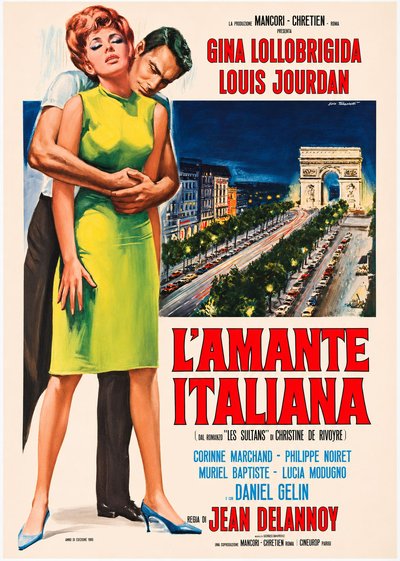
Ezio Tarantelli's poster for The Sultans (Jean Delannoy, 1966)
The French title, Les Sultans (in English, The Sultans), was about the men; the Italian one puts her, the Italian lover, back at the centre, and the poster follows suit. Tarantelli paints Lisa Bortoli, a fashion photographer, in a yellow-green shift dress, eyes closed, while Laurent Messager (Louis Jourdan) holds her from behind and rests his face on her head. Beside them, the Champs-Élysées and the Arc de Triomphe lit up for the night. For once he is the one holding on and she is the one letting go. The film goes further: Laurent is married, and Lisa spends half the story sitting by the telephone, willing it to ring. After twenty years of men on their knees, la Lollo is cast as the one who waits. The painter makes amends the only way he can: she takes up nearly the full height of the poster. The telephone, mercifully, has been left out of the picture.
The Other Side of the Lens
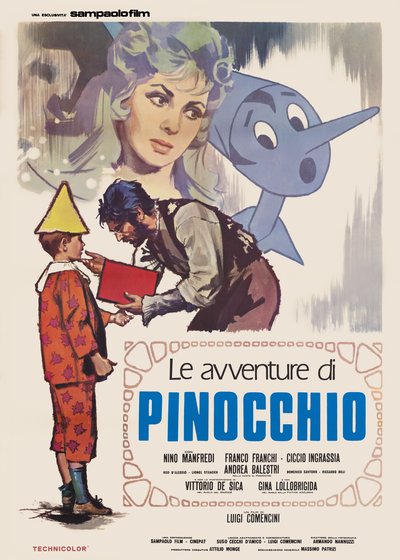
Angelo Cesselon's poster for Le avventure di Pinocchio (Luigi Comencini, 1972)
Comencini called her back for The Adventures of Pinocchio, made for television and then re-edited for cinemas, and cast her as the Fairy with Turquoise Hair. The poster turns her into exactly what the role requires: an apparition. At the top, a pale, almost translucent face, the hair a bluish cloud, watching the scene the way you look at a memory. Below is real life, noisy and made of wood: Geppetto (Nino Manfredi), stooping, hands the spelling book to the boy Pinocchio (Andrea Balestri), paper hat on his head; beside them, the long-nosed puppet, who knows a thing or two about fibbing. For the first time the men are in the middle and she is above them, far away. It is the perfect closing image for this gallery, because at just that time the most looked-at woman in Italy picked up a camera and turned the lens the other way.
A fashion photographer in make-believe in The Sultans, a photojournalist for real a few years later. For a quarter of a century the painters had decided where to put her and where to arrange the men around her. From then on, Gina Lollobrigida decided where everybody else should stand. Fidel Castro included.
The works reproduced on this page come from period prints, recovered, photographed and digitally restored by Movie.it
You may also like
Marcello Mastroianni, Anatomy of an Anti-Hero
Woody Allen, the Painted Persona