
Anselmo Ballester, Master of the Italian Movie Poster
Edited by Paolo Zelati, Editorial Director
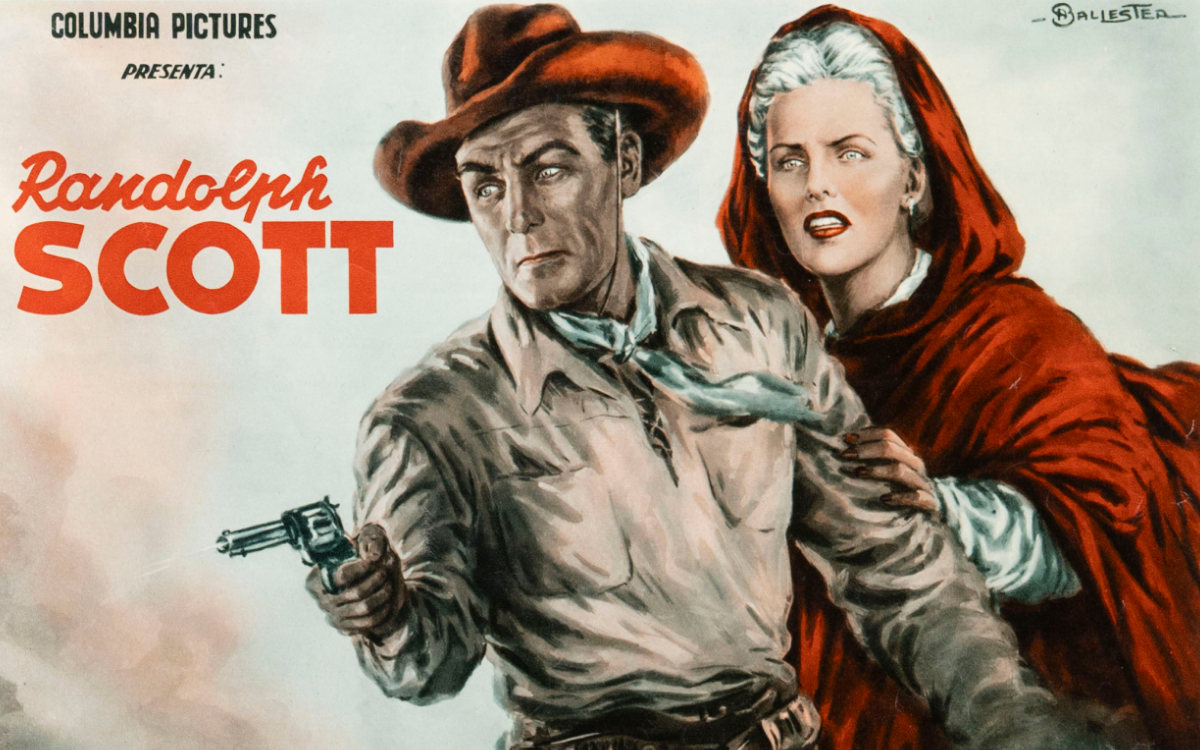
June 1, 2026
There is something deeply Roman in Anselmo Ballester's relationship with images: a sense of grandeur tempered by an artisan’s practicality, an eye capable of looking at melodrama without ever losing itself in excess. Born in Rome on 15 July 1897 to Federico Ballester, a painter of Spanish origin, Anselmo followed his father's artistic activity from childhood, producing his first works at just fifteen years of age. His father's workshop was his first academy, and he had no need to proclaim himself a prodigy to be one.
A Catalan Legacy and the Discovery of Cinema
After attending the Accademia di Belle Arti in Rome, he specialised in film advertising, working for the most important production houses of the silent film era. These were years in which the seventh art, born just two years before him, was conquering Italy with the speed of an epidemic. Young Anselmo, during one of his Parisian stays with his father, was struck by one of the first projections of images onto the façade of a building: from that moment on, cinema would become his creative horizon for almost half a century.
In his Rome studio, first at Via della Croce 50a, then at Passeggiata di Ripetta 19, he would spend nearly fifty years preparing thousands of sketches and designs for "locandina" (Italian small format) and film posters of every format, collaborating with production and distribution companies of the calibre of Titanus, Paramount, RKO and Fox. Together with colleagues he founded the B.C.M. group, a company specialising in film posters that would dominate Italian film-poster illustration for many years.
Art or Craft? The Poetics of an Unrivalled Poster Artist
Ballester had a precise theory about his own work. In his own words, the cinema poster artist «should unite within himself all the qualities of the painter, the portrait artist, the illustrator, the decorator, and carry in his mind a lavish palette of colours and a wealth of ideas, preferably brilliant ones. He must succeed in satisfying the tastes of both refined people and the less sophisticated, who are the majority.»
It is an artistic credo that says everything: the conscious duality of someone who works between art and industry without pretending the two are the same thing. His work is grounded in a solid academic training, enriched by the study of contemporary artistic currents and an eclectic approach, whose apparently realistic results were based on a visual repertoire that the general public had learned to read, and that film marketing repeatedly called for.
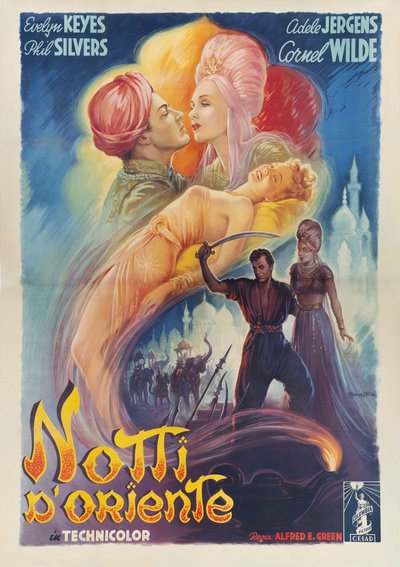
A Thousand and One Nights: when the poster doesn't tell, but seduces
Among the works considered here, the one for Alfred E. Green's film is perhaps the most overtly painterly, the most free from any obligation of verisimilitude.
Ballester deploys a warm, dreamlike palette of flaming oranges, sunlit yellows and evening blues, building a vertical composition that proceeds through superimposed dreamlike layers: the romantic couple at the top, almost dissolved into the air; at the centre, a languid female figure; at the bottom, a warrior with his sabre, surrounded by other figures, mists and Moorish architecture.
Echoes of Alphonse Mucha and Viennese Art Nouveau graphics are recognisable, but the structure is already thoroughly modern in its capacity to overlap distinct temporal planes on the same sheet.
You don't see a film: you sense an atmosphere. For certain genres of exotic adventure, Ballester had understood, the poster must not narrate, it must enchant.
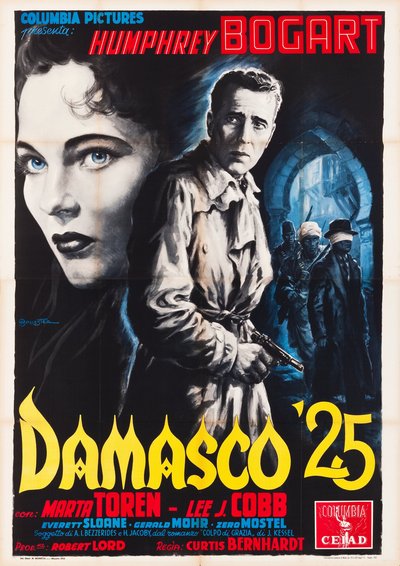
Sirocco: Bogart between love and war, in the shadow of noir
This work, created for the film released in Italy in 1952, positions Bogart with extraordinary effectiveness at the intersection of love and war. The challenge was not to betray an already well-established iconography, while still giving it a distinctive character of his own.
Ballester resolves it with a dual-register composition: in the foreground, the face of Marta Toren, painted with an almost photographic chiaroscuro, her eyes piercing the surface like headlights in the night; at the centre, Bogart advances in a raincoat, pistol in hand; behind him, an Orientalist arch bathed in blue opens onto the background.
The dialectic between the absolute black of the foreground and the cobalt blue of the architectural interior generates a chromatic tension that is already, in essence, the visual core of the noir genre.
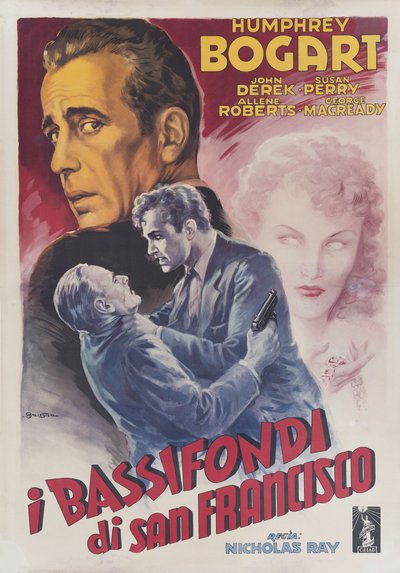
Knock on Any Door: montage as pictorial composition
If in the previous poster Bogart was a romantic icon, here he becomes brute force. His face occupies almost a quarter of the sheet in the upper left, shown in three-quarter profile against a brick-red background that drips with restrained violence. Below, a body falls, dragged by a young man with a gun; in the upper right, the evanescent silhouette of a blonde woman floats like a ghost or like a memory.
What strikes you is the structural modernity of the solution: no sequential storytelling, but an associative logic, three simultaneous images that the brain assembles on its own into a narrative. It is the language of cinematic montage translated into graphic design, anticipating solutions that editorial design would not adopt until the 1960s.
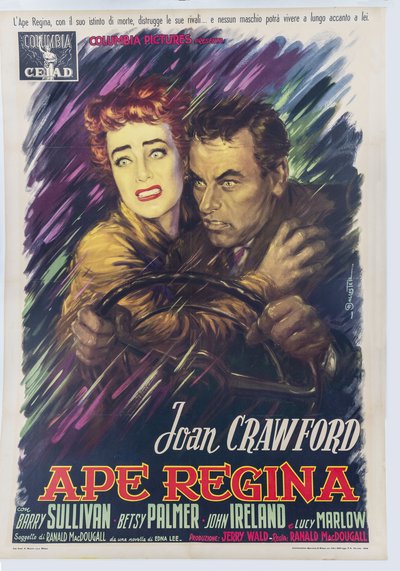
Queen Bee: Joan Crawford's emotional storm in a whirl of colour
Among the five posters, this is probably the boldest in terms of painterly gesture. The background is a vortex of broad, violent brushstrokes, purple, green, midnight blue that materialises the emotional storm of the story. From this turbulence emerge the two protagonists, the man gripping the steering wheel as Crawford clings to him, their faces marked by a mixture of fear and ferocity.
Joan Crawford is portrayed with that theatrical quality that was at once her trademark and her critical undoing. Ballester does not soften it: he amplifies it. The Crawford of his poster is a woman the wind itself seems to assail, and the red and yellow typography supporting the title is among the most successful graphic solutions in his entire output.
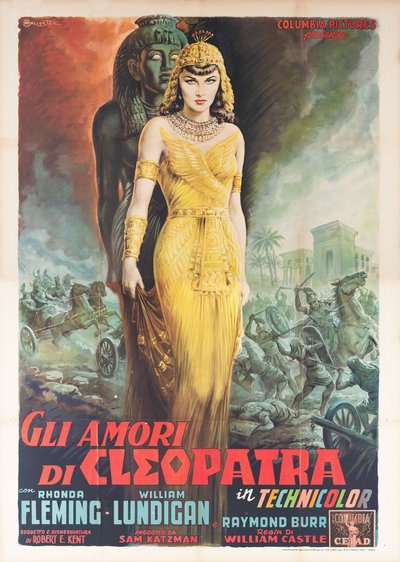
Serpent of the Nile: the epic as an auteur miniature
In the 1950s, Ballester's production reaches heights of refinement that border on preciousness and his sketches become genuine works of art. The poster for William Castle's film is the most eloquent demonstration: the colossal sphinx looming black and green against the background, Rhonda Fleming in a golden gown occupying almost two-thirds of the sheet, the battle scenes of chariots, horsemen and foot soldiers spread like an ancient frieze across the lower part of the composition. Every detail of the jewellery, every fold of fabric is resolved with a care that belongs more to miniature painting than to commercial graphics. The Egypt he depicts never existed, but it is immediately, inevitably recognisable and that is the most authentic measure of his talent.
The Legacy of an Artist without Category
When Ballester abandoned his career as a poster artist in the early 1960s to devote himself to painting and portraiture, he left behind an archive of over three thousand works for the cinema that together form an extraordinary visual chronicle of twentieth-century film. He found no place in post-war art-history manuals: too commercial for the academic establishment, too cultured to be dismissed as mere craftwork. His sketches, preserved today at the Centro Studi e Archivio della Comunicazione of the University of Parma and at the Museo Cinema a Pennello in Montecosaro, reveal a painterly quality that far transcends their original function.
As the scholar Paola Pallottino has observed, to find one of his posters is to rediscover an entire era: the golden years of cinema, condensed into the space of a single film poster. In an age when film promotion relies on algorithms and retouched photography, Ballester's work retains a quality no software can replicate: that of an artist who interpreted and reimagined the film through his hands, his imagination and a palette of colours. Painted cinema, indeed.
The works reproduced on this page come from the original prints of the period, recovered, photographed and digitally restored by Movie.it.