Franco Nero was born on 23 November 1941 in San Prospero Parmense, just outside Parma, and the register has him as Francesco Clemente Giuseppe Sparanero. Show business would later saw the surname in half, discarding the very syllables best suited to what lay ahead: "spara" is Italian for "shoots". The son of a carabiniere from Puglia, he moved to Milan as a boy, qualified as an accountant, thought better of it and ended up in Rome as a photographer's assistant on Via Margutta. A De Laurentiis photographer took a few pictures of him, the pictures reached John Huston's desk, and Huston summoned him to audition for The Bible: In the Beginning... In a room full of people, the great director told him to undress. Nero stood there in his pants and walked out as Abel.
That same year, 1966, Sergio Corbucci handed him the rope of a coffin and dragged him through the mud: Django made him famous across the world. Next came Lancelot in Camelot (Joshua Logan, 1967), where he met Vanessa Redgrave. They had a son in 1969, drifted apart, found each other again and married in 2006, some forty years on, which nobody could call rushing it. Along the way came more than two hundred films, from Buñuel (Tristana) to Fassbinder (Querelle), from Die Hard 2 to the voice of Uncle Topolino in Cars 2, a cameo in Django Unchained and the Pontiff himself in The Pope's Exorcist (2023). From Abel to the Pope is what you might call steady promotion. In February 2026 he got his star on the Hollywood Walk of Fame; this November he turns 85, and retirement is not up for discussion.
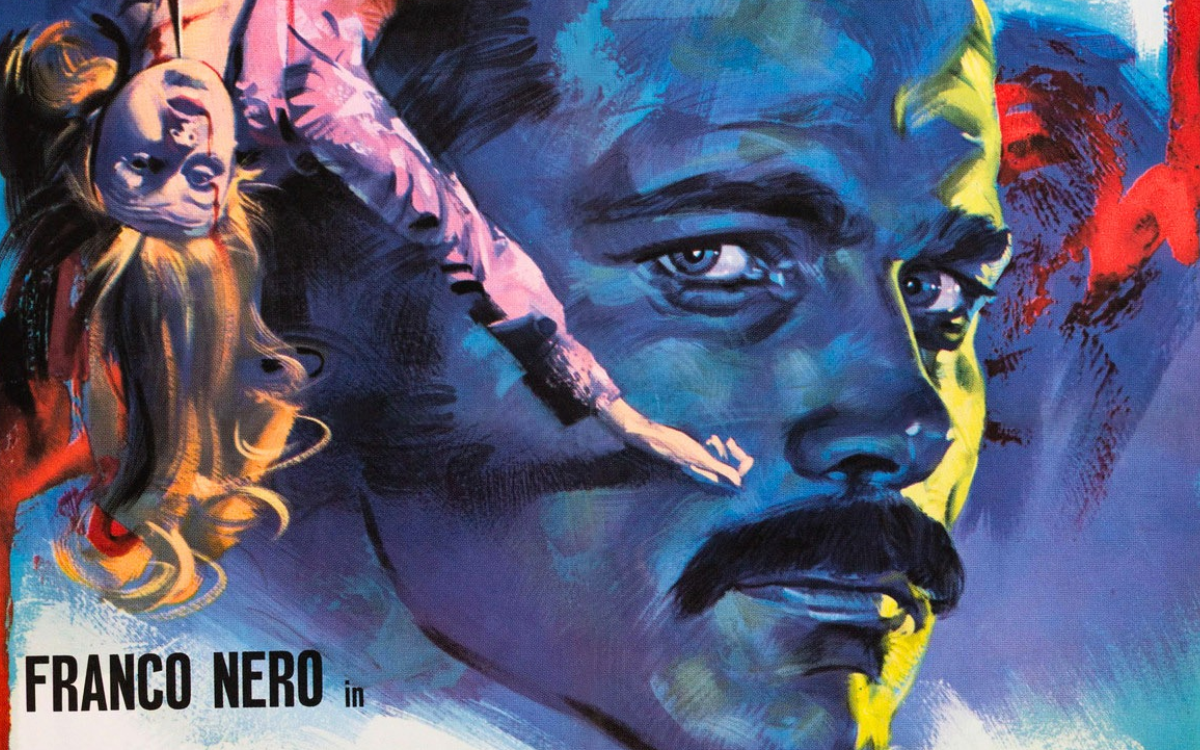
The painters who put him on Italian walls cared about precisely one of these things, and his name was no help. "Nero" means black. The eyes are blue. Line up seven posters from his first decade in films and you can watch what can be done with such a pair: light them, frighten them, steal them, smear them over an entire face. Or, to begin with, paint them brown.
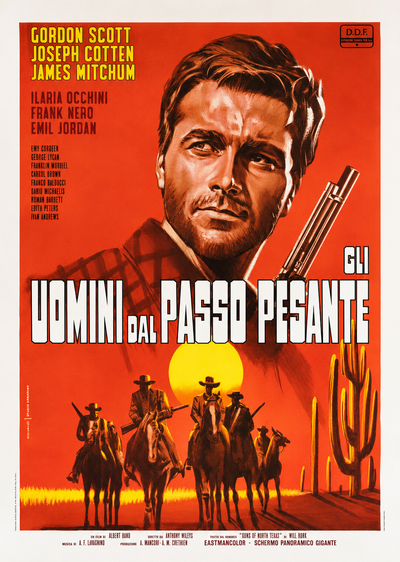
Piovano's poster for The Tramplers (Albert Band and Mario Sequi, 1965)
Before he was Franco, he was Frank. You have to read the small print to find him: "Frank Nero", fifth on the bill, below Gordon Scott, Joseph Cotten and James Mitchum, playing the supporting part of Charley Garvey. Then you look up, and the great face in the middle is his. This is a re-release, arriving once Django had been round the world, and the arithmetic was not difficult. Gordon Scott, the former Tarzan, who actually leads the film as Lon Cordeen, stays top of the bill and must settle, at best, for a silhouette on horseback. Small name, big face: you will not find a neater bit of cunning. Only one detail fails to add up, and that is the brown eyes.
In a picture done entirely in brick and sepia, blue simply does not exist, and the painter makes do. Here is a lad from Parma with a name from Texas, in a film whose co-director Mario Sequi also felt the need to become Anthony Wileys. From here on, others will sort out the colours.
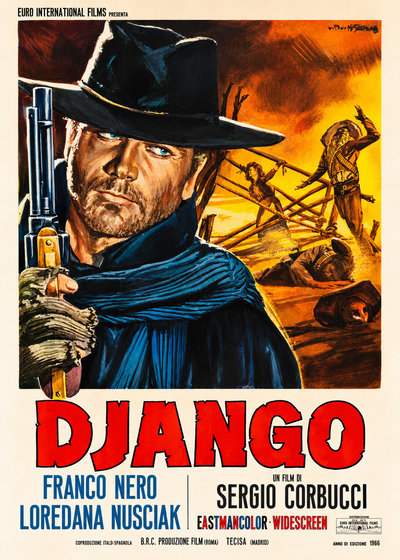
Gasparri's poster for Django (Sergio Corbucci, 1966)
In 1966 the name is already Italian and the eyes have arrived. Gasparri buries Django's face beneath the brim of his hat and leaves a single slit of light, placed exactly where a pair of blue irises is required, with a blue scarf underneath in case anyone missed the point. Nero is 24; the painter makes him at least 40, and six decades on we can confirm the face was always going to carry it off. What has gone missing is more interesting. The film is famous for its mud and its coffin. Here the mud has turned to gold and the coffin has vanished. Behind him are Maria (Loredana Nusciak), tied to the posts, a bandit toppling backwards and others already down, but Django does not turn round: that job is done. The gun stands upright by his cheek and his hand, poking out of a frayed glove, takes up the foreground. Anyone who knows the film knows what is coming to those hands. Best enjoy them while they last.
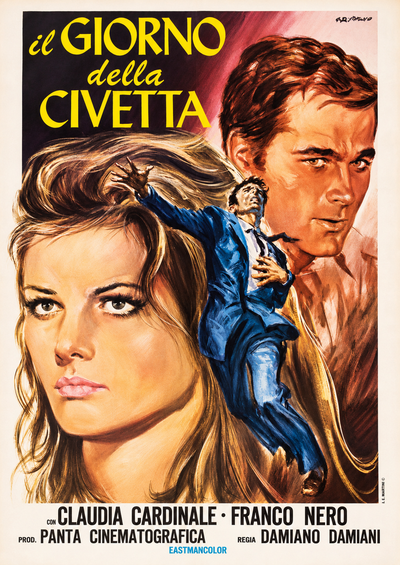
Di Stefano's poster for The Day of the Owl (Damiano Damiani, 1968)
At this point our theory trips over its own feet, which is rather good news. Di Stefano gives Captain Bellodi dark eyes. So where did the blue go? Just down the page, vast and pale, in the face of Claudia Cardinale (Rosa Nicolosi), whose own eyes were dark. It is daylight robbery, and no one comes forward, but then this is a film about people not coming forward. Stripped of his trademark, Nero turns out to be something else: a calm man at the back, in quiet browns, looking sideways and thinking it through.
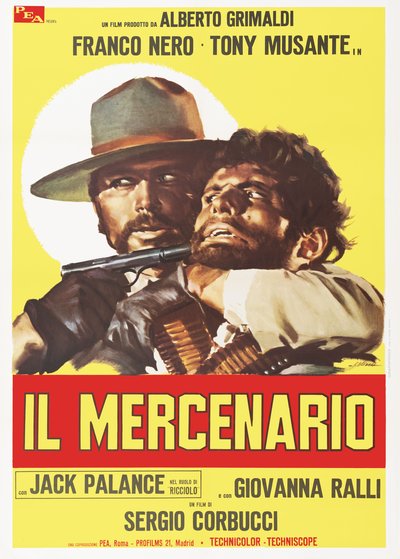
Olivetti's poster for The Mercenary (Sergio Corbucci, 1968)
Born in Parma, Nero now turns Polish: Sergei Kowalski hires out himself and his machine gun to whoever pays best in revolutionary Mexico. Olivetti sets him against a flat, shameless yellow with a pistol under the chin of Paco Román (Tony Musante). The joke lies in where he is looking. Most people holding a man at gunpoint give him at least some of their attention. Paco, wide-eyed, is searching for his captor's face; Kowalski is gazing elsewhere, with washed-out eyes nearer grey than blue. They are an accountant's eyes, and they are totting something up. At a glance it could almost be an embrace. On closer inspection it is an invoice. The film even hands him the last word on the subject, as he rides off shouting to Paco to keep on dreaming, but with his eyes open.
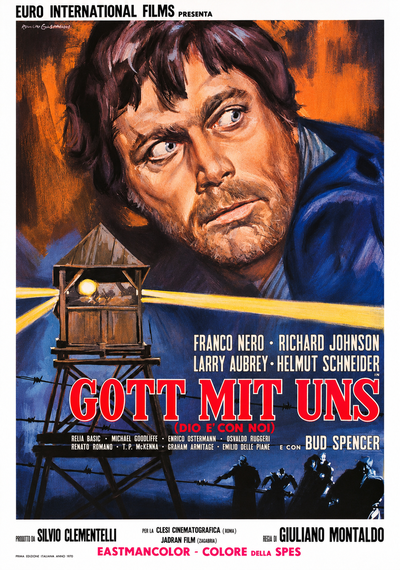
Gasparri's poster for The Fifth Day of Peace (Gott mit uns, Giuliano Montaldo, 1970)
Same painter, four years on, same blue eyes, and you would not know the man. Bruno Grauber is a German officer on the run, in a film drawn from a true story: two deserters shot in Amsterdam on 13 May 1945, days after the war had ended, in a camp under Canadian control, condemned by their own fellow prisoners. Off comes the hat, the gun and the gloves, leaving wild hair and several days' stubble. These eyes are no longer aiming at anyone. They dart away from the watchtower while the searchlight slides beneath his chin and slices the picture in two. Django had all the shadow he could want and chose to be seen; Grauber gets the light whether he likes it or not. The eyes that were frightening in 1966 are now frightened, and the painter has not had to change the colour. Down at the bottom, in generous lettering, comes "e con Bud Spencer". This was 1970, the year of They Call Me Trinity, but anyone turning up for a good slapping match was in for a long evening.
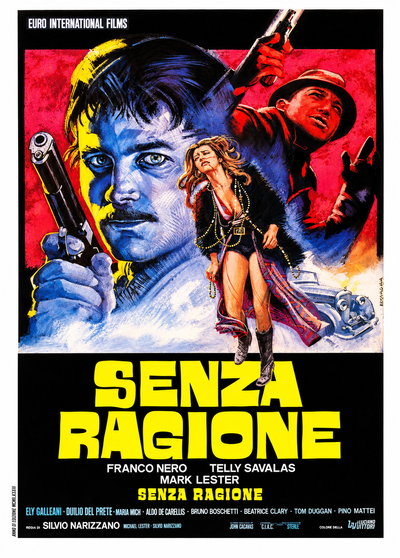
Iaia's poster for Redneck (Silvio Narizzano, 1973)
Iaia now settles the matter once and for all. The blue is no longer confined to the eyes; it has taken over the face, the hand and even the shadow of the gun. Mosquito, a thief on the run, is a blue man with a yellow stripe, while Telly Savalas (his partner Memphis) glows entirely red in the top corner, as if the pair had been sorted by department. Between them Ely Galleani (Maria) slumps, bloodied, in ropes of pearls. Look closely and one of Mosquito's eyes is blue, the other green. Why? The Italian title, which means "without reason", answers before you can ask. What matters is that Nero remains instantly recognisable while dyed the colour of a Smurf, moustache and all: by now the face works in any shade. Mark Lester (Lennox), the boy from Oliver!, third on the bill and kidnapped in the film, is missing altogether. He has been abducted from the poster as well.
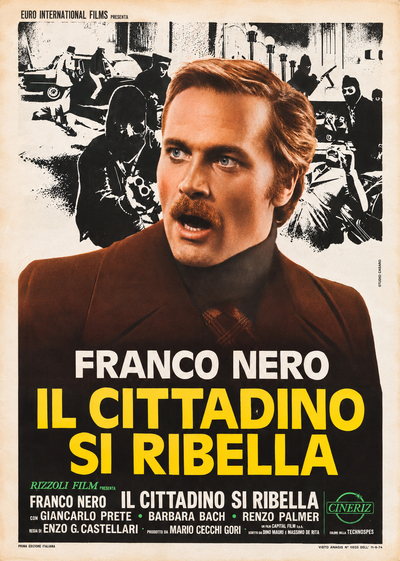
Casaro's poster for Street Law (Enzo G. Castellari, 1974)
Finally, the reality check. This face is not painted at all. It is a photograph, cut out, with the jacket, tie and moustache of Carlo Antonelli, a Genoese engineer beaten up in a robbery who decides to take the law into his own hands. With no brush in the way, the eyes turn out to be genuinely pale, a grey-blue less brazen than Gasparri's. The painters had laid it on a bit, but they had not made it up. Behind him, drawn by Casaro, the world is reduced to blotches of black and white, balaclavas included, leaving all the colour to him. After six posters of silence, his mouth is at last wide open, as any citizen's would be who has had enough. And look at the name. On Piovano's poster he was still Frank, fifth on the bill. Here he is FRANCO NERO in enormous letters, twice, just to be sure. Long ago he threw away the "spara" in his surname. In this film, as a mild-mannered engineer, he has to go back and fetch it.
The works reproduced on this page come from period prints, recovered, photographed and digitally restored by Movie.it.