
Woody Allen, the Painted Persona
By the Movie.it Editorial Team
October 26, 2026
Born Allan Stewart Konigsberg in New York in 1935 and raised in Brooklyn, Woody Allen was selling jokes to New York newspaper columnists while still a teenager. Television writing followed; then came stand-up appearances in Greenwich Village and, in 1965, his first produced film screenplay, What's New Pussycat?. Four years later he directed and starred in Take the Money and Run. Cinema became his working life, at a pace approaching a film a year for more than half a century.
His work ranges from broad parody to romantic comedy, from intimate drama to musical fantasy. Again and again, he returns to the large, awkward questions: love, desire, chance, morality, death. Few filmmakers have written so many memorable parts for women, or made a seemingly casual conversation carry so much philosophical weight. Annie Hall won Best Picture, Best Director and Best Original Screenplay at the 1978 Oscars.
For the screen, Allen also created an instantly recognisable comic persona: thick spectacles, a slight frame, hesitant speech and gestures that never quite go to plan. Over time, audiences came to identify Woody Allen with the man he played. Yet an artist's gift for portraying fear, insecurity and human contradiction does not necessarily mean he is captive to them. It may suggest the opposite: enough ironic distance to observe them with uncommon clarity. Perhaps we mistook for confession what was, at least in part, one of the great comic inventions of modern cinema.
Nor was that persona the limit of his imagination. Zelig makes identity a paradox; Crimes and Misdemeanors refuses the comfort of easy moral answers; Bullets Over Broadway asks awkward questions about artistic talent. Deconstructing Harry plays with the boundary between life and fiction, The Curse of the Jade Scorpion revisits classical comedy, and Midnight in Paris takes a hard look at nostalgia. Allen changes genre, period and tone, but keeps returning to the point where human certainties begin to unravel. His best-known character is one expression of that outlook, not the whole of it.
That was the mask Italy's film poster painters first had to capture, at a time when most Italian filmgoers had scarcely heard his name.
The Persona Before the Name
When What's New Pussycat? reached Italy in 1965, Allen was only sixth in the cast billing. He was no star. It fell to the poster, in those years still usually painted, to make audiences curious about this strange new face.
The artists quickly saw what could be done with the outsized glasses, the large head above a slight frame, the look of a man who would dearly like to be in charge but never quite is. These were not simply likenesses. Each poster had to find a visual joke that could introduce a whole style of comedy. Italian audiences would also come to know Allen through the voice of Oreste Lionello, whose dubbing caught the quickness and hesitations of his delivery for decades.
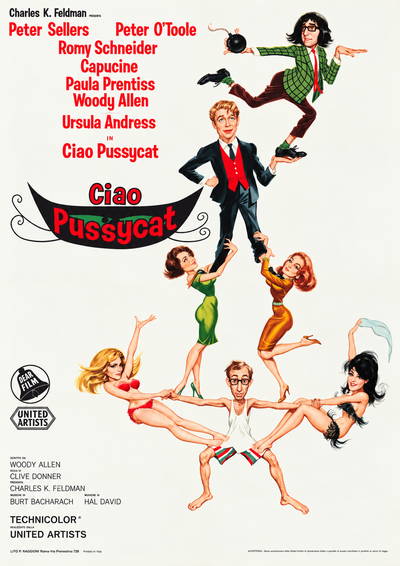
What's New Pussycat? (Clive Donner, 1965), poster by Dante Manno
Dante Manno arranges the cast as a human pyramid. Peter Sellers stands at the top, bomb in hand; Peter O'Toole occupies the middle, supported by two women. At the bottom is Allen, in a vest and striped underpants, entangled with two more. As the hapless Victor Shakapopulis, with his oversized spectacles and slight build, he looks barely able to bear the weight of it all.
Seen today, the composition has an unintended irony. Allen wrote the screenplay, yet he occupies the lowest rung of the star hierarchy. The man who would go on to make fifty films is still the newcomer propping everybody else up. We cannot know whether Manno meant any of this. Either way, it is a perfect introduction to the persona Allen would use again and again: the little man on whose shoulders the whole comedy seems to rest.
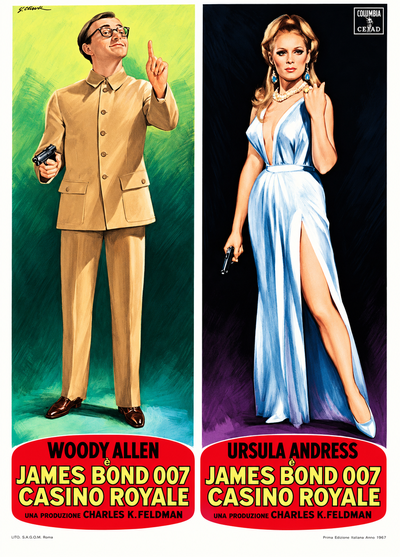
Casino Royale (John Huston and others, 1967), poster by Giorgio Olivetti
Two years later Giorgio Olivetti gives Allen a place beside Ursula Andress. He is Jimmy Bond, the secret agent's improbable nephew: pale suit, pistol in hand, one finger raised as if trying to butt into a conversation nobody invited him to. Andress belongs effortlessly in the Bond universe. Allen looks as though he has wandered onto the wrong set.
That collision is the joke. Spy films celebrate men who are always in control; Olivetti introduces somebody who has acquired the costume and props but none of the competence. Can a gun and a well-cut suit make a James Bond? Apparently not. It is Allen's comic persona at its most economical: the supposed misfit exposes the absurdity of the masculine ideal simply by standing beside it.
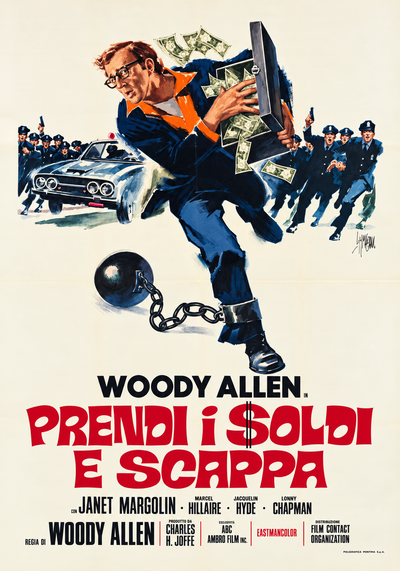
Take the Money and Run (Woody Allen, 1969), painted poster (version A) by Sandro Symeoni
Sandro Symeoni paints Virgil Starkwell, Allen's would-be bank robber, in desperate flight: banknotes spill from a briefcase, the police close in, and a ball and chain makes a successful getaway look distinctly unlikely.
The joke is not simply the chase. Virgil has ambition and perseverance to spare; what he lacks is almost everything else. Allen overturns the heroic notion that determination can conquer any obstacle. In his world, wanting something badly enough may be the surest way to fail spectacularly. Symeoni gives that doomed dash all the energy of a triumph.
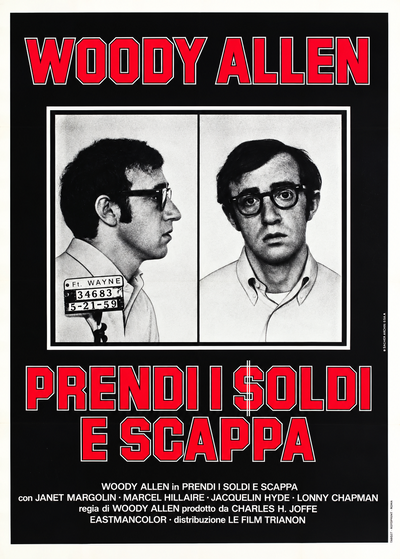
Take the Money and Run (Woody Allen, 1969), photographic poster (version B) by Pierpaolo Scalera
The film's alternative Italian design uses two police mugshots of Allen, full-face and in profile, against a black background, with the title picked out in vivid pink. No chase is needed. We are shown the ending first: the robber is already in custody.
He could hardly look less threatening. Allen seems more troubled by the camera than by the law. Together, the designs reveal two sides of his humour: Scalera depicts the frantic effort, while the photographs deliver the inevitable result. By now Allen can be funny standing perfectly still, without saying or doing anything.
The Antihero Takes Centre Stage
By the early 1970s Allen was the established star of his own films. The Italian artists could now play with a fully recognisable persona, dropping him into a revolution, a love affair, a distant future or a Napoleonic battlefield. The face remained familiar, but the target of the joke kept changing.
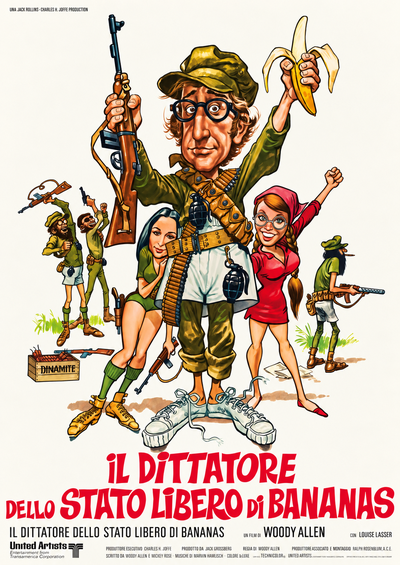
Bananas (Woody Allen, 1971), poster by Maro
Maro turns Fielding Mellish, the New Yorker swept into a Latin American revolution, into a parody of a propaganda hero. He has a rifle, ammunition belts and grenades, but also impossibly thin legs, enormous trainers and a peeled banana in his other hand. That last detail is enough on its own to undo the whole pose.
Everything hinges on the banana: a harmless, rather silly object dropped among the hardware of revolution. Fielding is not merely a bad revolutionary; he is an ordinary man trapped inside a picture that insists on heroism. One of Allen's favourite tricks is already at work: put the wrong person in the right costume and suddenly everyone else's solemn conventions begin to look faintly preposterous.
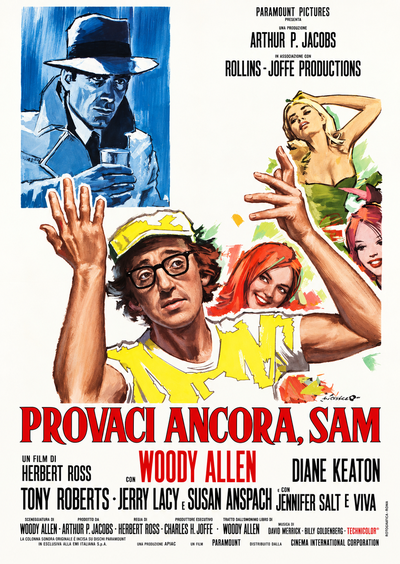
Play It Again, Sam (Herbert Ross, 1972), poster by Angelo Cesselon
Angelo Cesselon paints Allan Felix, the film critic abandoned by his wife, hands raised and eyes wide with uncertainty. On one side are the women he hopes to win over; on the other stands Humphrey Bogart, the embodiment of masculine assurance whose example Felix desperately tries to follow.
Cesselon, a master portraitist, builds the joke on a simple comparison. Bogart is screen masculinity made effortless; Felix knows that model by heart and has no idea how to inhabit it. He has learnt from the movies how a lover is supposed to behave. The movies, unfortunately, have not taught him how to live. It is a theme Allen keeps coming back to: understanding an ideal is no guarantee that we can live up to it. Herbert Ross directed the film, but the comic persona Cesselon paints is unmistakably Allen's.
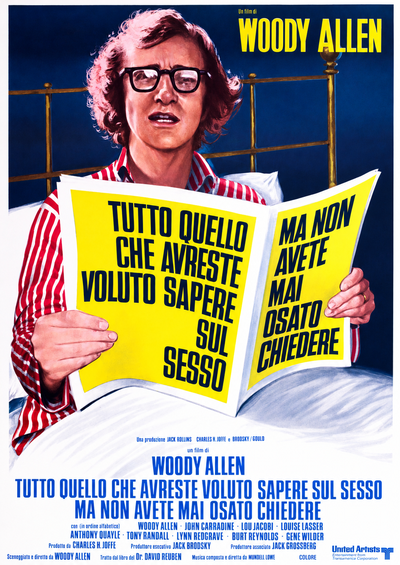
Everything You Always Wanted to Know About Sex (But Were Afraid to Ask) (Woody Allen, 1972), poster by Enzo Nistri
Enzo Nistri places Allen in bed, wearing pyjamas and peering over an enormous book that fills almost the entire poster. Only his eyes are visible above the pages, wide with curiosity and alarm.
The film draws on a popular sex manual, which Nistri puts quite literally into his protagonist's hands. It is a neat idea: Allen approaches even desire as something to be studied. Knowledge promises answers but offers no protection from embarrassment. It is a contradiction that runs right through his comedy: knowing a great deal about life is not the same as knowing how to live it. No book, however thick, can guarantee a solution.
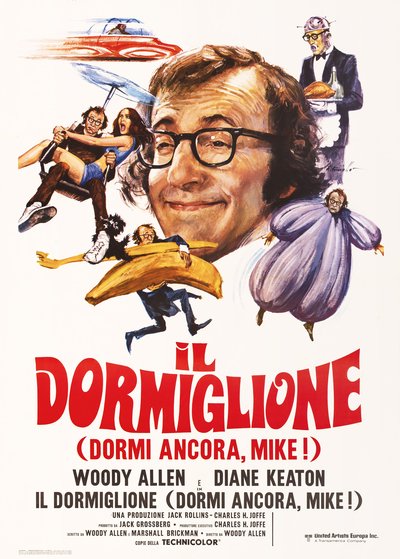
Sleeper (Woody Allen, 1973), poster by Averardo Ciriello
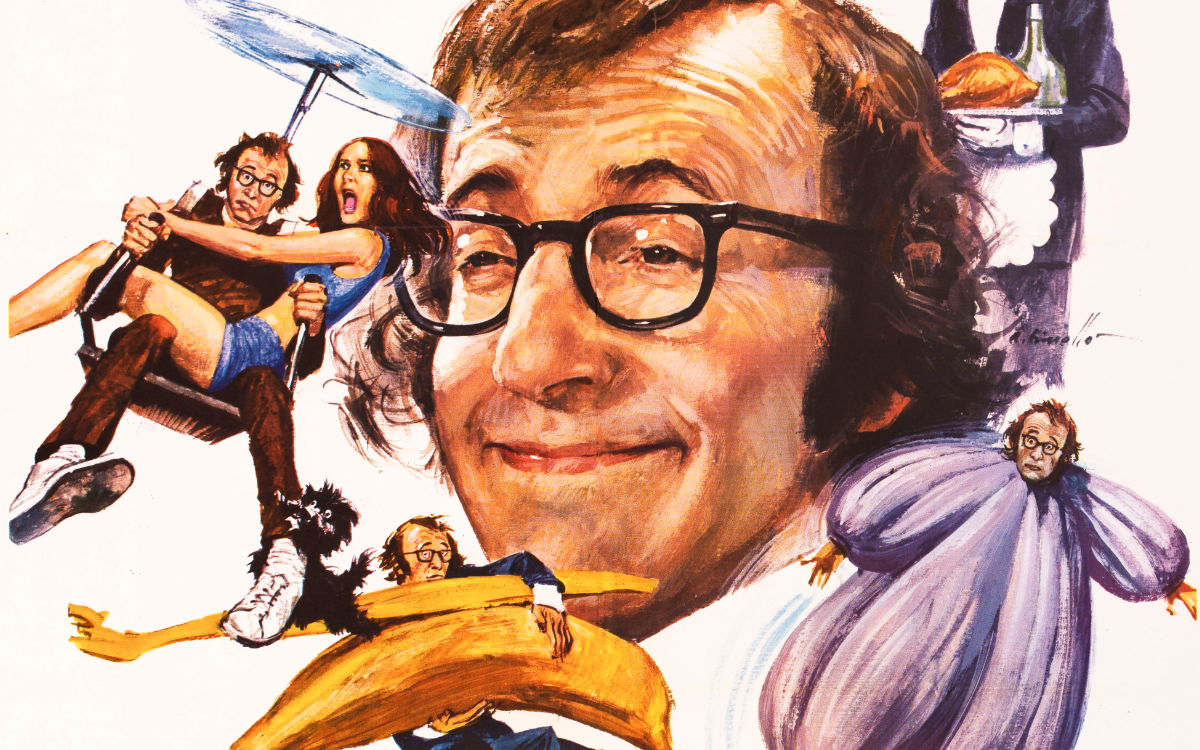
Averardo Ciriello sets a large, smiling portrait of Allen at the centre, with the film's absurd adventures orbiting around it: disguises, physical mishaps and futuristic inventions. Miles Monroe, the hero of Sleeper, seems capable of turning into almost anything.
Yet the face remains unmistakable. This is the paradox of a sophisticated writer-director who never gives up on physical comedy. Allen can ponder the great questions of existence one moment and entrust the next joke to a stumble, a disguise or an awkward movement. Behind the New York intellectual stand Chaplin and Keaton. Ciriello captures that versatility: even disguised as a robot, Allen is still clearly Woody Allen.
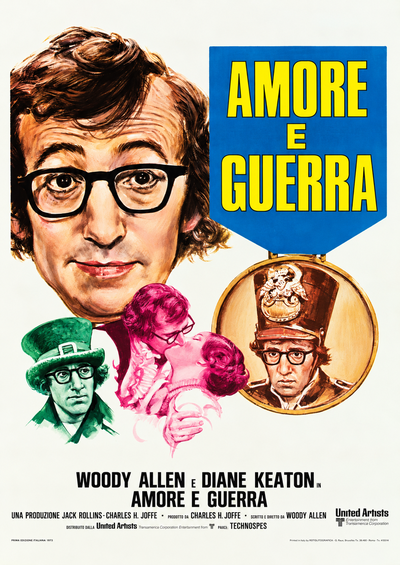
Love and Death (Woody Allen, 1975), poster by Averardo Ciriello
In Love and Death, Ciriello returns to the large central portrait surrounded by smaller scenes. This time, however, the smile has given way to a thoughtful, almost melancholy expression. Allen is Boris Grushenko, the reluctant soldier caught up in the Napoleonic wars.
Boris does not merely want to avoid fighting. He wants to know why people keep going to war when they know perfectly well that they are mortal. Allen sends into battle a man obsessed with death, who would much rather contemplate it from a safe distance. Ciriello keeps the comic exaggeration but lets a real question show through. In Allen's world, philosophy does not interrupt the joke; quite often, it sets it in motion.
When the Face Can Disappear
By the late 1970s, the posters themselves were changing. Allen was famous, certainly, but more importantly his cinema had developed a visual and emotional identity of its own. Photographs and quieter layouts gradually took the place of painted exaggeration. The posters could now suggest a mood or an idea rather than introduce a funny-looking man. A Woody Allen film had become recognisable even without Woody Allen's face.
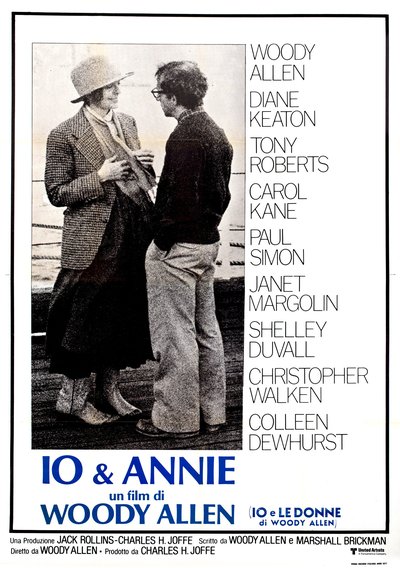
Annie Hall (Woody Allen, 1977), photographic poster
In the photographic poster for Annie Hall, Alvy Singer and Annie Hall, played by Allen and Diane Keaton, face one another on a jetty. No caricature, no exaggerated gestures: just two people, and the distance that already seems to lie between them.
It is a revealing change of register. The relationship between a man and a woman no longer needs to be presented as a visual gag. Annie Hall is about love, misunderstanding and how hard it is for two people to stay themselves and stay together. Allen's humour survives, but tenderness and regret have their place too. The Italian subtitle, Io e le donne di Woody Allen ('Woody Allen and His Women'), says something else about his new standing: the director's name is itself a selling point.
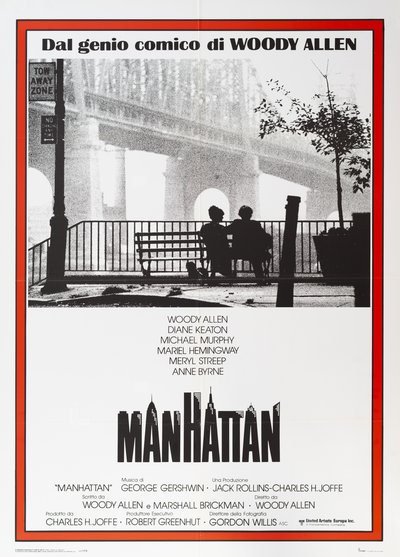
Manhattan (Woody Allen, 1979), photographic poster
In the Manhattan poster, two figures sit with their backs to us on a bench facing the Queensboro Bridge. New York is black and white, it is night, and Allen's face is nowhere to be seen. It no longer needs to be.
The real subject is New York, the city Allen had made one of cinema's great characters. In 1965 an Italian artist had placed him at the bottom of a human pyramid so that audiences could discover this unknown performer. Fourteen years later, a bench, a bridge and a city at night are enough. His comic persona has not vanished from the screen. It has simply ceased to be the only way of recognising his work.
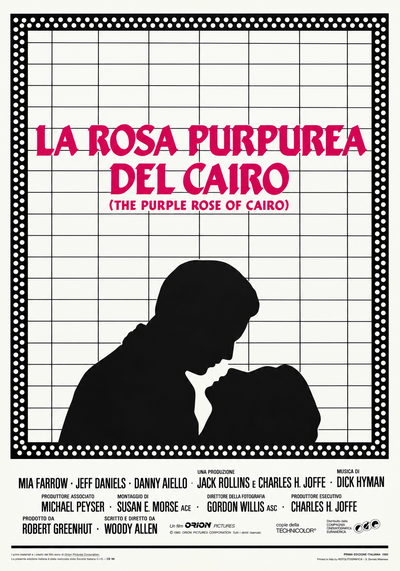
The Purple Rose of Cairo (Woody Allen, 1985), photographic poster
In The Purple Rose of Cairo, Allen does not appear even as an actor. The poster shows two silhouettes about to kiss in front of a cinema screen: Cecilia, played by Mia Farrow, and Tom Baxter, the screen hero played by Jeff Daniels, who walks out of the film to meet her in the real world.
A few simple elements reveal one of Allen's most poetic preoccupations: the distance between the life we have and the life we long to lead. The filmmaker no longer needs to put himself on screen; his way of seeing is recognisable without him. This movement towards greater visual restraint continues as far as Husbands and Wives (1992), where the title itself carries almost the entire design.
One Last Look
There is, however, one more image worth looking at. By 1995, Allen's face is no longer essential to representing his films. Yet an Italian poster brings it back into the spotlight. A familiar figure returns, now that the films have revealed just how much lies behind that familiar mask.
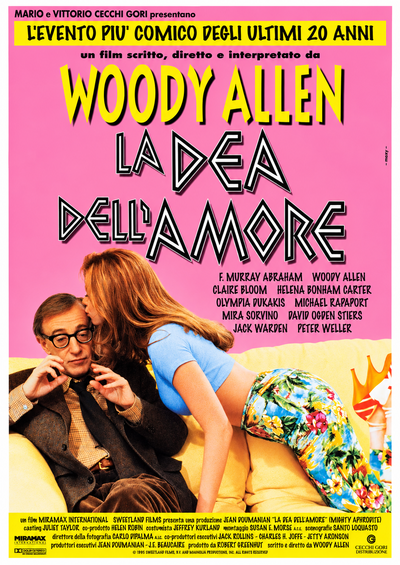
Mighty Aphrodite (Woody Allen, 1995), photo-based poster by Massimo Petrollo (Maxy)
In 1995 Massimo Petrollo, known as Maxy, worked from a photograph of Allen for Mighty Aphrodite. Lenny Weinrib adjusts his glasses while Linda Ash, played by Mira Sorvino, kisses his cheek. A pink background and bright lettering set a lighter tone. Thirty years after What's New Pussycat?, the spectacles and a moment of embarrassment still do the job.
That does not mean Allen has spent thirty years playing the same character. Quite the reverse: having explored so many cinematic possibilities, he can choose to put the old mask on again, knowing precisely what it will do. The audience recognises it at once; the actor knows when to use it and when to leave it behind.
The Face the Artists Understood
Looking at these posters today, we can watch a screen identity taking shape. The Italian artists first encountered a performer who was barely known to their audiences. Long before his name became a selling point, they recognised in his slight figure a new kind of comedy: the spectacle of a man unprepared for the world's grand promises.
Manno sees his apparently lowly position; Olivetti his distance from masculine ideals; Scalera his talent for persistent failure; Cesselon the hopeless comparison with Bogart. Nistri and Ciriello show how intelligence can coexist with panic, and thought with something close to silent-film slapstick. This is not an account of Allen's private self. It is the visual construction of a character audiences would come to know intimately.
That is why their intuition still matters. They did not have to discover who Woody Allen really was. They had to recognise what his comic mask could express: the often hilarious distance between what we aspire to and what we manage to achieve.
As the filmmaker matured, his films changed, and eventually his face could disappear altogether. A bench beside the Queensboro Bridge was enough to evoke his world. What began as a character had become a way of looking at life.
Perhaps that is the most revealing paradox these posters leave us with: to portray the contradictions of human nature with such intelligence, Woody Allen chose to wear them all.
The works reproduced on this page come from the original prints of the period, recovered, photographed and digitally restored by Movie.it..
You may also like

Otello Mauro Innocenti “Maro”, Colour and Storytelling in the Italian Movie Poster

Giorgio Olivetti, the Elegant Irony of a Bolognese Painter