
Otello Mauro Innocenti “Maro”, Colour and Storytelling in the Italian Movie Poster
By Movie.it Editorial Team
June 25, 2026
Among the great Italian film-poster artists, Otello Mauro Innocenti, known to all simply as "Maro", holds a special place: he was an artist who could turn colour itself into storytelling. His images do not merely illustrate a film, they condense it into a gesture, a patch of colour, a glance. Few strokes, few colours, but a dramatic synthesis capable of stopping the passer-by and telling them, in an instant, an entire story. For more than twenty-five years, from the early 1950s to the late 1970s, Maro was one of the leading figures in Italian film-poster art, closely associated with Titanus, one of the most prestigious production and distribution companies in Italian cinema, for which he created some of his most memorable images.
From Rome, by way of Florence
Otello Mauro Innocenti was born in Rome in 1927. His training took place in Florence, at the Accademia di Belle Arti, where he absorbed the great tradition of Tuscan draughtsmanship and where he met, among others, Silvano Campeggi, the "Nano" who would shortly become famous for his Hollywood posters. It is no small detail: the Florentine school, with its attention to line and synthesis, would deeply mark the style of both. Having completed his studies, Maro moved to Rome, capital of the film industry, to pursue the career of a cinema painter.
His signature was soon tied to a rapid, vibrant pictorial language, made of swift brushstrokes that condense emotion and dynamism. Unlike the great masters of the previous generation, such as Anselmo Ballester or Luigi Martinati, who built compositions of realistic and monumental design, Maro aimed at synthesis and immediate emotional impact. He became one of the favourite painters of Titanus, whose head, Goffredo Lombardo, personally admired his talent: for the Roman company he created the images of some of the most important films it produced or distributed, from Two Women to Rocco and His Brothers, from Il sorpasso to The Garden of the Finzi-Continis. As was the case for the cinema painters, his works were selected for promotional use connected with the film’s release, without that selection in itself amounting to a transfer of the artist’s rights for every other use. His versatility led him to work in every genre: he was among the poster artists of the "musicarelli", of the comedies of Franchi and Ingrassia, of epics such as The Vikings and of auteur films such as For Love and Gold and The Magliari. As has been written, he had many strings to his bow.
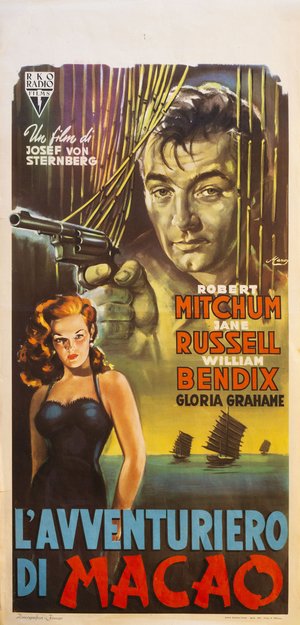
Macao (Josef von Sternberg, 1952)
The "locandina" (Italian small format) for Macao, an exotic film noir with Robert Mitchum and Jane Russell, released in Italy as L'avventuriero di Macao, shows the early Maro grappling with American cinema. The face of Mitchum, gripping a pistol, dominates the upper part behind a veil of yellow bamboo canes, while at the lower left stands the sensual figure of Jane Russell in a black dress. In the background, the Chinese junks and a palette of greens and yellows create the murky, adventurous atmosphere of the Eastern port. Already here one recognises Maro's ability to build the image through chromatic contrasts and to entrust all the tension of the story to a few elements.
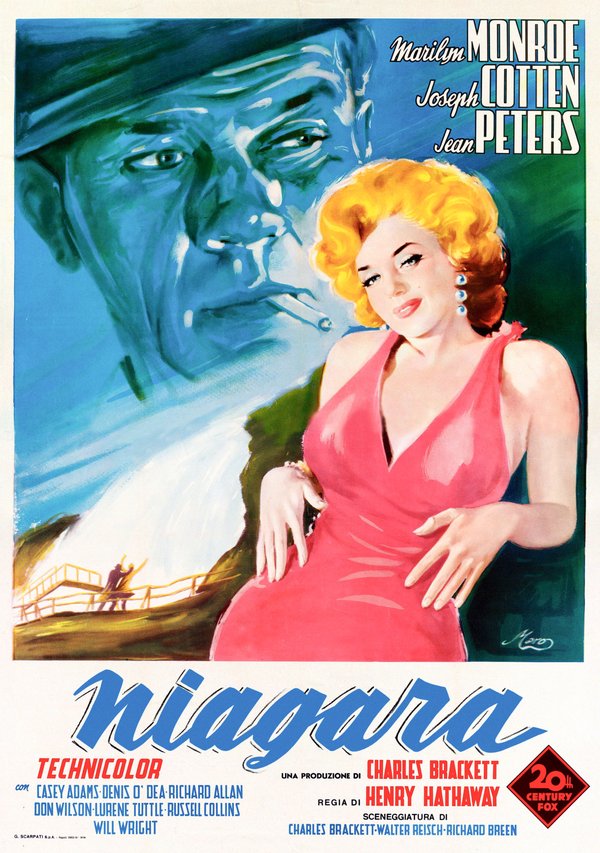
Niagara (Henry Hathaway, 1953)
The poster for Niagara is one of the most successful portraits of Marilyn Monroe signed by an Italian poster artist. Maro paints her in the foreground, sheathed in a shocking-pink dress, her gaze alluring and her pose sinuous, while behind her, in a cold tonality of greens and blues, looms the dark, menacing face of Joseph Cotten with a lit cigarette. Below, the Niagara Falls and a small figure on the bridge introduce the drama. The contrast between the warmth of the female figure and the chill of the background admirably sums up the structure of the thriller: seduction and death, love and betrayal.
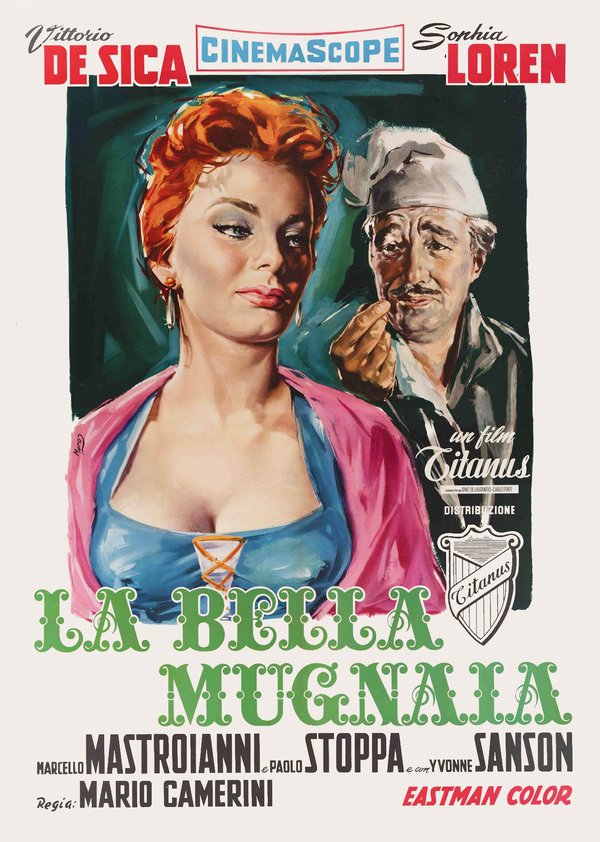
The Miller's Beautiful Wife (Mario Camerini, 1955)
In the poster for The Miller's Beautiful Wife, a comedy with Sophia Loren, Vittorio De Sica and Marcello Mastroianni, released in Italy as La bella mugnaia, Maro displays his virtuosity in portraiture. The face of a young, radiant Sophia Loren, with her auburn hair and her low-cut pink and blue dress, occupies the centre of the composition with a mischievous smile, while on the right De Sica, in the role of the local governor, kisses her hand with a lecherous expression. The brushstrokes are quick and zesty, the colours warm and Mediterranean. An image that perfectly captures the lively, earthy spirit of the period comedy.
Rocco and His Brothers (Luchino Visconti, 1960)
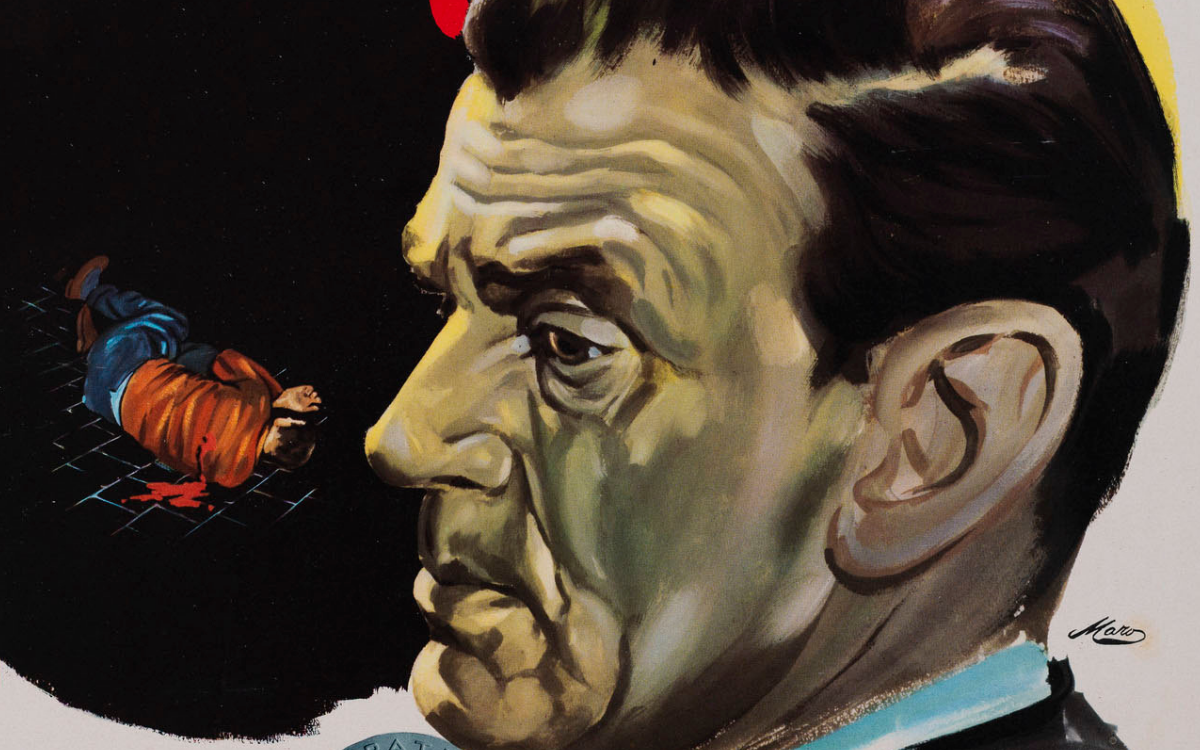
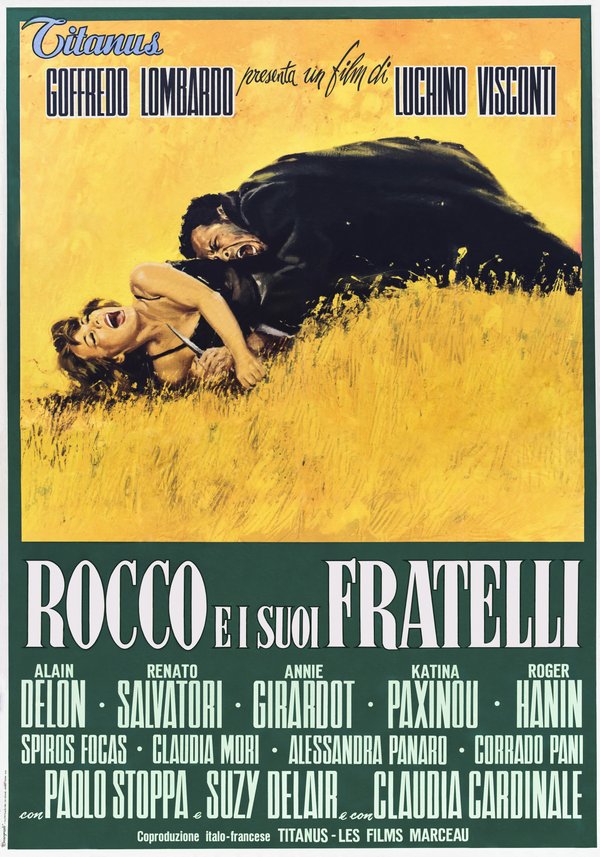
For the poster of Rocco and His Brothers by Luchino Visconti, Maro made a surprising and brilliant choice. Although the story is set in foggy Milan, the artist adopted an intense, almost blinding yellow background that evokes the colours of the South from which the protagonist family of immigrants comes. At the centre he placed the most tragic scene of the story, the murder of Nadia: Renato Salvatori with the knife still quivering in his hand and Annie Girardot collapsed among the stalks, in a dramatic embrace reduced to a dark patch against the immense golden field. It is one of his highest achievements: an image that, through pure chromatic and compositional force, sums up the tension of the entire film and foreshadows its tragic destiny.
The Lovemakers (Mauro Bolognini, 1961)
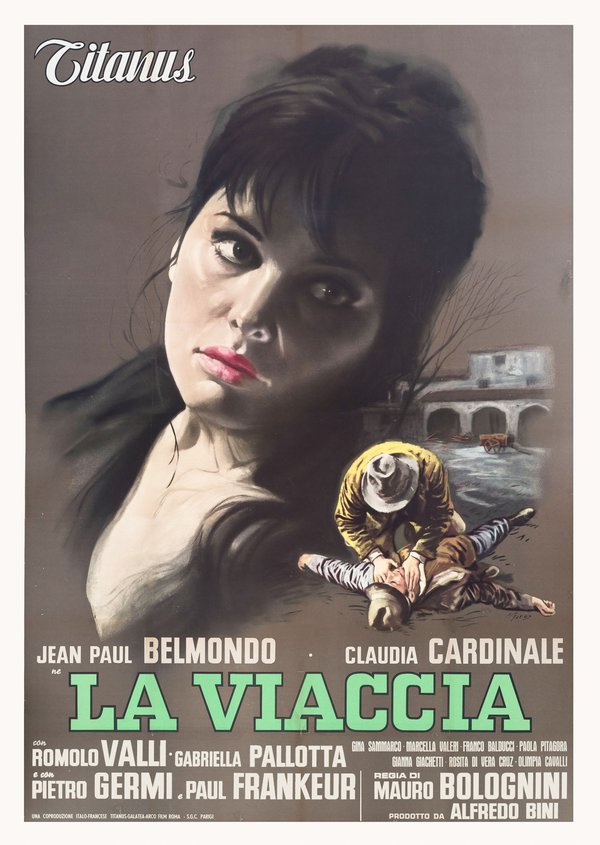
The poster for The Lovemakers by Mauro Bolognini, with Jean-Paul Belmondo and Claudia Cardinale, shows the more intimate, portrait-like Maro. The face of Claudia Cardinale, rendered in delicate shades of grey and brown with a few touches of pink on the lips, dominates the composition with a melancholy, proud gaze. At the lower right, a small dramatic scene and the architecture of a Tuscan farmhouse introduce the story. The almost total renunciation of colour, save for the bright green of the title lettering, gives the image a refined, sorrowful elegance, perfectly in keeping with Bolognini's period drama.
Maro's Style: Colour That Becomes Idea
What sets Maro apart from his colleagues is his ability to push synthesis to the point of conceptual abstraction. In some of his most celebrated designs, colour is no longer description but pure idea: in the splendid poster for The Professor, against a black background the figure of Alain Delon opens up like a blue sky, in an image of extraordinary intensity; in Viva Italia!, the background is white and the figure of Alberto Sordi stands out against it, all black and mocking. These are strikingly modern graphic solutions, in which the cinema painter becomes almost a conceptual designer, anticipating certain choices of contemporary graphics.
Maro also attached great importance to the graphic component of the poster: he often personally created the lettering of the titles and the actors' names, blending it harmoniously with the painted image. For him the poster was a single organism, in which painting and writing had to breathe together. He also worked on films by Pier Paolo Pasolini, creating posters for Love Meetings and The Gospel According to St. Matthew, where his rapid, immediate technique conveyed all the intensity of Pasolini's cinema.
The Legacy of Maro
Otello Mauro Innocenti died in Rome in 2003, leaving an artistic legacy that redefined the relationship between painting and narrative in the Italian film poster. His lesson is that of an artist who believed wholeheartedly in the expressive power of colour and synthesis, demonstrating that a yellow patch, a face, a gesture are enough to tell an entire tragedy. At a time when the painted poster was about to give way to photography, As photography increasingly began to replace the painted poster, Maro continued to push the medium towards almost abstract, conceptual solutions. Today, rediscovered by collectors and scholars together with the other great cinema painters, he remains one of the most original and modern interpreters of that unrepeatable age in which the walls of Italian cities were open-air art galleries.
The works reproduced on this page come from the original prints of the period, recovered, photographed and digitally restored by Movie.it.