
Marcello Mastroianni, Anatomy of an Anti-Hero
By the Movie.it Editorial Team
October 20, 2026
Marcello Mastroianni was born in Fontana Liri, in the Ciociaria region south of Rome, on 28 September 1924. He grew up between Turin and Rome and, after the war, while working as an accountant, drifted into university theatre and eventually into the company of Luchino Visconti, where years on stage alongside Vittorio Gassman and Rina Morelli gave him the discipline that would carry him through more than 140 films. He died in Paris on 19 December 1996. Rome said goodbye by switching off the Trevi Fountain and draping it in black, a farewell to a face that had carried so many of post-war Italy's desires, contradictions and frailties.
Shelves of biographies and studies already exist. This piece takes another route: it follows the changes in his screen persona, from young dreamer to bewildered father, through the posters that presented them to Italian audiences.
The Dreamer and the Birth of a Fragile Masculinity
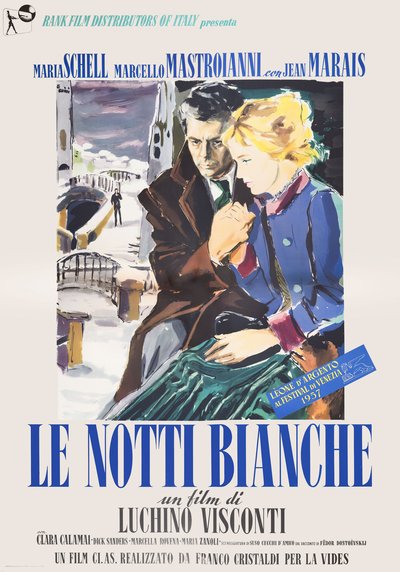
Ercole Brini's Poster for White Nights (Luchino Visconti, 1957).
In 1957 Visconti cast Mastroianni as Mario, a lonely clerk new to town who falls for Natalia (Maria Schell), a young woman waiting night after night for another man to return. He is a character who dreams more than he acts, and he already carries much of the anti-hero to come. Ercole Brini, working in his characteristic watercolour, builds the poster on two planes. In the foreground the couple stand very close: Mastroianni, in a brown overcoat, leans towards Maria Schell and watches her with an almost anxious intensity; she, blonde, in a blue coat with a pink collar, keeps her eyes lowered, absorbed elsewhere. Behind them the city lies under snow, all canals, bridges and violet sky, and on the farthest bridge a small dark figure is walking, like the man Natalia is waiting for. The whole film lies in that mismatch of gazes: he is looking at her, she is thinking of someone else.
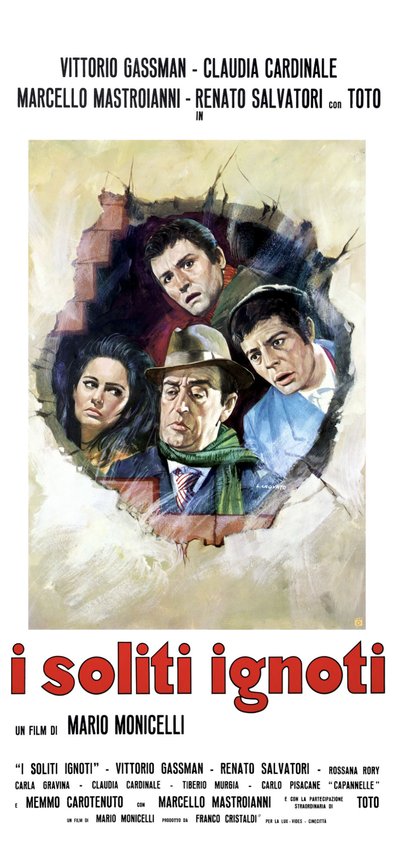
Luciano Crovato's "Locandina" (Italian Small Format) for Big Deal on Madonna Street (Mario Monicelli, 1958).
A year later, Mario Monicelli's Big Deal on Madonna Street (I soliti ignoti) placed him at the heart of the new Italian comedy. As Tiberio, a photographer left holding the baby while his wife is in prison, he is already a world away from the decisive, virile leading man. Luciano Crovato's "locandina" turns that marginality into composition: the gang's faces peer out through a jagged hole smashed into a brick wall, a nod to the botched break-in at the centre of the plot. Totò, in hat and green scarf, takes the middle, with Claudia Cardinale on the left and another of the gang above. Mastroianni is on the right, in a light-blue jacket, wide-eyed as if caught in the act: he does not dominate the scene; he belongs to it. This is the first image of the Mastroianni anti-hero: human, domestic and never quite a winner.
The Uneasy Elegance of Modernity
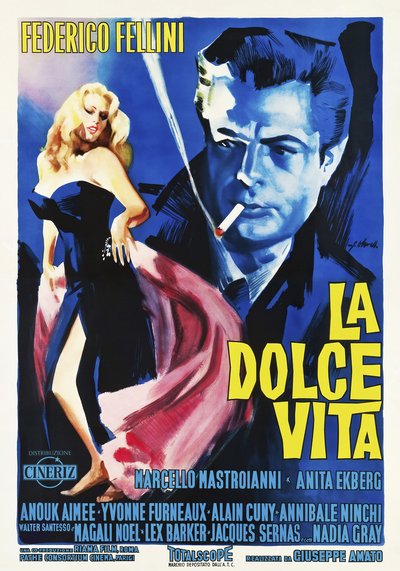
Giorgio Olivetti's Poster for La dolce vita (Federico Fellini, 1960).
With La dolce vita (1960), Federico Fellini turned Mastroianni into an international icon. Marcello Rubini, a society journalist, watches, desires and takes part, yet remains suspended, never quite inside the world he writes about. Giorgio Olivetti builds the poster on two temperatures. On the right, Mastroianni's face is painted entirely in nocturnal blue, a cigarette between his lips and a trail of smoke cutting across the image; on the left, Anita Ekberg, blonde and luminous, wears a black gown from which a pink train flares out like a flame. She is warmth and movement; he is a cold, motionless portrait, present yet apart. The contrast makes the character legible before the film has even begun, and it welded that face for good to Fellini's idea of modernity.
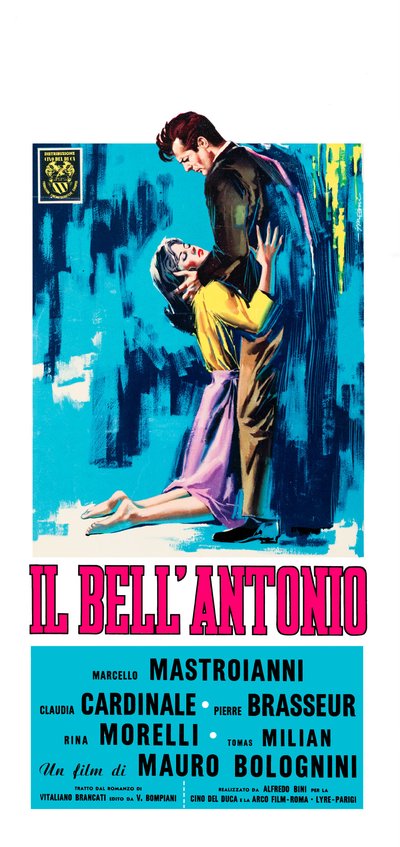
Sandro Symeoni's "Locandina" for Il bell'Antonio (Mauro Bolognini, 1960).
The same year, Mauro Bolognini's Il bell'Antonio took the crisis of masculinity somewhere more intimate. Antonio is the man every woman wants, yet his impotence quietly undermines the code of virility around him. In Sandro Symeoni's "locandina", Claudia Cardinale kneels barefoot, head thrown back and arms raised towards him. Mastroianni stands over her, stiff, head bowed: he looks down at her, but it is she who reaches for him. Vertical strokes of blue and turquoise, shot through with a flash of yellow, isolate the pair as if in a painting. At first glance it reads as a familiar image of male dominance; in fact it shows a man who receives desire without being able to return it.
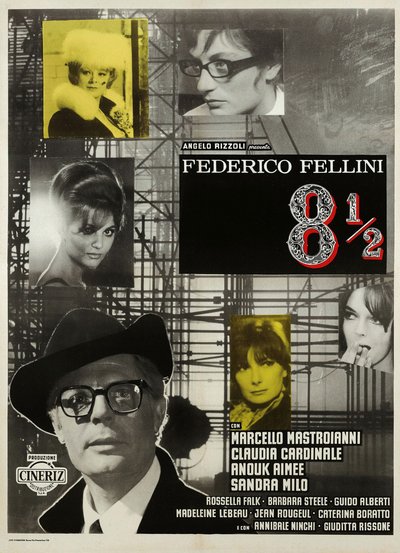
The Poster for 8½ (Federico Fellini, 1963).
Three years later, in 8½ (1963), Fellini made Mastroianni his own double: Guido Anselmi, a director in crisis who cannot make his film and takes refuge in memories and fantasies of women. The poster drops paint for a photographic montage and is built like the protagonist's mind. Behind everything rise the poles of a vast scaffold, the giant set the film never completes; hung across it in frames of different sizes, the women's faces seem to float. Bottom left, Mastroianni, in black hat and glasses, looks elsewhere, almost a stranger to the carousel of faces above him. It is a poster about an image split in two: the actor lending his face to the director, the star reduced to a witness of his own obsessions.
Sabotaging the Latin Lover
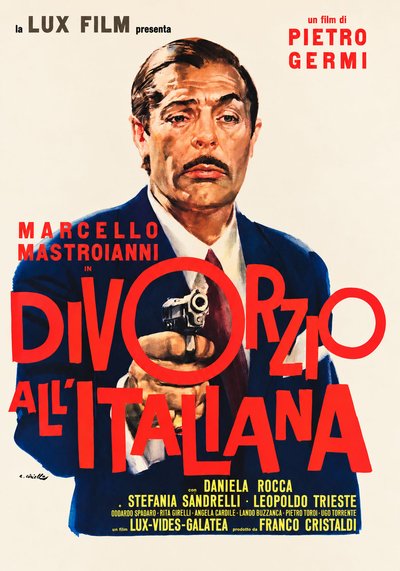
Averardo Ciriello's Poster for Divorce Italian Style (Pietro Germi, 1961).
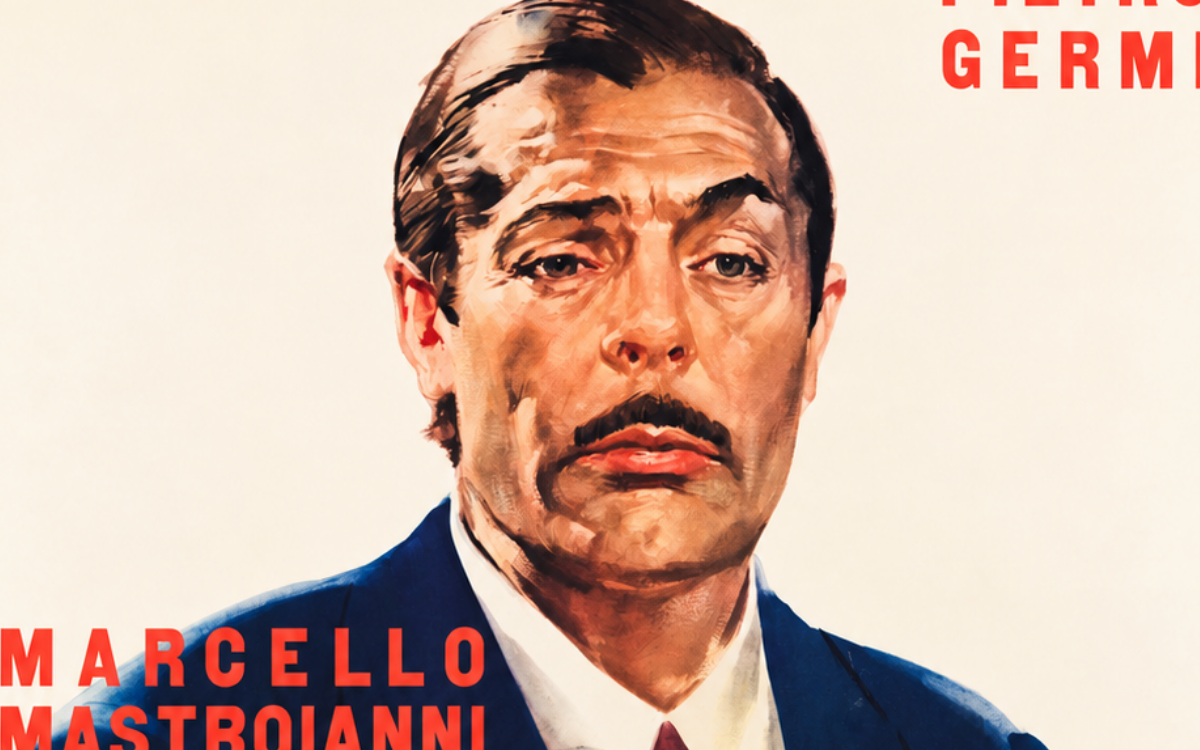
Throughout the 1960s Mastroianni seemed to take pleasure in dismantling his own appeal. In Pietro Germi's Divorce Italian Style (Divorzio all'italiana, 1961), Baron Fefè Cefalù keeps the actor's elegance but turns it into pose, calculation and cowardice. Averardo Ciriello pushes his features towards caricature: slicked-back hair, pencil moustache, heavy eyelids, an expression at once sluggish and self-satisfied. The masterstroke is the pistol aimed straight at the viewer. Its muzzle sits exactly inside the red O of the title, so that word and weapon read as a single phrase. The threat is real; the face stays limp and faintly ridiculous. The Latin lover is not celebrated here; he becomes the raw material of satire.
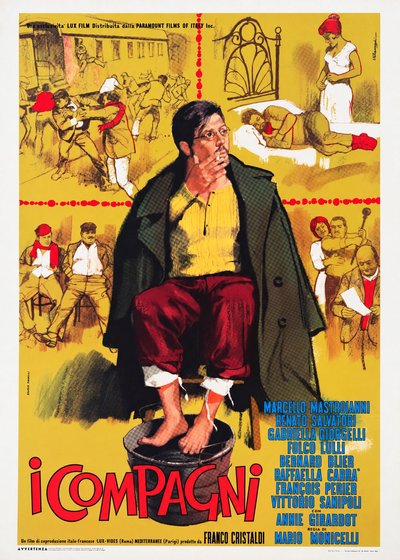
Rodolfo Valcarenghi's Poster for The Organizer (Mario Monicelli, 1963).
With Monicelli's The Organizer (I compagni, 1963), he moves the opposite direction: no glamour, only fatigue. Professor Sinigaglia is a socialist agitator among the factory workers of late nineteenth-century Turin, and his authority comes from stubbornness rather than presence. In Rodolfo Valcarenghi's poster, Mastroianni sits at the centre in spectacles, an unkempt beard and a heavy dark coat slung over his shoulders, cigarette at his lips, trousers rolled up and bare feet soaking in a tub of hot water. Around him, on an ochre ground, loosely sketched scenes of strikes, scuffles and working lives fill the margins. The star is still recognisable, but everything that normally makes one has been switched off: posture, clothes, heroic centrality.
Sophia Loren and Male Vulnerability
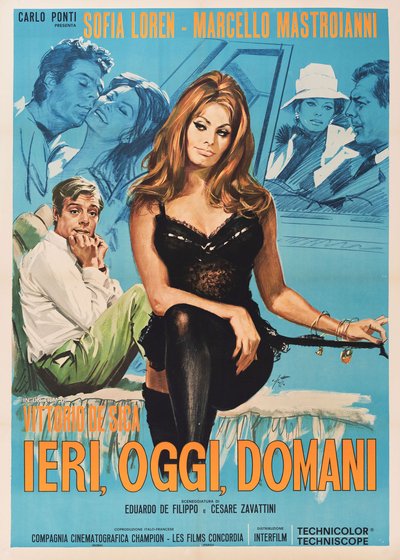
Arnaldo Putzu's Poster for Yesterday, Today and Tomorrow (Vittorio De Sica, 1963).
Working with Vittorio De Sica and Sophia Loren opened up another side of the Mastroianni persona: the man who does not command the scene but reacts, pursues and is repeatedly wrong-footed. In Arnaldo Putzu's poster for Yesterday, Today and Tomorrow (Ieri, oggi, domani, 1963), the hierarchy is explicit. Loren fills almost the entire image, multiplied into the film's three characters: the elegant lady in white hat and black gloves, the young woman in a black slip and dark stockings at the centre, the dark, intense face at top right. Mastroianni appears only in the bottom corner, a tense close-up with a furrowed brow, almost a spectator. The visual balance mirrors the logic of De Sica's films: he does not organise the world, he is swept along by its force and unpredictability.
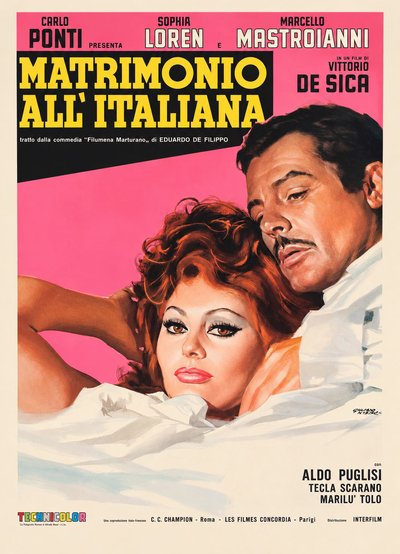
Giuliano Nistri's Poster for Marriage Italian Style (Vittorio De Sica, 1964).
A year later, Marriage Italian Style (Matrimonio all'italiana, 1964), adapted from Eduardo De Filippo's play Filumena Marturano, pushed the couple into melodrama. Domenico Soriano keeps his assurance and charm, but Filumena forces him, again and again, to lose control. Two variants of the poster translate the same tension in very different ways. In Giuliano Nistri's version, the couple lie among white sheets against a vivid pink ground. Loren is in the foreground, one arm bent behind her head, gazing straight out, steady and almost defiant; Mastroianni lies behind her, thin moustache, eyes half closed, as if caught dozing. She faces the audience; he seems to notice nothing. The image anticipates the film's meaning: a woman who can no longer be possessed or discarded, and a man who is always a step behind.
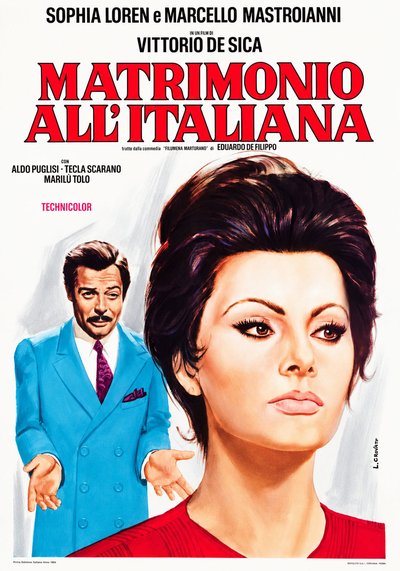
Luciano Crovato's Poster for Marriage Italian Style (Vittorio De Sica, 1964), Second Variant.
Luciano Crovato's variant tilts the relationship towards stage comedy without shifting the balance of power. Against a white ground, Loren's large face fills the right-hand side: hair swept up, lips pressed together, gaze turned away, unmoved. Mastroianni is smaller and set back, in a light-blue double-breasted suit and purple tie, eyebrows raised and arms spread with palms upturned, the gesture of a man explaining himself to someone who is no longer listening. It could be a scene from Eduardo: he talks, she has already decided. Crovato captures another facet of that face: the elegant man who keeps his charm even when the scene belongs to someone else.
Between Seduction and Existential Distance
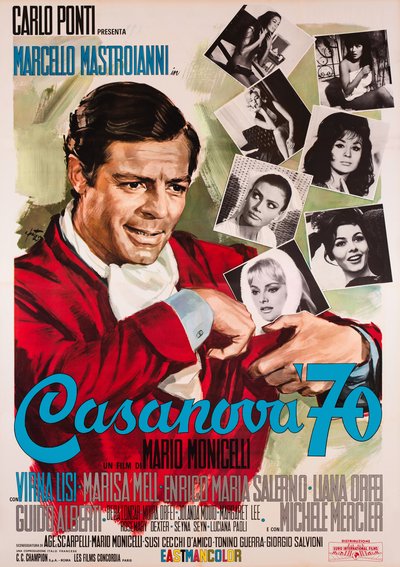
Arnaldo Putzu's Poster for Casanova '70 (Mario Monicelli, 1965).
In Casanova '70 (1965), Monicelli turns the seducer into a prisoner of his own neurosis: Andrea Rossi-Colombotti can only truly desire a woman when the conquest involves danger. Arnaldo Putzu paints Mastroianni in a red jacket and white scarf, smiling, holding a photograph of a blonde woman between his fingers like a card just drawn from the pack. Behind him on the right, a shower of black-and-white photographs repeats other women's faces, scattered like a collection. The contrast between the full colour of the painted portrait and the grey of the photographs is the heart of the image: he is alive and present, they are trophies already filed away. Yet their very number betrays the unease of a seduction that cannot stop.
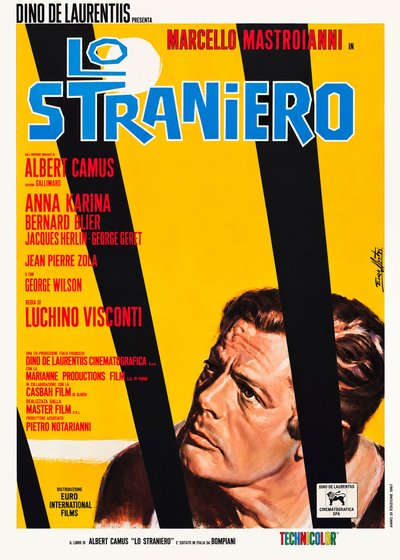
Enzo Nistri's Poster for The Stranger (Luchino Visconti, 1967).
In The Stranger (Lo straniero, 1967), Luchino Visconti's adaptation of Albert Camus, Mastroianni works by subtraction: Meursault moves through events without expression, intent or warmth, all the way to murder and prison. Enzo Nistri's poster uses only a handful of elements. A blinding ochre-yellow ground evokes the Algerian sun, which appears as a white disc behind the title. Three almost vertical black bands cross the image like bars, one grazing the actor's face as it surfaces at bottom right, eyes turned upwards towards the light. The poster anticipates the film's ending: a man already imprisoned, caught between the sun and the cell, and a face that offers no comment.
The Body in the Grotesque
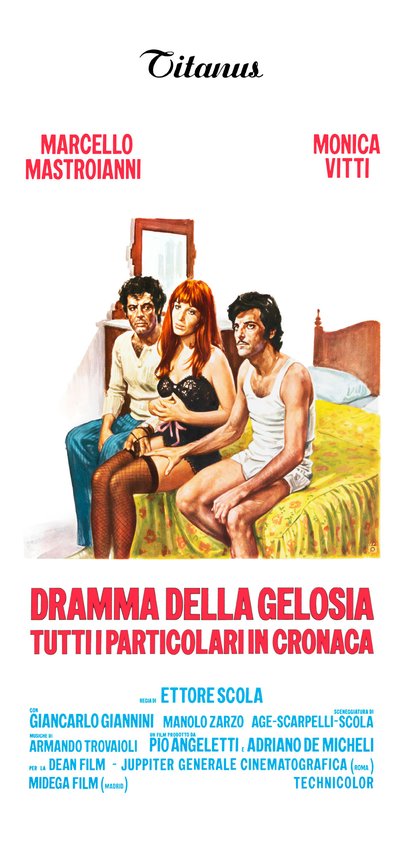
Maro's "Locandina" for The Pizza Triangle (Ettore Scola, 1970).
By the 1970s the satire had grown harsher and Mastroianni's body had lost any star protection. In Ettore Scola's Dramma della gelosia (tutti i particolari in cronaca), released in English as The Pizza Triangle, a role that won him Best Actor award Cannes, he plays Oreste, a jealous, dishevelled bricklayer worlds away from the society journalist of Via Veneto. Maro's "locandina" puts the love triangle quite literally on a bed. In a modest room, with a dressing-table mirror behind them and a yellow floral bedspread, Monica Vitti sits in the middle in a black slip and dark stockings, between Mastroianni in a jumper and Giancarlo Giannini in a vest. None of them smiles. The flat, realistic style of popular illustration strips away every trace of aura: Mastroianni is an ordinary man perched on the edge of a bed, one figure among others in a geometry heading for disaster.
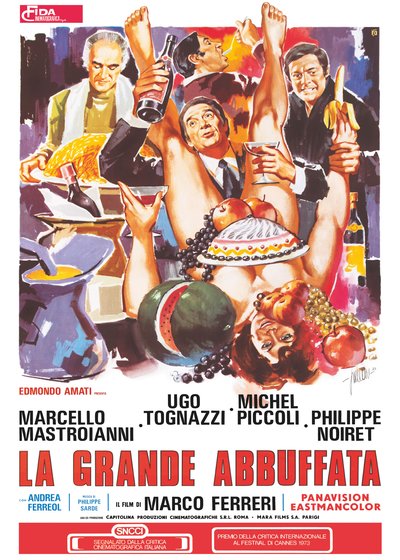
Sandro Symeoni's Poster for The Big Feast (Marco Ferreri, 1973).
Marco Ferreri's The Big Feast (La grande abbuffata/La Grande Bouffe, 1973) takes the process to its limit: four friends shut themselves away in a villa to eat themselves to death, and Marcello, the airline pilot played by Mastroianni, devours food and sex with the same appetite. Sandro Symeoni responds with a baroque pile-up. At the centre is Andréa Ferréol's body, upside down with her legs in the air, served up like a course among cakes, fruit and a split watermelon. Around her the four men toast, pour wine and present a dish of pasta; Mastroianni, top right, grins and grips a banana in a deliberately explicit joke. The sophisticated star of La dolce vita is very far away. What remains is an actor willing to hand even his glamour over to distortion and provocation.
Frailty Without a Mask
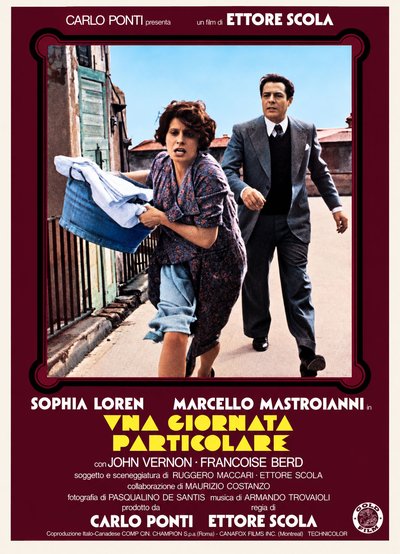
The Poster for A Special Day (Ettore Scola, 1977).
In 1977 Ettore Scola gave him perhaps his bravest role: Gabriele, a radio announcer sacked and awaiting internal exile because he is gay, who on 6 May 1938, the day of Hitler's visit to Rome, meets his neighbour Antonietta (Sophia Loren) in a building emptied by the parade. The photographic poster for A Special Day (Una giornata particolare), however, tells a different story. Inside a burgundy frame, Loren rushes towards the viewer clutching a basket of washing, hair dishevelled, in a print housedress; Mastroianni follows a few steps behind in a grey suit and tie. It is the tried-and-tested image of the star couple, almost the opening of a romantic comedy. Of the film's subject there is no trace: the poster sells its two stars and keeps quiet about what the film reveals. That silence says a great deal about the period, and about the gap between a character and the image chosen to present him.
Twilight
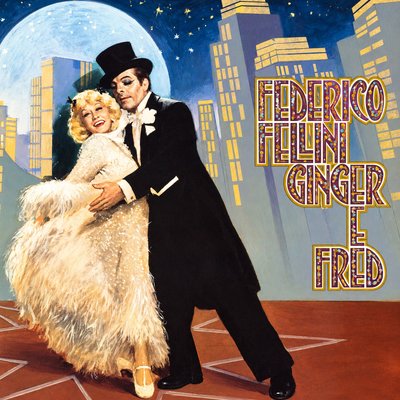
Giuliano Gèleng's Artwork for Ginger and Fred (Federico Fellini, 1986).
The journey ends with two farewells. In Ginger and Fred (Ginger e Fred, 1986), Mastroianni returned to Fellini as Pippo Botticella, an ageing variety dancer reunited with his former partner, played by Giulietta Masina, for a television show. In Giuliano Gèleng's artwork for the poster, the pair are locked in a dance step beneath a huge silver moon, in a deep-blue starry night framed by skyscrapers with golden windows, a city that looks like a studio backdrop. Masina, in a frothy white feathered gown, smiles; Mastroianni, in tails and top hat, has a powdered face and half-closed eyes, as if exhaustion were showing through the make-up. The tailcoat no longer restores the worldly glamour of earlier decades: it is the fragile costume of a performer who has outlived his world.
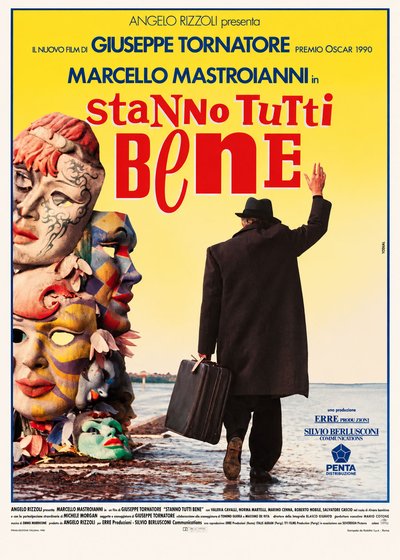
Pierpaolo Scalera's Poster for Everybody's Fine (Giuseppe Tornatore, 1990).
Four years later, in Giuseppe Tornatore's Everybody's Fine (Stanno tutti bene, 1990), he plays Matteo Scuro, a Sicilian pensioner who travels the length of Italy to visit his children and discovers, stop by stop, that their lives are nothing like the ones they have described to him. Pierpaolo Scalera's poster, built on a photographic montage, makes the most radical move of the entire sequence: it takes away Mastroianni's face. The actor is seen from behind, in a dark coat and hat, suitcase in hand, raising an arm in farewell against a yellow sky that fades into an empty plain. To the left rises a stack of faded carnival masks, the faces his children wear for his benefit. After decades of posters built around his features, the last one shows him walking away.
One Face, Many Readings
Follow Mastroianni across more than thirty years of posters and what emerges is not a stable icon but constant transformation. He is a dreamer in White Nights, fragile in Big Deal on Madonna Street, detached in La dolce vita, vulnerable in Il bell'Antonio, split in two in 8½, a caricature in Divorce Italian Style, worn down in The Organizer, wrong-footed beside Sophia Loren, hollowed out in The Stranger, grotesque in the 1970s, finally defenceless in A Special Day, elegiac in Ginger and Fred and faceless in Everybody's Fine. Painters and designers record, select and sometimes sharpen these changes, each in their own visual language; at times, as with A Special Day, they choose to keep quiet about them. No single image holds 'the' Mastroianni. Together they show why his face proved so fertile for cinema: it never imposed one identity, it knew how to lose one and rebuild it.
The works reproduced on this page come from the original prints of the period, recovered, photographed and digitally restored by Movie.it.
You may also like
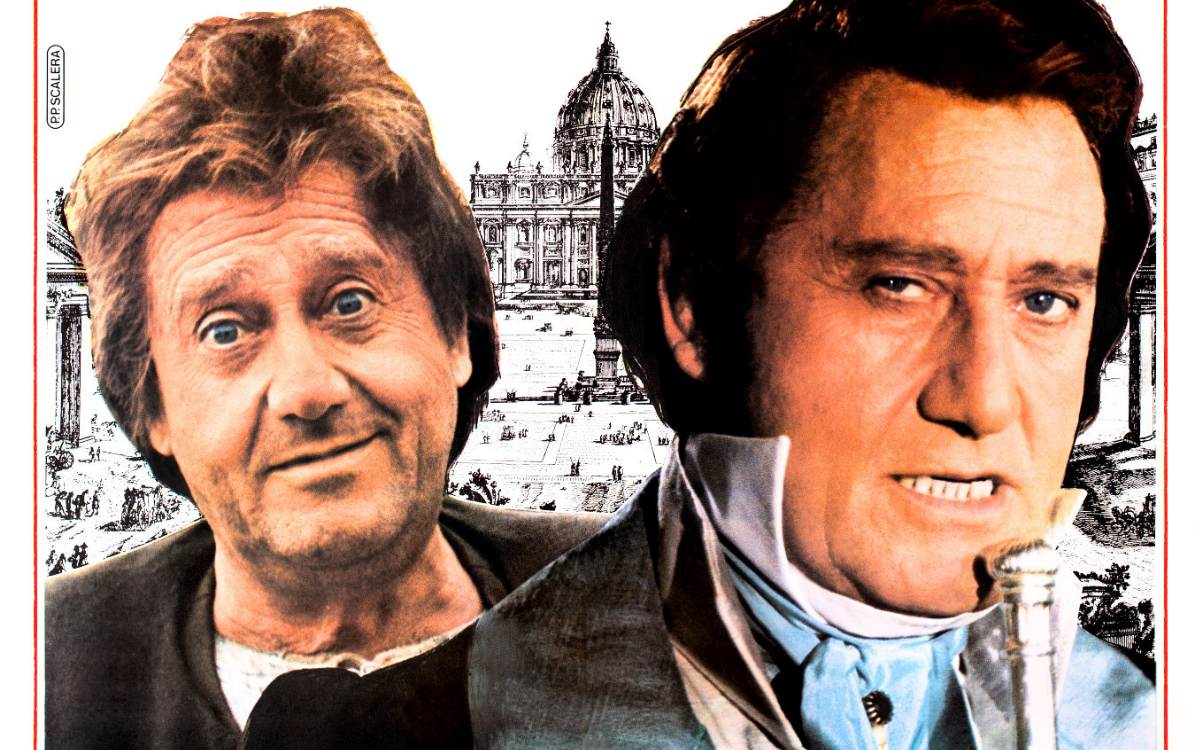
Pierpaolo Scalera, the Movie Poster in the Age of Photography

Otello Mauro Innocenti “Maro”, Colour and Storytelling in the Italian Movie Poster