
Sandro Symeoni, from Seductive Figures to Social Dramas
Edited by Paolo Zelati, Editorial Director
June 30, 2026
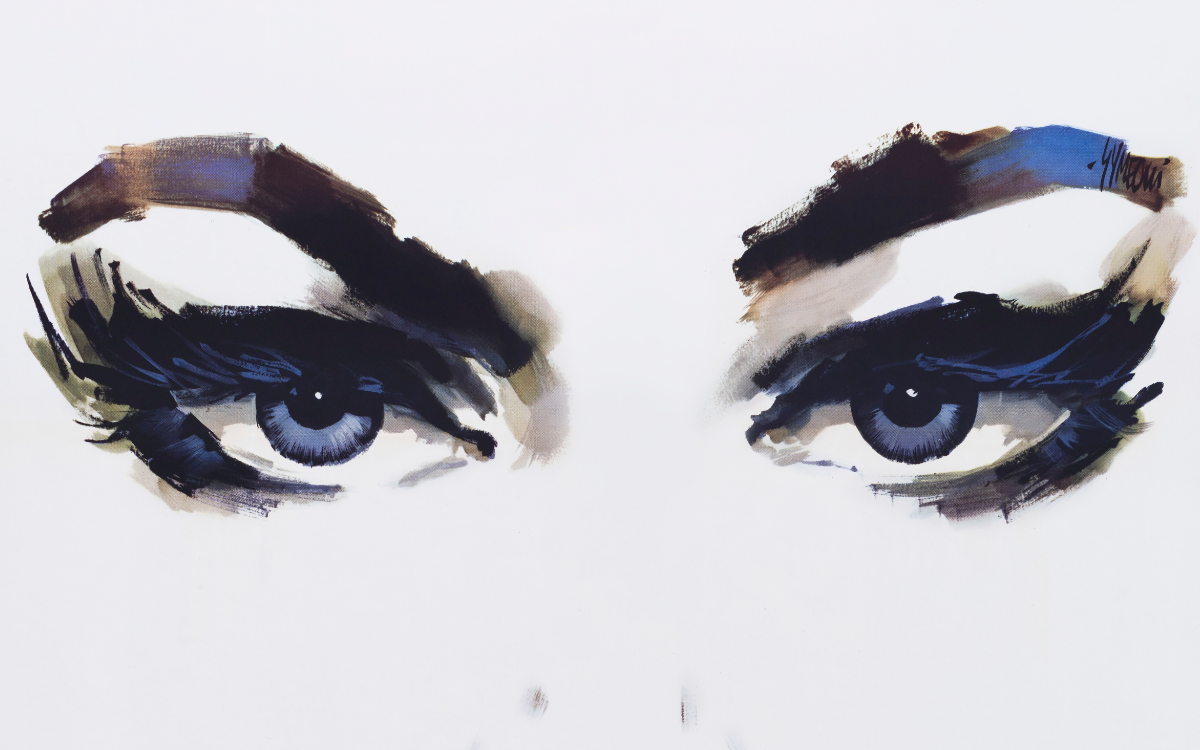
Among Italy's "cinema painters," Sandro Symeoni is perhaps the most chameleon-like: an artist able to reinvent himself again and again across half a century, moving through genres, styles and changing tastes without ever losing his unmistakable energy. The author of an astonishing number of posters, "locandina" (the small Italian format) and "fotobusta" (Italian lobby card), some three thousand films over more than fifty years of work, Symeoni did more than almost anyone to shape the visual imagination of Italian and international cinema. From the seductive female icons of the 1950s to social dramas and great auteur titles, his signature, that unmistakable "y", is one of the most familiar and best-loved in twentieth-century film advertising art.
From Ferrara to Rome: the caricaturist who became a cinema painter
Alessandro Simeoni, his real name, was born in Migliarino, in the province of Ferrara, in 1928. As a very young man he began contributing as a caricaturist to a few local newspapers, immediately revealing the taste for visual shorthand and wit that would remain a constant in his art. After studying at the "Dosso Dossi" art institute in Ferrara, he worked with his teacher Laerte Milani on advertising cartoons for the firm Pubblicine. During the 1950s he took the great leap and moved to Rome, where he embarked on a career as a cinema painter for the major Italian and American production and distribution houses: Paramount, Warner Bros., Columbia, Cineriz, Titanus.
There is a curious and telling detail in his biography that captures the international flavour of those golden years. Midway through his career, the artist decided to sign himself "Symeoni," replacing the first "i" of his surname with a "y": a small device to make the name easier for his American clients to pronounce, as he worked with them more and more often. From then on that "y" became his trademark, identifying him even more than his name itself; at times he signed even more tersely, "Sym." Like many of his colleagues, from Giorgio Olivetti to Carlantonio Longi, with whom he often found himself "competing" on the same film by proposing different solutions, Symeoni belonged to that community of artists who presented their work in the hope of seeing it chosen and paid for (usually modestly, and only for its exploitation in cinemas), content to remain the owners of their own creations.
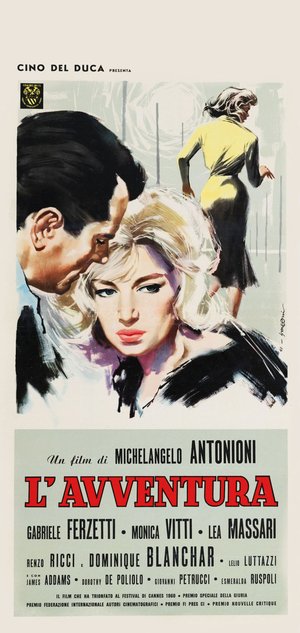
L'avventura (Michelangelo Antonioni, 1960)
The locandina for L'avventura by Michelangelo Antonioni, the film that triumphed at Cannes and rewrote the grammar of modern cinema, shows Symeoni at his most refined and psychological. Against a rarefied grey-green ground, the enigmatic face of Monica Vitti dominates the composition with its absent, melancholy gaze, while behind her we glimpse the figure of Gabriele Ferzetti and, in the distance, a woman seen from behind in a yellow dress. The brushwork is nervous, modern, almost expressionist: Symeoni renounces every advertising effect to convey the emptiness and unease that pervade Antonioni's masterpiece. It is worth recalling that a more traditional poster by Carlantonio Longi also circulated for the same film: two opposite ways of understanding the craft.
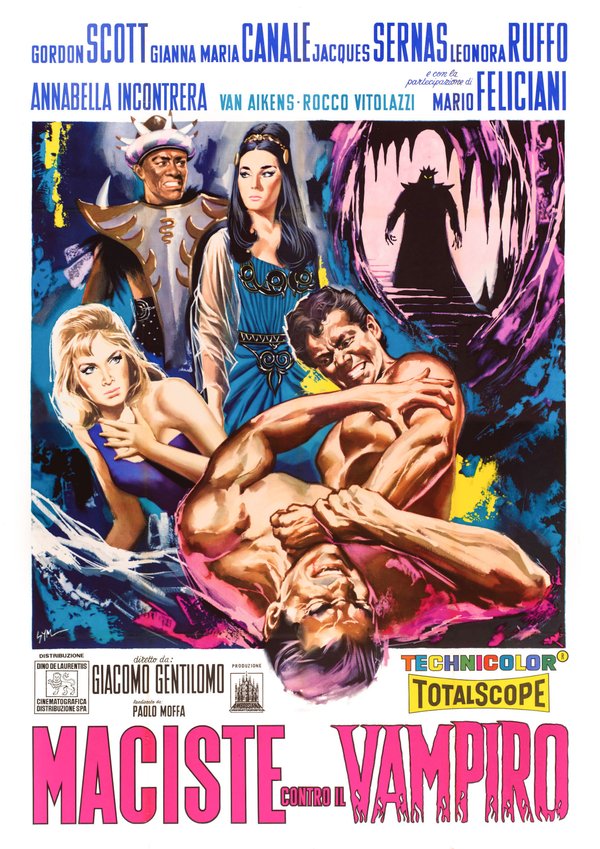
Goliath and the Vampires (Giacomo Gentilomo, 1961)
A wholly different register in the poster for Goliath and the Vampires, a delicious example of the "peplum" cinema that was all the rage in the early 1960s. Here Symeoni, signing "Sym," lets loose in a baroque, garish composition dominated by hot tones of pink, turquoise and violet. At the centre the mighty body of Maciste (Gordon Scott) wrestles bare-chested, surrounded by the figures of the beautiful Gianna Maria Canale and a sinister tyrant, while in the background the monstrous shadow of the vampire looms among the stalactites of a cave. This is the most popular, adventurous Symeoni, able to translate the genre's spectacular energy into pure chromatic action. A poster that is a small manifesto of commercial efficacy.
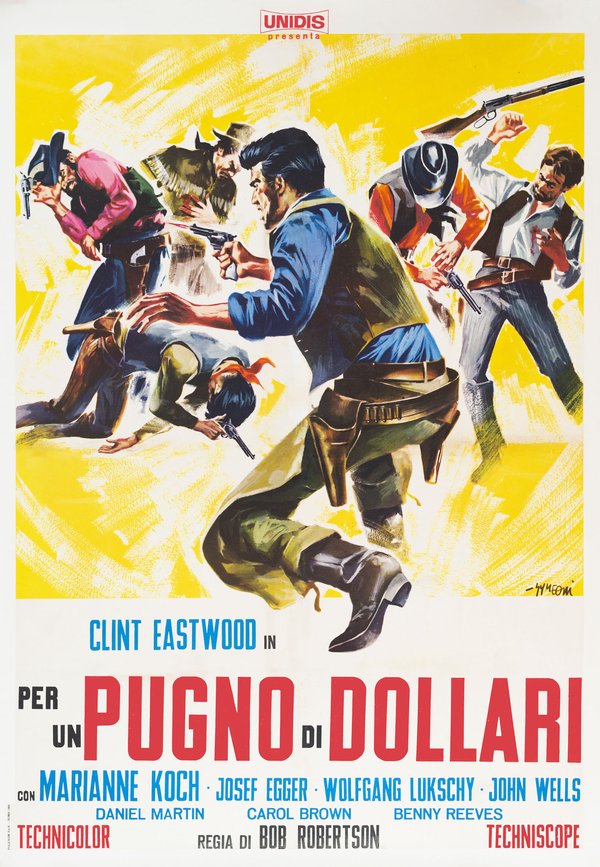
A Fistful of Dollars (Sergio Leone, 1964)
The poster for A Fistful of Dollars marks Symeoni's encounter with the emerging myth of the Italian Western. Against a blazing yellow ground swept by broad white brushstrokes that seem to kick up the dust, the artist builds a carousel of duels: at the centre, the springing figure of Clint Eastwood, not yet wrapped in the legendary poncho, but already in a feline pose, gun in hand and cartridge belt on show — is surrounded by a melee of gunmen who fall, fire and lunge, rifle raised. All around is pure action, resolved with his customary chromatic mastery and signed with the full "Symeoni" in the lower right corner. Curious, too, is the director's name at the bottom: "Bob Robertson," the anglicized pseudonym with which Sergio Leone, in homage to his father Vincenzo, a silent-era director known as Roberto Roberti, hoped to make a Western shot in Spain by Italian crews feel more "American." A disguise perfectly in tune with the "y" that Symeoni himself had adopted to please foreign eyes: two small strategies of camouflage for the same unrepeatable piece of film history.
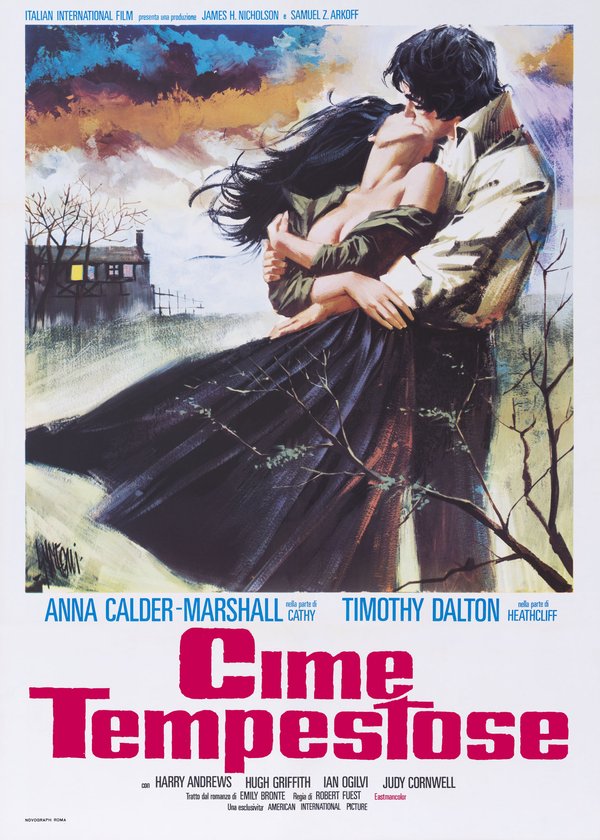
Wuthering Heights (Robert Fuest, 1970)
In the poster for Wuthering Heights, the adaptation of Emily Brontë's novel with a young Timothy Dalton as Heathcliff, Symeoni shows his painterly maturity. The passionate embrace of the two protagonists, Cathy and Heathcliff, is immersed in a wind-swept moorland landscape, rendered with broad, material brushstrokes and a dramatic sky of blue, ochre and violet. The woman's figure, with her very long black hair and wide dark skirt, merges with the earth and the wind in a romantic vortex. It is an image that translates the whole pathos of the story into paint, showing how easily Symeoni could move from the kitsch of the peplum to the lyricism of great romantic drama.
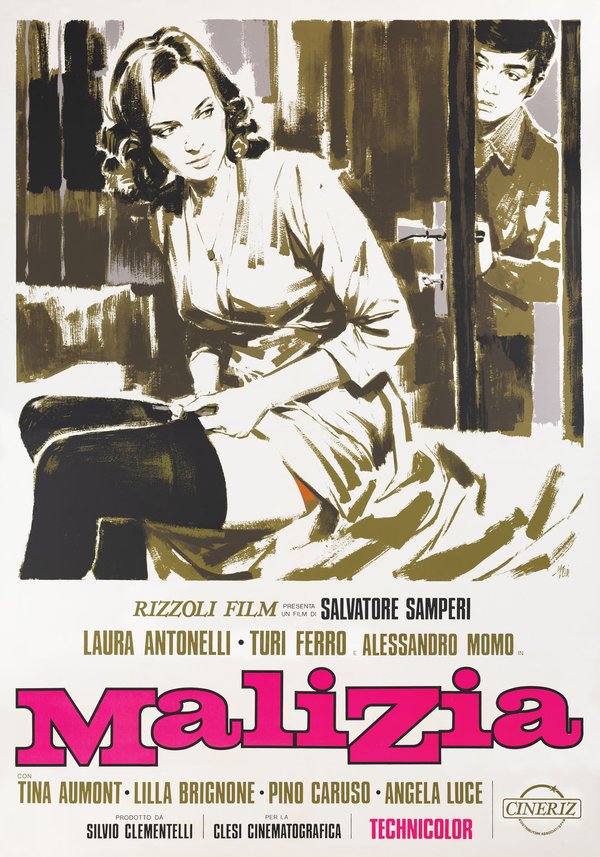
Malicious (Salvatore Samperi, 1973)
The poster for Malicious by Salvatore Samperi, one of the most resounding successes of the Italian erotic comedy, is a small masterpiece of synthesis and, fittingly, of malice. Symeoni resolves everything with a severely reduced palette of browns, blacks and whites, soiled by a single accent of red. At the centre is the figure of Laura Antonelli as the housekeeper Angela, portrayed with her stocking slipping down as an adolescent spies on her from the doorway. The technique is that of a rapid drawing, almost a sketch in loose brushstrokes, staking everything on psychological tension and on suggestion rather than display. It is proof of the refinement of an artist who could evoke eroticism with a single, knowing stroke of the brush.
Symeoni's style: continuous metamorphosis
What makes Symeoni a unique case among cinema painters is his relentless stylistic evolution. In his early period, up to the 1960s, he favoured sculpted, volumetric figures, often full-length and sensual female icons rendered with irony and seductive charge: this is the festive, narrative Symeoni of the posters for La Dolce Vita, close in spirit to the "Margutta" painters of those years. Then, gradually, his language became more modern and dramatic, nervous palette-knife strokes, cold contrasting colours, ever bolder synthesis, as in his celebrated artwork for The Canterbury Tales and for Dario Argento's iconic Deep Red, resolved with a few essential strokes.
Finally, with the arrival of political and social themes in cinema, Symeoni changed his skin once more: dark lines, marked outlines, an almost folk-lithograph graphic force. To this vein belongs his most famous work for auteur cinema, Pier Paolo Pasolini's Accattone: for that film the poet-director had drawn on sketches by artists such as Corrado Cagli, Carlo Levi, Mino Maccari and Anna Salvatore, yet the final choice fell precisely on Symeoni, who portrayed the protagonist Franco Citti steeped in a livid olive-green palette. He became the "official painter" of one of the most revolutionary films in our cinema.
Symeoni's legacy
Sandro Symeoni died in Rome in 2007, after a very long career that had seen him painting without interruption from the 1950s to the 1990s. Honoured with the title of "Ambassador of Ferrara to the World," he was celebrated by his home city with two major retrospective exhibitions, which finally acknowledged his stature as a fully rounded artist. Alongside his film advertising work, Symeoni left hundreds of record covers and a tireless body of graphic and painterly research.
His legacy is that of an artist who managed to be at once popular and refined, commercial and experimental, able to reinvent himself in every season without ever betraying his own energy. At a time when the painted poster was about to be supplanted by photography, Symeoni defended to the last the dignity of an art that united eros, irony and social expressionism. Today, rediscovered by collectors and scholars alongside the other great cinema painters, he remains one of the most versatile and surprising names of that unrepeatable era when the walls of Italian cities were open-air art galleries.
The works reproduced on this page come from the original prints of the period, recovered, photographed and digitally restored by Movie.it.