
Enzo Nistri, Elegance and Drama in the Movie Poster
Edited by Paolo Zelati, Editorial Director
June 23, 2026
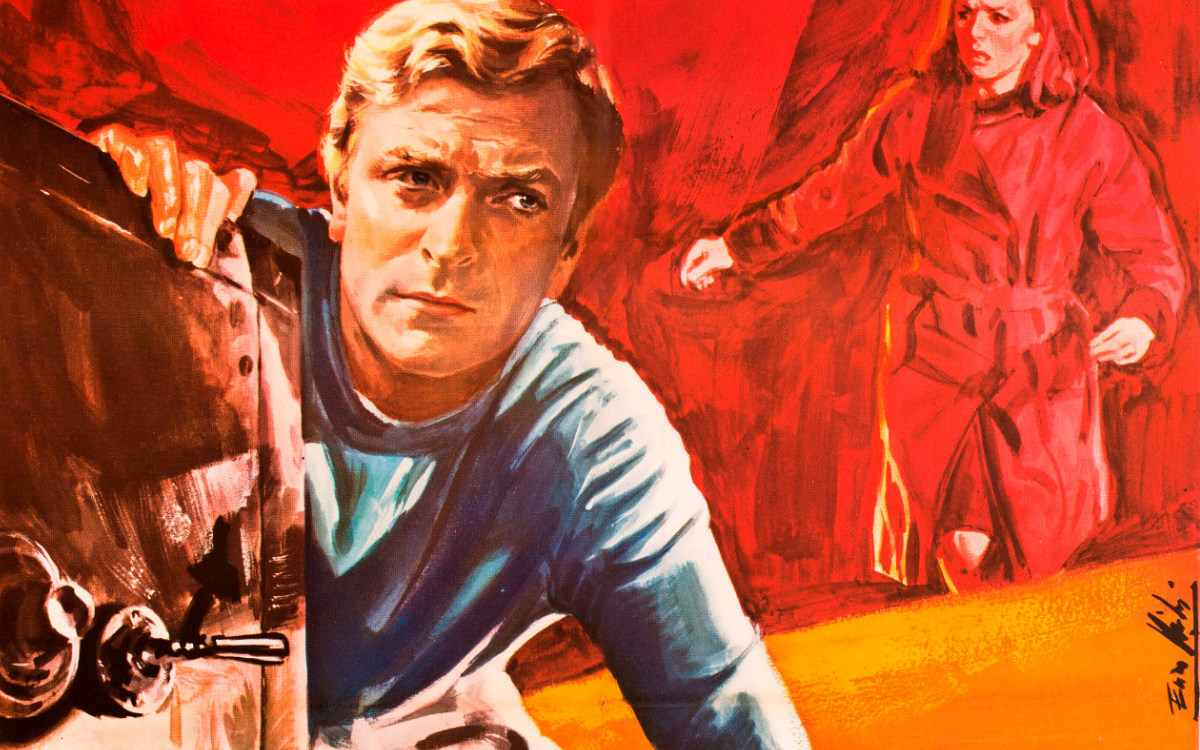
Enzo Nistri, born Lorenzo Nistri in Rome in 1923, worked across half a century of Italian and international cinema, creating thousands of posters, from light comedy to the darkest drama, and becoming one of the most refined and elegant figures in Italian poster art. But to reduce him to cinema alone would be unfair: before, during and after his work for the big screen, Nistri was a true painter, gifted with a sure hand and a sensibility for colour and composition that went far beyond film advertising. His is a particular case for another reason too: he was not alone. Alongside him worked his younger brother Giuliano, born in 1926, himself a talented poster artist, with whom Enzo ran a parallel career, in one of those family stories that dot the great age of the Italian cinema painters.
Rome, the Two Brothers and a Half-Century Career
Enzo Nistri began his career as a poster artist in the 1950s, at a moment when cinema was a true driving industry: more than five hundred titles a year arrived in Italian theatres, between domestic and foreign productions, and each one needed an image capable of stopping the passer-by and drawing them into the cinema. It was a competitive and fascinating world, dominated by the great founding masters of the genre such as Anselmo Ballester and Luigi Martinati: the painters would often present their works in competition with one another, hoping to be chosen and paid for the promotional use tied to the film, and quite happy to remain in any case the owners of their own creations for every other purpose.
The Nistri brothers entered this world with a talent and a versatility that would make them among the most sought-after names in the field. Enzo signed posters for every genre: the western, the drama, the comedy, the horror, the thriller, always with a sober and elegant style that combined sharp, intense lines with vibrant colours, often set in strong contrasts.
His art oscillated constantly between two poles: an exploration of volume, with solid, sculpted figures, plastically constructed, and graphic synthesis, with essential compositions and flat colours. A distinctive trait of his language is precisely the use of simple, flat backgrounds, which set off the protagonists, volumetric and modelled with a sure hand. He worked across every format, from the large poster to the "locandina" (Italian small format ). Behind this technical skill one always senses the classically trained painter, the artist capable of holding his own with the canvas and not only with billboard paper: an autonomous vocation that would re-emerge powerfully in his final years, when Nistri worked extensively with the Carabinieri, creating illustrations and paintings, while returning to landscapes and compositions of delicate naturalism, executed for the pure pleasure of painting.
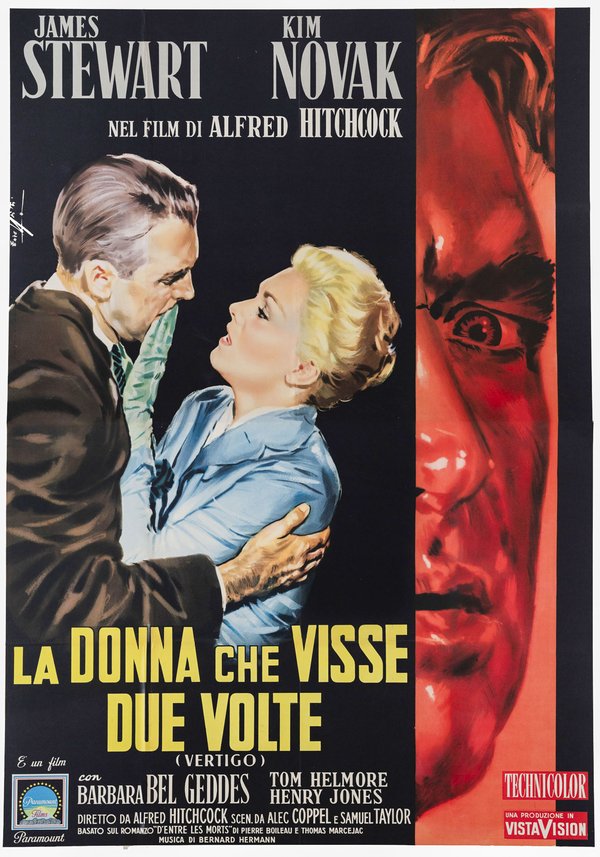
Vertigo (Alfred Hitchcock, 1958)
The poster for Hitchcock's Vertigo, released in Italy as La donna che visse due volte, with James Stewart and Kim Novak, is one of Nistri's absolute peaks. On the left, the tense, almost desperate embrace between Stewart and Novak; on the right, the giant face of the man rendered in a dramatic red monochrome, symbol of the obsession that devours the protagonist. The black background sets off the two elements, and the yellow lettering of the title closes a composition that translates the film's theme into an image: love as vertigo and illusion. A perfect example of Nistri's style, capable of uniting volumetric portraiture and chromatic synthesis.
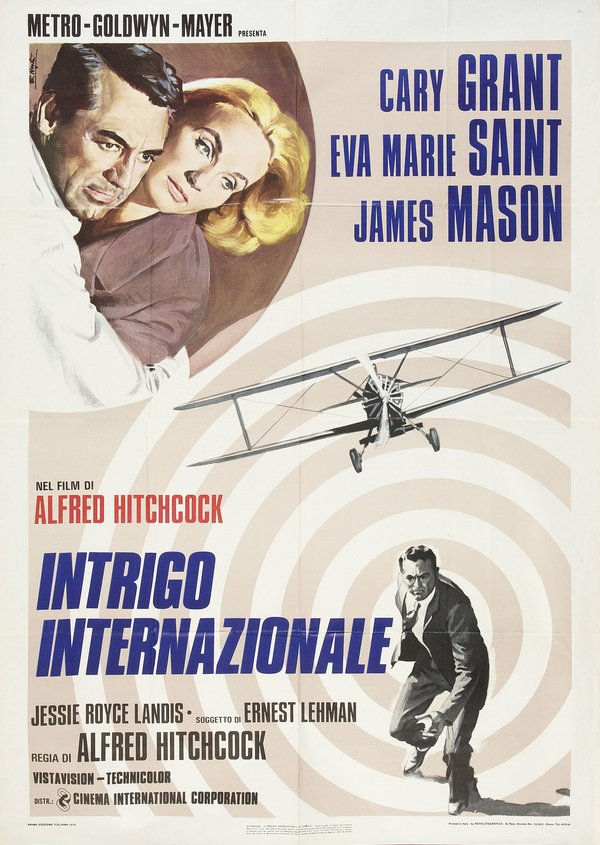
North by Northwest (Alfred Hitchcock, 1959)
The poster of North by Northwest is one of Nistri's most elegant and ingenious works, released in Italy as Intrigo internazionale. The composition plays on a background of hypnotic spirals that immediately creates a sense of movement, pursuit and disorientation. At the top, the portrait of Cary Grant and Eva Marie Saint; at the centre, the famous biplane pursuing Grant; at the bottom right, the small figure of the fleeing man rendered in an almost photographic black and white. Nistri synthesises in a single poster the most memorable sequences of the film, building an image that is at once portrait, narrative and graphic play.
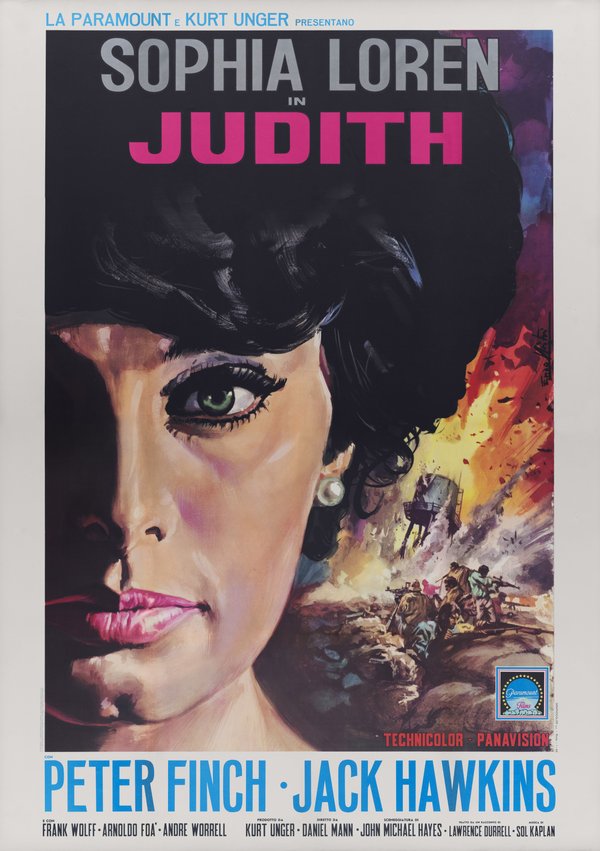
Judith (Daniel Mann, 1966)
A masterly example of Nistri's portraiture. In the poster for Judith, Sophia Loren’s face occupies the left half of the composition, rendered with extraordinary precision and an intense sensuality, the green, magnetic eyes, the pink lips. The boldest choice is the cut: the face is literally halved, and on the right, where it ought to continue, there opens instead a scene of war and explosions in a warm palette of yellows and reds. A powerful solution, which contrasts the static beauty of the portrait with the dramatic dynamism of the background, synthesising the film's two souls.
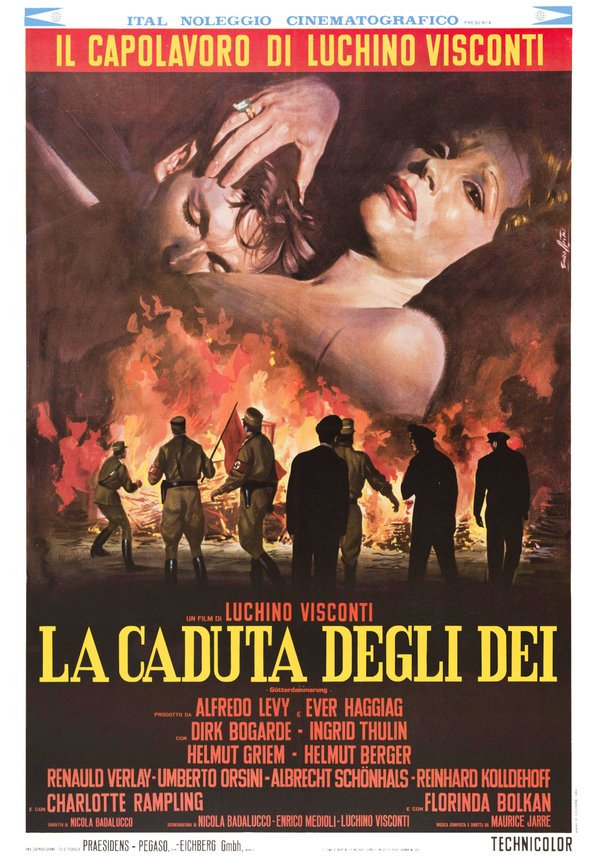
The Damned (Luchino Visconti, 1969)
The poster for Visconti’s The Damned is one of Nistri’s most dramatic works. At the top, two female faces reclined in an ambiguous, morbid embrace, rendered with dense brushstrokes; below, the black silhouettes of the SS and the uniformed men standing out against the flames of a bonfire, symbol of the descent into hell of Nazi Germany told by the film. The palette, dominated by fiery reds and deep blacks, wraps the figures in an atmosphere of looming tragedy, perfectly conveying the film's dimension of decadence and corruption.
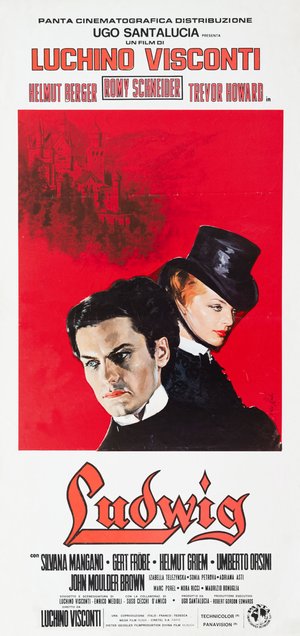
Ludwig (Luchino Visconti, 1973)
The locandina for Ludwig, again for Visconti, with Helmut Berger and Romy Schneider, shows Nistri grappling with an off-centre, original composition. Against an intense red background, the two protagonists emerge in the foreground, back to back: the melancholy, tormented face of Ludwig of Bavaria and the haughty one of Sissi, wearing the black top hat of a horsewoman. At the top left, the silhouette of Neuschwanstein Castle, the architectural dream of the mad king, stands out in transparency. Nistri builds the image on a few base colours that heighten the intensity of the faces in the foreground, almost ready to step out of the poster. A refined solution, in keeping with the film's twilight tone.
The Legacy of Enzo Nistri
Enzo Nistri died in Rome in 2008, leaving an immense artistic heritage. His work spans every genre and every season of postwar cinema, from the Hollywood western to the auteur masterpiece, from light comedy to horror, always with that combination of elegance and drama that was his signature. Together with his brother Giuliano, he represents one of the most fascinating chapters of Italian poster art: that of two brothers who, side by side, helped build the visual imagination of millions of spectators. A master of visual communication but first and foremost a genuine painter, capable of combining classical rigour with modern invention, Nistri showed how the film poster could be at once a promotional lure and an autonomous work of art, leaving behind images that continue to tell the story of cinema with the same force as when they first appeared on the walls of Italian cities.
The works reproduced on this page come from the original prints of the period, recovered, photographed and digitally restored by Movie.it.