Rinaldo and Giuliano Gèleng, Surrealism in the Movie Poster
By Movie.it Editorial Team
June 22, 2026
There are stories that are worth a film in themselves, and that of the Gèleng is one of them. It begins in front of the window of a Roman rotisserie, at the end of the 1930s, where two penniless young men gaze longingly at a tray of supplì they cannot afford. One is a young draughtsman named Rinaldo Gèleng. The other is a boy from Rimini who has come to Rome to try his luck, and his name is Federico Fellini. From that hungry encounter would be born one of the longest and most fruitful friendships in the history of Italian cinema, destined to last until the director's death in 1993 and to involve an entire family of artists: the "Bottega dei Geleng", the Geleng Workshop, as Fellini himself affectionately called it. This is also the story of two great poster artists, father and son, and of their posters, which have remained in the memory of entire generations.
Rinaldo Gèleng: From the Orphanage to Fellini's Workshop
Rinaldo Gèleng's life began as an uphill struggle. Born in Rome in 1920 and soon orphaned of both parents, he was taken in at the Istituto di San Michele, where he learned various trades and above all the first rudiments of drawing and painting. He was related to the German painter Otto Gèleng, whose celebrated views of Mount Etna helped turn Taormina into an international tourist destination in the nineteenth century. After his apprenticeship at the Institute, Rinaldo attended the art school in via Ripetta and in 1939 began to contribute to the "Marc'Aurelio", the legendary satirical magazine that was a breeding ground for so many talents, where he met Fellini.
In those years Rinaldo made a name for himself in the Rome of variety theatre, producing caricatures and portraits of the stars of the day: Rascel, Macario, Wanda Osiris, Nino Taranto. These were the years of apprenticeship, in which he also signed his first film posters. Between 1950 and 1959 he lived in Paris, where he became artistic director of the publishing house Opera Mundi and founded a school of illustrators. These were fundamental years: in contact with the legacy of Van Gogh, Rembrandt, the Impressionists and masters such as Soutine and Modigliani, Rinaldo refined that full-bodied brushwork and that vein of portraiture that would become his signature. Back in Italy, he worked with Mondadori on covers and illustrations and signed famous advertising campaigns such as the one for Wührer beer in 1960. From the 1970s, beginning with The Clowns and especially with Roma in 1972, Rinaldo became one of Fellini’s trusted painters, creating posters and "locandina" (the small vertical Italian format) for several of his films as well as, above all, numerous scene paintings. He was, as the family recalled, one of the greatest portraitists of his time: in his studio on the slope of via di Capo le Case he portrayed, besides Fellini and Giulietta Masina, Alberto Sordi, Sophia Loren, John Paul II and Gianni Agnelli.
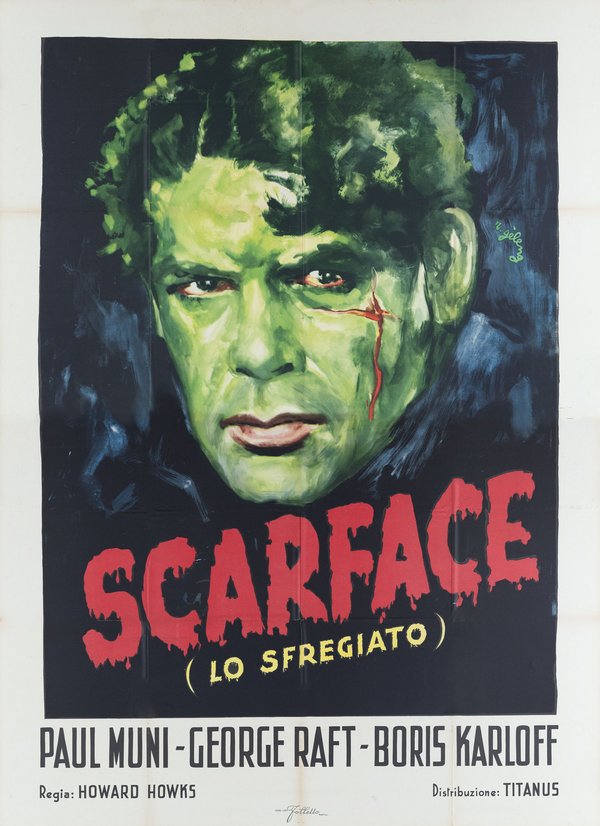
Scarface - Shame of the Nation (Howard Hawks, 1932)
Among the boldest images of Rinaldo's early period, the poster for Scarface - Shame of the Nation shows the face of the scarred man painted in an unnatural, sickly green, evoking the underworld and death, as it emerges from the black background with a grim stare and the red scar clearly visible on the cheek. The blood-red title completes an image of great expressive power, which anticipates certain chromatic solutions by decades. Already in his youthful works Rinaldo was unafraid to be daring with colour.
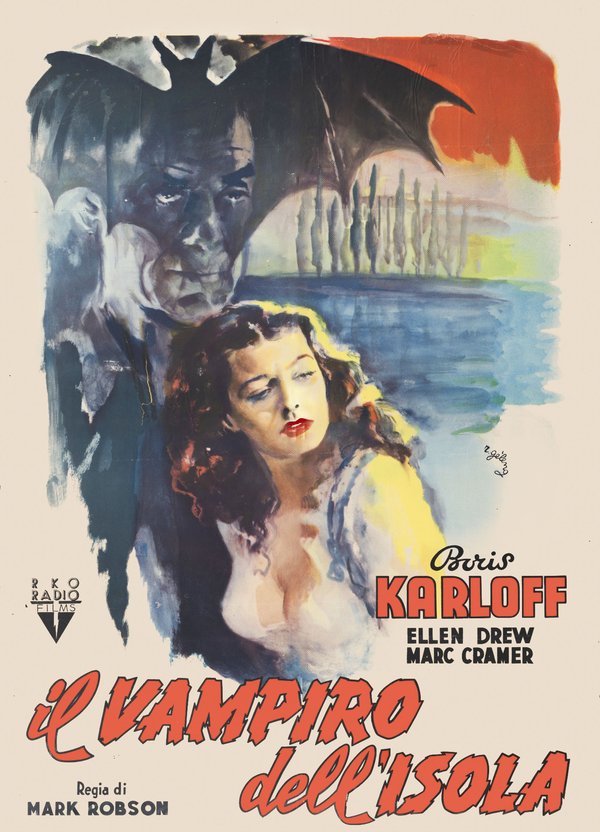
Isle of the Dead (Mark Robson, 1945)
In the poster for Isle of the Dead with Boris Karloff, released in Italy as Il vampiro dell'isola, Rinaldo stakes everything on suggestion. Against a watercolour background of cypresses and a livid sky, the great dark, winged figure of the vampire looms like a menacing shadow over the pale, terrified face of a young woman. The cold palette of blues and greys, broken by the dark red of the sky, creates a gothic, unsettling atmosphere. It is a sensibility for the fantastic that we will find again, in a more dreamlike key, in the Fellini collaborations.
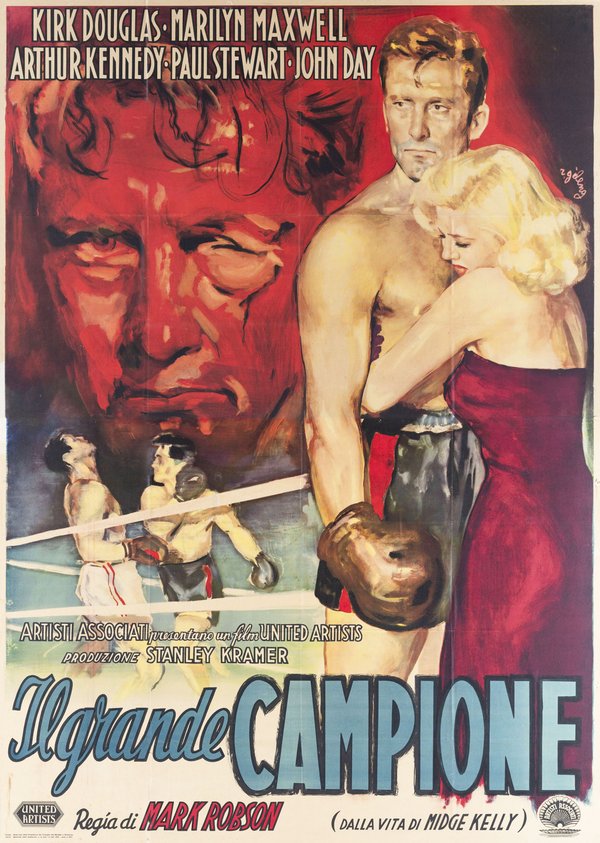
Champion (Mark Robson, 1949)
The poster for Champion, released in Italy as Il grande campione, with Kirk Douglas as a bare-chested boxer with gloves, shows the early Rinaldo, still tied to the great dramatic realism of the Roman school. A woman in a red dress presses close to him, while on the left the giant, tormented face of the champion merges with the blood-red background and, lower down, a fight scene in the ring introduces the action. A powerful, muscular image, built with dense brushstrokes and a warm palette.
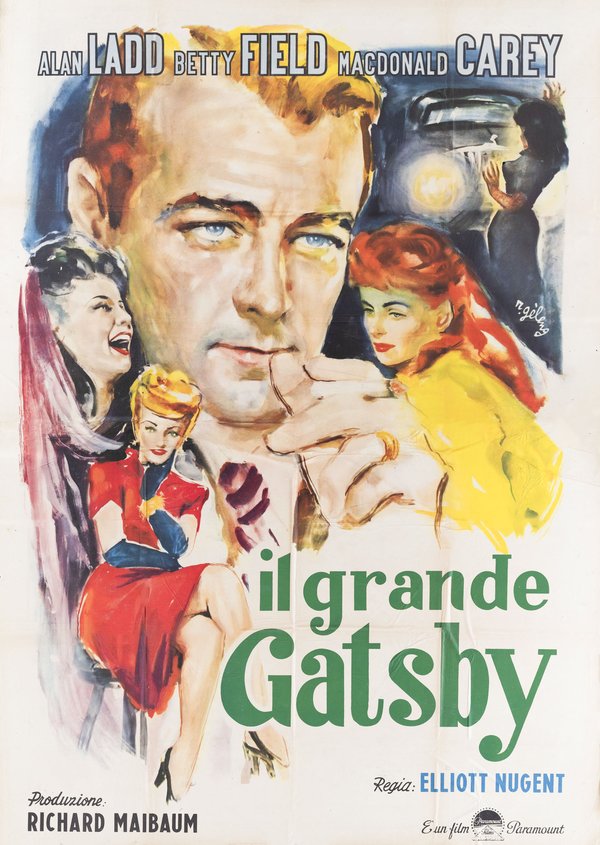
The Great Gatsby (Elliott Nugent, 1949)
A refined example of Rinaldo's ability to construct ensemble images, the poster for The Great Gatsby, released in Italy as Il grande Gatsby, with Alan Ladd, places the protagonist's face at the centre, rendered with full-bodied, luminous brushwork, while all around the film's female figures, each with her own dominant colour, are arranged like fragments of a gilded, decadent world. In the background, the automobile and the mysterious figure introduce the dramatic tension. A poster that perfectly conveys the atmosphere of luxury and melancholy of the novel.
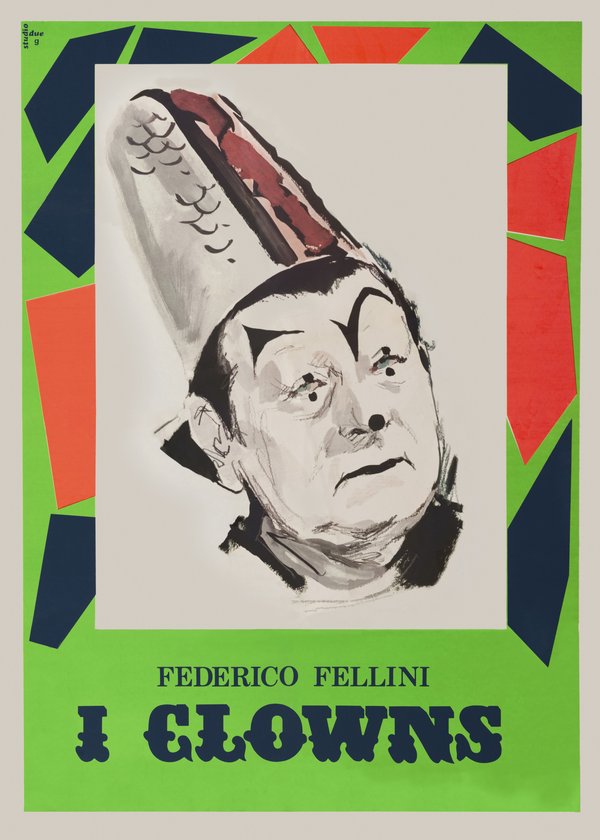
The Clowns (Federico Fellini, 1970)
The poster for The Clowns is one of Rinaldo's most poetic works: against a background of geometric fields of green, blue and red that evoke the circus, the face of a white clown emerges, painted with rapid, sorrowful brushstrokes, the conical hat, the poignant expression of one who has made people laugh a whole life long while hiding his own sadness. Not a clowning, jolly clown, but a deeply human and moving mask, perfectly in tune with the declaration of love for the circus that the film is.
Giuliano Gèleng: The Legacy that Becomes Surrealism
Giuliano Gèleng was born in Rome in 1949, son of Rinaldo and brother of Massimo Antonello, set and costume designer. He grew up literally inside art, in his father's studio and in Fellini's orbit, whom he frequented from childhood and whom he affectionately called "Uncle Federico". He trained at the Accademia di Belle Arti in Rome and moved towards film advertising, but his destiny was sealed: like his father, he would become one of the great director's trusted painters, collaborating repeatedly on Fellini’s films, from a id="a2">Roma to The Voice of the Moon, both on posters and on scene paintings.
Giuliano's language carried his father's legacy towards an even more surreal and metaphysical dimension. In almost daily contact with Fellini, whom his collaborators called "the Lighthouse", Giuliano absorbed that capacity for escape from reality that would nourish all his art, leading him to works of a dreamlike, fantastic character. When father and son worked together, or when Giuliano signed alone, they sometimes used the mark "Studio 2G", to indicate that "little Geleng team" that was at once a Renaissance workshop and a family affair.
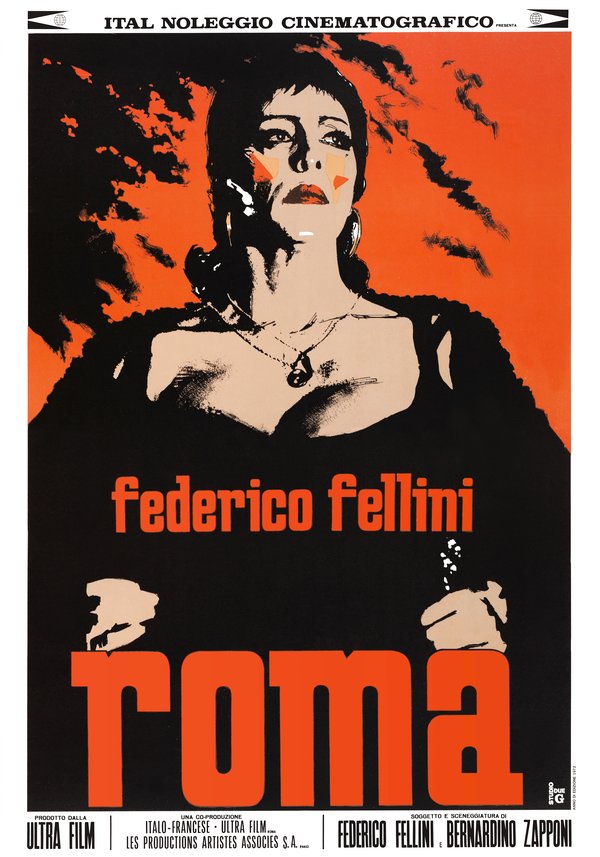
Roma (Federico Fellini, 1972)
Signed Studio 2G, the poster for Roma is one of the most powerful images to come out of the workshop. Against a bright orange background, the face of a woman with an intense gaze and theatrical make-up, with orange tears streaking her cheeks, emerges from black hair rendered in broad, gestural brushstrokes. The figure, wrapped in a dark dress, has something archaic and maternal about it, almost a personification of the Eternal City in its contrasts of the sacred and the profane. The orange lettering of the title completes a composition of great graphic synthesis.
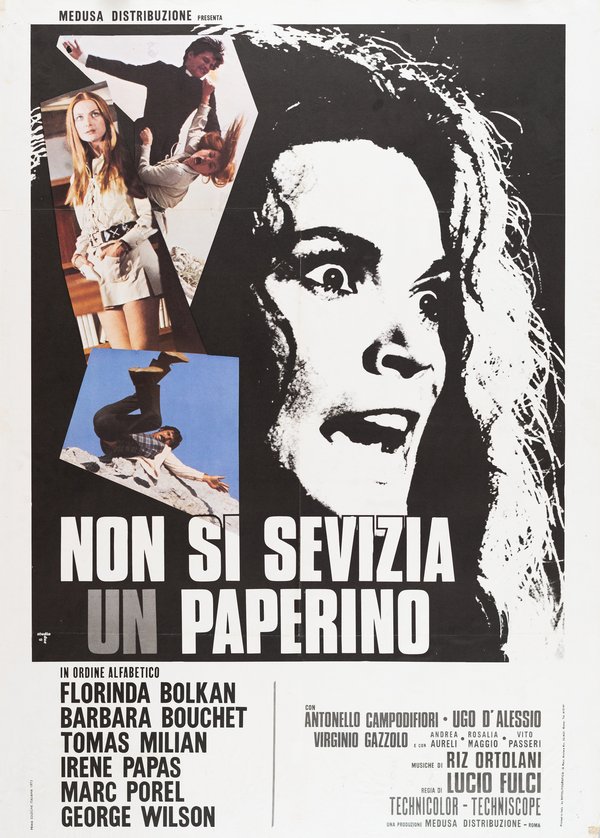
Don't Torture a Duckling (Lucio Fulci, 1972)
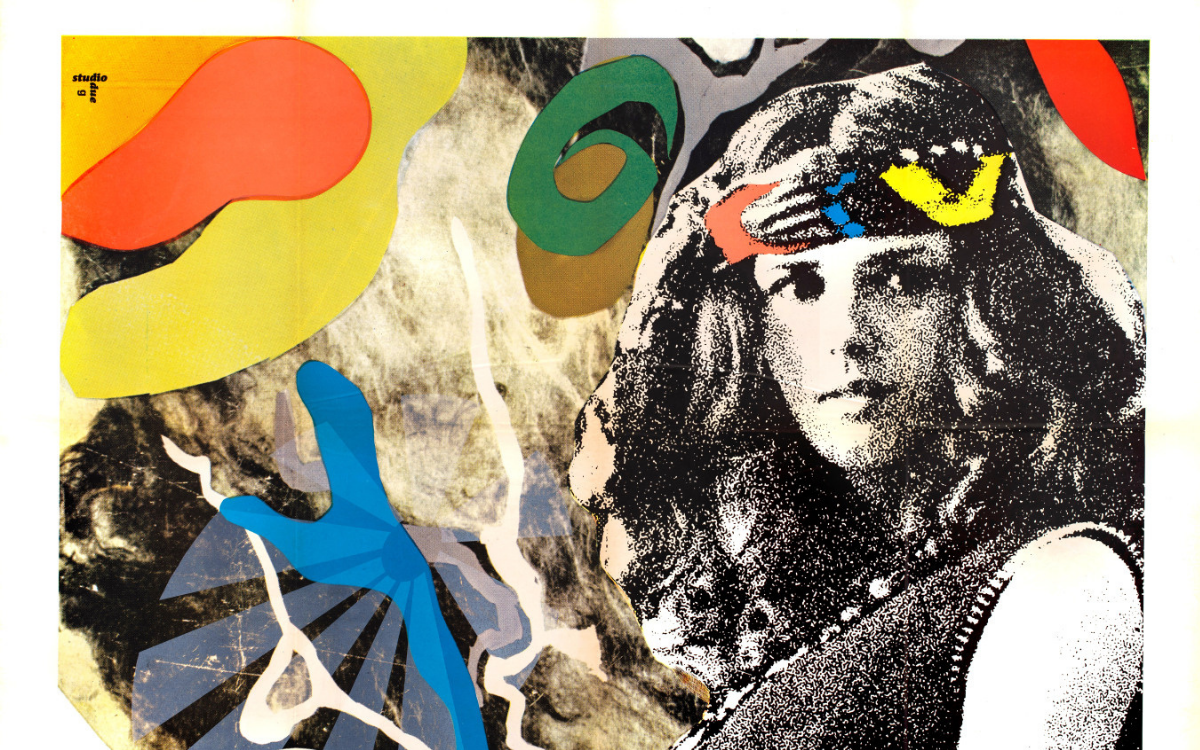
The film Don't Torture a Duckling Again Studio 2G, a work of great graphic modernity: the screaming face of a woman, rendered in a dramatic, high-contrast, almost photographic black and white, dominates the right side of the composition with her mouth wide open in a cry of terror. On the left, a few production stills introduce the violence of the thriller. The contrast between the extreme graphic treatment of the face and the photographic images creates a very strong effect, perfectly calibrated to one of the most disturbing giallo films of 1970s Italian cinema.
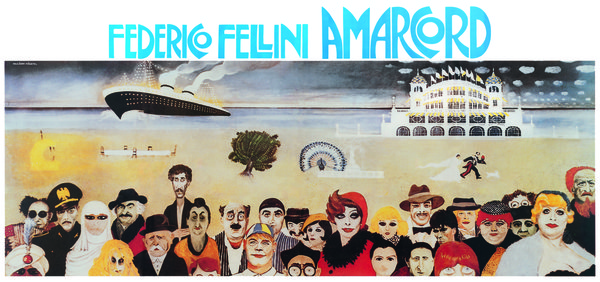
Amarcord (Federico Fellini, 1973)
The locandina for Amarcord is Giuliano's absolute masterpiece and one of the most famous images in all of Italian cinema. To create it, Giuliano received from "Uncle Federico" a letter with extremely precise instructions on how it should look. The result departs completely from traditional conventions: all the protagonists are arranged in the lower part, as on a surreal proscenium, and address the viewer directly, each with his own almost caricatural characterisation. Above them, the beach, the illuminated ocean liner, the grand hotel: the film's symbolic elements float in an abstract, timeless space. An ensemble image, poetic and melancholy, which condenses the entire memorial universe of the film into a single unforgettable composition.
The Legacy of the Gèleng
Rinaldo Gèleng died in Rome in 2003, ten years after his friend Federico. His son Giuliano survived him until 2020, continuing to guard that visionary poetics learned in his father's studio and in the company of the great director. Together, father and son represent a unique chapter in the history of Italian film poster art: not mere executors of posters, but true co-authors of the Fellinian imagination, capable of translating into images the same surreal, melancholy poetry that animated the Maestro's films. Their story, which began in front of a tray of supplì, shows how great artistic adventures are sometimes born from the humblest of circumstances, and how a friendship can turn into one of the most fruitful collaborations ever seen between cinema and painting.
The works reproduced on this page come from the original prints of the period, recovered, photographed and digitally restored by Movie.it.