Arnaldo Putzu, Italian Movie Poster Artist: Wit and Pictorial Elegance
By Movie.it Editorial Team
June 26, 2026
Among Italian film-poster artists, few transformed the poster into an object of pure pop seduction as brilliantly as Arnaldo Putzu. His images have the enamelled gloss of great illustration, an almost advertising-like power of synthesis, and a smile, often a literal one, that makes them instantly recognisable. Able to move with ease from drama to comedy, from oil to tempera, Putzu was a versatile and thoroughly modern artist, one of the few great Italian poster artists to build a second, successful career in Britain, becoming a cult name of British popular graphics.
From Rome to London: The Double Life of a Poster Artist
Arnaldo Putzu was born in Rome in 1927. After studying at the Accademia di Belle Arti, he entered the world of poster art by collaborating with Enrico De Seta, one of the masters of the trade, and with the Favalli studio. These were the apprenticeship years, in which Putzu refined the luminous technique and the taste for synthesis that would become his signature. In the 1950s and 1960s he was among the most sought-after names in Rome, able to sign with equal ease the neorealist drama and the comedy, the auteur film and the popular product.
Unlike many of his colleagues, however, Putzu’s career took an international turn. Putzu had already been working for the British market through Eric Pulford, creative director associated with Downton Advertising, since the late 1950s. In 1967 he moved to Britain, where his international career truly took off. It proved to be a successful partnership: Putzu became one of the foremost illustrators working for British cinema, creating the bright, ironic posters for the famous Carry On comedy series and for many other films. In England, he achieved a level of recognition that few Italian artists in the field ever reached, to the point that from 1973 to 1981 he painted almost every cover of Look-In, the hugely popular children’s television magazine, portraying television and pop stars week after week. It was a career path that set him apart from colleagues whose careers remained largely centred in Italy, such as Ercole Brini or Alfredo Capitani, and one that reflected his nature as a cosmopolitan and highly adaptable artist.
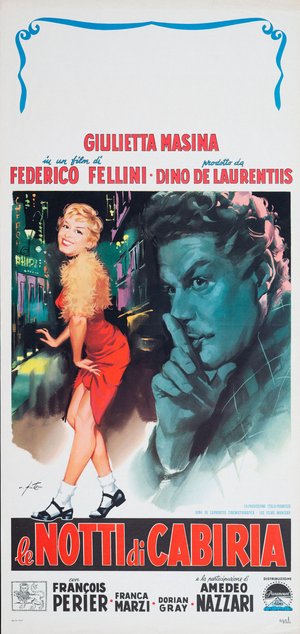
Nights of Cabiria (Federico Fellini, 1957)
The "locandina" (the small vertical Italian format) for Nights of Cabiria, Fellini's masterpiece awarded an Oscar, is one of the young Putzu's most intense works. The composition sets two registers against each other: on the left, the small Cabiria of Giulietta Masina, portrayed in vivid colour in a red dress and feather boa, smiling and fragile beneath the city's night signs; on the right, the male face tinted a spectral green, finger on his lips in an ambiguous, unsettling gesture. Putzu thus sums up all the tension of the film, the contrast between the protagonist's innocence and the world that threatens her. A poster of great narrative force, built on the dialogue between warmth and chill.
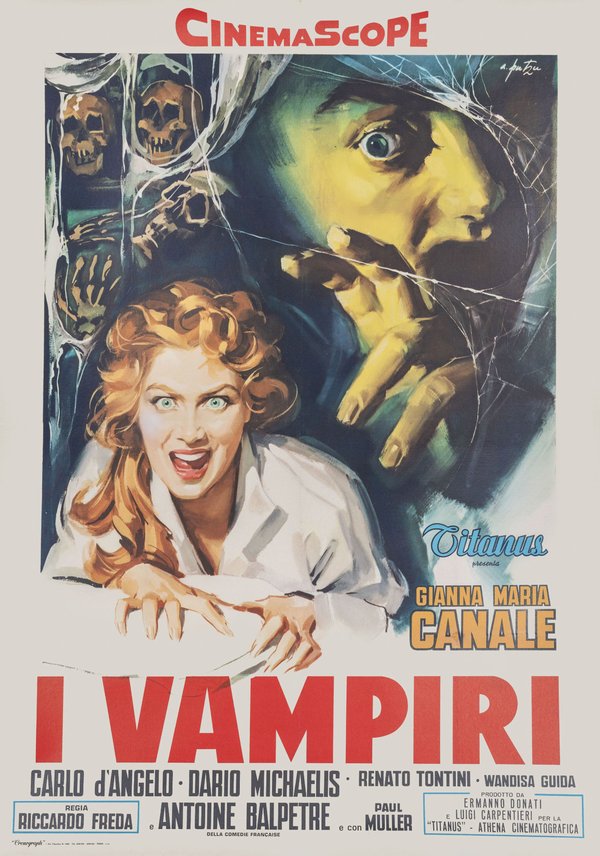
Lust of the Vampire (Riccardo Freda, 1957)
The poster for Lust of the Vampire by Riccardo Freda, generally considered the first Italian horror film of the sound era, shows Putzu's talent in the gothic genre. On the left, the terrified face of Gianna Maria Canale emerges among the cobwebs and skulls of a crypt; on the right looms a sinister figure with a greenish, cadaverous face, its skeletal hand reaching forward. The cold palette of greens and blues and the theatrical use of shadows create an atmosphere of genuine terror. Here Putzu shows that he could handle the repertoire of horror with the same elegance with which, elsewhere, he sketched a comedy smile.
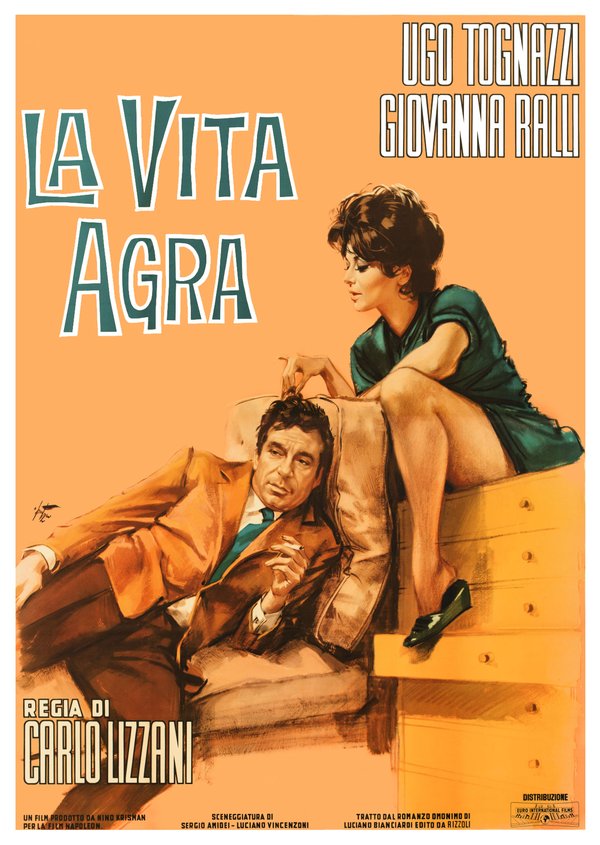
It's a Hard Life (Carlo Lizzani, 1964)
In the poster for It's a Hard Life, based on Luciano Bianciardi's novel and starring Ugo Tognazzi, Putzu captures with irony the disenchantment of boom-era Italy. Against a warm, flat orange background, Tognazzi is portrayed half-reclining, cigarette in hand and the disillusioned expression of the intellectual defeated by the metropolis, while above him sits the figure of Giovanna Ralli in a green dress, legs crossed and with a provocative air. The graphic synthesis is perfect: few colours, an essential, modern composition, and all the bitter comedy of the film contained in the contrast between the two characters.
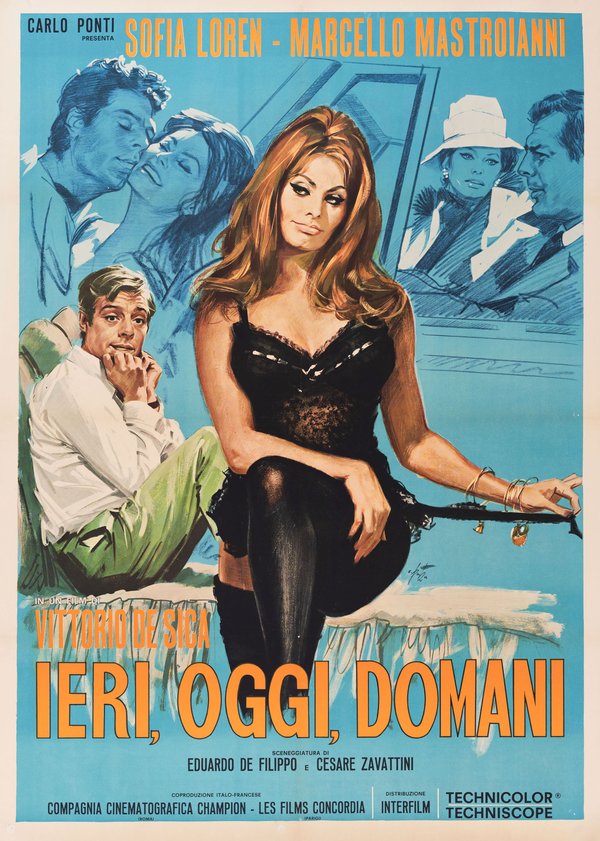
Yesterday, Today and Tomorrow (Vittorio De Sica, 1963)
The poster for Yesterday, Today and Tomorrow, a triumph for the Sophia Loren–Marcello Mastroianni pairing and winner of the Oscar for best foreign film, is a triumph of pop seduction. At the centre, a statuesque Sophia Loren in black, stockings and suspenders, her gaze proud and alluring: the echo of the famous striptease that made her legendary. All around, Putzu arranges the other incarnations of the two actors in the film's three episodes, some in colour, others tinted blue like marginal sketches. It is a choral, dynamic composition, a small poster-narrative that wittily sums up the three stories and celebrates the most beloved couple of Italian cinema.
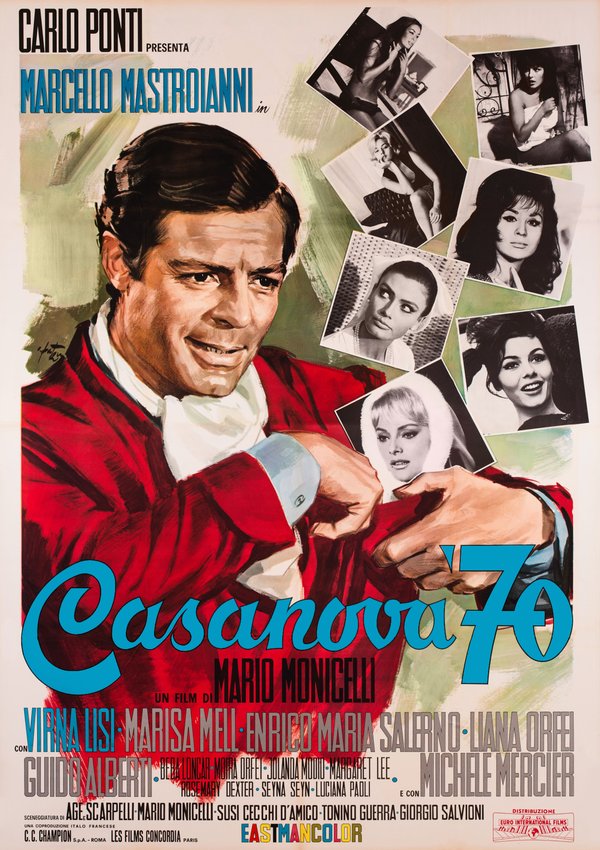
Casanova '70 (Mario Monicelli, 1965)
In the poster for Casanova '70 by Mario Monicelli, Putzu portrays Marcello Mastroianni in a red dress coat, with a smug, seductive smile, while around him blossoms a scattering of black-and-white photographs, the faces of the many women of the modern Don Juan he plays. It is a brilliant graphic solution, fusing the painted figure of the protagonist with the photographic collage of his conquests, and translating into an image the film's irony. The bright red of the coat, set against the light background, makes the figure stand out with the elegance of great fashion illustration, showing how close Putzu was to the world of the most refined advertising.
The Legacy of Putzu: The Smile of the Film Poster
Arnaldo Putzu died in Rome in 2012, having returned to Italy. His work represents one of the most original chapters of Italian poster art: that of an artist who knew how to combine the pictorial tradition of the Roman school with the glossy, brilliant language of international advertising graphics. If Maro Innocenti pushed the poster towards conceptual abstraction and Brini towards the transparency of watercolour, Putzu carried it towards the full light of pop, made of bright colours, smiles and dynamic compositions.
His double career, Italian and British, makes him a bridge figure between two visual cultures, and his posters, today highly sought-after by collectors around the world, remain the testimony of a talent able to speak to everyone, with immediacy and cheerfulness. At a time when the painted poster was about to give way to photography, Putzu showed that illustration could still be utterly modern, seductive and popular. Looking at his works today, from Fellinian drama to the commedia all'italiana, one recognises the hand of an artist who never stopped believing in the power of a well-made image: able, in a single glance, to make us smile and to invite us to the cinema.
The works reproduced on this page come from the original prints of the period, recovered, photographed and digitally restored by Movie.it.