Luciano Crovato, the Italian Movie Poster Artist Who Crossed Over to the Screen
Edited by Paolo Zelati, Editorial Director
July 9, 2026
Crovato is also an apparently unique case among Italian poster artists to have lived cinema from both sides of the poster: first as an artist creating posters for theatrical releases, then as an actor, and finally as a film director.
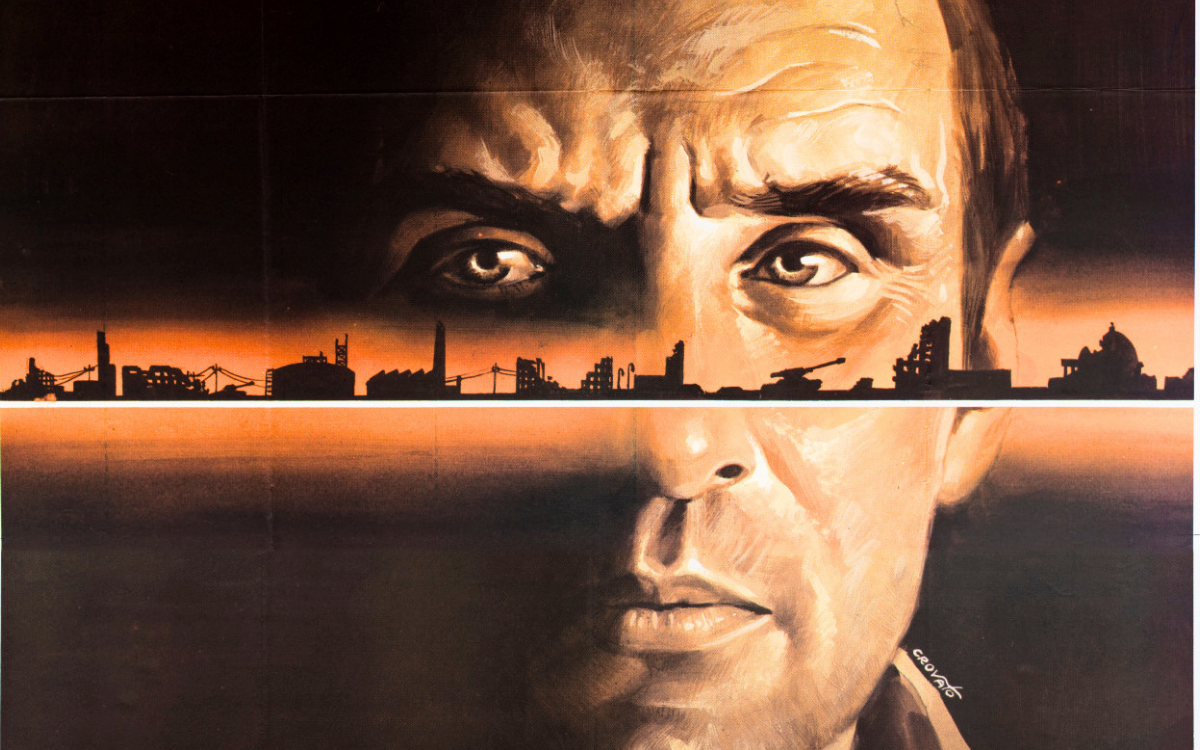
Among the painters who gave a face to Italian cinema, Luciano Crovato holds a singular position. His signature, a spare "L. Crovato", appears on posters spanning commedia all'italiana, 1970s gothic horror and re-releases of the great classics. Yet Crovato is also the only Italian poster artist to have lived cinema from both sides of the poster: first as an artist creating posters for theatrical releases, then as an actor, and finally as a film director. It is a trajectory with no equal among his colleagues and one that shows better than any other how deeply the world of film-poster artists was woven into the daily life of Rome's film industry.
Painting for Italian Theatrical Releases
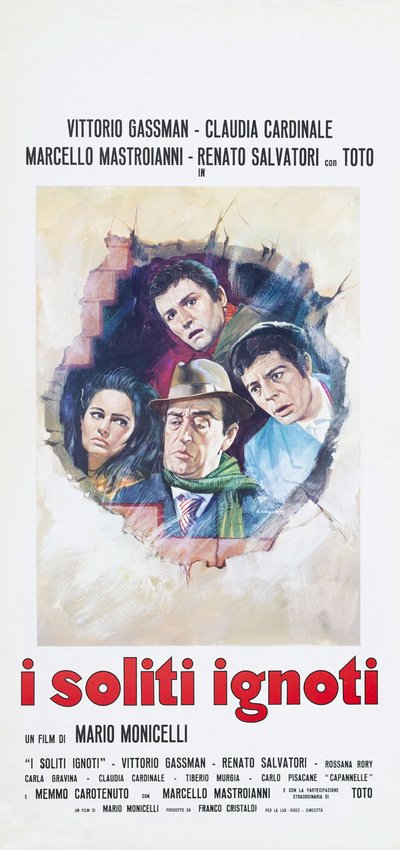
Born in Venice on 19 December 1944, Crovato belongs to the youngest generation of the Maestri Cartellonisti, the one that entered the trade when the golden age of the painted film poster was already mature and accompanied it through to its final season. Like the great masters of Italian film-poster art, he worked with considerable creative freedom: often starting from limited information, sparse reference material or little more than a few indications about the film, he created original images that could bear only a loose relationship to what would eventually appear on screen. He was the illustrator chosen for releases of remarkably different kinds: comedies starring Italy's greatest stars, international horror productions and, to a notable degree, the re-releases of classics returning to cinemas. This is the case of the "locandina" (Italian small format) for Monicelli's I soliti ignoti and of the artwork for Victor Fleming's Joan of Arc, both created for the return of those films to Italian screens: re-releases demanded a fresh image, able to speak to an audience different from that of the first run, and Crovato became one of the most trusted hands for this delicate task.
This versatility was the true currency of the trade. Distributors needed an image that could sell a film in seconds, and the painter had to shift register from one week to the next, moving from glamour portraiture to caricature, from brooding atmosphere to the bright colours of farce. Today his name appears in specialist auctions alongside those of Averardo Ciriello, Angelo Cesselon, Rodolfo Gasparri and Marcello Colizzi, confirming his full place within the generation that painted Italian cinema through the post-war years and the economic boom.
The Style: The Portrait Above All
Looking at Crovato's works preserved in the Movie.it archive, one constant emerges: the absolute centrality of the face. Crovato builds the poster around the actors' features, rendered with precise but never photographic likeness, always filtered through a visible brushstroke and full-bodied colour. In comedies his line relaxes happily into affectionate caricature, with enlarged heads and broad smiles that declare the film's tone at once. In dramatic or gothic subjects the same hand becomes more controlled, working on dark grounds and contrasts, letting atmosphere do the talking.
It is a style built for immediate legibility, conceived for the street rather than the gallery, yet capable of refined compositional solutions: the hole in a wall framing the faces, the contrast between a standing figure and a kneeling one, the symbolic object placed in the foreground as a threshold into the image.
The Works
Big Deal on Madonna Street (Mario Monicelli, 1958)
The locandina for Big Deal on Madonna Street shows four faces emerging through a ragged hole torn in a brick wall: Claudia Cardinale with a sidelong glance and raven hair, Vittorio Gassman open-mouthed, a startled Marcello Mastroianni in a pale cap, and at the centre Totò, hat pulled low and a green scarf at his neck, wearing the expression of a man who already knows the heist will fail. The broken wall becomes a narrative frame: it is the hole of the famous botched robbery and, at the same time, a comic window onto the protagonists. The painting alternates quick, almost abstract passages in the plaster with careful attention to the faces, a balance of synthesis and portraiture that is the most recognisable trait of the work.
My Wife (Mauro Bolognini, Tinto Brass, Luigi Comencini, 1964)
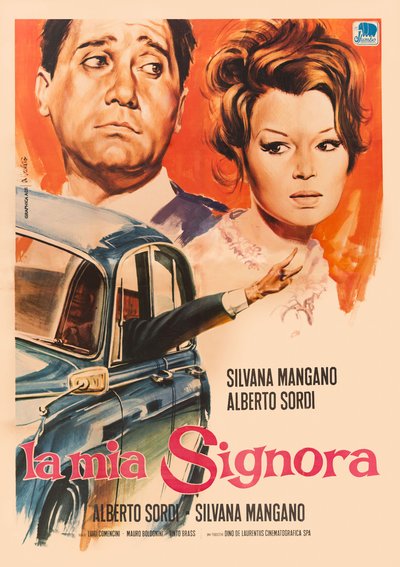
The poster for My Wife brings the faces of the two stars out of a vivid orange ground: Alberto Sordi, eyes turned upward somewhere between worry and resignation, and Silvana Mangano, elegant and unruffled. Below them a blue car cuts diagonally across the scene, a man's arm extending from the window in an eloquent gesture. The two-tier composition, faces above and action below, captures at a glance the dynamics between the couple in this anthology film, while the warm, almost monochrome ground gives the whole a graphic modernity in step with the most current design of the Sixties.
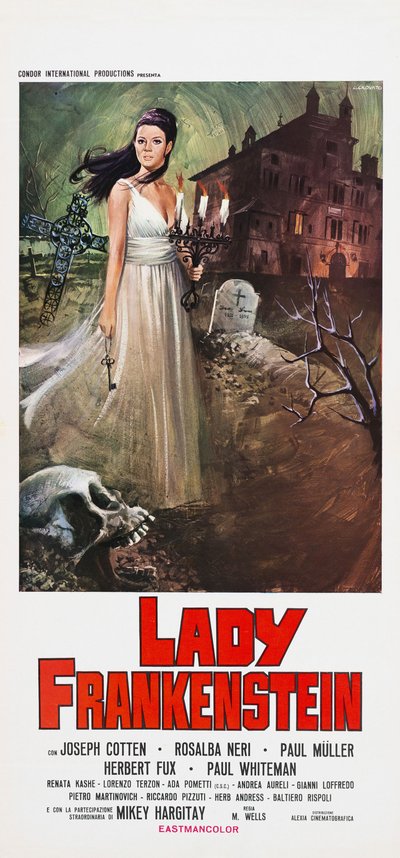
Lady Frankenstein (Mel Welles, 1971)
The locandina for Lady Frankenstein shows a young woman in a white gown advancing through a nocturnal cemetery, a candelabrum in one hand and her gaze fixed on the viewer, while behind her a gothic mansion with lit windows looms under a greenish sky. In the foreground a skull surfaces from the earth beside bare branches and a leaning cross. The image gathers the full repertoire of Italian gothic horror of those years, yet holds it together with precise chromatic direction, the white of the gown against the greens and browns of the ground, and with an almost storybook-cover sensibility that makes the scene instantly narrative.
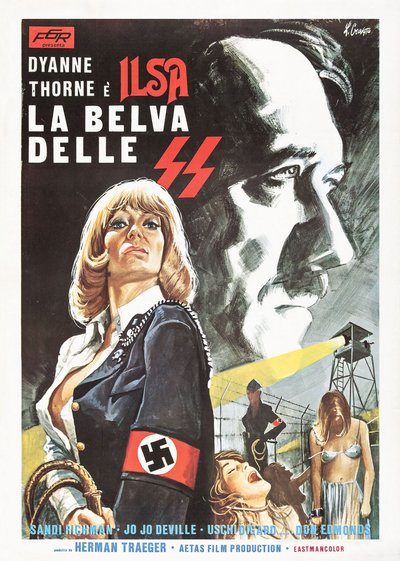
Ilsa, She Wolf of the SS (Don Edmonds, 1975)
The poster for Ilsa, She Wolf of the SS is one of the defining titles of the Seventies’ most extreme and controversial exploitation cycle, Nazisploitation: the protagonist, blonde and statuesque in a black uniform with a coiled whip in her fist, is seen from below and towers over the viewer with a gaze of icy superiority, while behind her an enormous male face in black and white surveys the scene like a shadow of History. On the right, the watchtower cuts the dark with a beam of yellow light above the barbed wire and the prisoners. The construction is that of a pulp cover carried to giant format, with the contrast between the coloured figure and the monochrome ground as its dramatic engine: a document, to be read today with a historian's eyes, of how far the consumer cinema of those years would go, and of how even its excesses passed through a painter's hand.
On the Other Side of the Camera
Here Crovato's story takes a direction all its own. From the mid-1970s the painter began appearing as a supporting actor in dozens of films: he can be spotted in Marco Bellocchio's Marcia trionfale (1976), in Tinto Brass's Action (1979), and even in Massimo Troisi's Ricomincio da tre (1981). His relationship with Brass continued on the painted front as well: the locandina for Miranda (1985) is attributed to him. In 1994 came the final step: Crovato co-directed the film Donna di cuori with the artist Lina Mangiacapre, and the following year directed Per favore, strozzate la cicogna on his own, as recorded in Roberto Poppi's Dizionario del cinema italiano. It is a trajectory with no known equivalent among Italy’s major poster artists.
Rediscovery: Rome, 1994
One documented episode captures the moment when Crovato's work began to be seen as art rather than mere advertising. On 16 March 1994 the Istituto Europeo di Design in Rome, under the scientific direction of Francesco Moschini, devoted an exhibition to him titled "Cinema e televisione in cornice", reviewed in the press of the time under an eloquent headline: the film industry in Crovato's drawings. The following year, in May 1995, the same institute presented a second exhibition, "Doppio gioco", pointedly billed under the name "Luciano Crovato, illustratore". They offer early evidence of the recognition of his work in a cultural and educational setting, at a time when film-poster art was still rarely considered beyond its advertising function.
Crovato among the Maestri Cartellonisti
Placing Crovato within the landscape of Italian cinema painters means recognising what made him distinctive. He does not have the monumental output of a Ciriello nor the long arc of a Gasparri, and compared with a Colizzi his path is less linear, crossed as it is by the detour into acting and directing. Yet precisely this double life makes him an especially valuable witness: an artist who knew the film set, the stars and the machinery of the industry not only through the stills that arrived at his studio, but from direct experience. The works preserved in the Movie.it archive, photographed from the original vintage prints, today show the full extent of this understated and surprising talent.
The works reproduced on this page come from the original prints of the period, recovered, photographed and digitally restored by Movie.it.