
Angelo Cesselon, Master of the Portrait and the Spell of Colour
Edited by Paolo Zelati, Editorial Director
June 17, 2026
In the postwar years, before they ever saw a film, Italians met its face on the walls of their cities. And often that face, Marilyn Monroe, James Dean, Ingrid Bergman, had been painted by Angelo Cesselon, built up with a thousand touches of colour and a few strokes of the palette knife. More than illustrating a plot, Cesselon captured a gaze, and into that gaze he put the entire film.
From the Veneto to Rome
Angelo Cesselon was born in Settimo di Cinto Caomaggiore, in the province of Venice, on 17 February 1922. He began painting very young in his home village, in the wake of late-19th-century Venetian painting: at the start his reference was not cinema but masters such as Giovanni Boldini and Ettore Tito, from whom he inherited the rapid brushstroke and the richness of colour. When the family moved to Rome, he discovered contemporary art in the city's many graphic studios. It was here that, around 1950, he became one of the founders of the informal group that history would remember as "I Cartellonisti Italiani": some thirty artists who, gathering in Rome almost by chance, would go on to sign the finest film posters of the postwar era. His technique was tempera on paper, quick and luminous.
The Face Instead of the Story
This was his small revolution. The posters of the early twentieth century broke the scene into many descriptive panels that told the plot. Cesselon did the opposite: he chose the salient moment and entrusted it almost entirely to the faces of the protagonists and a few telling objects. A single detail of a look or a mouth was enough to evoke the mood of the film and send audiences off to dream. He built his figures with a thousand touches, from browns to greens, from vermilion reds to blues and his beloved fuchsia, combined with a boldness we would now call pop: a style suspended between figuration and Pop Art.
Reproduced in their thousands, his posters brought art directly onto the streets, making it accessible to all. Yet, while a democratic appeal was already the defining hallmark of titans like Ballester, Martinati and Capitani, Cesselon took this a step further. His sharp visual shorthand and audacious palette single-handedly paved the way for modern Italian poster art. It marked the dawn of a new mass iconography, one that shared a distant dialogue with Andy Warhol’s Pop Art, and closely mirrored the trajectory of Mimmo Rotella, who would soon harvest those very same posters from the walls of Rome to forge the avant-garde.
Directors, film studios and distributors courted him. The studios used the printed reproduction for the theatres, while the original was a true tempera painting in its own right. Many of those sketches, however, stayed behind at the printer's: the poster artists worked at such a pace that they often did not bother to go back and reclaim them.
The Stars
It was above all his female portraits that made him famous, to the point of being considered the foremost portraitist of international cinema. Through his brush passed the Marilyn Monroe of Don't Bother to Knock and The Asphalt Jungle, the sensual Ava Gardner of Pandora, the lively Gina Lollobrigida of Woman of Rome, in close-up against a background peopled with other faces, and of Fast and Sexy, the enigmatic Lucia Bosè of Antonioni's first films, the Alida Valli of The Third Man, the Ingrid Bergman of Notorious. Built with soft, blended touches, those faces became the symbol of a new postwar idea of femininity, elegant and fragile at once. For each of them a few recurring elements were enough, a bare shoulder, a glove, a sidelong glance, that became almost his signature. Yet he did not stop at beauty alone: in posters such as The Chapman Report, Acid (Delirio dei sensi) or Parrish he probed female psychology and sensuality, now with the impasto of the palette knife, now with delicate arabesques and luminous chromatic harmonies. The male portrait suited him just as well, but with a different mark: more nervous, detached touches of brush and knife, warmer colours. You can sense it in the intense Paul Newman of The Left Handed Gun or in the determined faces of Gary Cooper and Burt Lancaster for Vera Cruz, rendered in rapid, almost impressionist touches that convey the tension of the showdown.
From Cinecittà to Hollywood
His hand knew no boundary of genre or language. For Italian cinema, posters such as Friends for Life by Franco Rossi and the Gastone directed by Mario Bonnard and starring Alberto Sordi.
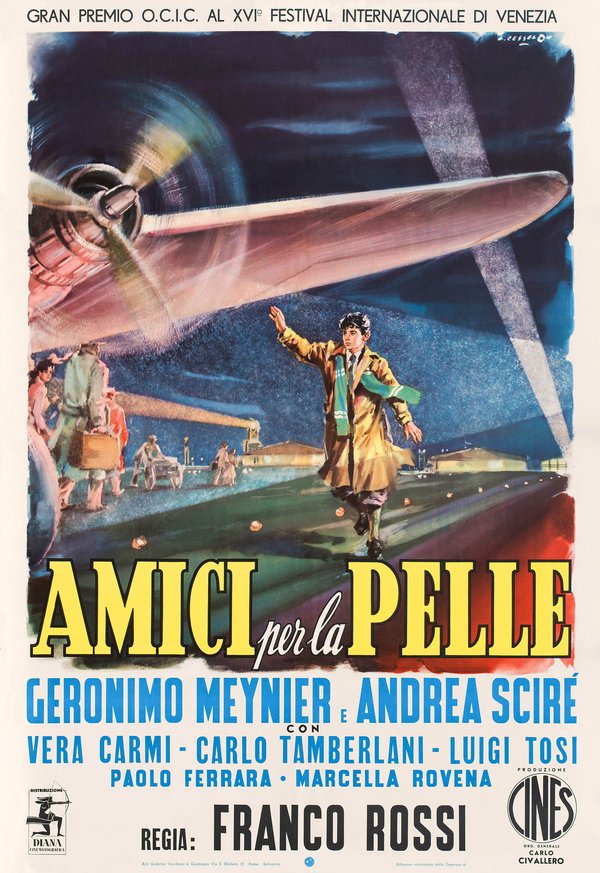
Friends for Life (Franco Rossi, 1955)
Cesselon builds the poster on emptiness: a small figure low on the sheet, dwarfed by the huge diagonal of the propeller and an almost monochrome blue field. By renouncing bright colour and using raking, watercolour-like light, he turns the negative space into the true subject. The whole weight rests on a single accent of figure, a rare exercise in restraint for the period.
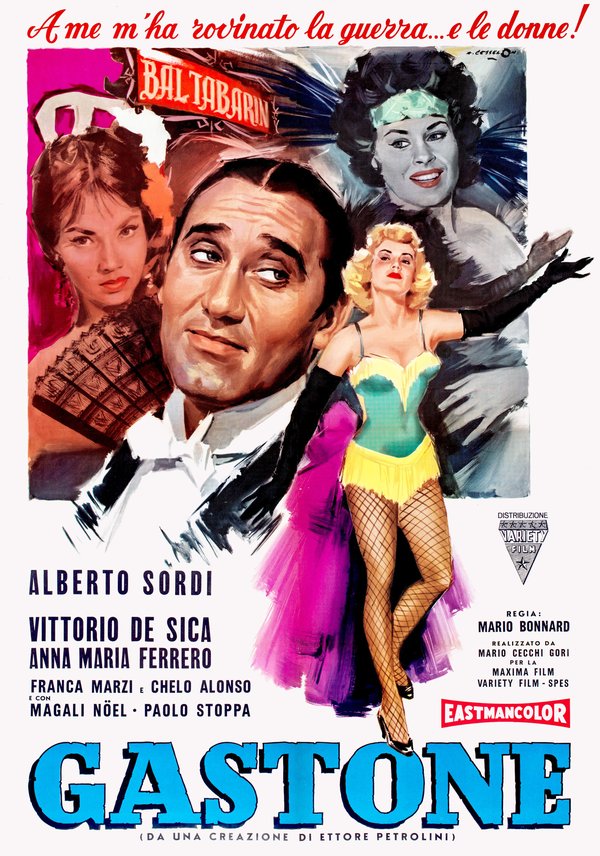
Gastone (Alberto Sordi, 1960)
The poster is a montage of faces orchestrated around a central head, in the panelled manner dear to poster art, yet held together by colour. Cesselon works the central face in nervous touches of brush and palette knife, while the figures at the sides are laid in with bright, flat fields. The chromatic contrast, sober at the centre and vivid at the edges, becomes an expressive device in itself.
For the great foreign films arriving in Italy he signed some of the finest posters of the era: George Stevens's Giant, Alfred Hitchcock's Spellbound, and the "locandina" (Italian small format) of William Wyler's Wuthering Heights. It was often companies like Globe Films International, which imported the art-house titles, that chose his images.
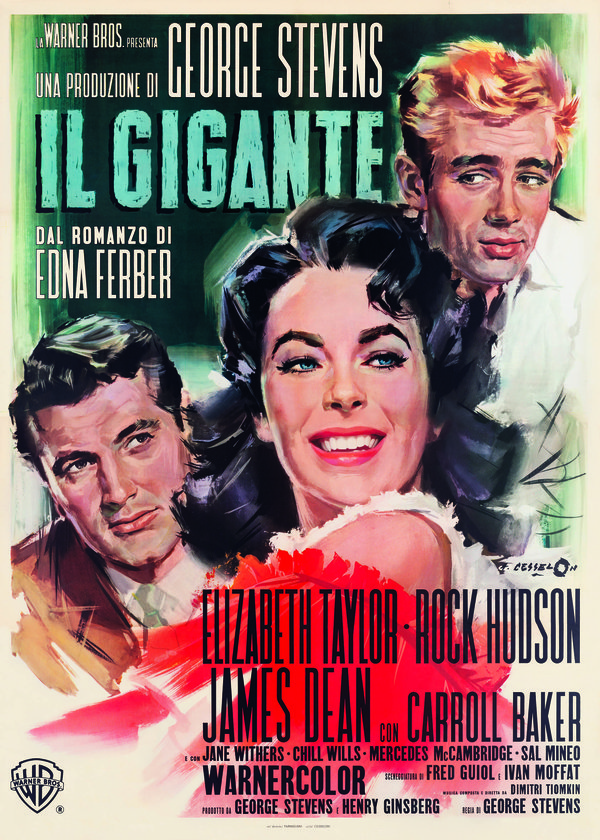
Giant (George Stevens, 1956)
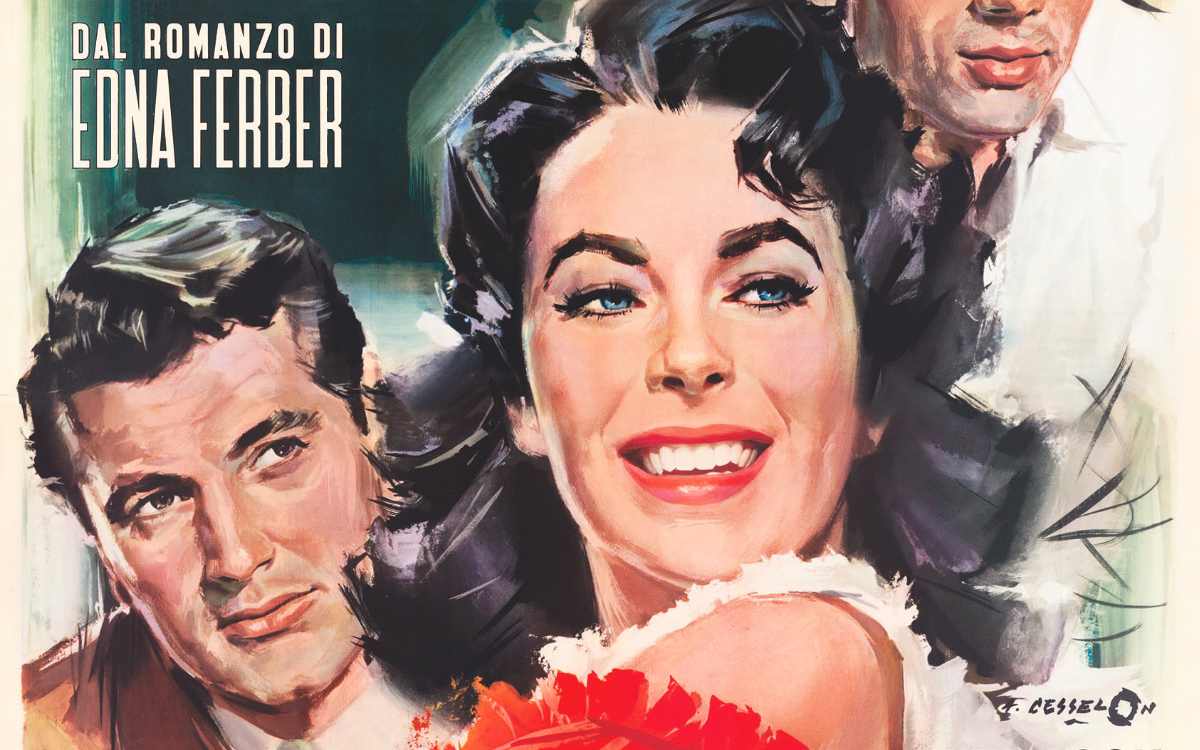
Here Cesselon drops every scene and reduces the poster to three heads set on a diagonal, against a raw ground shifting from green to red. Rapid brushstrokes and bare, visible paint give the faces the freshness of a life drawing.
The hierarchy lies entirely in scale and light: no narrative, only presences.
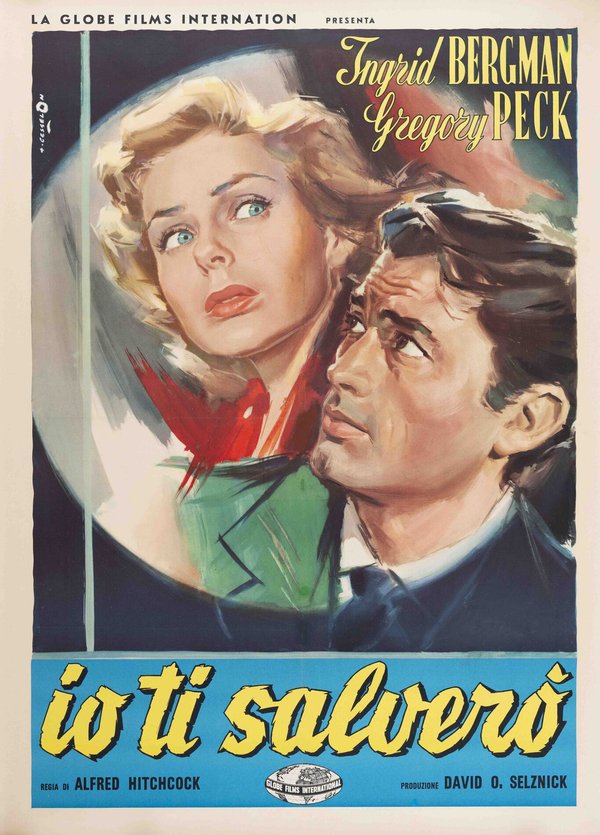
Spellbound (Alfred Hitchcock, 1945)
The graphic idea is pure synthesis: two faces enclosed in a single oval of light that acts as a lens, against a dark ground that isolates and dramatises them. The soft modelling and the economy of elements throw everything onto the play of gazes. Cesselon shows that a poster needs only a face and a direction of looking to build tension.
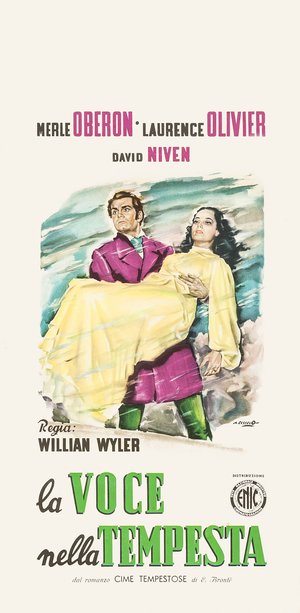
Wuthering Heights (William Wyler, 1939)
In this locandina the vertical format concentrates the eye on a single core: a group of figures that seems to surface from a whirl of brushwork. The greens and yellows, laid down in rapid, almost abstract gestures, work more as a metaphor of wind and passion than as description. It is a fine example of how Cesselon made the painted matter itself the real subject.
Prizes, Presidents and Saints
Recognition came early: In 1955 he received the Spiga Cambellotti prize as the year's best Italian film-poster painter; in 1958 he was recognised as the best international portraitist. From there his fame as a portraitist reached beyond cinema. He was asked to paint figures such as President of the Republic Giovanni Gronchi, and then Pope John XXIII and Pope John Paul II. In his final years he painted above all large portraits of saints and founders of religious orders, from Saint Francis of Assisi to Maximilian Kolbe, still kept today in churches and convents. One exhibition summed up this double world with a perfect title: "From Francis to Marilyn."
The Legacy
In 1975 Cesselon retired to Velletri, where he went on painting at a calmer pace, alongside his wife and lifelong companion, Lina Forte. Illness drew him away from work at the end of the 1980s, and he died on 26 September 1992. Of the roughly three thousand sketches he is reckoned to have made, a great many are lost: what remains is kept by the Archivio Cesselon, curated by his daughter Alessandra, an art historian, while other works are held in the film archives of Turin, Bologna and Milan, in the Vatican, and even at the Carabinieri General Command in Rome. But his true legacy is hundreds of faces: the ones that taught a whole generation to dream by looking at a wall.
The works reproduced on this page come from the original prints of the period, recovered, photographed and digitally restored by Movie.it.