Averardo Ciriello, Master of Italian Movie Posters
By Movie.it Editorial Team
May 28, 2026
Averardo Ciriello (Milan, 28 May 1918 – Rome, 5 November 2016) was one of the greatest poster painters in the history of cinema. In a career spanning almost seventy years he produced around three thousand sketches for the Italian and international markets. Today, on his birthday, is the right moment to tell the story of his life, his works and a talent that remained in the shadows for far too long.
Biography: from the Castello Sforzesco School of Art to the Navy
Ciriello grew up in Milan and trained at the Art School of the Castello Sforzesco, in an environment that prized rigorous draughtsmanship and the applied arts. It was a technical grounding that would remain visible throughout his career: even in his most commercial works, the anatomical and compositional control is of almost academic precision.
In Milan he soon began working in advertising, first at the Non Plus Ultra agency, then at IMA, the largest advertising agency in Italy. With the outbreak of the Second World War his path changed abruptly: he enlisted in the Navy, where he remained for five years. When the military discovered his graphic gifts, he was assigned to the Press and Propaganda Office as an illustrator for the official journal of the Italian Navy. This experience, far from any art school, proved fundamental: it developed in him an extraordinary speed of execution and the ability to communicate instantly through the image, two qualities that would later become hallmarks of his film posters.
The post-war years and the rise in popular illustration
It was precisely in the Navy that he met journalist Vittorio Calvino, who introduced him to the world of cinema. Meanwhile, his name began to spread rapidly through the Italian popular illustration circuit. He debuted as a cartoonist for the weekly AAcqua salata and in 1945 joined the pages of Cino Del Duca's Intrepido. These were years when illustration was a genuine cultural industry, and Ciriello became one of its most recognisable figures.
His great popular success came with the alluring pin-up covers of the magazine 7Sette (later Otto and Otto volante), which turned him into the true heir of Gino Boccasile, the most celebrated Italian illustrator of female figures in the twentieth century. The comparison is flattering but not entirely accurate: compared to Boccasile, Ciriello's line was generally softer and more cinematic, less geometric and propagandistic. His women did not pose, they lived inside the image.
However, the drawings for 7Sette provoked the fury of the era's strict censors, to the point that the magazine was forced to close, only to be reborn under the title 8otto. During the 1950s he also created vignettes and covers for Marc'Aurelio and La Domenica del Corriere, two of the most widely read publications in Italy.
The film career: three thousand posters for the silver screen
Ciriello signed his first contract for works chosen by the publicity office of Lux Film around 1947. Over the course of his career he produced around three thousand sketches for both the Italian and the foreign markets.
Three thousand. This is not an abstract number: it is a constant, almost industrial output, demanding speed without ever sacrificing quality. Colleagues and collaborators recalled his ability to complete covers and film sketches in surprisingly short periods of time, a direct legacy of his years in military propaganda. His distinctive painterly style was characterised by the use of colour for symbolic and strongly emotional effect, with a meticulous attention to detail and nuance that was uncommon in film illustration of the period.
Unlike other, more expressionist poster artists, Ciriello always kept a strong bond with figurative realism. His faces are built with almost academic care, often derived from close photographic study of the actors. In the posters devoted to actresses there emerges a particular sensitivity in the rendering of skin, gazes and fabrics, a painterly quality that makes his works admired well beyond the world of cinema. He also worked on retouching production stills: but he interpreted them. He brought them to a higher emotional temperature.
The James Bond posters: Ciriello draws the world's most famous secret agent
One of the most fascinating chapters of his production concerns the 007 saga. In the 1960s he created Italian poster artwork for some of the earliest Bond films starring Sean Connery, including Dr. No (1962), From Russia with Love (1963), Goldfinger (1964) and Thunderball (1965). He also created the celebrated collective poster Tutti contro James Bond for the 1972 film festival, a rare piece keenly sought by collectors all over the world.
His most celebrated works: four posters to know
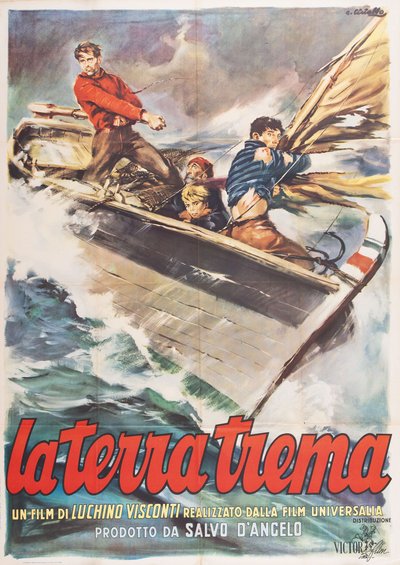
La terra trema - Luchino Visconti (1948).
A raw, demanding neorealist film with no stars to portray. Ciriello responds with pure pictorial dynamism: men on a boat in a storm, waves, foam, the red of the title cutting through the scene like a cry. Popular without betraying the seriousness of the subject.
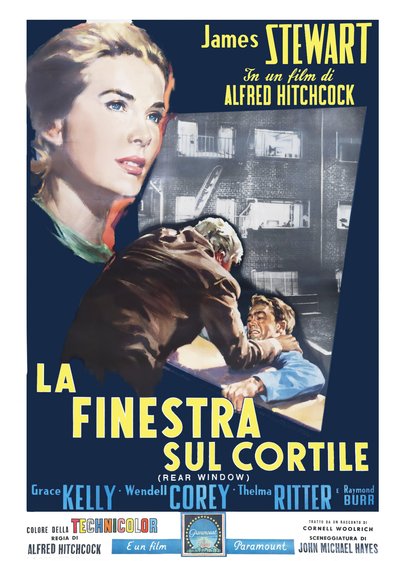
Rear Window – Alfred Hitchcock (1954)
The poster that best reveals his compositional intelligence. At the top, Grace Kelly's luminous face, suspended in the darkness like a promise. Below, James Stewart motionless and the threatening silhouette in the opposite window. Two contrasting emotional registers in perfect balance. Ciriello does not illustrate the plot, he captures its psychological atmosphere.
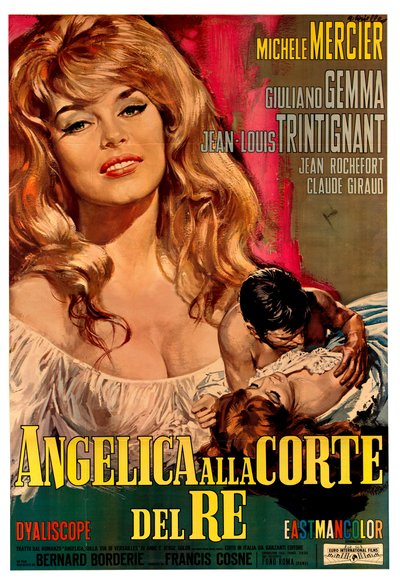
Angelique and the King - Bernard Borderie (1966)
The poster is a triumph of his celebrated sensitivity for skin, gazes and fabrics: Michèle Mercier fills the sheet with her tousled auburn mane and the white chemise slipped from her shoulders, the direct gaze of a woman who asks no one's permission, while below a small alcove scene tells the rest. The background of pink and grey brushstrokes brings the portrait to life without stealing anything from it. It is the living proof of the comparison with Boccasile: Ciriello's women do not pose, they live inside the image.
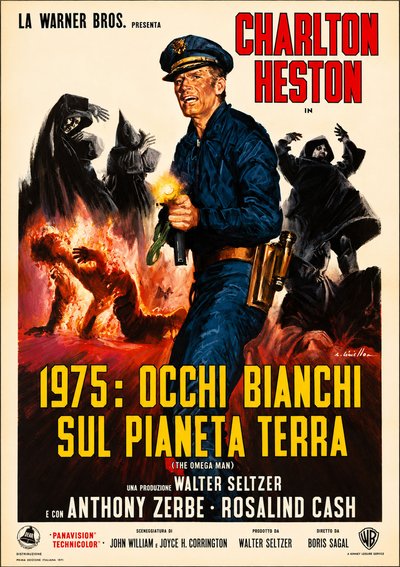
The Omega Man - Boris Sagal (1971)
The poster shows what Ciriello could do with science fiction: Charlton Heston in a blue suit advances, shooting, the yellow flame at the mouth of the weapon, surrounded by hooded figures in black tunics with ghostly eyes, while on the left a sickly pink fire illuminates crawling bodies. The symbolic function of colour that his scholars talk about is all here: the apocalypse rendered with a feverish palette, the dynamism of the composition that pushes the hero off the page. Proof that he mastered every visual register, from neorealism to fantasy.
A professional of the image, not an elite artist
He moved in the circles of the great post-war Italian poster designers, coming into contact with Alessandro Biffignandi, Fernando Carcupino, Carlo Jacono and Enzo Sciotti.
Although they belonged to different generations and had different sensibilities, these artists shared studios, publishers, markets and artisanal techniques linked to the great tradition of Italian illustration. It was an extremely competitive world, where the pressure to produce was very high and specialised printing houses, communication companies and the advertising offices of film distributors competed for the works of the best talents.
Ciriello saw himself first of all as a professional of the image at the service of the public, not as an elite artist. This almost artisanal conception of the trade is exactly what makes him great: he knew that the poster displayed outside the cinema was often the first and only contact a viewer had with a film before buying a ticket. There were no trailers, no clips, no instant reviews. There was that image, there, on a wall. And it had to be enough.
Ciriello worked in publishing even after he gave up his work as a poster designer, lending his pencil to the erotic-satirical magazine Menelik, published by Tattilo, a famous publishing house known for publishing Playmen. His involvement in the erotic comics of the 1960s and 1970s was for a long time one of the reasons for his critical underestimation, a genre viewed with suspicion by the cultural intelligentsia, but which reached millions of readers.
Reappraisal and the collectors' market
Rediscovery came late, but decisively. Original period prints of Ciriello’s posters now form part of an important international collectors’ market, with particularly rare examples achieving substantial prices at major specialist auctions.
Ciriello died in Rome on 5 November 2016, at the age of 98. Almost a century of life, almost seventy years of career. His posters, born to last a few days on a wall, have been preserved thanks to the many collectors and lovers of art and cinema.
The works reproduced on this page come from the original prints of the period, recovered, photographed and digitally restored by Movie.it.