
Renato Fratini, Striking Balances of Intense Color and Painterly Harmony
By Movie.it Editorial Staff
July 27, 2026
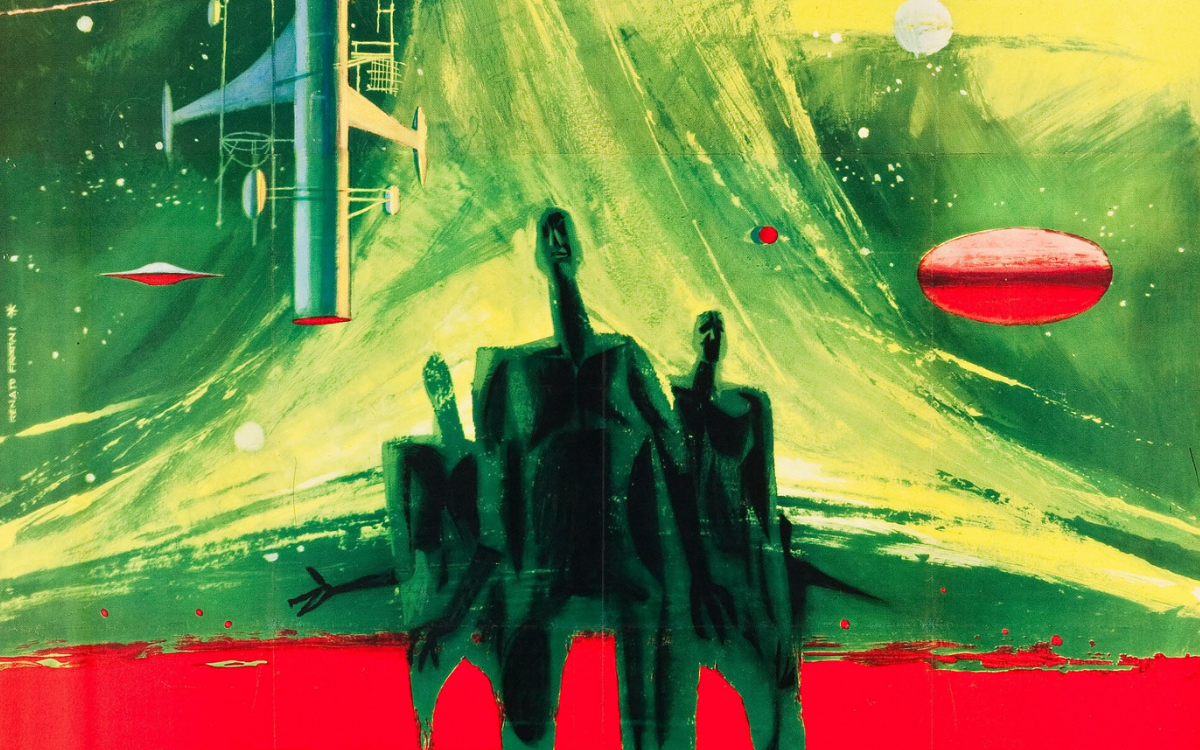
Some cinema painters can be recognized by a single detail, others by a chord of colors. Renato Fratini belongs to the second family: his intense hues, boldly juxtaposed yet always harmonious, stand out at a glance on any wall. Born in Rome in 1932, he lived a short but intense life, driven by a talent that ranged freely from figurative language to the suggestions of abstract art. In little more than twenty years of activity he left a deep mark on two schools at once, the Italian film poster tradition and British advertising illustration, a double achievement no other cartellonista of his generation can claim.
From the Academy in Rome to Studio Favalli
Fratini's training was that of a classically educated painter: studies at the Academy of Fine Arts in Rome, drawing from life, a full command of anatomy and composition. In 1952, barely twenty years old, he joined Studio Favalli, one of the great forges of Roman poster painting, and immediately stood out for his gifts. In those years the studio was a crossroads of talent through which future masters would pass, among them a very young Renato Casaro. As always in these workshops, the works were created independently: each image remained the creation of its specific Author, and the distribution companies then selected them to accompany the films' theatrical releases.
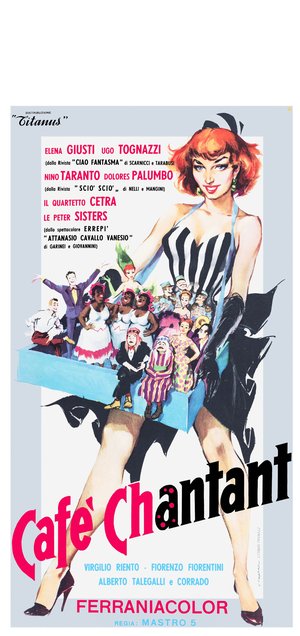
Cafè chantant (Camillo Mastrocinque 1953)
The "locandina" (Italian small format) for Cafè chantant is a witty invention: Fratini condenses the whole world of variety theatre and avanspettacolo into a single image, with the full-length soubrette holding up the whole cast like a tray, each rendered as a miniature portrait somewhere between affectionate caricature and brilliant portraiture. The red of her hair and the black and white of her bodice light up the composition with the elegance of a fashion plate.
From Milan to London: The Italian Who Taught the British
At the end of the 1950s Fratini moved to Milan, and there his story took a turn without parallel among his colleagues. He met Eric Pulford, head of the London agency Downton Advertising, who was struck by his work and persuaded him to settle in England, where Fratini remained until the 1970s, becoming one of the most sought-after illustrators in British cinema. It is the anecdote that best captures his stature: a Roman painter called to London not to learn, but to teach the British how cinema is painted. Among the fruits of that partnership is one of his most iconic works, the poster for From Russia with Love: the secret agent's pose, arms crossed and pistol in hand, has become a timeless symbol of the spy genre, imitated for decades.
The Style: Abstraction and Realism in a Single Glance
Fratini handled color with absolute confidence. His mature style rests on intense hues and daring pairings that never slip into discord: every contrast generates a poetic emotion. He often built abstract structures as the compositional skeleton of an image, and within that framework he developed scenes of full naturalism: a fusion of abstraction and realism that produced an original, intellectually refined language. Another hallmark is the dialogue between flat backgrounds and central figures modeled in three-dimensional volume, from which vibrant, dynamic atmospheres arise. It can be seen in the modern, graphic line of White Nights, or in Paths of Glory, where Kirk Douglas's fragmented face stands against a red and blue ground of expressionist intensity. And it can be seen in the painting for Nanà, closer to easel art than to the poster: a sensual, ironic female figure recalling Goya's Maja vestida and the beguiling women of Salvatore Fiume, with touches that even wink at comic-strip art.
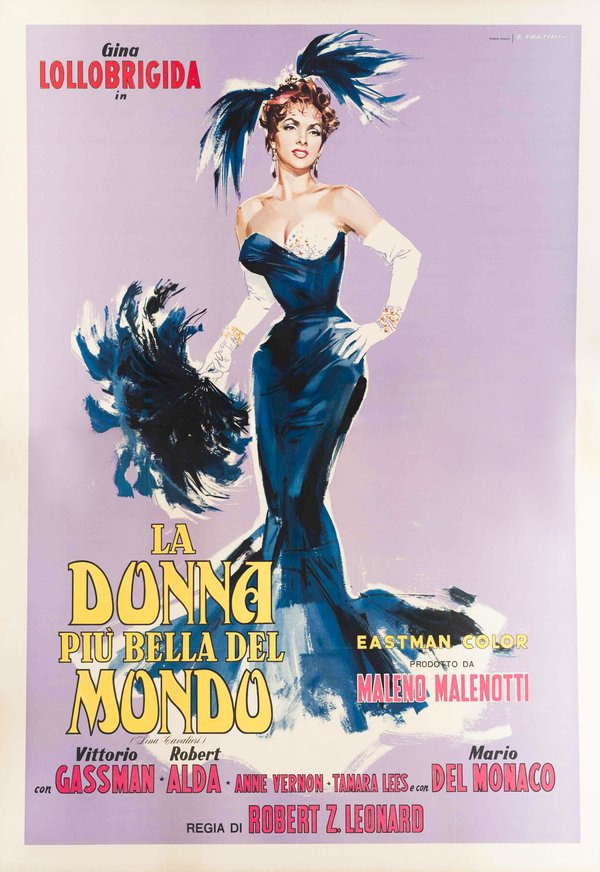
Beautiful but Dangerous (Robert Z. Leonard, 1955)
The poster for Beautiful but Dangerous. Gina Lollobrigida, in the role of Lina Cavalieri, commands the lilac ground like a figure from a couture sketchbook: the blue feathers of her headdress and fan explode in free, almost abstract brushstrokes, while the face remains a perfect likeness. It is the definitive statement of the Fratini style: rigor in the portrait, freedom in the paint.
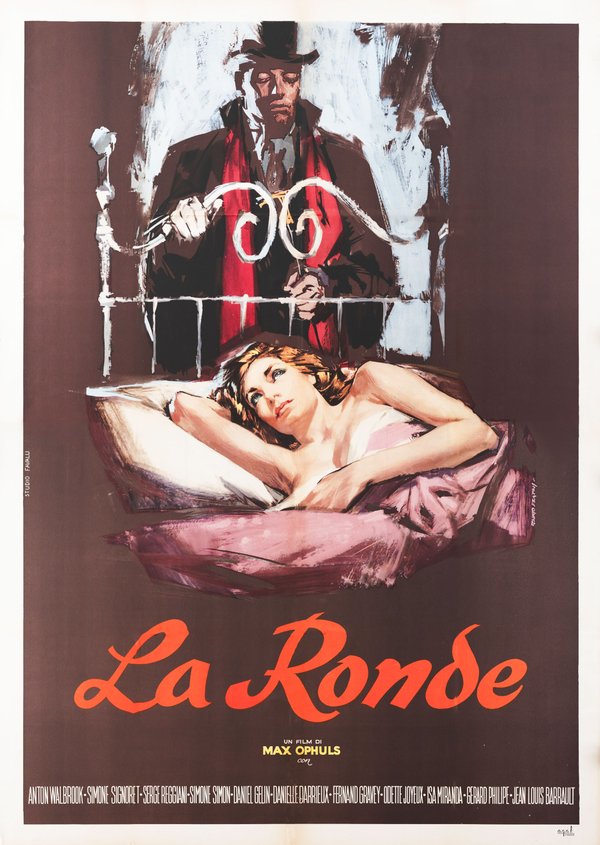
La ronde (Max Ophuls, 1950)
The poster for La ronde, created for the film's Italian release. Against a dark brown ground, the man in the top hat looms like an apparition behind the bed frame, sketched in nervous strokes of white and red, while the reclining woman in the foreground is modeled with warm softness. Two painterly registers in a single image, to convey the film's uneasy elegance.
A Masterpiece for Visconti and a Career Cut Short
Of remarkable beauty is the poster for Luchino Visconti's Senso, where all of Fratini's lessons converge in a single stroke: against a dramatic red ground the characters emerge in brilliant, shimmering colors that capture the full emotional force of the story. A brilliant artist with a passion for fashionable society, Fratini died prematurely in 1973, at only forty-one. His visual legacy is still recognized and admired on both sides of the Channel.
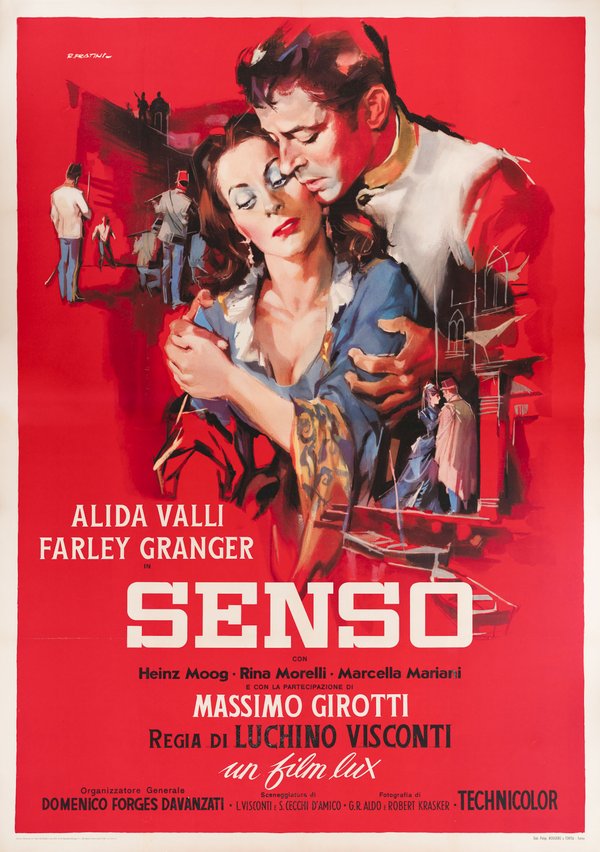
Senso (Luchino Visconti, 1954)
The poster for Senso: the embrace of Alida Valli and Farley Granger dominates a field of total red that is melodrama itself; around them, Venice and the war surface in rapid touches, like passing thoughts. The shimmering colors of the blue dress and the uniform make the couple vibrate against the flat ground: the balance of figure and abstraction that makes Fratini unmistakable.
Fratini and the Master Poster Painters
In the landscape of cinema painters, Renato Fratini is the bridge between the Roman school and international illustration. Trained in the same Favalli forge through which Renato Casaro passed, he shares with Angelo Cesselon the craft of the star portrait and anticipates, with his modern graphic line, solutions that Sandro Symeoni would push to their furthest consequences. His story proves, once again, that Italian painted cinema was no local phenomenon: it was a school the world came looking for.
The works reproduced on this page come from the original prints of the period, recovered, photographed and digitally restored by Movie.it.