
King Vidor: Horizon and Soul
By the Movie.it Editorial Team
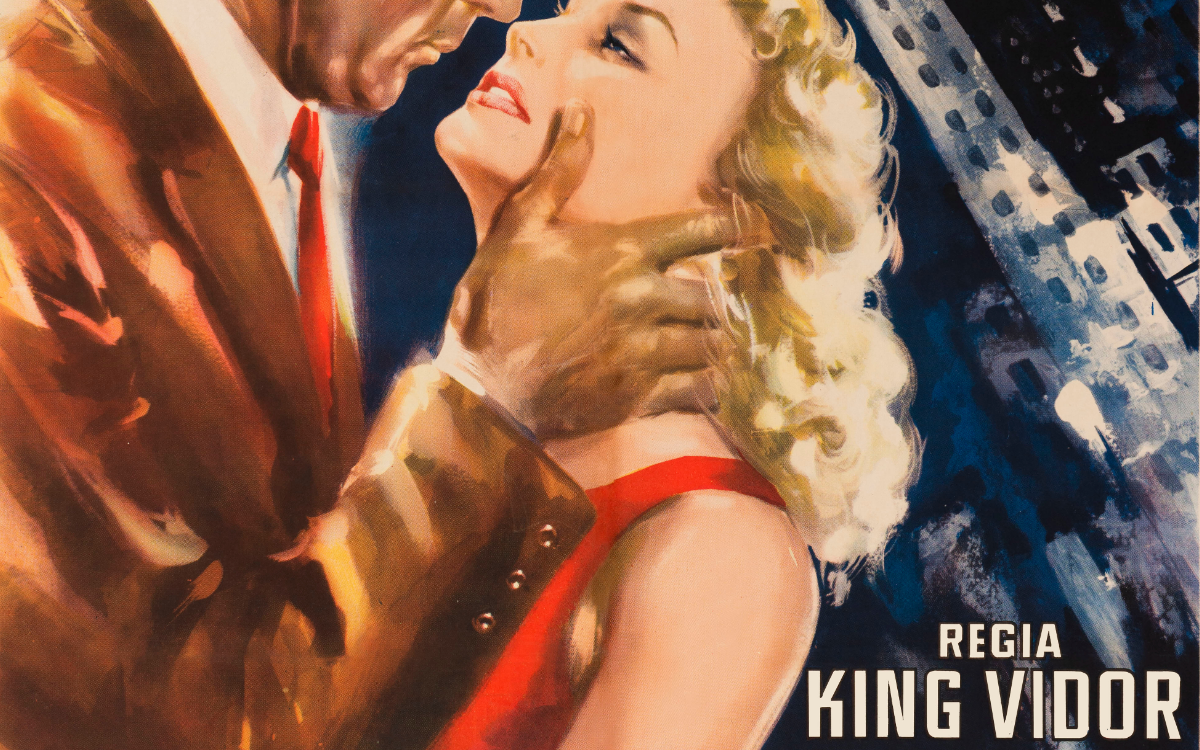
October 22, 2026
When King Vidor was six, a hurricane devastated his hometown. In the decades that followed, he returned again and again to men and women confronting forces beyond their control: nature, the crowd, the city, history. The Italian artists who painted posters for his films sometimes brought those anxieties into focus in unexpected ways. Looking at their work, we may glimpse aspects of Vidor that the films’ plots alone cannot reveal.
The Man Who Measured the Crowd
King Wallis Vidor was born in Galveston, Texas, on 8 February 1894. In September 1900, the deadliest hurricane in American history devastated the city. He spent the night sheltering in a friend’s house with his family and dozens of strangers. We cannot say how profoundly that experience shaped his art. Yet it is difficult not to recall it when his characters struggle against the elements, or try to find their place in a world seemingly too vast to master.
In 1915, after making a handful of short films, Vidor left for Hollywood, where he worked for nearly half a century, much of it at MGM. The Big Parade (1925) became one of the silent era’s great box-office successes. In The Crowd (1928), an ordinary man is all but swallowed by the modern metropolis. Vidor moved restlessly among melodrama, Westerns, comedy and historical epic. Nominated five times for the Academy Award for Best Director, he received an honorary Oscar in 1979. He died in Paso Robles, California, on 1 November 1982. Beneath the extraordinary variety of his work lies a recurring question: how much freedom can an individual retain in a world that threatens to overwhelm him?
Vidor and American Painting
Vidor’s films occasionally invite comparison with American painting of the same period: the muscular landscapes of Thomas Hart Benton, the industrial geometries of Charles Sheeler, the stillness of Grant Wood’s rural scenes. Such parallels do not imply direct influence, still less that the Italian poster painters were followers of these artists. Rather, they suggest a shared way of seeing that crosses boundaries of geography and medium.
In the Italian posters, from Longi to Ciriello, spectacle is still part of the appeal. Yet at times another story comes through: the loneliness of open space, the struggle to remain an individual in a crowd, the fragile freedom of people caught up in history.
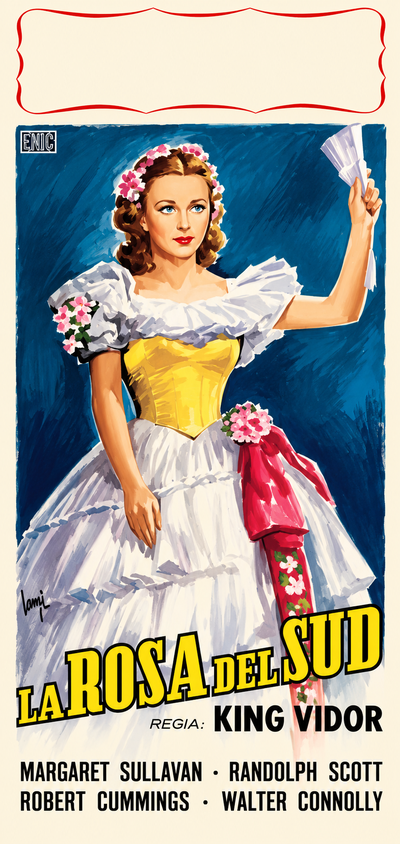
So Red the Rose (1935): The War That Isn’t There
So Red the Rose was presented as a Civil War melodrama. Yet Vidor is concerned less with battle than with what war takes away: the security of home, the bonds of family, the assumption that life will continue as before. Carloantonio Longi sets Margaret Sullavan, playing Valette, alone against a deep nocturnal blue. Her outstretched arm may be bidding farewell to someone departing; it might equally be reaching towards a world already slipping away. The painter evokes not the war itself, but the absence it leaves behind.
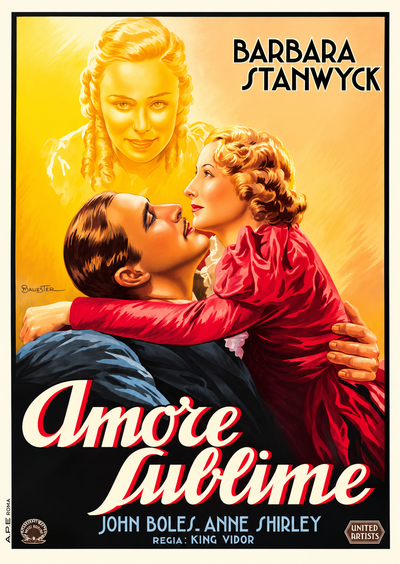
Stella Dallas (1937): The Sacrifice No One Sees
In Stella Dallas, Vidor turns melodrama into a question about the cost of maternal love: is it possible to love someone enough to renounce a place in their happiness? Anselmo Ballester senses that division. He sets Barbara Stanwyck’s flamboyant yet vulnerable Stella, in her red dress, against a face suspended in light. The poster anticipates the devastating restraint of the ending: watching her daughter’s wedding from outside in the rain, Stella gives the fullest expression to her love by remaining unseen.
Northwest Passage (1940): Into the Unknown
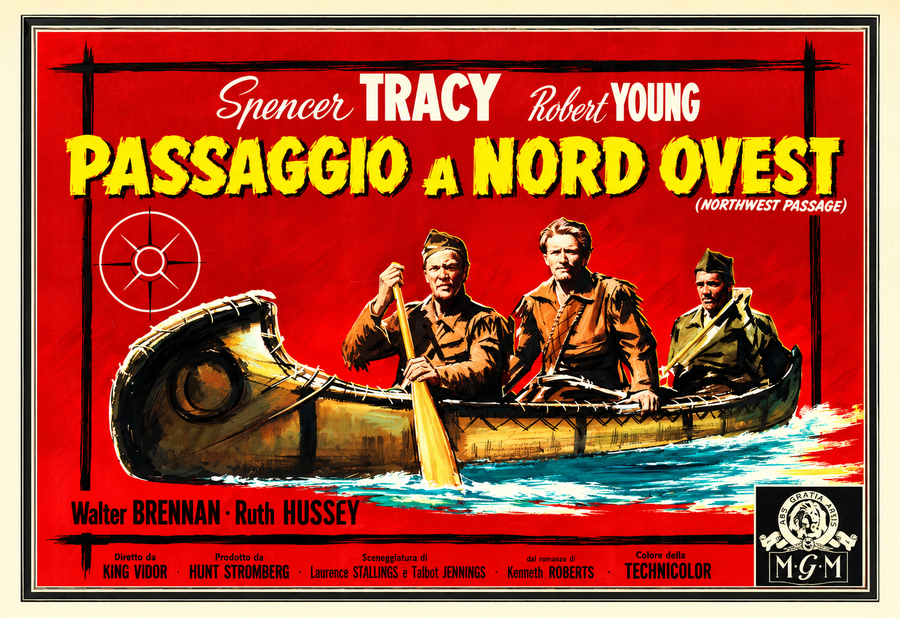
Vidor sends the rangers in Northwest Passage through mud, rivers and forests, determined to make adventure a physical experience. Silvano Campeggi, known as Nano, strips almost all of that away. Spencer Tracy’s Major Rogers, Robert Young and Walter Brennan occupy a canoe against an unbroken expanse of red. Without a landscape to orient them, they seem less like conquerors of the wilderness than men confronted with something they cannot control. In Vidor, courage seldom exists without a trace of fear.
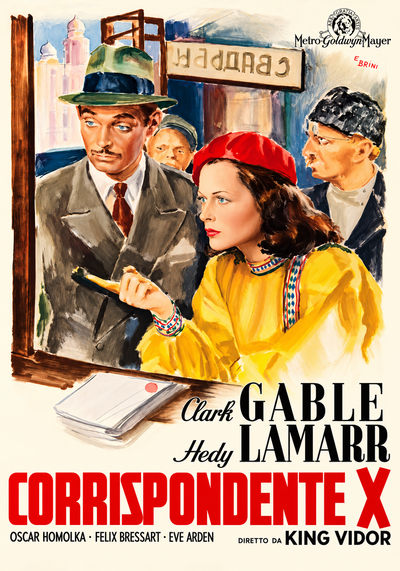
Comrade X (1940): Love Under Surveillance
When Comrade X reached Italian cinemas in 1949, it could readily be taken for an anti-Soviet satire. Ercole Brini’s poster offers a subtler reading. Through glass crossed by reversed Cyrillic letters, Clark Gable’s American reporter and Hedy Lamarr’s Moscow tram driver appear close to one another yet exposed to a world of scrutiny. Political comedy becomes a story about private life. Even in this lighter register, Vidor is alert to how difficult it can be to preserve a space of one’s own.
Duel in the Sun (1946): Nature Takes Centre Stage
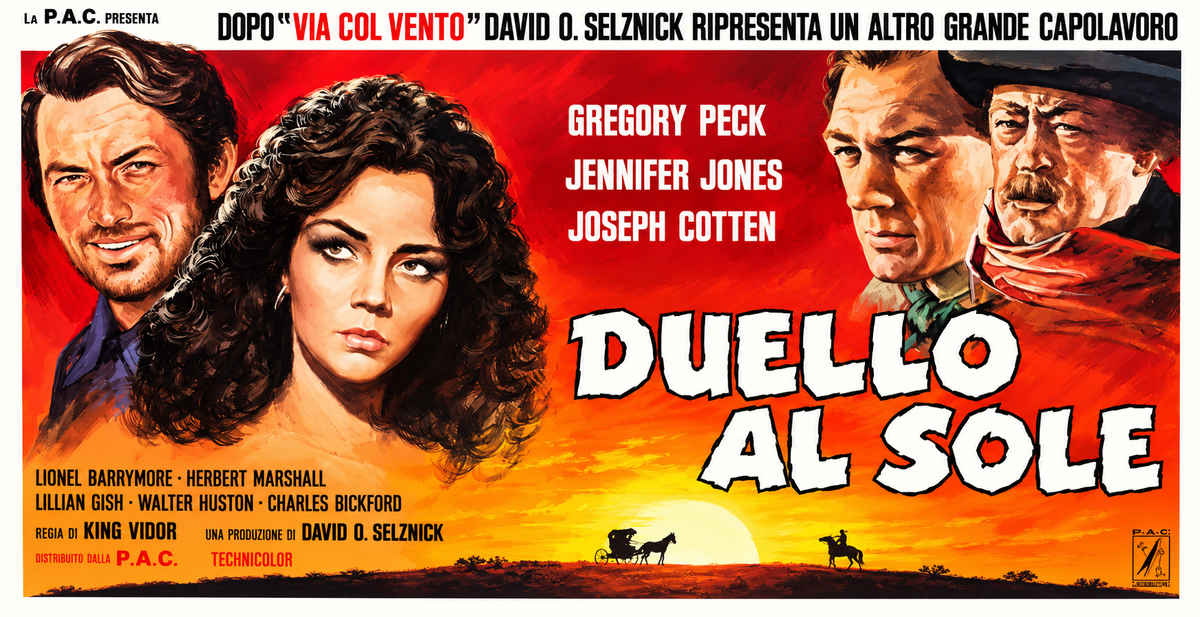
Duel in the Sun was marked by repeated interventions from its producer, David O. Selznick; Vidor left the production before filming was complete. Yet something unmistakably his remains: the landscape as an expression of passions that threaten to engulf the people caught within them. In an Italian poster by an unidentified artist, Jennifer Jones and Gregory Peck surrender the centre of the composition to a blazing sunset. Far from being mere spectacle, the image hints that Pearl and Lewt can no more master their fate than the land around them.
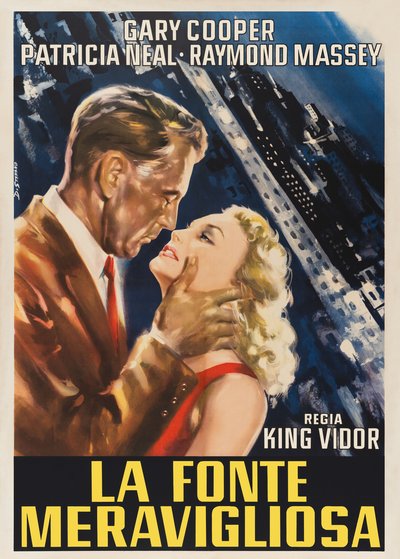
The Fountainhead (1949): The City Turned on Its Head
In The Crowd, the city threatens to swallow the ordinary man. Two decades later, The Fountainhead pursues almost the opposite vision: an individual determined to impose his own design upon the city. In Di Stefano’s poster, Gary Cooper and Patricia Neal, as the architect Howard Roark and Dominique Francon, rise above the skyscrapers in a sculptural embrace. The crisp geometries evoke the Precisionist paintings of Charles Sheeler, but their deeper significance lies in the reversal: what once diminished the individual now sustains his ambition.
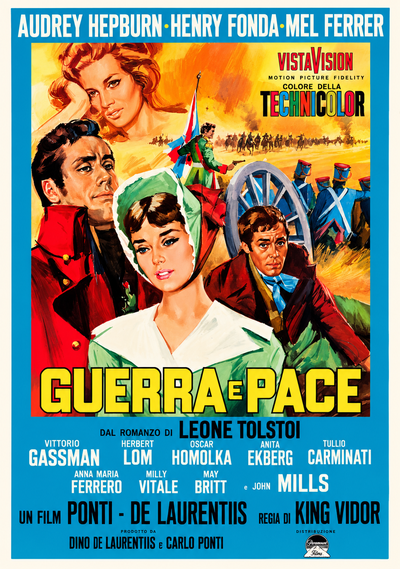
War and Peace (1956): History, One Face at a Time
Filmed at Cinecittà, War and Peace embraces the scale of Tolstoy’s novel without losing sight of individual lives. Averardo Ciriello arrives at a similar insight through painting: armies and cannon recede, while Audrey Hepburn’s Natasha holds our gaze. Vast historical upheavals acquire meaning through the experience of one person.
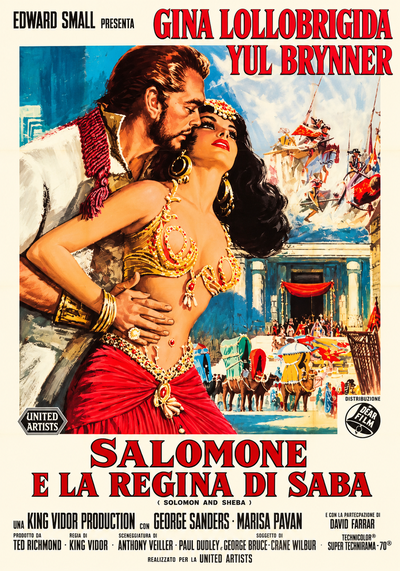
Solomon and Sheba (1959): The Final Feature
Vidor’s final feature was overshadowed by Tyrone Power’s death during filming and his replacement by Yul Brynner. In the Italian poster, by an unidentified artist, biblical grandeur gives way to the magnetic presence of Gina Lollobrigida’s Queen of Sheba. Rather than providing a tidy conclusion to Vidor’s career, the image draws us towards a tension at work in this final film too: desire, faith and power.
Coming Full Circle: Metaphor (1980)
In 1980, Vidor completed Metaphor, a short documentary about the painter Andrew Wyeth. Wyeth told him he had watched The Big Parade some 180 times, and acknowledged its profound influence on his paintings, among them Winter 1946. The encounter reverses the direction of our journey: having watched Italian painters interpret Vidor, we discover an American painter who carried Vidor’s images into his own work. Yet he did not simply reproduce them. A hillside associated with a soldier’s homecoming in the film became, in Wyeth’s painting, a landscape of memory and loss. The same image could give rise to entirely different meanings. That, perhaps, is the deepest reason to see cinema through the artists’ eyes.
The works reproduced on this page come from the original prints of the period, recovered, photographed and digitally restored by Movie.it.
You may also like

Anselmo Ballester, Master of the Italian Movie Poster

Ercole Brini, Master of the Watercolour Movie Poster