
Giovanni Di Stefano, the Painter of Movement
By the Movie.it Editorial Team
July 14, 2026
Some poster artists build their images like formal portraits; others conceive them as frames stolen from the action. Giovanni Di Stefano belongs unmistakably to the second family. His signature, a nervous cursive "G. Di Stefano", appears on works in which everything is caught mid-instant: a body floating in space, a general standing among the fallen with his pistol raised, a drawn sword before a masked face. Before being a painter of stars, Di Stefano is a painter of gesture and this quality, matured over years of illustrated covers for Italy's great popular weeklies, made him one of the most effective hands in adventure and genre posters between the Sixties and Seventies.
From Illustrated Covers to the Cinema
Giovanni Di Stefano was born in Rome on 24 March 1930. After finishing his studies in 1954, he began working the following year as an illustrator for history and news magazines and as a comics artist for boys' mystery series, collaborating with Studio Rosi. His true training ground, however, was the painted cover: for three years he was the cover painter of La Tribuna Illustrata, one of Italy's most popular illustrated weeklies, where every week a news story had to be condensed into a single dramatic, legible image. Collaborations followed with the historical magazine 7 anni di guerra (1959) and, over the years, with Cronaca, Polizia Moderna, Il Carabiniere and Cronaca Nera.
This background explains everything about his painted cinema. The news cover and the film poster obey the same law: stop the passer-by, tell a story at a glance, promise emotion. An artist who has learned to paint a chase or a rescue for the front page of a weekly arrives at the film poster already master of the trade.
The Illustrator Chosen for the Italian Releases
Between 1960 and 1980 Di Stefano became the illustrator chosen for the Italian releases of Italian and foreign production and distribution companies, among them United Artists, Delta Film and above all Metro Goldwyn Mayer, for which he painted several posters for the Italian market. Like all the masters of Italian film poster art, he works independently in his Roman studio, starting from the films' photographic materials to build new images conceived for Italian formats and audiences. Within the trade he is also known by the diminutive Nino.
His repertoire covers the full range of the period's genres: musical films with American stars, science fiction, westerns and swashbucklers, classic comedy revived in re-releases. This versatility was the very condition of the work, since distributors demanded a different image every week, one able to sell the film in seconds on the walls of Italian cities.
The Style: The Body in Action
Looking at his works, one constant trait emerges: the poster is built around a movement. Where other colleagues stake everything on the star's likeness, Di Stefano seeks the twist of a body, the suspended gesture, the diagonal crossing the sheet. The faces are accurate and carefully rendered, but it is action that commands the composition: his figures seem to be entering or leaving the scene, never posing. To this he adds warm, ringing colour, often built on a dominant ground, a yellow, a midnight blue, an orange, that acts as a sounding board for the figures. It is the lesson of the popular covers carried to the giant format of the wall: openly simple means, maximum emotional yield.
The Works
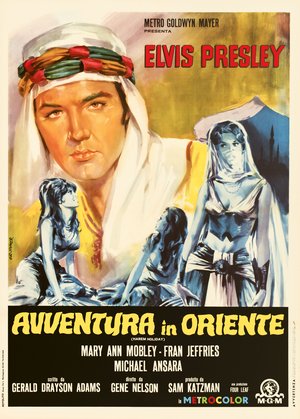
Harum Scarum (Gene Nelson, 1965)
The poster for Harum Scarum is dominated by the face of Elvis Presley wrapped in a white Arab headdress bound with coloured cords, his magnetic gaze fixed on the viewer. Around him, on a golden yellow ground, three veiled female figures emerge in a dreamlike blue monochrome, while at the upper right a tent and the minarets of an oriental city stand in silhouette. The contrast between the full-colour portrait of the star and the immaterial blue world of the harem women organises the reading of the image, with a chromatic direction that turns the poster into an exotic fantasy rather than a scene.
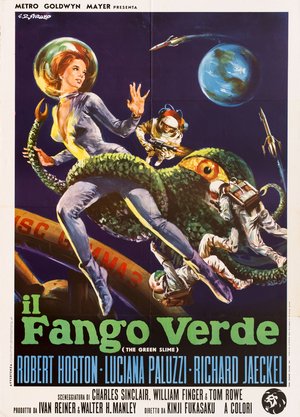
The Green Slime (Kinji Fukasaku, 1968)
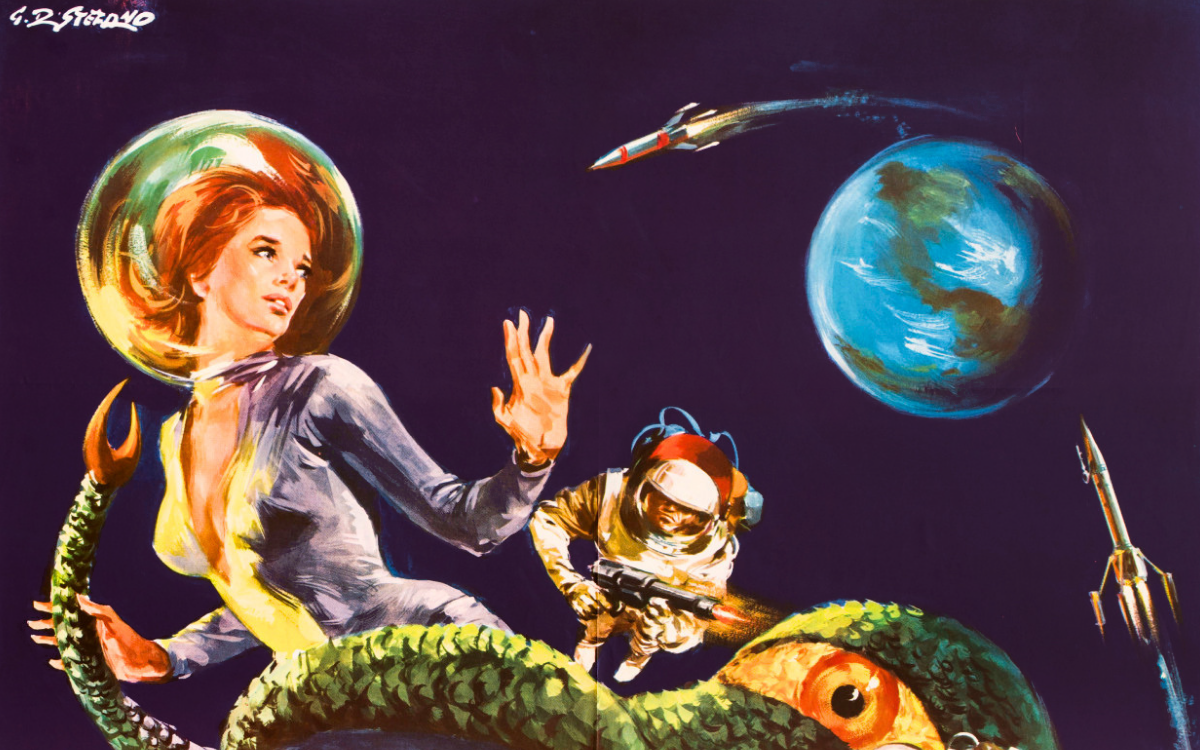
The poster for The Green Slime stages a woman in a silver spacesuit and bubble helmet, her red hair loose inside the transparent sphere, gripped by the scaly tentacle of a green creature from which a single yellow eye stares out. Around her, armed astronauts float in the deep blue of space, among flying rockets, the suspended Earth and the wheel of an orbiting station. It is a small handbook of painted science fiction: the monster, the heroine in peril, the cosmos as backdrop, all held together by a spiralling movement that keeps the eye circling inside the image without ever letting it rest.
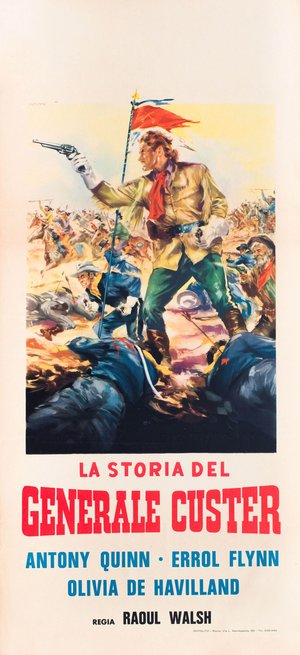
They Died with Their Boots On (Raoul Walsh, 1941)
The "locandina" (Italian small format) for They Died with Their Boots On portrays Errol Flynn standing on the last hill of Little Bighorn, in a pale buckskin jacket and red neckerchief, pistol raised beside the regimental flag, surrounded by the fallen in blue uniforms while on the horizon the charge of mounted warriors closes off every escape. The pyramidal composition, with the general at the apex and the bodies at its base, gives the scene the solemnity of history painting, and the yellow sky streaked with smoke ignites the epic tone of the whole.
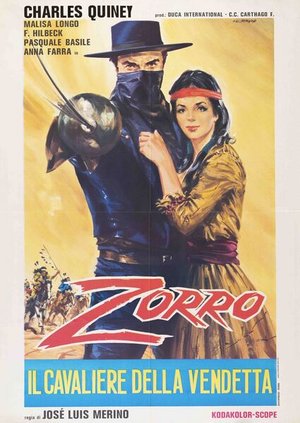
Zorro, Rider of Vengeance (José Luis Merino, 1971)
The poster for Zorro, Rider of Vengeance focuses on the hero, wide-brimmed black hat and face covered by a kerchief, his sword drawn diagonally across his chest, while a young woman with a red band in her hair clings to his arm seeking protection. On the bright yellow ground below, a patrol of riders gallops toward the title, slashed in red like a blade stroke. The contrast between the motionless couple and the tiny cavalcade in the background gives the scene depth, and the whole image lives on that outstretched sword cutting it in two.
The Painter of Via Margutta
Alongside cinema, Di Stefano has never abandoned easel painting and this second life has brought him documented recognition: first prize at the Primavera Romana trophy in 1980, first prize at La Sciara di Stromboli in 1986 and again in 1988, the year he also won the open-air painting competition Maggio a via dei Giubbonari. He is counted among the members of the Cento Pittori di via Margutta, the historic association that brings figurative art into the street of Rome's artists. His favourite subjects are the sea and its fishermen, galloping horses, mothers with children: once again bodies in motion, as on his posters. In September 2021 the Roman gallery Studio CiCo devoted an exhibition to him, presented by the art critic Mara Ferloni, which brought renewed attention to his career.
Di Stefano among the Maestri Cartellonisti
Within the landscape of Italian cinema painters, Di Stefano holds the territory of action and adventure with a recognisability that stands comparison with his most celebrated colleagues. Critics have placed him alongside Angelo Cesselon for his gifts as a portraitist, and his work for Metro Goldwyn Mayer sets him within an Italian tradition of collaboration with the great American studio whose historic name was Silvano Campeggi. Compared with a Symeoni, more graphic and experimental, Di Stefano remained faithful to the full-bodied painting of the popular covers and it is precisely this faithfulness that makes his posters so immediately evocative of an era today: they belong to the last great season in which adventure, before being seen on the screen, was painted on the walls.
The works reproduced on this page come from the original prints of the period, recovered, photographed and digitally restored by Movie.it.