Salvatore Spataro, Master of the Airbrush
By the Movie.it Editorial Team
October 8, 2026
Every golden age has its celebrated names and its overlooked talents. In the heyday of the painted Italian film poster, some artists became famous while others stayed in the wings, despite signing dozens of titles seen by millions of cinemagoers. Salvatore Spataro belongs firmly to the second group. A gifted painter who learned his trade alongside Renato Casaro, he worked throughout the 1980s and 1990s, using both brushwork and, above all, the airbrush to create glossy, eye-catching images for comedies, horror films and westerns. Then, almost without warning, the trail goes cold.
From the South to Rome, at Casaro's Side
Spataro came from southern Italy but arrived in Rome very young, when the capital was still the beating heart of Italian film production and of the whole industry that had grown up around it. His real apprenticeship was the long stretch he spent working with Renato Casaro, for whom he produced a great deal. He was never a mere assistant, though: he already had a sure hand for drawing and a fine sense of colour.
Working side by side with Casaro every day inevitably left its mark. Casaro's influence became clearly visible in Spataro's work: the polished realism, the care devoted to faces and light, and the ability to create an image that could be read at a glance from across a cinema foyer.
The Linea Leader Years
Between 1980 and 1990 Spataro worked for Linea Leader, a company that brought together three key figures in the business: Renato Casaro, Pino Petrollo, who ran the Selegrafica printing works, and Osvaldo De Micheli, head of DEMBA. De Micheli had founded the communications agency with Carlo Alberto Balestrazzi, who died before his time, and its name joins the first syllables of their surnames, DE and BA. Painting, publicity and printing under one roof: the entire life cycle of a poster.
The large studio on Via Castellini in Rome saw a steady stream of talented painters, from Luciano Crovato to Ezio Tarantelli and others besides. It was a true workshop, where ideas were shared and every artist kept a close eye on the others. For Spataro it was an extraordinary training ground, at a time when Italian popular cinema was turning out films at a furious pace and distributors were choosing ever more spectacular images to fill the seats.
SP and the Airbrush Years
In 1990 Casaro left Italy for Hamburg to follow Gabriella, who would become his wife, and Linea Leader was wound up. Pino Petrollo, who had long appreciated Spataro's abilities, was not about to let that talent go to waste: together they set up a new company, SP, named after their initials. The partnership lasted the best part of a decade, and Spataro signed a great many titles in those years.
The airbrush became his signature tool, which he used constantly and with real mastery. More than any other technique, it defines the look of the posters of that era: seamless gradations, surfaces that gleam like metal, halos of light that seem to burst out of the paper. Spataro bent it to every genre, from comedy and horror to the western, without ever losing the crisp draughtsmanship he had refined in the workshop.
SP broke up towards the end of the decade over personal differences. Since then, reliable information about Salvatore Spataro has become extremely scarce, and even the most basic details of his later life remain difficult to establish. If you have information, documents or personal memories relating to him, please get in touch: every piece of the puzzle helps restore a painter to the place he deserves.
Comedy
The six works that follow, all from the 1980s, show Spataro's range across three very different genres: comedy, horror and adventure.
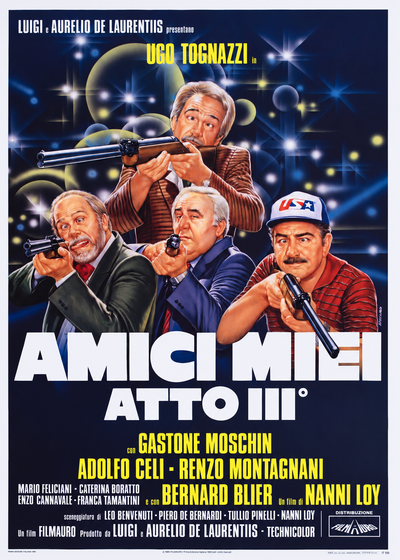
My Friends Act III (Nanni Loy, 1985)
The poster for My Friends Act III shows four mature men wielding rifles and handguns like boys at a shooting gallery, each aiming in a different direction, a single detail that perfectly captures the film's spirit. The pyramid composition, one figure at the top and three below, is built entirely around the faces: the men's wrinkles and furrowed brows are rendered with near-photographic precision, right down to the tongue-in-cheek detail of a baseball cap. Behind them there is no landscape, only an airbrushed night sky of stars and glowing bubbles that lifts the scene out of time altogether.
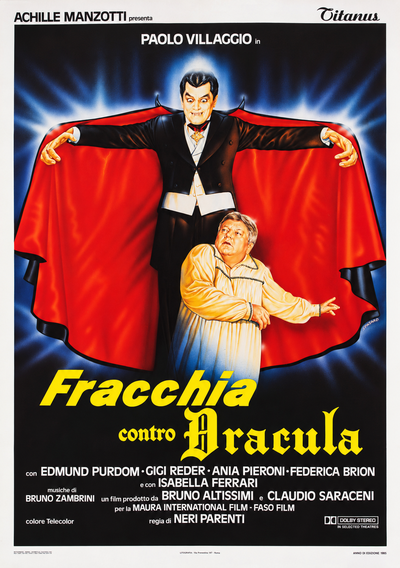
Fracchia vs. Dracula (Neri Parenti, 1985)
The poster for Fracchia vs. Dracula evokes a veritable horror theater scene, skillfully crafted with a single purpose: to make people laugh. Above, the vampire spreads his red cape like a theatre curtain, arms flung wide, his pallid face caught in a white halo that looks for all the world like a spotlight. Below, small and stooped in his nightshirt, the hapless accountant shrinks back with his hands raised. The contrast in scale, the towering figure against the tiny, clumsy one, is the whole gag in a single image, while the soft, glossy folds of cape and satin show just how well the airbrush can render fabric.
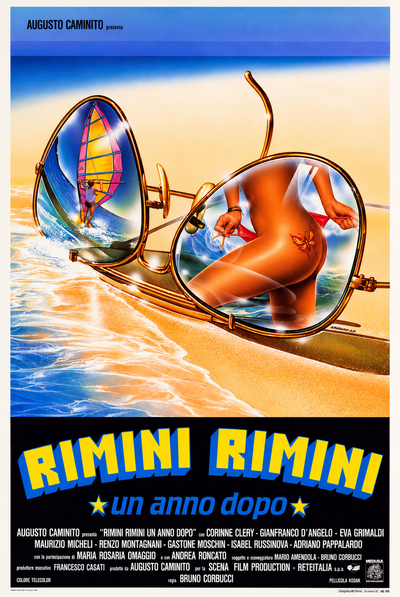
Rimini, Rimini: A Year Later (Bruno Corbucci, 1988)
The poster for Rimini, Rimini: A Year Later features a pair of aviator sunglasses abandoned on the shoreline; lapped by the waves, they become a miniature stage for summer. Each lens reflects a different scene: in one, a windsurfer out at sea; in the other, a tanned figure in a bikini with a butterfly tattoo. It is a clever graphic idea that sums up the two sides of summer by the sea, sport and seduction, without showing a single face. The gold frame, the chrome-like reflections and the wet sand have the smooth finish typical of the airbrush, while the foam of the breaking wave gives the composition depth.
Horror
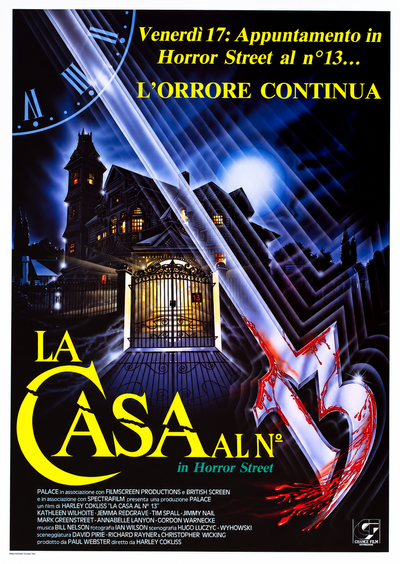
Dream Demon (Harley Cokeliss, 1988)
The poster for Dream Demon features a Victorian villa illuminated at night dominating the center of the composition, with a wrought-iron gate gleaming like a threshold best left uncrossed. Shafts of white light cut diagonally across the blue sky, while a clock face emerges at top left, a hint that time is running out. In the foreground the number 13 is daubed in red brushstrokes that drip like blood, the only flash of warm colour in an image played almost entirely in night-time blues. The lit windows and the beams slicing through the darkness are a small masterclass in airbrush work. The film was released in Italy as La casa al n. 13 in Horror Street.
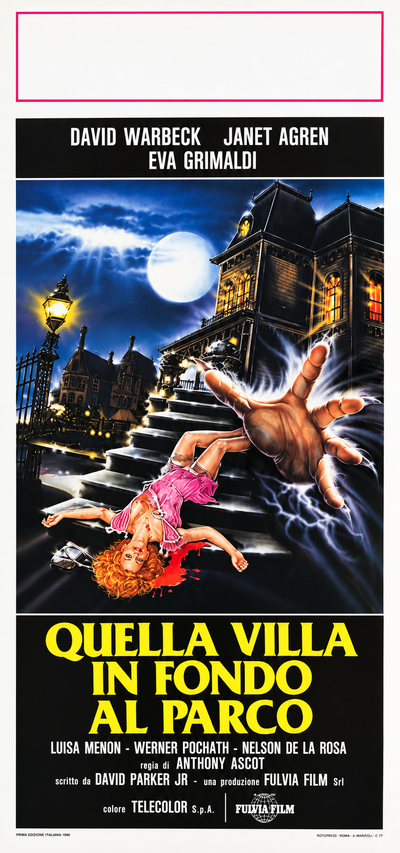
Rat Man (Giuliano Carnimeo, 1988)
The "locandina" (Italian small format) for Rat Man, the tall, narrow format becomes a staircase, drawing the eye from the Gothic villa at the top down to the victim at the bottom. Beneath a full moon veiled in violet cloud, a woman in a pink dress lies sprawled across the steps, while a monstrous clawed hand, its veins bulging, reaches in from the right amid crackles of light. The glowing street lamp, the house with its yellow windows and the bruised sky all recall the Gothic imagery of American cinema, reworked in the acid colours and sleek finish of late-1980s horror.
Adventure
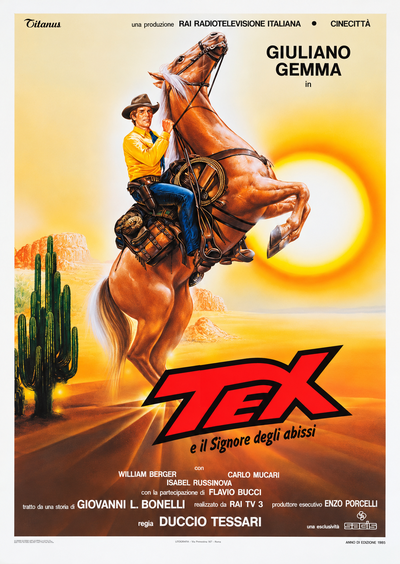
Tex and the Lord of the Deep (Duccio Tessari, 1985)
In the poster for Tex and the Lord of the Deep, a rearing horse viewed from below takes up the full height of the image, lending the rider a monumental presence. The yellow shirt, jeans, and hat are the comic book character's canonical attire, rendered with a fidelity that bridges the drawn page and the screen. The background features a fiery sunset: the massive sun, concentric halos, and rays fanning out across the desert—with rocks and saguaro cacti silhouetted against the light-showcase the power of airbrushing applied to the Western genre. The large red logo, slashed diagonally, completes the composition with the energy of a cover.
A Painter Worth Rediscovering
Comedy, horror, western: whatever the genre, Spataro finds the most effective visual solution, whether a graphic conceit like the sunglasses of Rimini Rimini un anno dopo or the sheer force of a figure like Tex rearing against the sun. Trained alongside one of the great masters of Italian poster art, Spataro absorbed his mentor's lessons so thoroughly that his work came to resemble Casaro's, while keeping the sure hand that had been his from the start. He belongs to the generation of Pittori di Cinema, the artists who shaped Italy's painted film poster tradition and kept it alive until the dawn of the digital age. Rediscovering his work means putting a name to images that a whole generation of filmgoers saw countless times without ever knowing who had painted them.
The works reproduced on this page come from the original prints of the period, recovered, photographed and digitally restored by Movie.it.
You may also like
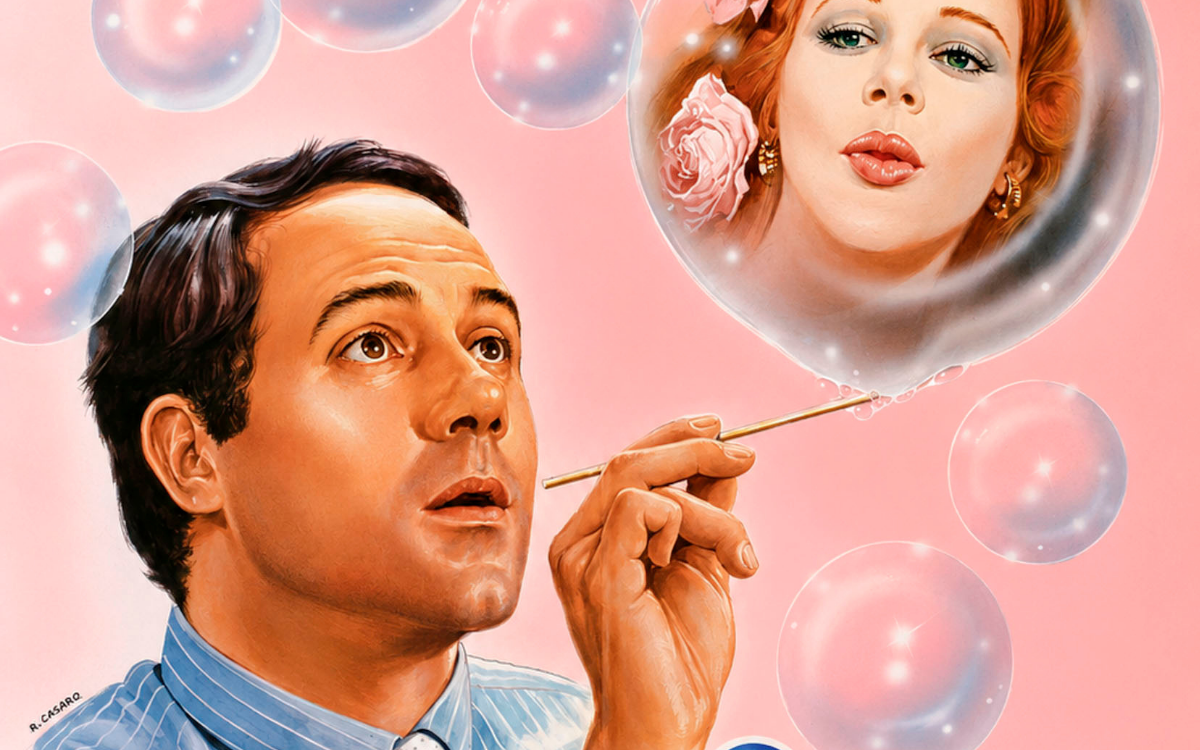
The Art of Renato Casaro, the Last Master of Cult Movie Posters
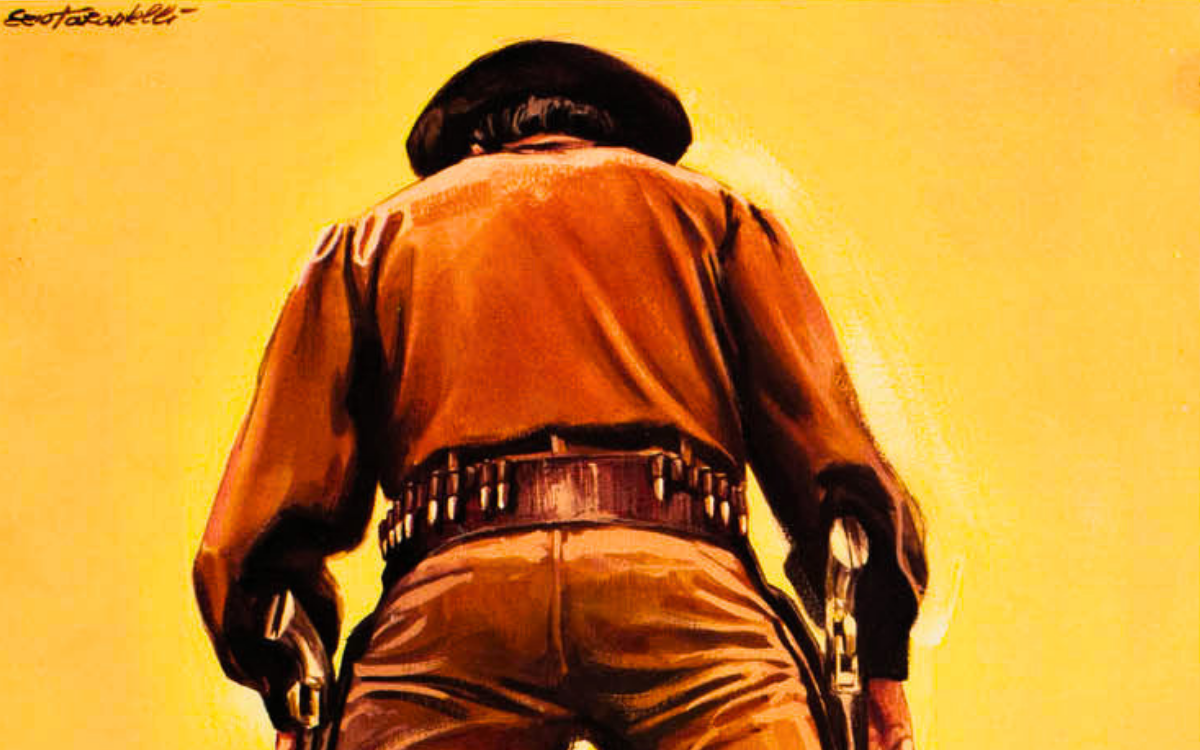
Ezio Tarantelli, the First E of Studio E2