Paolo Villaggio, a Talent for Being Out of Place
By the Movie.it Editorial Team
November 2, 2026
Paolo Villaggio was born in Genoa on 30 December 1932 and died in Rome on 3 July 2017. An actor, writer and screenwriter, he was one of the best-loved figures in Italian comedy. After some years as an office worker in his home city, he made his name on television in 1968 with Quelli della domenica, creating characters such as Professor Kranz and the timid Giandomenico Fracchia. His most famous invention was Ugo Fantozzi, an accountant tormented by his bosses and by fate. Fantozzi began in comic monologues and stories, became a book that sold over a million copies in 1971, and went on to carry a series of ten films. The adjective “fantozziano” has since passed into everyday Italian. Recognition from auteur cinema came later: he acted for Federico Fellini in The Voice of the Moon (1990), which won him a David di Donatello, then for Ermanno Olmi and Mario Monicelli. In 1992 the Venice Film Festival gave him a career Golden Lion.
A film poster usually promises that its hero will pull through. With Paolo Villaggio, the opposite happens: hand him a cowboy hat, a superhero costume or a diploma, and the picture already seems to be bracing for disaster. Nothing needs to fall on him. One look is enough to suspect he has ended up in the wrong place and that, out of sheer good manners, he will not dare complain.
Villaggio, of course, was not Fantozzi. He invented the hapless accountant, did not necessarily share his resignation, and knew perfectly well how to hold an audience in the palm of his hand. But the creature born partly of his years in the offices of Italsider ended up lending him a way of being in the world that was recognisable at a glance: the body on the defensive, authority always somewhere else, the suspicion that every occasion hides a fresh humiliation. Fantozzi reached cinemas in 1975, but the mask was already in the air.
Seven posters, made between 1969 and 1992, let us follow its transformations. Not all of them are painted, and not all of them advertise Fantozzi films. That is precisely the fun: watching the artists of film advertising find the accountant even in clothes that do not belong to him and, now and then, catch sight of a different Villaggio.
A Hero? We Shall See
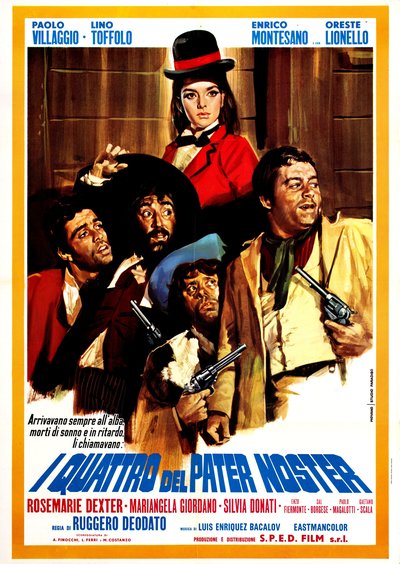
In the Name of the Father (1969). Poster by Piovano, Studio Paradiso
Let us start in the West. On the poster for In the Name of the Father (1969), Piovano, of Studio Paradiso, gathers four more or less credible gunslingers under the unflappable gaze of a woman. Guns are plentiful; confidence, rather less so, and the tagline confirms the suspicion: “Arrivavano sempre all’alba, morti di sonno e in ritardo” (They always arrived at dawn, dead on their feet and late). Villaggio, on the right of the group, brandishes his pistol but looks elsewhere, as if more interested in finding out who gave the order to shoot. The poster promises outlaws; he already has the air of a man who, at the first shot, will ask for a form to report the incident.
The image predates the screen debut of Fantozzi, and there is no need to turn it into a prophecy. It is enough to note how early Villaggio was convincing as a man on whom the hero's costume never quite fits. The others may well be bandits; he looks like a clerk hastily transferred to the frontier.
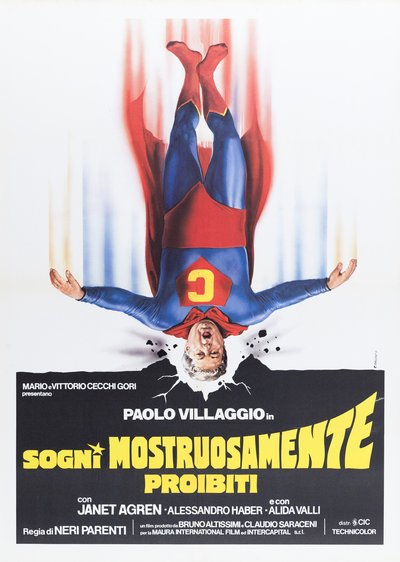
Forbidden Dreams (1982). Poster by Renato Casaro
Renato Casaro takes this idea to its logical conclusion in Forbidden Dreams (1982). Villaggio wears a superhero suit, cape and outstretched arms included. The problem is the direction of travel: he is plummeting head first, so hard that he smashes through the black band carrying the title. Casaro has granted him the costume of triumph but forgotten the one superpower that matters: flight.
The effect is irresistible because the image does more than show a fall: it stages a grand feat that ends before it has even begun. For other heroes the sky is a conquest; for Villaggio it is a shortcut to the floor. And the most Fantozzian touch of all is that his crash looks as though it was already in the rulebook.
Duty, Even When Nobody Asked
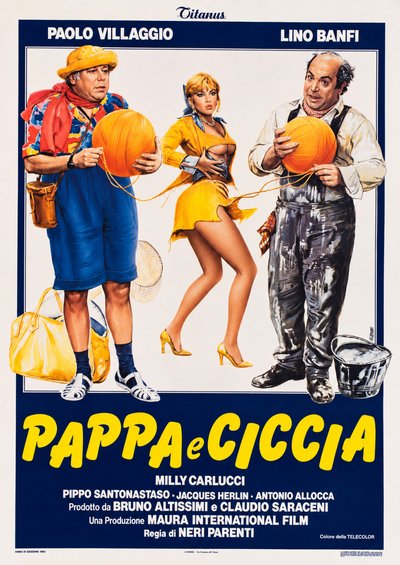
Two of a Kind (1983)
In Two of a Kind (1983), Enzo Sciotti moves the question from the sky to the summer holidays and finds a subtler cruelty. In the centre stands a young woman whose woollen dress is unravelling; on either side, Villaggio and Lino Banfi hold the balls of yarn on which the whole show depends. The image follows the rules of the Italian sex comedy, but Villaggio brings in something those rules never allowed for: duty. He holds the yarn with the unease of a man afraid he will be held responsible for the ruined dress.
Here Sciotti seems to catch something in the character deeper than clumsiness: an inability to enjoy even what ought to be a transgression. Where the advertising promises an adventure, Villaggio finds a chore. He is not the seducer of the scene; he is the one who, in the end, will have to wind it all back up.
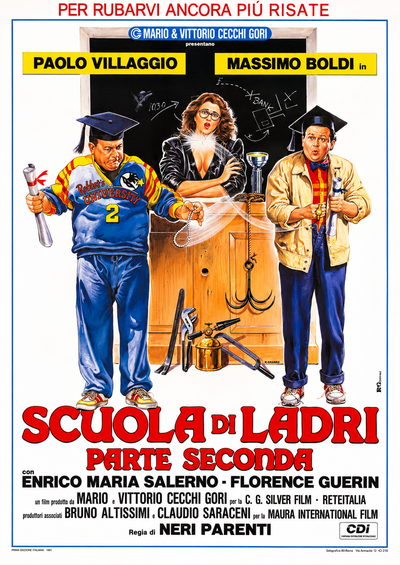
School of Thieves 2 (1987). Poster by Renato Casaro
Not even a degree changes things. On the poster for School of Thieves 2 (1987), Casaro hands Villaggio and Massimo Boldi mortarboards and diplomas, while a huge number 2 sits on Villaggio's chest, an unintentionally accurate statement of his place in the world. There is even a "Robber's University": rather than freeing him from discipline, crime simply offers him another institution, another exam and, presumably, another boss.
Casaro's neatest idea lies in the gap between the trappings of success and the faces of the graduates. They have officially passed, yet gained not an ounce of authority. Villaggio looks as if he is about to ask where to clock in before the robbery. After all, organised crime is still an organisation.
Other People's Paradise
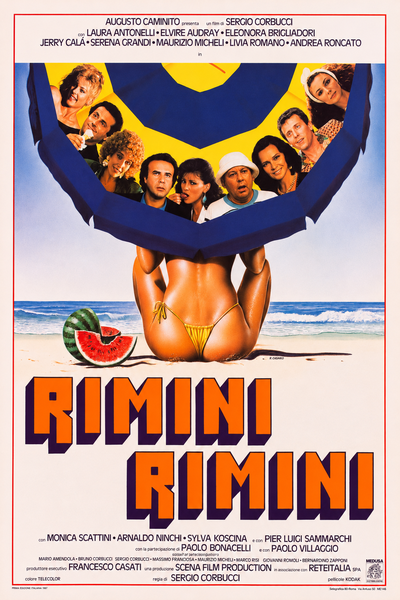
Rimini Rimini (1987). Poster by Renato Casaro
In Rimini Rimini (1987), Casaro stages another hierarchy, that of desire. A huge female body seen from behind dominates the composition; above it, among the folds and openings of a blue beach umbrella, the cast crowds together. Villaggio, in a pale hat and with his mouth open, is just one of many onlookers drawn by the same spectacle. He does not own the centre of the image. He gazes at it.
This detail sums up the Italian beach comedy of the 1980s better than many explanations: the holiday is sold as a catalogue of promises, while Villaggio remains the baffled consumer of a pleasure organised by somebody else. He is not the conqueror of summer; he is the man who seems to have turned up with the wrong ticket.
The poster even contains what looks like an accidental joke. In the upper band, the trace of an earlier line of text bearing Paolo Villaggio's name shows faintly through. We do not know which stage of production left it there, and it would be wrong to credit it to Casaro. But the effect is striking: the actor's very name seems to have been asked to move. In the world of Fantozzi, even the typography risks a demotion.
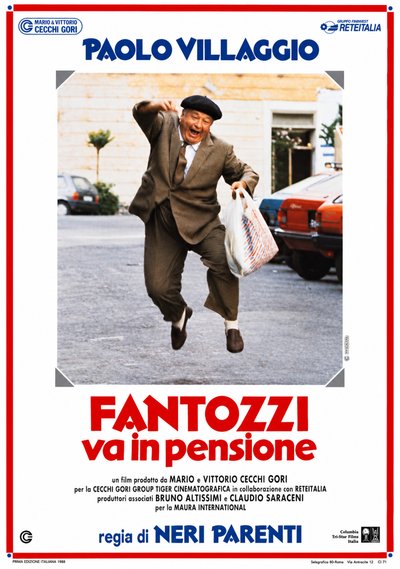
Fantozzi Retires (1988). Layout by Pierpaolo Scalera
Then comes Fantozzi Retires (1988), and the language of the poster changes. In the layout signed by Pierpaolo Scalera, the painted portrait gives way to a photograph held to the page by the little corner mounts of a family album. Fantozzi is caught in mid-air, mid-lurch, a shopping bag in hand. Retirement, clearly, has not taught him to sit still.
The idea is almost wistful: there is no longer any need to distort Villaggio with a brush. Photographing him is enough. The accountant has entered Italy's domestic memory like a relative everyone recognises and nobody would want to see turning up in that state. He has left the Megaditta, but not its laws. The briefcase has become a shopping bag; the race goes on.
The Surprise of the Right Place
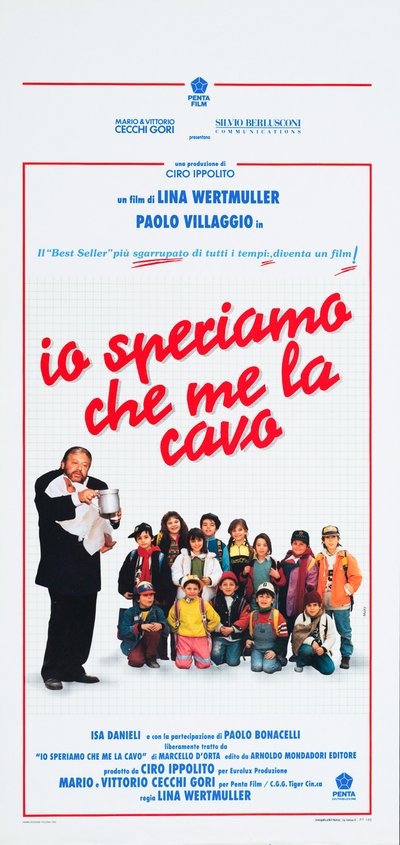
Io speriamo che me la cavo (1992). Maxy's "locandina"
The last image, Io speriamo che me la cavo (1992), seems to work a small miracle. Maxy builds the "locandina" (Italian small format) on a squared exercise-book page and places a class of children beside the teacher Marco Tullio Sperelli, played by Villaggio in Lina Wertmüller's film. The children take up most of the scene; Villaggio stands to one side, a baby in one arm and a pot in the other hand. He is still awkward, of course. But for once, his awkwardness is not the joke. It leaves room for tenderness.
It would be an exaggeration to call it redemption, and the "locandina" claims nothing of the sort. Yet it shows a possibility the others had almost always denied him: Villaggio can be funny without being humiliated, clumsy without being ridiculous at all costs. Maxy gives him no superpowers, no degrees, no beach conquests. He entrusts him with children, and leaves him the dignity of looking after them.
Seen together, these seven posters say something that goes beyond the individual films. The artists recognised in Villaggio a very rare gift: making visible, with a grimace or a posture, the feeling of never being where you are supposed to be. Cowboy, superhero, graduate thief, holidaymaker or pensioner, his body always seems to lag behind what the image is asking it to be.
Then, on Maxy's squared page, something quietly changes. The man forever out of place does not suddenly become a winner. For once, he is exactly where he is needed.
The works reproduced on this page come from the original prints of the period, recovered, photographed and digitally restored by Movie.it.
You may also like
The Art of Renato Casaro, the Last Master of Cult Movie Posters

Biography of Enzo Sciotti, the Poet of the Eighties