Biography of Enzo Sciotti, the Poet of the Eighties
Edited by Paolo Zelati, Editorial Director
July 10, 2026
Among film-poster enthusiasts, the artwork of Enzo Sciotti's has achieved cult status. His creations for 1980s genre cinema, most notably horror, are revered by collectors worldwide. Reprinted, tattooed and endlessly referenced, few artists defined the visual aesthetic of an era with such force.
Yet his story is as quintessentially Roman and artisanal as one could imagine: a workshop apprenticeship at sixteen, a master, a business partner. This old-school beginning led to more than three thousand works over the course of a career spanning half a century, from pitch-black horror to bawdy Italian comedies. When Enzo passed away in April 2021, the international film community paused to pay its respects.
Born into the Trade: A Workshop Apprenticeship
Enzo Sciotti was born in Rome on 24 September 1944, into the trade in the oldest sense of the word: his father was a decorator specialising in sacred art. In the Sciotti household, painting was regarded as a craft rather than merely a vocation.
At sixteen, the young artist entered Riccardo Battaglia’s Studio Bat, one of the historic poster workshops of Cinecittà. There, he met Renzo Cenci and Ezio Tarantelli, who would become lifelong friends and colleagues. He later moved to the studio of Maro (Otello Mauro Innocenti), completing an apprenticeship that reads like a family tree of Roman poster art.
Eventually, alongside Tarantelli, he co-founded Studio E2, under whose name the duo would sign some of the most popular and commercially successful Italian posters of the 1970s and 1980s.
Artwork for Italian and International Releases
Sciotti’s catalogue remains one of the most substantial bodies of work in Italian film-poster art, with a career spanning more than three thousand works across cinema, publishing and illustration. His film work included productions associated with directors such as Dario Argento, Lucio Fulci, Sam Raimi, David Lynch and Ettore Scola.
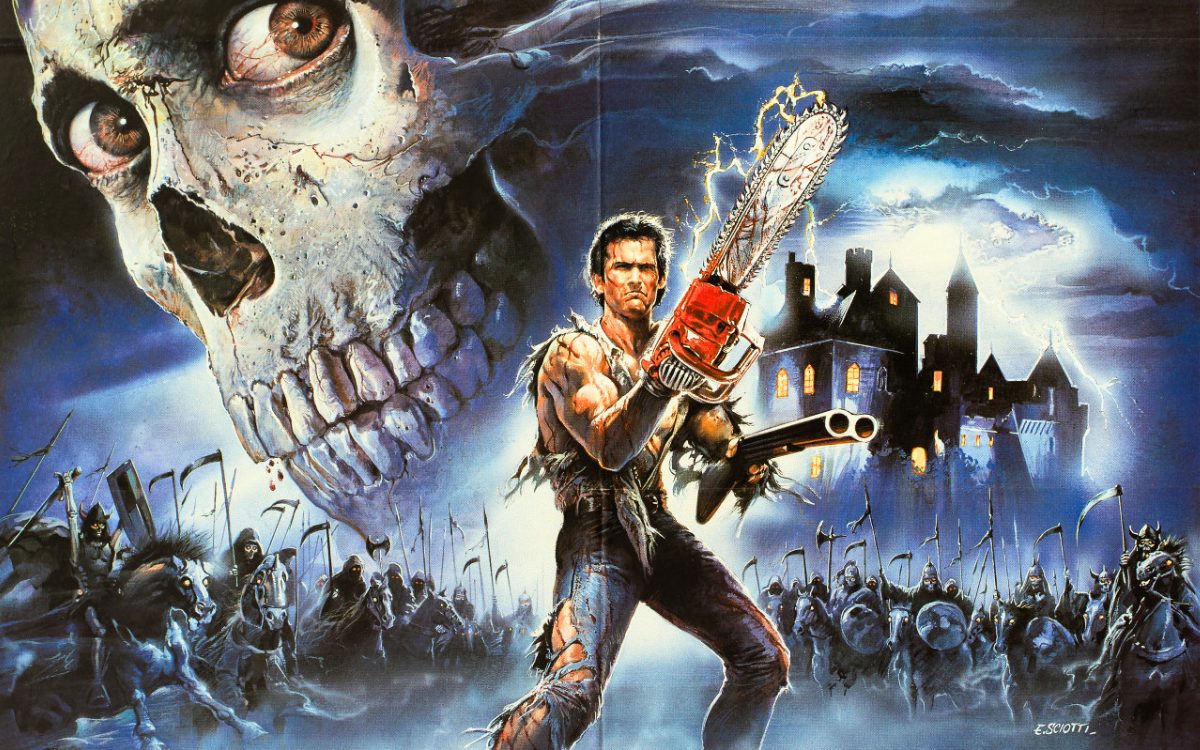
His natural territory was genre cinema, particularly horror, science fiction and fantasy. Key examples include his internationally acclaimed artwork for Army of Darkness, the striking pool-table composition for Lynch’s Blue Velvet, and his evocative designs for Demons and Phenomena, which also adorned soundtrack covers.
Alongside the thrills, however, lay the other half of his world: classic Italian comedy, where the very same hand that summoned demons could effortlessly spark a smile.
Equally noteworthy is his often overlooked work in publishing, where he painted covers for the dark pulp comics (fumetti neri) of the 1970s and 1980s, including Terror and Storie Blu.
From a purely technical standpoint, commissions came to Sciotti through film producers or distribution companies; only a small number of directors took a personal interest in the marketing process. Sciotti would work with whatever materials were available, and the final artwork was then selected by industry professionals.
The Invented Image
An anecdote told by Sciotti himself in an interview explains his method better than any description could. In 1984, when Titanus commissioned the poster for Phenomena, Dario Argento had not yet finished filming. Sciotti therefore painted a scene entirely from his own imagination.
He recalled that this happened frequently, across all genres. By contrast, for Demons, he was able to view a few scenes beforehand, making it one of the rare instances in which he used an actual film still as an iconographic reference.
Perhaps this reliance on pure suggestion was the secret of his posters: they did not merely illustrate a film; they dreamed it before it even existed. The poster artist became a kind of “second director”, tasked with capturing the essence of a narrative from little more than a plot synopsis and a handful of reference images.
“For a creative mind, inventing from scratch is the ultimate,” Sciotti once remarked.
These stories offer compelling evidence that a poster design can be an autonomous creation, rather than merely a derivative of the film itself.
The Style: The Texture of Things
Sciotti’s painting has an almost tactile quality. His surfaces are alive: skin slick with sweat, gleaming metal, dense blood and hair whipped by an unseen wind.
His classical workshop training gave him an extraordinary command of anatomy, which he charged with theatrical tension.
In horror, this emotional hyperrealism became his trademark: fear was not merely suggested; it was embodied. In comedy, that same precision became warmer and more affectionate, with star faces remaining instantly recognisable even within a gag.
Governing it all was a theatrical palette, deep blacks and midnight blues from which figures emerged as if caught in a spotlight: the perfect stage for the 1980s, a decade that demanded strong emotions from every wall.
The Works
The Beyond (Lucio Fulci, 1981)
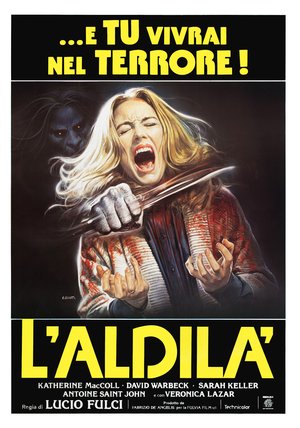
The poster for The Beyond is a portrait of pure terror. A young blonde woman screams with her eyes shut as, emerging from the darkness behind her, a livid creature with glowing, ember-like eyes grabs her and presses a large, gleaming knife against her throat. Her hands clutch desperately at the monster’s wrists; her shirt is stained with blood, her hair swept by an unnatural wind.
Above it all, the famous tagline promises: "...And you will live in terror!" Beneath it, the yellow title stands out in heavy, block lettering. Everything is built around an extreme close-up, with no conventional setting or background. Fulci’s horror is right up against the victim, leaving no room to escape. It is a poster that collectors and fans around the world regard as one of the absolute high points of horror iconography.
Talcum Powder (Carlo Verdone, 1982)
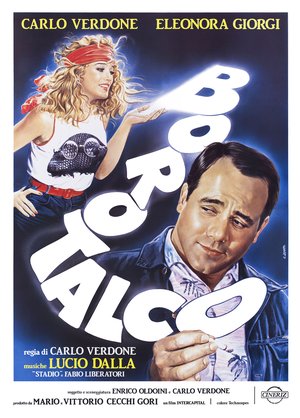
The poster for Talcum Powder is one of the most elegant visual inventions in Italian comedy. Eleonora Giorgi, wearing a red headband in her blonde curls and a T-shirt featuring a bespectacled fly, blows a cloud of talcum powder from the palm of her hand. The powder becomes the title itself: soft white letters drifting diagonally across a midnight-blue background until they reach Carlo Verdone, who catches the final “O” with a melancholy expression and a cigarette between his fingers.
The title is not simply printed onto the poster, it is part of the scene. It becomes a physical object, a cloud of scented powder travelling from her to him. A wonderfully simple idea, rendered with a softness that seems almost to turn the painting itself into talcum powder.
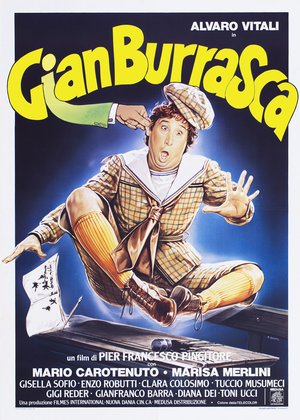
Gian Burrasca (Pier Francesco Pingitore, 1982)
Sciotti’s poster for Gian Burrasca literally lifts its protagonist by the ear. Alvaro Vitali, dressed in a checked sailor suit with yellow socks and heavy shoes, hangs suspended above his school desk, his mouth wide open at the precise instant of capture. An adult hand emerging from a green sleeve holds him aloft, while his ink-stained notebook and pen fly through the air.
Above the scene, the yellow title, rendered in swollen lettering, seems to tumble across the top like a burst of laughter. The entire mechanics of childhood mischief are compressed into one decisive moment, the moment of punishment, yet Sciotti’s meticulous attention to fabric, gesture and expression transforms farce into a small piece of genre painting.
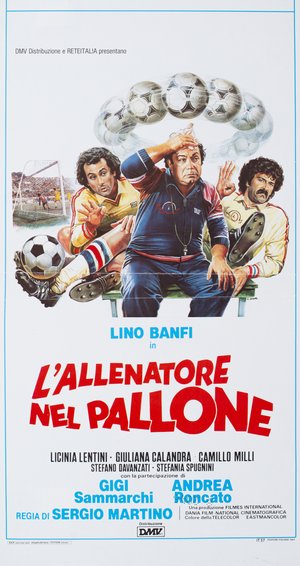
The Trainer on the Beach (Sergio Martino, 1984)
The "locandina" (Italian small format) for The Trainer on the Beach gave Italian cinema its definitive image of Oronzo Canà. Lino Banfi sits on the bench in a blue tracksuit, whistle around his neck and a wet cloth draped over his head, wearing the expression of a man who has just watched his team’s hopes of avoiding relegation disappear. Above him, a crown of footballs circles his head like the stars around someone who has just been knocked unconscious, while two players behind him make unmistakable gestures.
Off to the left, a small goal and a fragment of the action complete the composition. The caricature is both affectionate and extraordinarily precise. The football in the foreground almost seems to invite the viewer into the scene, while the revolving crown of balls is a comic-book device translated directly into painted form. This is provincial Italian football captured in its definitive visual form.
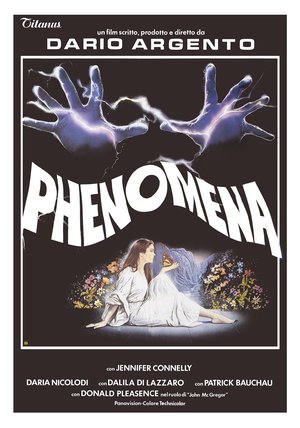
Phenomena (Dario Argento, 1985)
The poster for Phenomena is divided between sky and earth. From above, two enormous livid hands descend, streaked with electrical discharges that illuminate their contours. Beneath their weight, the white title bends and ripples like fabric caught in the wind.
Below, in a nocturnal clearing filled with vividly colored flowers and framed by a mountain gorge, Jennifer Connelly sits on the ground in a white nightgown, watching a butterfly resting on her hand.
Threat above, innocence below, and between them a title that seems to deform under pressure: the entire visual language of Argento’s cinema is condensed into a single composition, an image invented, as Sciotti himself explained, before the film had even been completed.
Cult Status and Farewell
In the final years of his life, Sciotti witnessed his work attain international cult status. He was invited as a guest of honour at collectors’ conventions, his lithographs were sought after worldwide, and horror fans travelled simply for the chance to meet him.
He eventually brought together his work in an art book bearing a title familiar to many of his admirers: Il Cinema Dipinto (Painted Cinema).
When he passed away in Rome on 11 April 2021, his family posted a farewell message on his profile that deeply moved his global following: “I have flown away, and I carry you all in my heart.”
Obituaries appeared in major publications around the world an honour bestowed upon very few poster artists. The boy from the Cinecittà workshop had become a master recognised far beyond Italy.
Sciotti and the Master Poster Artists
Within the landscape of cinema painters, Enzo Sciotti represents a vital link between the classical Roman workshop tradition and global popular culture. Trained in the tradition of Maro and having worked alongside colleagues such as Ezio Tarantelli, with whom he shared a studio for many years, he carried that artisanal wisdom into a decade in which genre cinema was reaching an unprecedented international audience. In this sense, he stood alongside Renato Casaro, the other great poet of 1980s poster art, in the international recognition achieved by Italian cinema painters
While Casaro became an ambassador for Italian poster art to the major Hollywood studios, Sciotti remained its great champion within Italian popular culture. Their paths were different, but they led to a remarkably similar conclusion: Italian painted film-poster art could stand confidently among the finest traditions of international cinema illustration.
The works reproduced on this page come from the original prints of the period, recovered, photographed and digitally restored by Movie.it.