
Federico Fellini, an Imagination Made for Painting
By the Movie.it Editorial Team
October 19, 2026
Federico Fellini was born in Rimini on 20 January 1920 and was a draughtsman before he was a director: caricatures, cartoons and humorous pages for the satirical weekly Marc'Aurelio after his move to Rome in 1939, and in 1944, in newly liberated Rome, caricature portraits of Allied soldiers. He worked in radio, met Giulietta Masina and married her in 1943; after the war he wrote for neorealism, including for Roberto Rossellini, and in 1950 he co-directed Variety Lights (Luci del varietà) with Alberto Lattuada. From there he built a cinema in which reality is enlarged, remembered and reinvented, until his name became an adjective: Felliniesque. Four of his films won the Oscar for Best Foreign Language Film; in 1993 he received an honorary Oscar, and he died in Rome on 31 October that year.
Fellini thought in images even before he thought in stories. He never stopped drawing: he sketched his characters before casting them, and for decades he recorded his dreams in notebooks of drawings, published after his death as The Book of Dreams. For the film poster painters he was therefore not just a director to interpret but almost a colleague. Faced with each of his films, every one of them had to decide who Fellini was: a storyteller of the provinces, a poet of the circus, a portraitist of women, a man who dreamed with his eyes open. Lined up together, their answers form a portrait no photograph could have captured.
Beginnings: Variety and its Dreamers
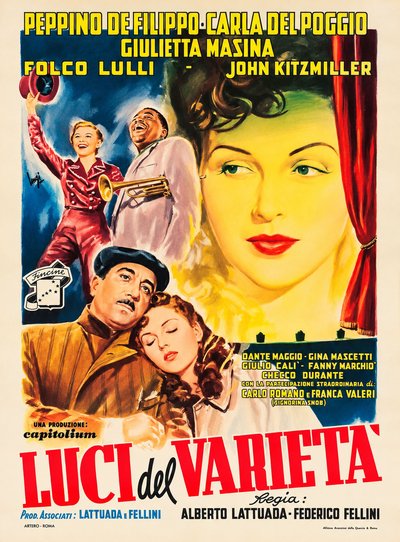
Carloantonio Longi's Poster for Variety Lights (Alberto Lattuada and Federico Fellini, 1950).
Checco Dalmonte (Peppino De Filippo), the leader of a shabby variety troupe, loses his head over Liliana (Carla Del Poggio), a provincial girl who uses him to break into show business. Longi divides the poster the way Fellini would always divide the world: spectacle above, life below. At the top Melina (Giulietta Masina) waves her hat beside Johnny the trumpeter (John Kitzmiller), while a huge diva's face glows in front of the red curtain, Liliana's dream of herself. At the bottom Checco holds the girl as she rests on his shoulder: he thinks she is his, she is already dreaming elsewhere. This is the first portrait of the man Fellini would film for the rest of his life, the Italian male convinced he is running the game while the game runs him. And the director knew that world from the inside: during the war years he wrote for variety theatre and followed Aldo Fabrizi's company on tour.
The White Sheik, the Dream Factory
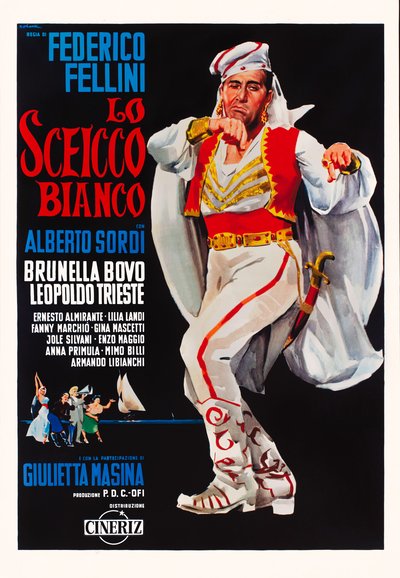
Giorgio Olivetti's Poster for The White Sheik (Federico Fellini, 1952).
On honeymoon in Rome, Wanda (Brunella Bovo) slips away from her husband to meet the idol of her favourite photo-romance, the White Sheik; under the turban is Fernando Rivoli (Alberto Sordi), a married, cowardly beach-resort seducer. Olivetti isolates him full-length against black, in his white and red costume, and catches the very instant the pose gives way: legs crossed in a clumsy dance step, hands hovering in mid-air, a gaze both smug and weary. Tiny in the bottom corner, the photo-romance crew with a megaphone and a sailing boat give the game away. Here Fellini handed Sordi his first great screen mask, the vain man who cannot carry the part, and the painter put it on display before audiences had even met it.
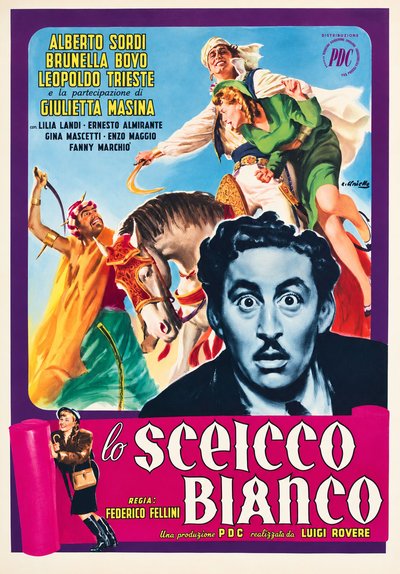
Averardo Ciriello's Poster for The White Sheik (Federico Fellini, 1952).
Ciriello turns to the other man in the story, Ivan Cavalli (Leopoldo Trieste), Wanda’s young clerk husband who has planned everything in Rome: the uncle, the audience with the Pope, respectability. In the foreground his black-and-white face, eyes wide, discovers the unthinkable: above, in full colour, Wanda lies in the Sheik's arms, inside the photo-romance. Colour belongs to the dream, grey to reality, and that gap is the one on which Fellini would build almost all his cinema. Ivan is the first in a long line of Fellini men wrong-footed by female desire. And at the bottom, tiny on the title band, Cabiria walks by with her handbag, the streetwalker played by Giulietta Masina: five years later she would have a film all of her own.
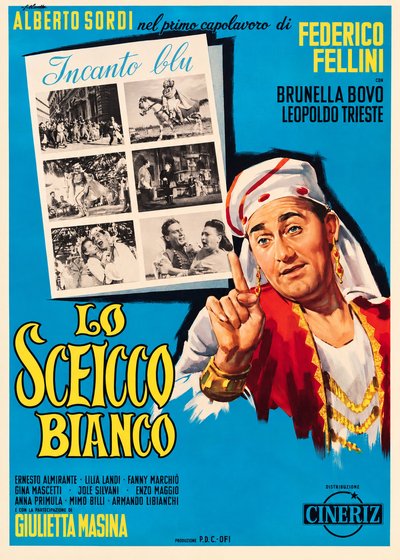
Giorgio Olivetti's Poster for The White Sheik (Federico Fellini, 1952), Second Version.
In the second version Olivetti puts the Sheik back in front of his factory. Rivoli raises a finger with the air of a professional seducer, and behind him opens a page of Incanto blu, the film's photo-romance, its black-and-white frames laid out like a contact sheet. The poster shows the dream and the way it is manufactured at once, a deeply Fellinian reading: Fellini came from that world of popular magazines and humorous drawings, knew its tricks and looked on them with affection and irony alike. It is also a hall of mirrors: a poster painter portraying a paper idol, popular images telling the story of popular images. And the line billing the film as Fellini's first masterpiece already reads like a coronation.
I Vitelloni, the Town Nobody Leaves
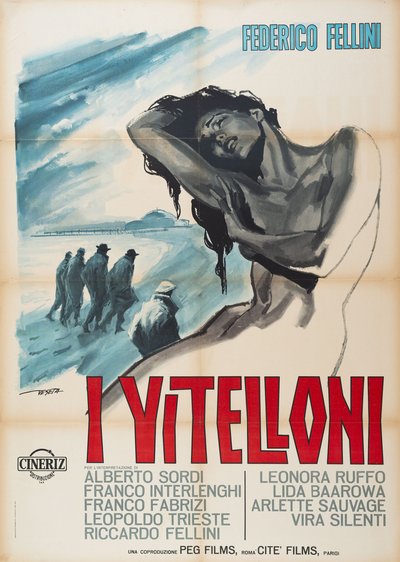
Enrico De Seta's Poster for I Vitelloni (Federico Fellini, 1953).
Five friends in a small seaside town, Moraldo (Franco Interlenghi), Fausto (Franco Fabrizi), Alberto (Alberto Sordi), Leopoldo (Leopoldo Trieste) and Riccardo, played by the director's brother Riccardo Fellini, drag out a youth that refuses to end. De Seta, who signed five of the works on this page and was Fellini's leading interpreter in the 1950s, portrays none of them: he shrinks them on a winter beach, hunched in their coats, and fills the foreground with a woman whose eyes are closed and head thrown back, drawn in quick strokes of grey and blue. She is the dream that keeps them standing still. The poster senses that this is early Fellini's most autobiographical film: an off-season town that resembles Rimini, his brother in the cast, Moraldo leaving by train at the end just as Fellini himself had left. The empty landscape is a memory before it is a place.
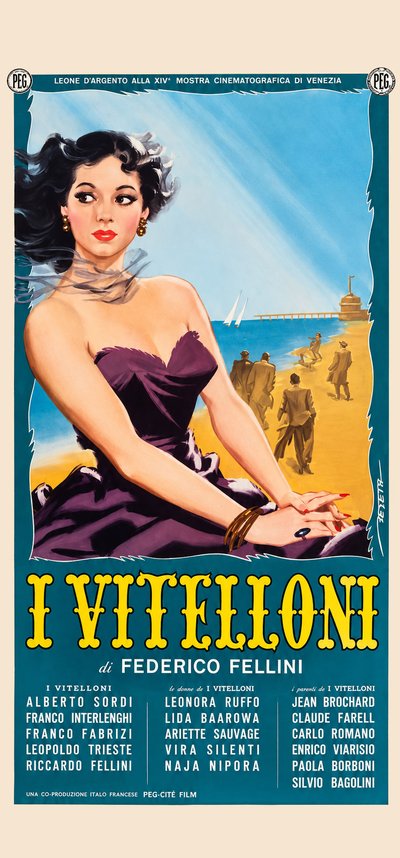
Enrico De Seta's “Locandina” (Italian Vertical Format) for I Vitelloni (Federico Fellini, 1953).
In the “locandina” De Seta moves the woman from dream to portrait: black hair stirred by the wind, a strapless purple gown, hands folded in her lap, her gaze sliding sideways. Behind her lies the same beach, now sunlit, with the men in overcoats drifting towards the pier. She is seated and still, yet she is the only figure who seems to have a future; they walk without going anywhere. It is a faithful reading of the film, in which the women marry, leave and make decisions while the vitelloni stay put. For Fellini immaturity is a male condition, and the painter stages it with nothing more than a hierarchy of scale.
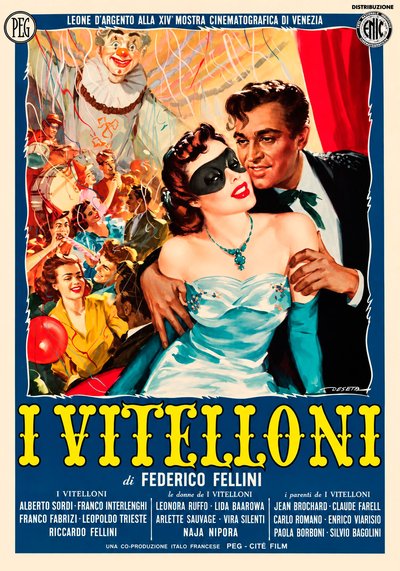
Enrico De Seta's Poster for I Vitelloni (Federico Fellini, 1953), Second Version.
In his second version De Seta tells a different film. He chooses the carnival ball and the affair between Fausto (Franco Fabrizi), the group's womaniser, and the woman played by Lída Baarová, who clings to him in a black mask. Around them swirl streamers and confetti beneath a laughing clown. The painter sells a romance, yet still captures two of Fellini's obsessions: the party as a ritual in which everyone performs, which returns in La Dolce Vita and Amarcord, and the clown, to whom the director would devote an entire film, The Clowns (I clowns). For the Belgian release, as Les Inutiles, the same image was used again, a sign of how highly Italian poster painters were regarded abroad. Beside the first version, it shows how the same painter could shift his gaze, from a winter beach to the euphoria of carnival.
La Strada, a Circus of the Soul
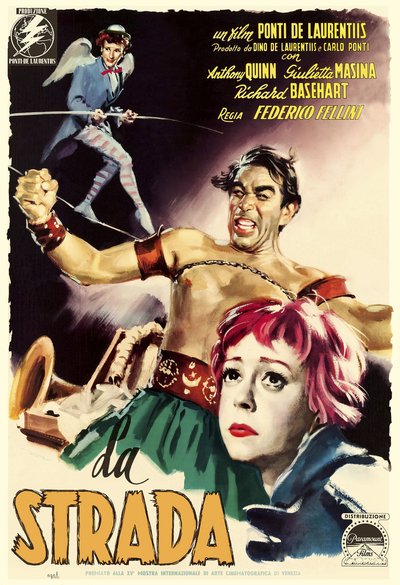
Enrico De Seta's Poster for La Strada (Federico Fellini, 1954).
Sold by her mother to Zampanò (Anthony Quinn), a brutish travelling strongman, Gelsomina (Giulietta Masina) learns cruelty at his side and learns from the Fool (Richard Basehart) that even a pebble has its purpose. De Seta arranges the three on three planes, like an altarpiece: at the top the Fool on the high wire, wearing the angel wings of his act; in the centre Zampanò, fist raised and chain across his chest; at the bottom Gelsomina, clown-faced, eyes lifted upwards. Angel, beast, soul. The painter reads into the film Fellini's highly personal sense of the sacred, in which grace comes from the smallest and strangest. And in Masina's face, made up like a clown's, lies the poetics of the circus that would stay with Fellini until his last film. The director liked to tell how, as a boy, he had run off after a travelling circus passing through Rimini; it may not have been true, but it was the memory he chose to have, and De Seta paints it as a vocation.
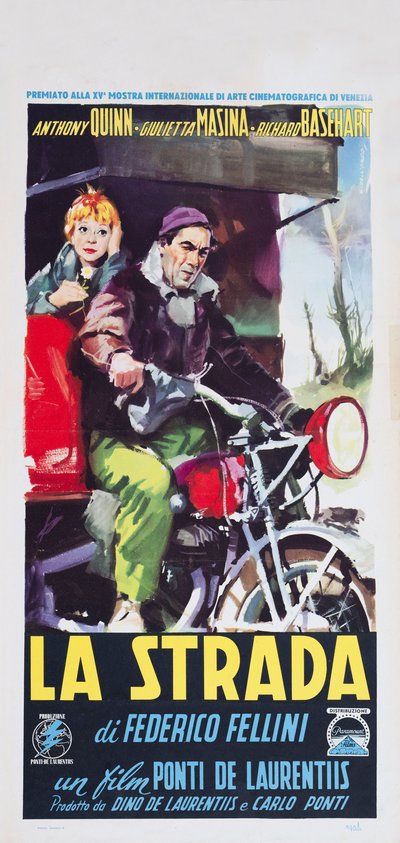
Giuseppe (known as Pino) Dell'Orco's “Locandina” for La Strada (Federico Fellini, 1954).
Dell'Orco removes the sky and the Fool and keeps the simplest thing of all: the road. Zampanò rides the motorcycle wagon hunched over, cap pulled low, eyes fixed ahead; behind him, leaning against the cart, Gelsomina holds a daisy and half-smiles. The trees are bare, it is winter, and the big red headlamp in the foreground seems the only warm spot in the image. Where De Seta sees an allegory, Dell'Orco sees a couple: two people bound by a journey she never chose and he cannot understand. This is the Fellini of vagrants and street performers, cinema as a caravan moving from town to town, and Gelsomina's daisy is the only luxury that world allows.
Cabiria, Faith Against the Dark
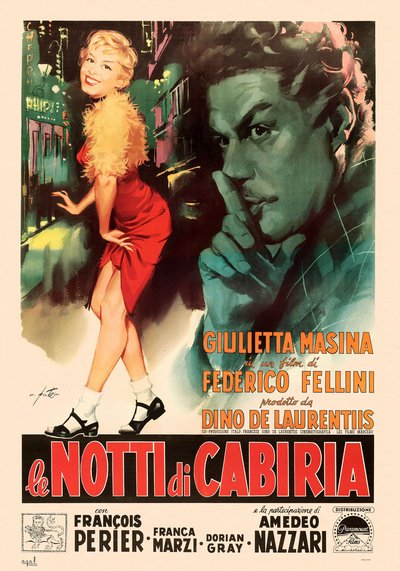
Arnaldo Putzu's poster for Nights of Cabiria (Federico Fellini, 1957).
Cabiria (Giulietta Masina), a streetwalker on the edge of Rome, keeps believing in love despite every betrayal, and the last, at the hands of Oscar (François Périer), is the cruellest. Putzu paints her beneath the neon signs of the night, blonde and smiling, in a feather stole and red dress, striking a street pose with something comic about it. Behind her rises Oscar's greenish face, a finger pressed to his lips. It is the gesture of a secret, and the painter uses it to do what Fellini does throughout the film: let us know more than she does, so that we fear for Cabiria from the poster onwards. Yet she keeps laughing towards us, and that stubbornness, a faith that survives everything, is the heart of the character Fellini had written for his wife.
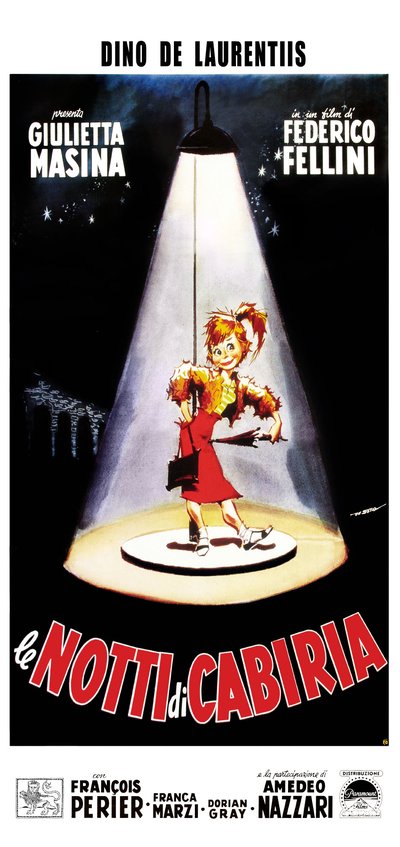
Enrico De Seta's “Locandina” for Nights of Cabiria (Federico Fellini, 1957).
In the “locandina” De Seta reduces Cabiria to a small red-haired figure, handbag in hand, standing in the cone of light from a street lamp against black. But the bright circle at her feet is also a stage, and the lamp a spotlight: the street becomes a theatre. It is a precise insight, because in the film Cabiria really does end up on stage, hypnotised in a variety theatre and mocked by the audience as she confesses her dreams. For Fellini the lives of the poor are always exposed, watched and performed, and compassion is born from that very gaze. Putzu paints the threat; De Seta paints the loneliness of someone at the centre of the stage with no one beside her.
La Dolce Vita, an Alter Ego Is Born
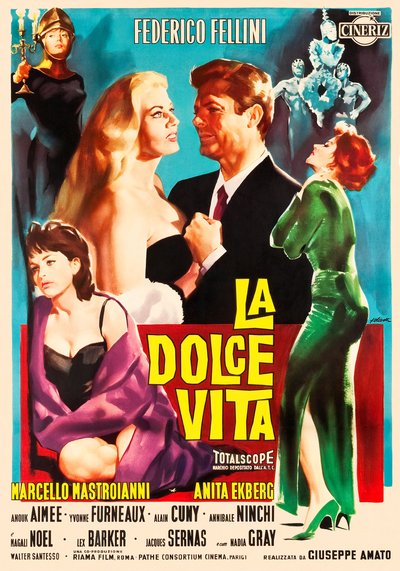
Giorgio Olivetti's poster for La Dolce Vita (Federico Fellini, 1960).
Marcello (Marcello Mastroianni), a gossip columnist, drifts through Rome's nights among parties, film stars and intellectuals, searching for a meaning that keeps slipping away. Olivetti places him at the heart of a constellation of women: Sylvia (Anita Ekberg) embracing him in evening dress, a brunette crouching in a slip, a redhead in green turning away and, above, a woman in an armoured helmet holding a candelabrum. He looks at Sylvia, the others look elsewhere: each is an opportunity, none an answer. The painter anticipates an image Fellini would take to its limit three years later, the imaginary harem of 8½, with the man at the centre and the women around him, desire as an endless round dance. In La Dolce Vita the dance is still a social one; later it would turn inward.
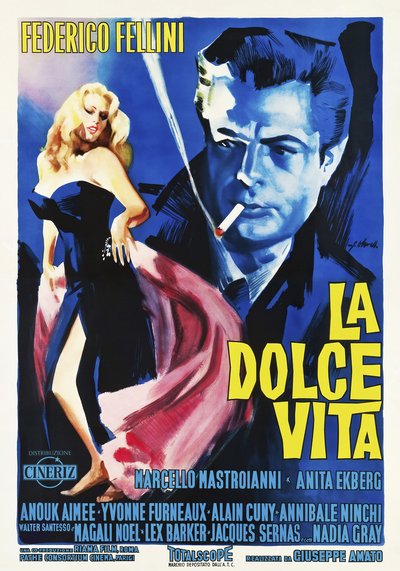
Giorgio Olivetti's Poster for La Dolce Vita (Federico Fellini, 1960), Second Version.
In the second version Olivetti tightens the frame on two figures. Mastroianni's face, painted entirely in blue, cigarette lit and smoke rising, fills half the poster; before him Sylvia, in a black dress, unfurls a pink stole like a wave. The blue is the Roman night, but also Marcello's melancholy as he looks past the woman in front of him. This is the poster that fixed Mastroianni's face as Fellini's face for good: from here on the actor would be his double, Guido in 8½, Snàporaz in City of Women, Pippo in Ginger and Fred. Olivetti paints an actor and hands the public an alter ego.
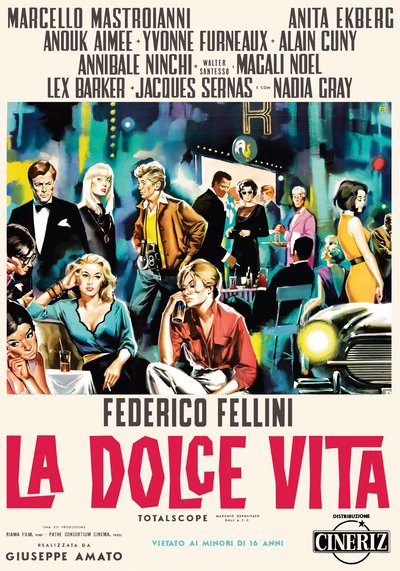
Sandro Symeoni's Poster for La Dolce Vita (Federico Fellini, 1960).
Symeoni chooses not a face but a street: above, night at an open-air café, among tables, parked cars and neon signs; below, the title in large fuchsia letters. Men in dinner jackets, bored young women, figures who never look at one another. It looks like Via Veneto, the street the film made famous and that Fellini had rebuilt at Cinecittà, because for him even reality had to be remade to become true. The painter captures the director's choral side, the one that fills the screen with extras, faces and high society and that returns in Roma and Amarcord. Olivetti paints the icon; Symeoni paints the world that produces and consumes it.
Mind and Memory
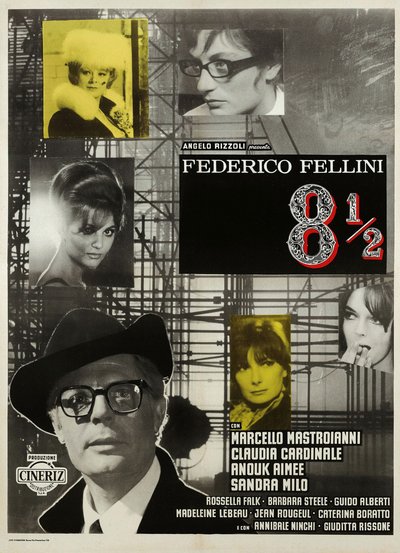
The photographic poster for 8½ (Federico Fellini, 1963).
Guido Anselmi (Marcello Mastroianni), a director in crisis, has to make a film he can no longer imagine and takes refuge in memories, dreams and the women of his life. The photographic poster is built like his mind: pinned like cuttings to a vast metal scaffold, the launch tower for the film Guido will never shoot, are the faces of the women, among them his wife Luisa (Anouk Aimée) in her glasses. At the bottom Guido, in black hat and dark glasses, gazes out of frame. That hat was also Fellini's own trademark on set, and the poster knows it: of all the works on this page, this is where the director comes closest to appearing in person. And those faces pinned up like cuttings resemble the pages Fellini, in those very years and on his psychoanalyst's advice, was beginning to fill with drawings of his dreams. The fragmentary montage also marks the move from painted to photographic posters traced in The History of the Italian Film Poster.
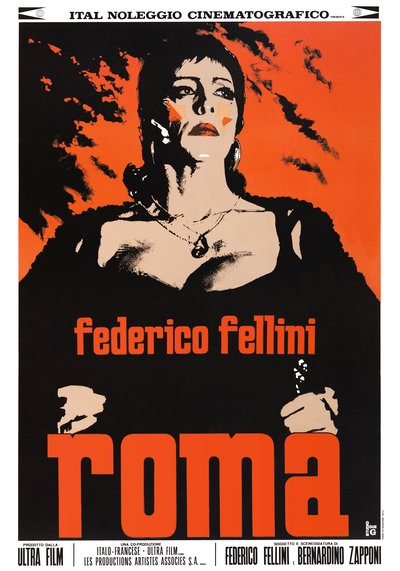
Studio Due G's Poster (Rinaldo and Giuliano Gèleng) for Roma (Federico Fellini, 1972).
Roma has no plot: it is a portrait of the city in fragments, from the young Fellini's arrival at Termini station to the brothels, from variety theatre to an ecclesiastical fashion show and the night traffic on the ring road. Studio Due G, named after the two Gèleng brothers, Giuliano and Rinaldo, sums it all up in one monumental woman, black hair, red lips, make-up streaked across her cheeks, against a vivid orange ground torn by flame-like black brushstrokes. The film licenses this reading: Fellini's Rome is female, opulent, maternal and threatening at once, like the statuesque women of the brothels and the she-wolf of the city's origins. She is also the same overflowing woman who fills the director's own drawings, from his early cartoons to his dream notebooks: the Gèlengs, who had worked with Fellini for years, paint the city with his own pencil. The heavy lower-case lettering places the poster firmly in the 1970s: no Colosseum, no postcard. The city is a body.
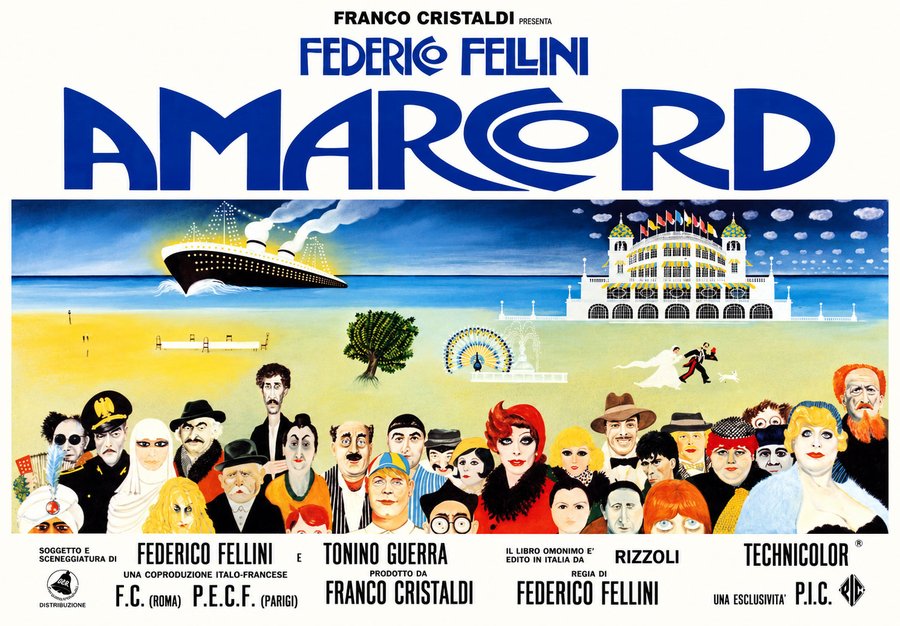
Giuliano Gèleng's poster for Amarcord (Federico Fellini, 1973).
Amarcord, Romagnol dialect for “I remember”, follows a year in a seaside town in the 1930s through the family of Titta (Bruno Zanin). Giuliano Gèleng turns it into the family album of an entire town: along the bottom a row of faces turned towards us as if for a group photograph, Fascist officials in uniform, grotesque figures and, in a red coat, Gradisca (Magali Noël); behind them, on the beach, the Grand Hotel, the liner Rex, a peacock in full display and a lone tree recalling the one mad Uncle Teo climbs. The painter does not sort the memories but piles them up, as Fellini's memory does, reinventing Rimini rather than reconstructing it. The Grand Hotel in the background is the palace the young Federico gazed at from outside, peopling it with princes and divas: Gèleng sets it where it stood in the director's dreams, behind everyone, out of reach. It is perhaps the most Fellinian poster in the series: it does not illustrate the film; it imitates the way the film remembers.
Women and Theatre
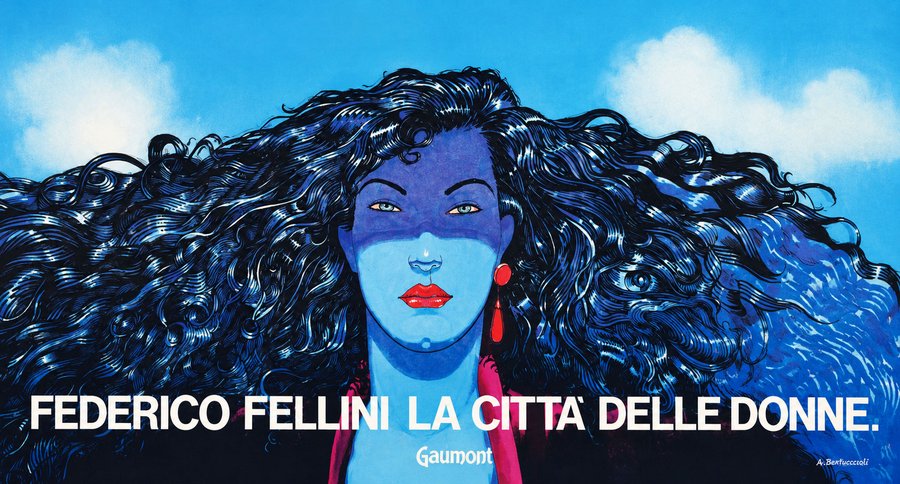
Andrea Pazienza's Poster for City of Women (Federico Fellini, 1980).
Snàporaz (Marcello Mastroianni) follows a stranger off a train and finds himself in a world peopled only by women, from a feminist conference to the villa of an ageing seducer. Pazienza leaves Mastroianni out and puts the film's one true protagonist at the centre: woman, nameless, filling the whole width of the poster, face blue and violet, a dark band across her eyes like a mask, hair spilling to the edges. She does not let herself be looked at; she does the looking. This is the fear and desire of Snàporaz, and perhaps of Fellini, before a femininity he can no longer pin down: the huge, unreadable women of his dream notebooks, who here, for the first time, look back at him. It is significant that the image comes from a comics artist: Fellini started out as a cartoonist, and here his cinema finds an interpreter in a young heir to that world.
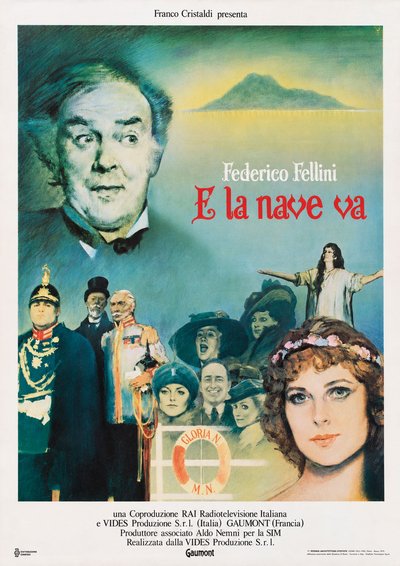
Giuliano Gèleng's Poster for And the Ship Sails On (Federico Fellini, 1983).
In July 1914 a liner sets sail to scatter the ashes of a great opera singer at sea; on board are artists and aristocrats, later Serbian refugees, as Europe slides towards war. The story is told by the journalist Orlando (Freddie Jones), whose face dominates the top of the poster with the astonished look of a man watching a show. Below him crowd uniforms, plumed hats, a singer with arms flung wide and a lifebuoy; on the horizon lies the volcanic island. The ship never appears, yet everything it carries is there. The film justifies the choice: in its finale Fellini reveals the set, the plastic sea, the camera itself. Giuliano Gèleng paints a work that declares its own artifice, in the muted tones of an old hand-tinted photograph.
One Last Look Back
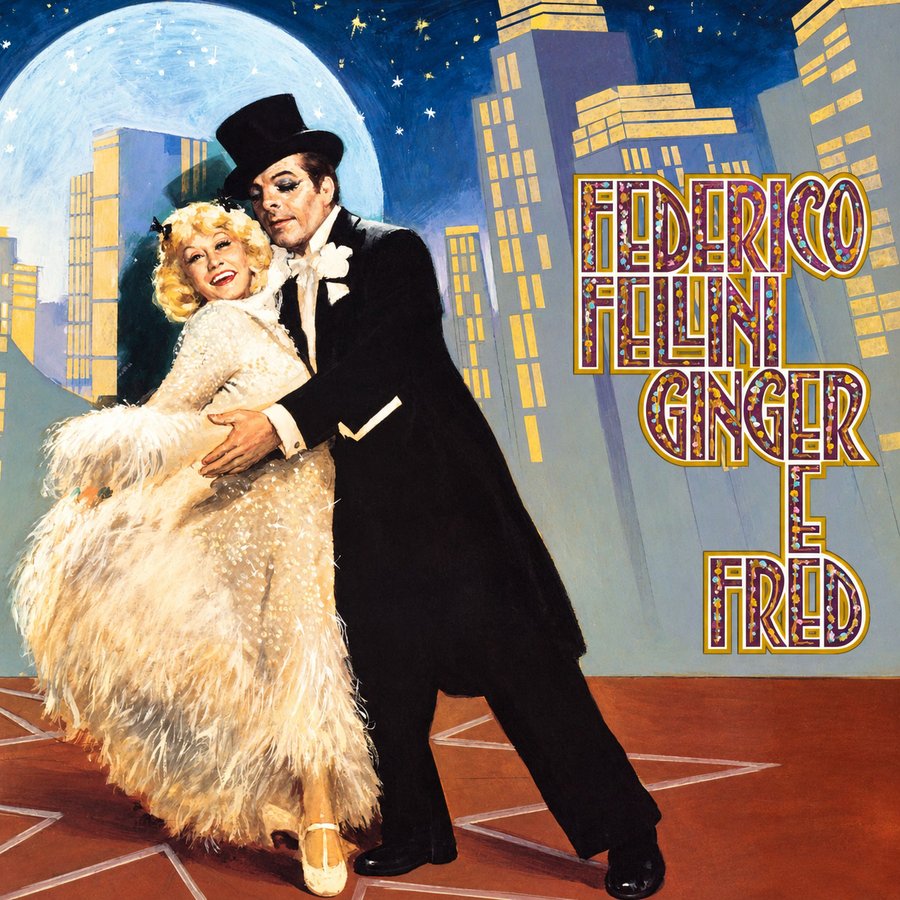
Giuliano Gèleng's Artwork for Ginger and Fred (Federico Fellini, 1986).
Amelia (Giulietta Masina) and Pippo (Marcello Mastroianni), two elderly tap dancers who in the 1940s performed as an imitation of Ginger Rogers and Fred Astaire, are reunited after thirty years for a television variety show. It is the only film in which Fellini brought together the two performers who had come to embody different sides of his cinema: his wife and his alter ego. In this artwork Giuliano Gèleng sets them dancing before a skyline of skyscrapers drawn like stage scenery, beneath a huge moon: she in white feathers, he in tailcoat and top hat, locked in a step that tilts them to the right. In the film they are out of time, swamped by the television circus; here they become the musical couple they once dreamed of being. The painter paints their memory rather than their present, and in that dance step lies Fellini's farewell to his own world.
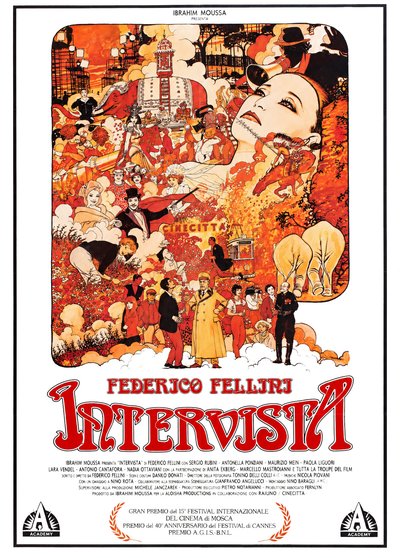
Milo Manara's Poster for Intervista (Federico Fellini, 1987).
A Japanese crew interviews Fellini at Cinecittà as he prepares an adaptation of Kafka's Amerika, and the set becomes a chance to recall his arrival at the studios in 1940 (Sergio Rubini plays the young Fellini) and to meet Mastroianni and Anita Ekberg again. Milo Manara builds a crowded composition in orange, red and sepia: the tram marked Cinecittà, elephants, a cameraman at work, men in uniform, young women, sets and female bodies pile up freely. It is the most explicit portrait in the series, because its subject is Fellini himself: the poster tells the story not of one of his films but of Fellini making cinema. And that it should be drawn by Manara, who would soon turn Trip to Tulum and then The Journey of G. Mastorna, the film Fellini dreamed of but never made, into comics with him, closes the circle opened by the young cartoonist of Marc'Aurelio.
A Director Who Became a Style
Viewed one after another, these posters tell the story of a director changing his skin. In the early years the painters read Fellini through his stories: the deluded troupe leader, the young husband betrayed by a photo-romance, the vitelloni on a winter beach. With Gelsomina and Cabiria they discover that his cinema has a face, Giulietta Masina's; with La Dolce Vita that it has a second, Mastroianni's, the double who would stay with him until Intervista. Then plots are no longer needed: a gigantic woman, a row of faces, a tree or a lifebuoy is enough, and audiences already know whose film it is.
Few directors became recognisable as a style even before they did as a name, and the film poster painters recorded that shift in real time, one poster at a time. With Fellini, moreover, the dialogue was between equals: the young man who drew caricatures of Allied soldiers and the man who drew his own dreams spoke the same language as the painters who interpreted him, and in the end he entrusted to a draughtsman the film he never managed to shoot. Fellini's face hardly ever appears in these works. Yet it is everywhere.
The works reproduced on this page come from the original prints of the period, recovered, photographed and digitally restored by Movie.it.
You may also like

Enrico De Seta, the centenarian painter between irony and modernity

Giorgio Olivetti, the Elegant Irony of a Bolognese Painter