Bud Spencer, the Calm at the Centre of the Brawl
By Movie.it Editorial Team
November 11, 2026
Before Bud
Long before he was Bud Spencer, Carlo Pedersoli had already been several other people. Born in Naples on 31 October 1929, he found his calling in the swimming pool: in 1950 he became the first Italian to swim the 100 metres freestyle in under a minute, and went on to compete at the Helsinki (1952) and Melbourne (1956) Olympics. Most people would have stopped there. Not him. He studied law, worked in Venezuela, wrote songs, qualified as a pilot and, while he was at it, founded an airline. All with the air of a man who just happened to be passing.
He had already strolled through Quo Vadis (1951) as an extra, but his real screen debut came in 1967, when Giuseppe Colizzi cast him in God Forgives... I Don’t! opposite Mario Girotti. Both men changed names for the occasion. Girotti became Terence Hill; Pedersoli borrowed Bud from Budweiser and Spencer from Spencer Tracy, which tells you most of what you need to know about his priorities, if not their order. Married since 1960 to Maria Amato, daughter of the producer Peppino Amato, he died in Rome on 27 June 2016. His last word was ‘thank you’. Audiences have been saying the same to him ever since.
The centre of gravity
Line up the posters for his films and a pattern jumps out: everything revolves around him. Terence Hill runs, leaps and rides; fists, horses, motorbikes and helicopters fly in all directions. Bud, as often as not, is the fixed point: planted in the middle of the picture, unruffled, with the air of a man who has all the time in the world. The poster painters, and Renato Casaro, above all, worked out early on that this giant had no need to flap about to get noticed. The calmer he is, the busier the world around him gets. There is no need to paint the famous slap. It is enough to suggest that one might be on its way.
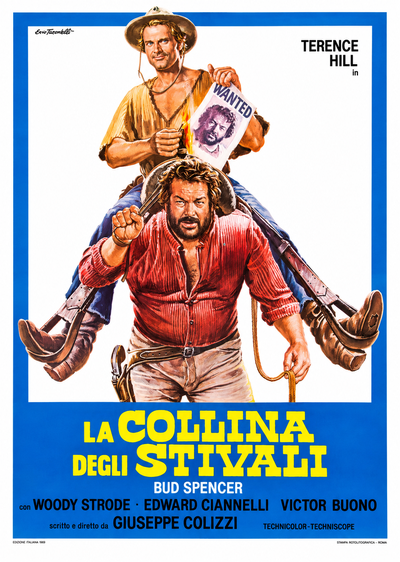
Ezio Tarantelli’s poster for Boot Hill (Giuseppe Colizzi, 1969)
The division of labour is clear from the start. Cat Stevens (Terence Hill) sits astride the shoulders of Hutch Bessy (Bud Spencer) like a man on a carthorse, idly setting fire to a wanted poster to pass the time. The giant underneath clenches a fist and trudges on without making a fuss. Terence may be higher up, but the whole weight of the picture rests on Bud: one has the ideas, the other has the shoulders. Audiences would soon learn to trust the horse rather more than the rider. The film reached English-speaking cinemas as Boot Hill.
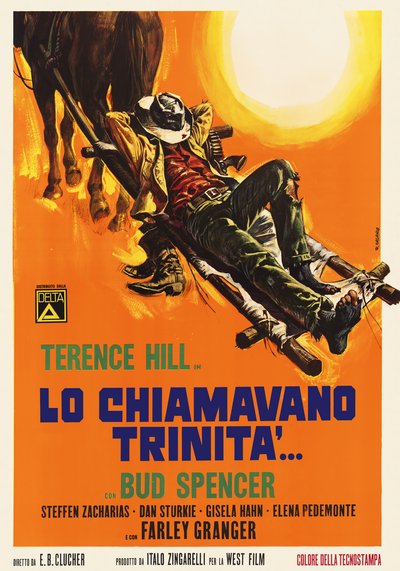
Renato Casaro’s poster for They Call Me Trinity (E.B. Clucher, 1970)
Here Bud Spencer is missing altogether. His name is there, near the bottom, after a rather modest ‘con’, like a relative invited at the last minute. The whole scene belongs to Trinity (Terence Hill), sprawled on a travois dragged by his horse beneath a white sun that looks suspiciously like a fried egg. Yet the absence works like a magnet: audiences were waiting for Bambino, Trinity’s brother and a self-appointed sheriff, to bring his mighty slaps down like a lid on a saucepan. It is the only time a painter could afford to leave him out. In They Call Me Trinity the missing man became the reason to buy a ticket, and it never happened again.
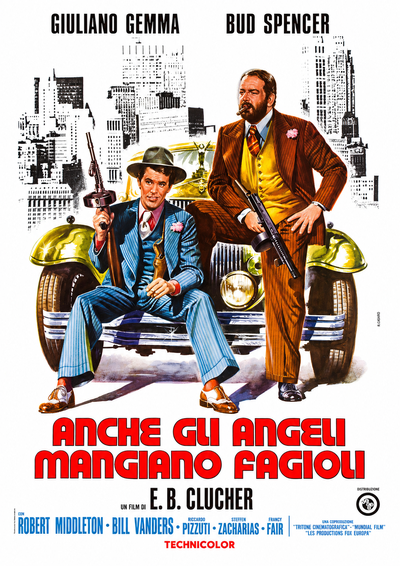
Renato Casaro’s poster for Even Angels Eat Beans (E.B. Clucher, 1973)
A new partner means a new pose, but the same man. Sonny (Giuliano Gemma) perches on the wing of a vintage car, tommy gun in hand; Charlie Smith (Bud Spencer) stands beside him with a cigar, one hand on his hip and a machine gun held as casually as an umbrella. He doesn’t shoot, he doesn’t threaten: he leans. In that mustard waistcoat and buttonhole carnation he looks less like a New York gangster than a publican on fête day. Casaro gives us a good man dressed up as a heavy, and the title, Even Angels Eat Beans, finishes the job. No genuinely wicked man has ever been that keen on pulses.
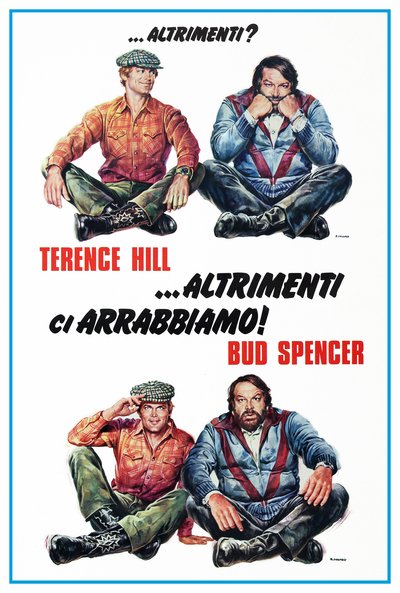
Renato Casaro’s poster for Watch Out, We're Mad (Marcello Fondato, 1974)
Two pairs, two lots of crossed legs, like a spot-the-difference puzzle at the back of a Sunday paper. At the top, Kid and Ben (Terence Hill and Bud Spencer) ask ‘...or else?’; at the bottom, the title answers. Up top, Bud rests his chin on his fists and counts to ten; below, his hands are already on his knees, ready to push himself up. It is a countdown in two frames: Bud’s patience is long, but not infinite, and audiences bought tickets precisely to see where it ran out. The famous dune buggy, star of Watch Out, We’re Mad!, is nowhere in sight. The pose is threat enough.
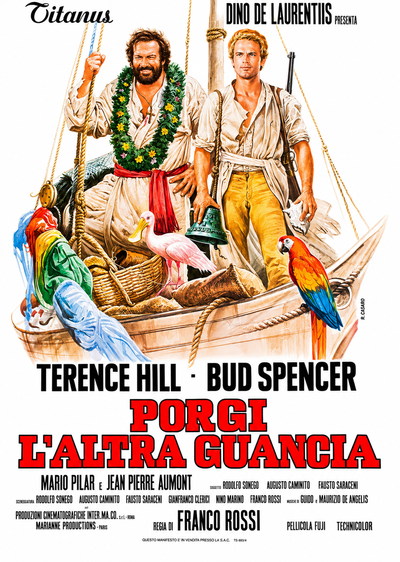
Renato Casaro’s poster for The Two Missionaries (Franco Rossi, 1974)
Two missionaries in a boat piled high with baskets, chickens, a pelican and a parrot. Father Pedro (Bud Spencer) sports a garland of flowers and the beam of a man welcomed like royalty; Father J. (Terence Hill) clutches a bell that may summon the faithful or, more likely, the opposition. Casaro honours the Gospel title, ‘turn the other cheek’: not a fist in sight, just peace and pelicans. Audiences, however, knew exactly what they were in for. In a Bud Spencer film you may certainly turn the other cheek. It just tends to be the other fellow’s.
When he does move
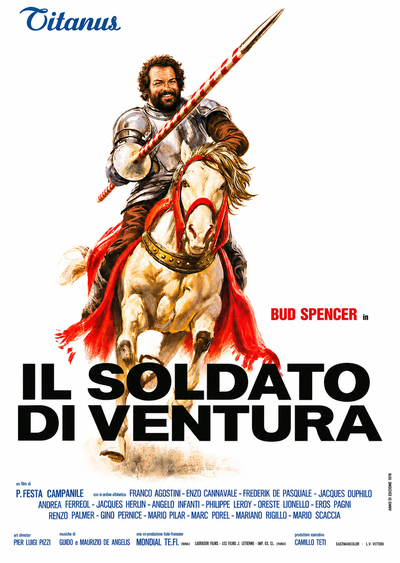
Averardo Ciriello’s poster forSoldier of Fortune (Pasquale Festa Campanile, 1976)
Here, on the other hand, he moves at quite a lick, and tellingly the painter is not Casaro. Ciriello puts Bud Spencer in full armour as Ettore Fieramosca, hero of the Challenge of Barletta, on a white horse at full gallop with his lance aimed skywards. But look at his face: serene, faintly amused, as if the charge were entirely the horse’s idea and he had simply raised no objection. The horse supplies the motion, Bud the composure. Judging by its eyes, the horse is rather less relaxed about it. English-speaking audiences knew the film as Soldier of Fortune.
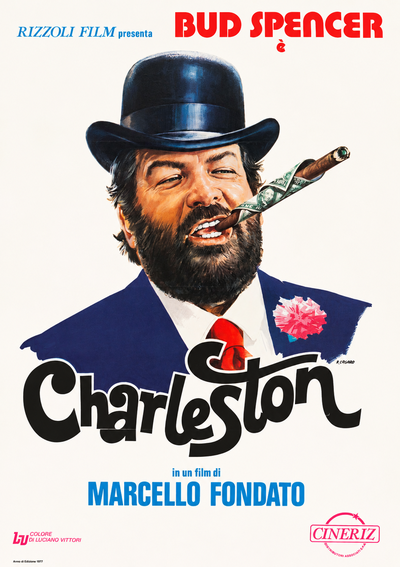
Renato Casaro’s poster for Charleston (Marcello Fondato, 1977)
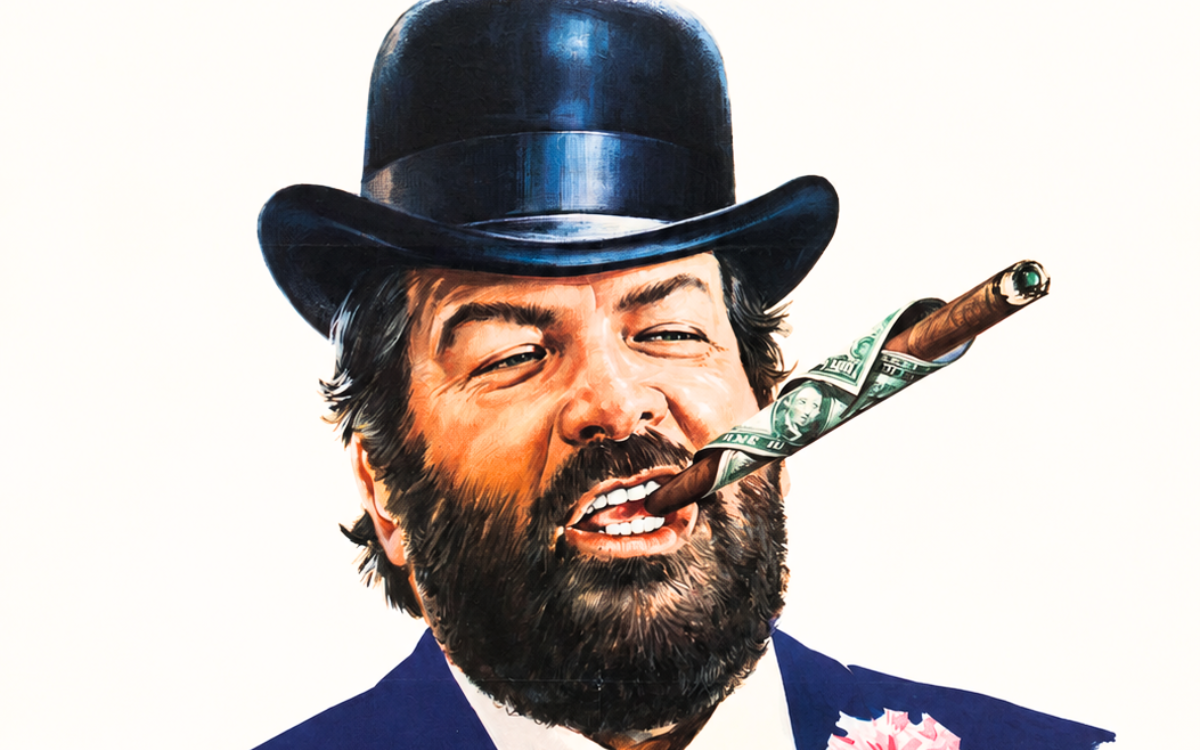
This time Bud is alone, and he is all head. Black bowler, pink carnation, red tie and, clamped between his teeth, a cigar rolled in a hundred-dollar bill: the most expensive way of smoking ever devised. We don’t catch the con man Charleston in the act. Casaro moves in close instead: half-closed eyes, the grin of a man who has just pulled it off. The bowler promises a gentleman; the banknote gives him away. No fists, no beans, just guile, and those who knew the man behind the beard, with his law studies and his nose for business, might say the mask was not so far from the truth.
Carrying everyone else
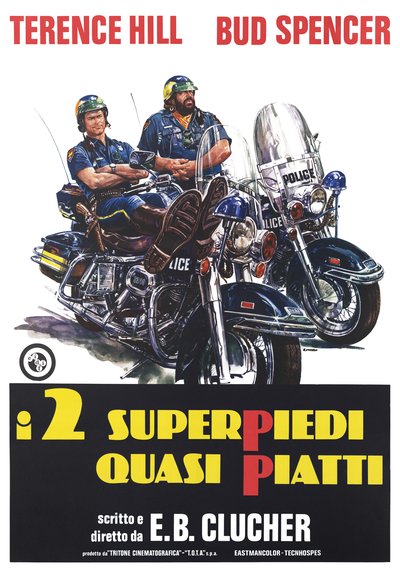
Renato Casaro’s poster for Crime Busters (E.B. Clucher, 1977)
Matt Kirby and Wilbur Walsh (Terence Hill and Bud Spencer), two Miami cops perched on a pair of hulking police motorbikes. Arms folded, boots up on the handlebars, and not the slightest intention of chasing anybody. Here the bikes are plinths. The Italian title pokes fun at their flat feet; the poster pokes fun at the very idea of action, and Bud’s sidelong glance is that of a man waiting for crime to come to him, ideally after lunch. Given his methods, crime would have been wise to stay at home. English-speaking audiences knew the film as Crime Busters, which seems generous.
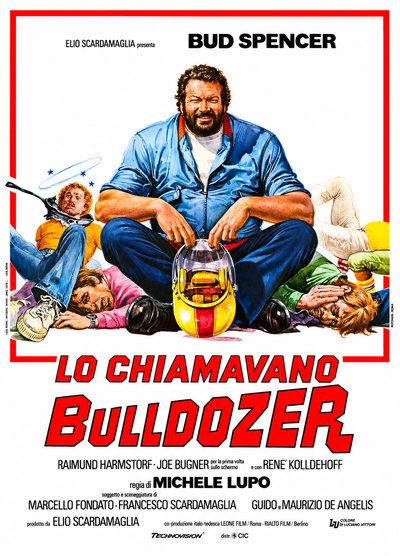
Renato Casaro’s poster (attributed) for They Called Him Bulldozer (Michele Lupo, 1978)
The title winks at Trinity, but this time the nickname is all his, and the poster takes it literally. Bulldozer, a former American football star, sits squarely in the middle with a helmet in his hands, surrounded by the wreckage of several young men: one flat out, one with his legs in the air, one sailing off amid cartoon stars. Nobody saw him throw a punch. The painter skips the fight and goes straight to the aftermath: a ring of fallen bodies and the contented look of a man who has just dealt with a minor chore. The smile, mind you, is pure favourite uncle: the kind who sorts you out and then buys you an ice cream. The film was released in English as They Called Him Bulldozer.
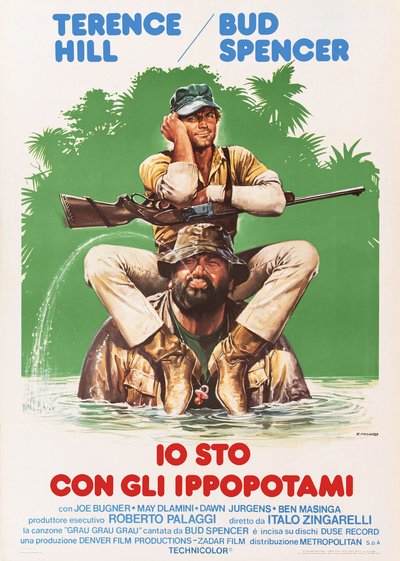
Renato Casaro’s poster for I'm for the Hippopotamus (Italo Zingarelli, 1979)
Ten years after Boot Hill, the pecking order hasn’t budged, and it is plainer than ever. Slim (Terence Hill) sits on the shoulders of Tom (Bud Spencer), rifle across his lap and cheek propped on one hand, looking faintly bored. Tom stands chest-deep in the river, holding him up without so much as a blink, while a jet of water arcs in from a hippo just out of shot. The title, I’m for the Hippopotamus, suggests the comparison; Casaro makes it unmissable. Bud is the hippo of the partnership: vast, apparently placid, and best not provoked. For a former Olympic swimmer, standing in a river with a friend on his shoulders must have been the cushiest day’s work of his career.
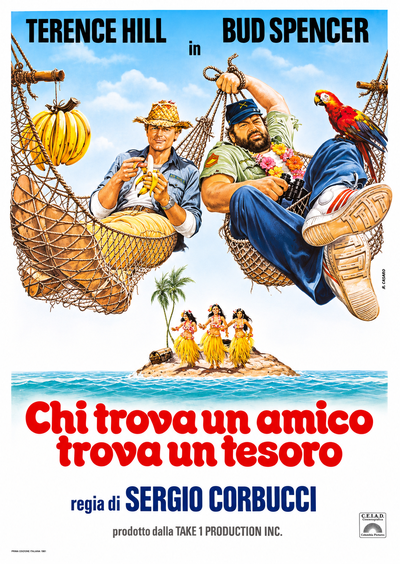
Renato Casaro’s poster for Who Finds a Friend Finds a Treasure (Sergio Corbucci, 1981)
When there is nobody left to sort out, even the centre of the universe is allowed a breather. Alan (Terence Hill) and Charlie (Bud Spencer) dangle over the sea in two hammocks, like a pair of ripe fruit. Terence peels a banana; Bud, in a flower garland and trainers, scans the horizon through binoculars, a parrot perched on the rope beside him. What has caught his eye? On a little island below, three dancers in grass skirts. The action stays outside the picture; inside there is only the fine art of doing nothing in good company. The treasure of Who Finds a Friend Finds a Treasure, evidently, comes in many forms.
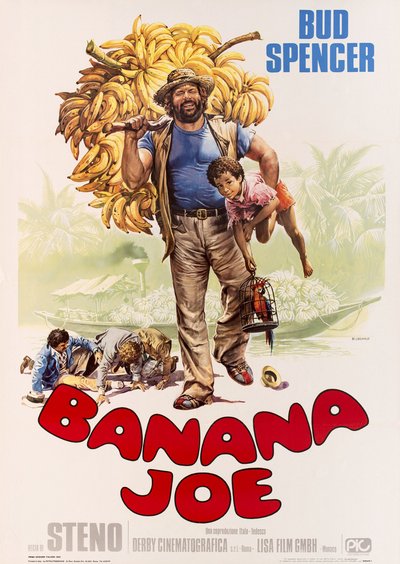
Renato Casaro’s poster for Banana Joe (Steno, 1982)
And here come the bananas, this time in industrial quantities. Banana Joe carries a colossal bunch over one shoulder, practically a whole tree, and under his other arm a small boy who is himself clutching a caged parrot. At his feet, three unfortunates in suits crawl through the dust, presumably in search of their dignity. The whole man in a single picture: he shoulders the work, the little ones and even the wildlife, and leaves the bullies on the floor. Casaro has him walk slowly, at the pace of a man carrying a load that doesn’t tire him. Those who knew him say he was much the same off screen: generous by nature, with a pair of shoulders always available to somebody.
The final rounds
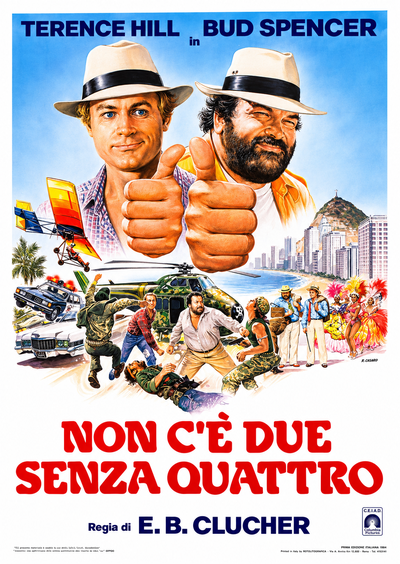
Renato Casaro’s poster for Non c’è due senza quattro (E.B. Clucher, 1984)
The Italian title gets its sums right: Terence Hill and Bud Spencer each play two parts, which makes four. Up top, enormous, the pair in white panamas give us a double thumbs-up, motionless as a couple of pop deities and as reassuring as two old friends who have already booked the restaurant. Down below, in miniature, all hell breaks loose: a helicopter, airborne cars, a hang-glider, the carnival and the skyline of Rio de Janeiro. There is even a tiny Bud in the thick of the scrap, though he is little more than a detail. The big one stays up there, perfectly still, signalling that all is well. English-speaking audiences knew the film as Double Trouble.
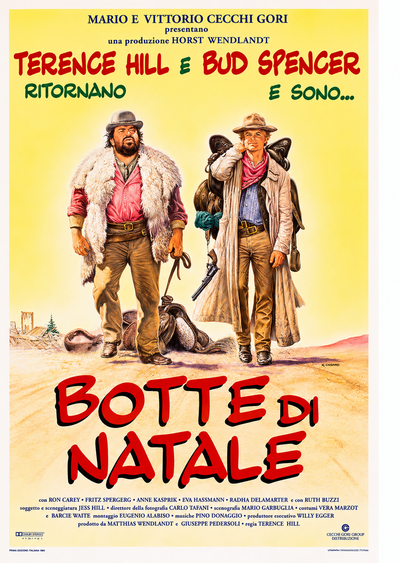
Renato Casaro’s poster for Botte di Natale (Terence Hill, 1994)
Twenty-five years after Boot Hill comes the pair’s last film together, directed by Terence Hill himself. And something happens here that deserves to go on the record: for the first time, Terence is the one carrying the load. Travis strides along with a saddle on his back; beside him his brother Moses, that is Bud, walks empty-handed, wrapped in a fur coat that looks like an entire bear, his own saddle left comfortably on the ground. It took a quarter of a century and a few grey hairs, but the accounts are finally settled. Among the producers, in the small print at the bottom, is Giuseppe Pedersoli, Bud’s son. Once again, a Pedersoli was taking the weight.
Laid side by side, these fourteen posters tell a simple story, one the poster painters grasped long before most critics. Bud Spencer never needed to run: everything around him was running already. He was the centre of gravity, solid as a monument and patient as a patriarch, with friends on his shoulders and bananas in his arms. Anyone who saw him on a wall knew that inside the cinema nobody would get seriously hurt and everybody would leave in a better mood. Which is why, all these years later, audiences have just one word for him. The same one he chose to say goodbye.
The works reproduced on this page come from period prints, recovered, photographed and digitally restored by Movie.it.
You may also like
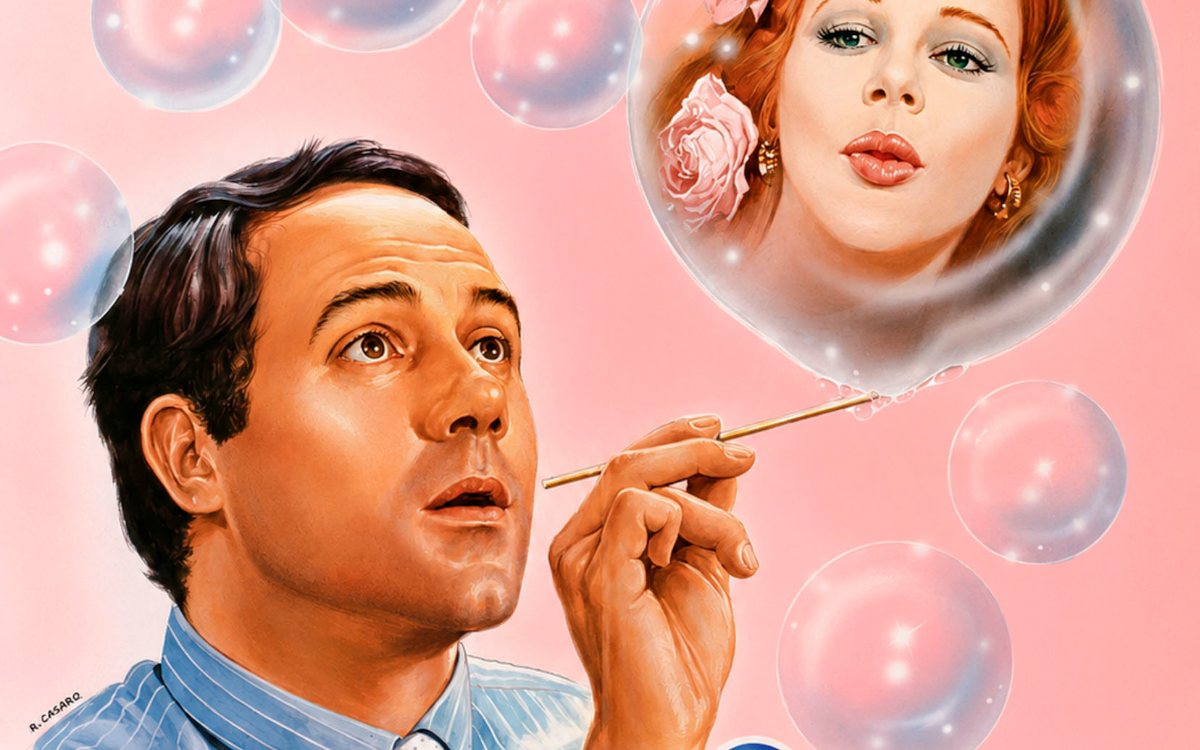
The Art of Renato Casaro, the Last Master of Cult Movie Posters

Averardo Ciriello, Master of Italian Movie Posters