Michelangelo Papuzza, the Painter with a Designer's Eye
By the Movie.it Editorial Team
October 14, 2026
A Signature Worth Discovering
Little is known about Michelangelo Papuzza beyond the extraordinary images he left behind. There are no reliable biographical dates, no known interviews and no monograph. His name is more likely to surface in an international auction catalogue than in a history of cinema, usually alongside one film: Star Wars. But look beyond that celebrated poster and a strikingly versatile artist comes into focus. Among Italy’s Pittori di Cinema, the name Maurizio Baroni gave to this generation of film poster painters, Papuzza had an especially modern eye. He moved easily between pop art, optical illusion, psychedelic Art Nouveau and adventure comics, always building his compositions around a strong graphic idea.
Sometimes signed PAPUZZA in block capitals, sometimes in a loose cursive hand, his known body of work spans from at least the mid-1960s to the late 1970s. Distributors including Unidis and the Italian arm of Twentieth Century-Fox chose his designs.
Making Colour Do the Work
Papuzza understood that a poster had to make its point at a glance. Instead of building every form through carefully shaded modelling, he often turned to flat colour, sharp contrasts and instantly readable silhouettes. His design for the Italian 1965 re-release of Sergio Leone's A Fistful of Dollars (1964) is a case in point. Under the brim of his hat, Clint Eastwood's face divides into red and blue, with the punch of a pop-art screenprint. The poncho becomes a pattern of brightly coloured geometric borders. Leone's Man with No Name is no longer merely a western hero. He is a graphic icon. Papuzza's work also appears on The Good, the Bad and the Ugly (1966), linking his name to two chapters of the Dollars trilogy.
For Jacques Tati's Playtime (1967), Papuzza found a different visual language. Concentric black-and-white squares draw the eye into an optical tunnel. At its centre, brightly coloured figures spin and multiply; beside them, a cut-out photograph of Tati surveys the spectacle. It is a witty piece of collage that catches the film's obsession with geometry, repetition and the bewildering life of the modern city.
When the Line Takes Over
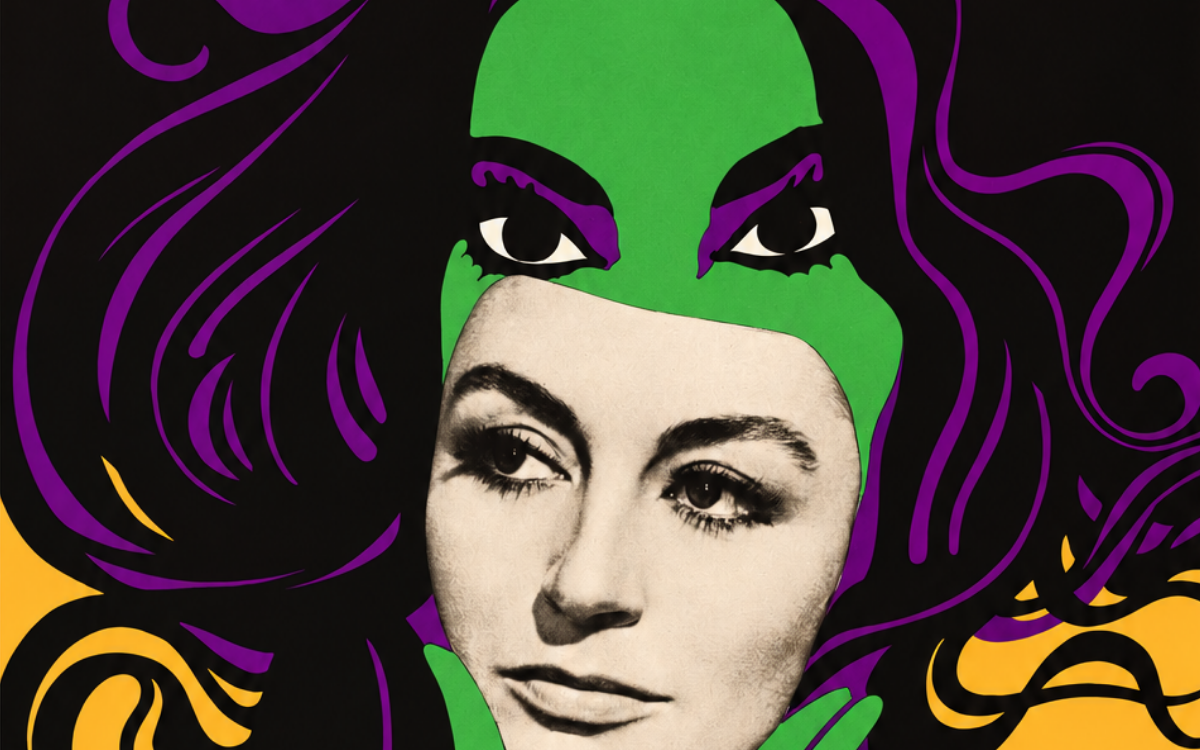
Psychedelic graphics brought Art Nouveau's curling lines back into fashion in the late 1960s, and Papuzza knew exactly what to do with them. For George Cukor's Justine (1969), drawn from the world of Lawrence Durrell's Alexandria Quartet, he placed a black-and-white photograph of Anouk Aimée's face inside a flat green silhouette. Black and violet hair spills outward in sweeping curves. The result could almost be a poster for a San Francisco rock concert.
Those curves return with even greater freedom in Franco Rossetti’s The All-Naked Horse (1972), one of the bawdy period comedies that followed in the wake of the Decameron craze. Papuzza sidestepped the genre’s obvious visual jokes. Instead, he imagined a creature part woman, part mare, with blonde hair turning to flames and a body filled with tiny medieval scenes like pieces of stained glass. The result is a playful, richly detailed image that brings an unexpected touch of sophistication to the genre.
A Distinctly Italian Star Wars
For many collectors, Papuzza means one image: the poster created for the original Italian release of Star Wars in 1977. Its science-fiction universe looks unexpectedly close to an old-fashioned adventure epic. Luke Skywalker stands bare-chested, draped in green like a sword-and-sandal hero. Princess Leia wears flowing white drapery; the droids, Chewbacca and Darth Vader’s menacing helmet crowd the scene. Everything is rendered in the clean outlines and vivid colours of an adventure comic, against a black circle scattered with stars and planets. It is a strikingly original take on science fiction, filtered through the visual language of Italian adventure cinema.
The final design was not Papuzza's only attempt. He also painted four alternative concepts in tempera, several of which have acquired lives of their own. One appeared on the cover of the Italian Star Wars novel issued by Club degli Editori in 1978. Another was reproduced on a 1993 Topps "Star Wars Galaxy" trading card, featured in Star Wars Art: Posters (2014) and used for a 2017 fortieth-anniversary poster. In February 2024, an original study sold at Finarte in Rome for €28,800, including the buyer's premium. Papuzza's vision has become part of the visual history of a phenomenon far larger than the Italian cinema market in which he worked.
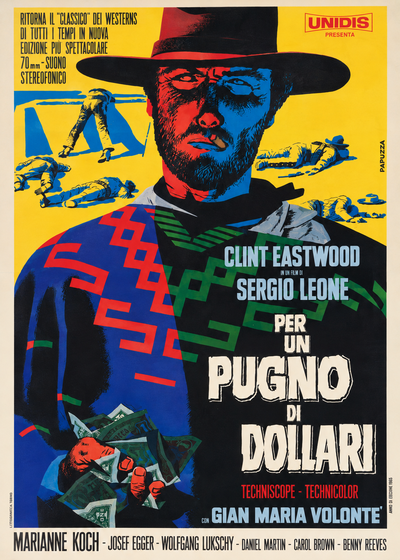
A Fistful of Dollars (Sergio Leone, 1964)
The poster for A Fistful of Dollars splits a gunman’s face into blocks of red and blue beneath the deep shadow of his hat. Black hatching picks out the lines of his face, while the poncho spreads across the foreground in a bold pattern of green and red geometric motifs. A fistful of banknotes appears at the bottom; further back, fallen men are reduced to small blue shapes against a brilliant yellow ground. The oversized face and flat, forceful colours command attention at once, while the miniature figures suggest a wider scene without distracting from the central image.
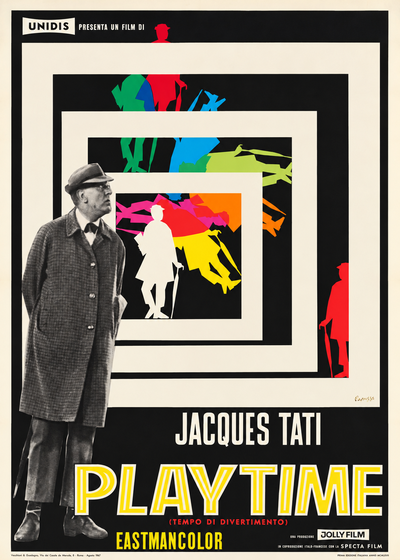
Playtime (Jacques Tati, 1967)
The poster for Playtime draws the eye into a tunnel of concentric black-and-white squares. At its centre, brightly coloured figures in hats and carrying umbrellas spin and overlap like the spokes of a pinwheel, repeating in red, yellow, green, blue and magenta. Off to one side, a cut-out black-and-white photograph shows a similar figure in profile, apparently looking in on the spectacle. The contrast between the photographic image, the flat painted silhouettes and the illusion of depth creates a composition that feels both meticulously ordered and delightfully disorienting.
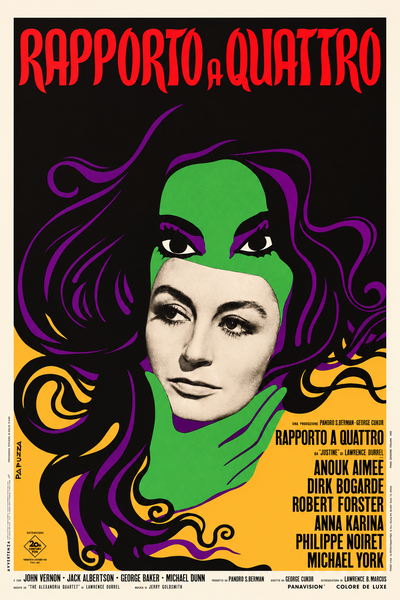
Justine (George Cukor, 1969)
The poster for Justine sets a black-and-white photographic face inside a head painted in a single vivid green. A green hand supports the chin, while great ribbons of black and violet hair curl outwards towards the edges of the composition. Behind them, the dark background gives way to warm orange near the bottom. The photograph lends the face an unsettling immediacy, but the flowing outlines and blocks of unmodulated colour pull the image towards the decorative, psychedelic style of the late 1960s.
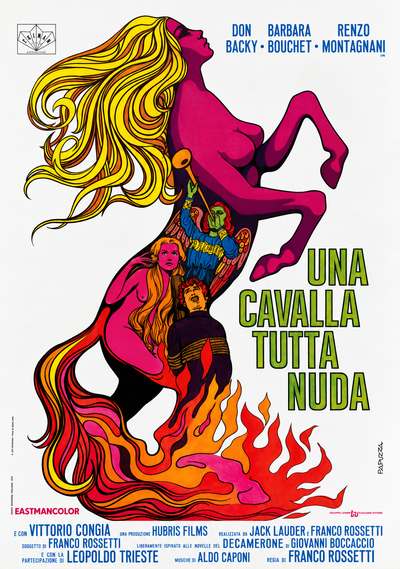
The All-Naked Horse (Franco Rossetti, 1972)
The poster for The All-Naked Horse is dominated by a rearing magenta creature, half woman and half horse, her head thrown back as long blonde hair tumbles down the left side and bursts into orange and red flames. Small medieval-style scenes fill the silhouette: an angel with a trumpet, a nude woman and a man bound with rope. Each appears almost like a miniature trapped inside a stained-glass window. A continuous black outline gives the intricate design its shape, while the sweeping curves keep the entire image in motion.
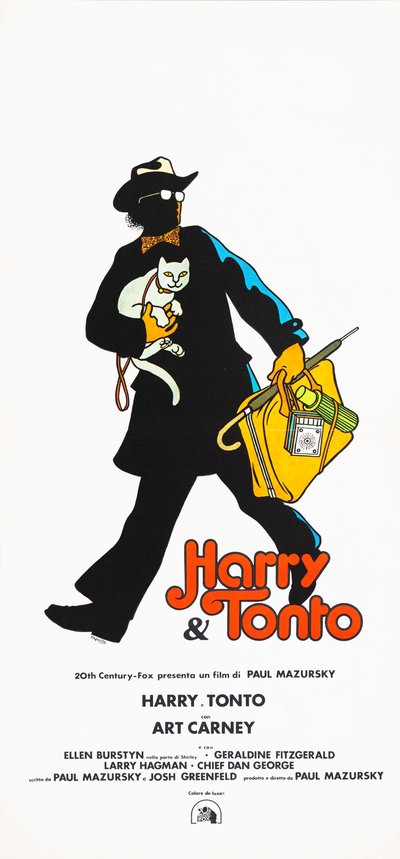
Harry and Tonto (Paul Mazursky, 1974)
The "locandina" (Italian small format) for Harry and Tonto makes striking use of empty space. Across an almost completely white background strides an elderly figure rendered as a black silhouette, interrupted by a hat, spectacles, a patterned bow tie and yellow hands. A white cat with bright yellow eyes rests beneath one arm, its lead dangling freely. In the other hand are a yellow travelling bag, an umbrella, a small radio and a flask. The clustered objects follow the direction of the stride, setting an unexpectedly lively rhythm against the quiet expanse of white.
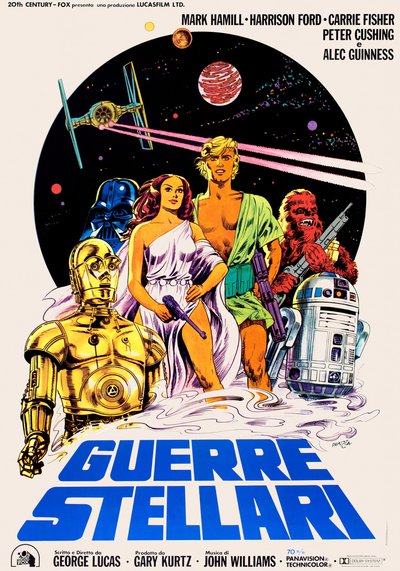
Star Wars (George Lucas, 1977)
The poster for Star Wars places a crowded group of figures against a vast black disc scattered with stars and tiny coloured planets. A white cloud rises from below, revealing a bare-chested young hero in green, a woman in flowing white, two droids and an armed, furry creature, with a dark helmet looming behind them. High above, a spacecraft fires two pink beams diagonally across the scene. Crisp outlines, saturated colours and a bold, almost heraldic arrangement give the composition the exuberance of a classic adventure illustration.
The Power of Less
Then consider the locandina for Paul Mazursky’s Harry and Tonto (1974), made for its 1979 Italian release. Suddenly the spectacle is gone. There is no galactic backdrop, no crowd of figures, just an elderly man walking with a cat tucked under his arm. The black silhouette stands against an almost entirely white background. A few small flashes of colour convey both his stubbornness and his warmth.
That may be Papuzza’s greatest strength: knowing what to leave out. Photography, geometric patterns, sinuous Art Nouveau lines, comic-book illustration: each was simply another way of giving a clear idea its strongest possible form. More than half a century later, that instinct for clarity still gives his posters their remarkable vitality.
The works reproduced on this page come from the original prints of the period, recovered, photographed and digitally restored by Movie.it.
You may also like
Rodolfo Gasparri, a Painter of Originality and Simplicity
Sandro Symeoni, from Seductive Figures to Social Dramas