Marino, the Artist Behind the Posters for “Out of the Past” and “The Outlaw”
By Paolo Zelati
October 9, 2026
For many years, Marino Gramaticopulo's name was all but hidden in the signatures tucked into the corners of old film posters. Today, those images help us piece together the extraordinary story of a painter who moved between countries and artistic worlds, working for French and American cinema long before the golden age of the Italian film poster. Gaps remain in his biography: neither his exact birthplace nor a documented account of his artistic training has been established with certainty. Much of what we know about his life comes from family recollections, while poster archives and catalogues of surviving works, including those sold at auction, offer a record of his career. Bringing these private and documentary sources together reveals a surprisingly coherent portrait of the man and the artist.
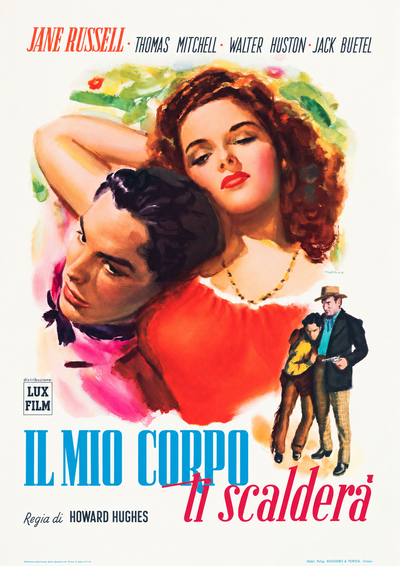
The Outlaw (Howard Hughes, 1943)
The two-sheet poster for The Outlaw (Howard Hughes, 1943) places Jane Russell and her co-star at the centre of the composition, their pose both tender and sensuous. Their thoughtful expressions suggest a love story shadowed by tension and obstacles. The delicately painted figures have an almost dreamlike quality, brought into sharper focus by the vivid red of Russell’s dress. At the lower right, two men fighting introduce a more immediate note of drama.
Origins and Training
Marino was born in 1900 into a large family of Istrian origin. His father, a doctor, had eleven children, perhaps twelve; several died in infancy. Among his brothers was Ernesto, an unconventional figure in his own right, who left the Austro-Hungarian navy during the First World War to join the Italian air force. The family carried memories of a generation shaped by war, shifting borders and the collapse of the Austro-Hungarian Empire. Marino showed a gift for drawing and painting from an early age. Family accounts remember him above all as a talented portraitist, a skill that would later prove invaluable in his work as a poster artist. Before becoming a full-time painter, however, he followed a very different path, working as a radio operator aboard an English ship.
In 1922, he left Italy for Paris, one of the great centres of European artistic life, where a young painter could learn, test his abilities and perhaps make his name. For Marino, however, these were also years of real hardship. He lived in poverty and at one point was reduced to asking a local baker for bread. The baker took a liking to him and fed him free of charge for a time.
The Paris Years
Those years in France are crucial to understanding Marino's career. Records held by the Bibliothèque nationale de France show that he did not turn to cinema only later in life: he was already designing film posters in the 1930s. The BnF holds two posters attributed to him, Le mari garçon (1933) and Baccara (1935), made for A.C.E. In both cases, the institution explicitly describes him as an 'affichiste de cinéma'. These early works belong to a wider group of posters attributed to Marino for French cinema in the second half of the decade. Among those recorded today are Remous and Baccara (1935); La belle équipe, Club de femmes and Razumov: Sous les yeux d'Occident (1936); L'homme de nulle part, L'alibi and Claudine à l'école (1937); and Quadrille, Wives Under Suspicion and The Renegade Ranger (1938). Particularly striking is La belle équipe, directed by Julien Duvivier in 1936 and starring Jean Gabin and Viviane Romance. These early posters already reveal a feature that would recur in his Italian work: placing the actors' faces at the heart of the composition.
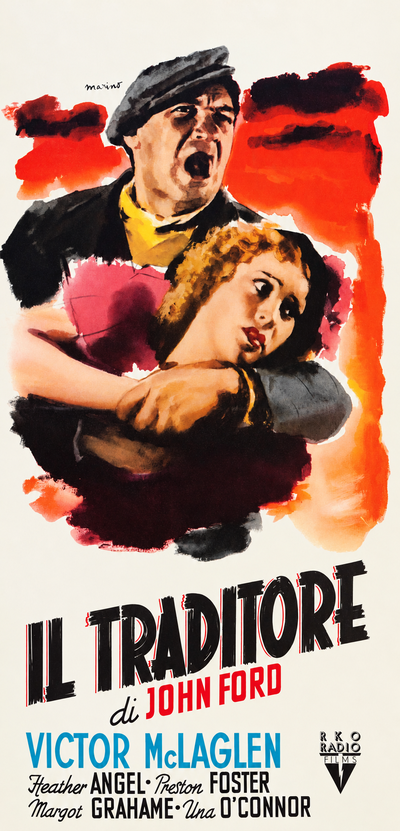
The Informer (John Ford, 1935)
The "locandina" (Italian small format) for The Informer (John Ford, 1935) captures the tension of John Ford’s film at a glance. Victor McLaglen, his face contorted and mouth open, grips a screaming woman in an almost violent embrace. The red and brown background seems to engulf them in flames. Above all, the poster reveals Marino’s gift for portraiture and his ability to convey emotion through the actors’ expressions.
The Portrait at the Heart of the Work
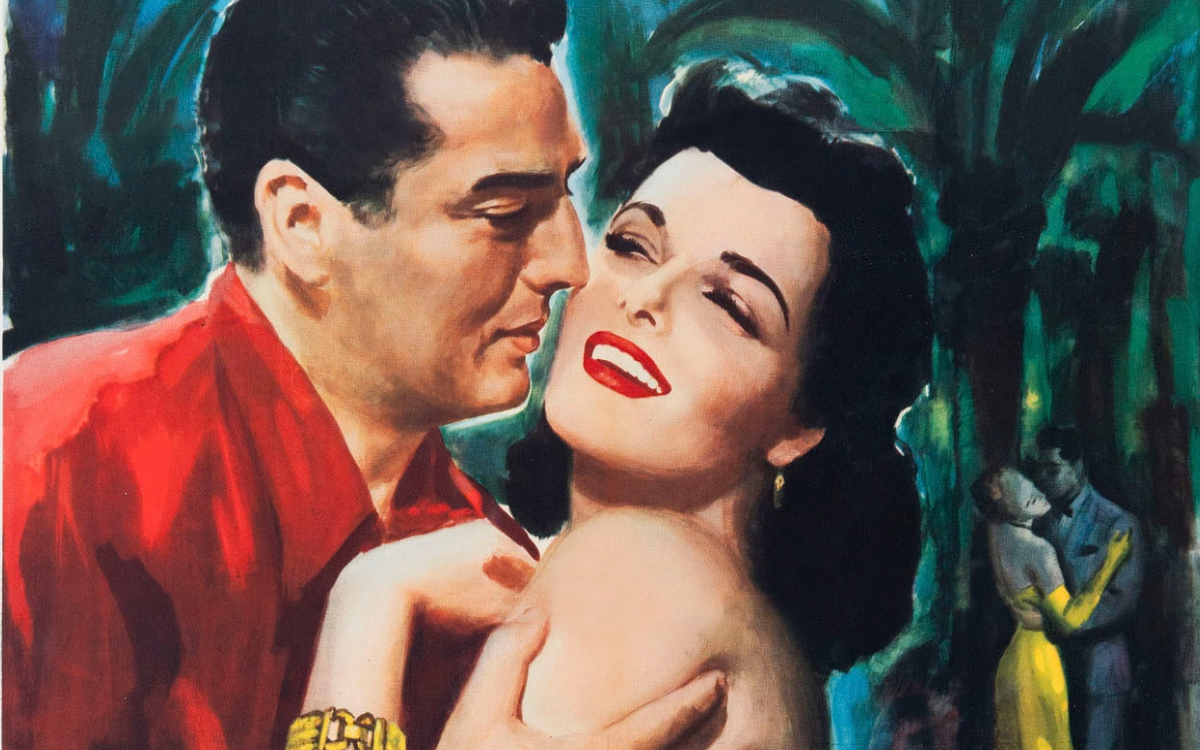
Cinema offered Marino an ideal outlet for the talent his family had always recognised: his gift for portraiture. A film poster demanded more than the ability to illustrate a scene. The artist had to make an actor instantly recognisable, emphasise distinctive features and create a likeness powerful enough to catch the eye from a distance. In Marino's posters, faces increasingly take centre stage, conveying the characters' emotions and often the mood of the film itself. One example is the close-up of Robert Mitchum on the two-sheet poster for Out of the Past. Yet life in Paris remained difficult. In 1939, as war broke out in Europe, Marino decided to leave France and return to Italy. His journey is one of the most remarkable episodes preserved in family memory. Unable to afford conventional transport, he built a small handcart, loaded it with his belongings and set off on foot, using the cart as a makeshift shelter at night. About a month later, he reached Bolzano, where his sister Anita lived, still wearing the clothes in which he had left Paris. She even had to find him a clean change of underwear. From Bolzano, he travelled to Rome and found an unusual place to live: a greenhouse near the Via Appia, which became both his home and his studio. What began as a practical solution became the centre of his Roman life, where he painted, lived and welcomed visitors.
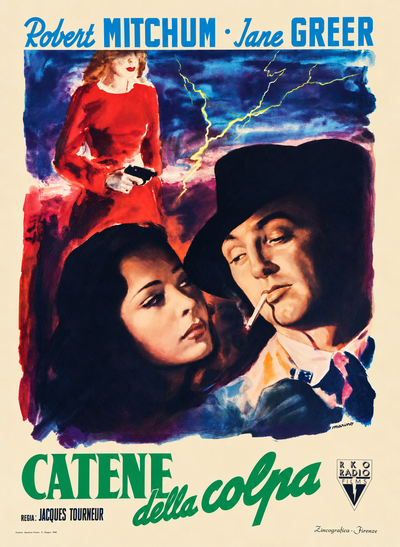
Out of the Past (Jacques Tourneur, 1947)
The two-sheet poster for Out of the Past (Jacques Tourneur, 1947) draws its power from close-ups of Robert Mitchum and Jane Greer and the exchange of glances between them. Marino brings together mystery, danger and an unsettling sensuality in their faces. The result is a striking painted distillation of the mood of American film noir.
The Rome Years: Hollywood and the Star System
His professional career can be traced more precisely in Rome. Contrary to what family recollections might suggest, Marino had begun designing film posters before the Allies arrived. Records from 1941 identify two posters produced in Rome, L'attore scomparso and Il pozzo dei miracoli, both starring Vivi Gioi and printed in four-sheet colour lithography by the APE studio. The greenhouse near the Via Appia also served as his portrait studio. After Allied forces entered Rome, American servicemen began bringing him photographs of wives and sweethearts back home, which he turned into painted portraits. One family anecdote is particularly revealing. An American colonel, delighted with his portrait, asked how much he owed. Speaking mostly in his Istrian dialect, Marino managed to explain that he needed no money, only food. The next day, a US Army lorry laden with provisions pulled up outside the greenhouse.
After the war, his output expanded considerably, particularly through posters for American films. Works listed in international archives include The Outlaw, Out of the Past, La città del piacere, La bella e la bestia, Femmina, Golden Earrings, Night and the City, Infedelmente tua and The Informer. Marino seems to have been especially drawn to stars. Robert Mitchum, Jane Greer, Marlene Dietrich, Gene Tierney, Spencer Tracy, Katharine Hepburn and others are rarely treated as mere elements of a composition; their faces often become its main focus. This visual language was ideally suited to post-war popular cinema, when an actor's name and face were among a film's greatest attractions. Marino instinctively understood the appeal of the star system. His portrait of Jane Greer for the two-sheet of Out of the Past is a striking example. Rather than simply reproducing her features, the Italian poster captures the sensuality, ambiguity and danger of her character in a single image. Marino's gift for portraiture becomes a powerful storytelling tool, capturing the allure of one of American film noir's most memorable femmes fatales. A similar effect can be seen in his depiction of Gene Tierney for the two-sheet of Night and the City. In Golden Earrings, he portrays one of international cinema's most recognisable stars, Marlene Dietrich. For The Boy with Green Hair, by contrast, he turns to a very different subject, drawing on the colour and symbolic power of the young protagonist's image. This range makes it difficult to describe Marino simply as a 'film noir painter', a label sometimes attached to him because of his best-known work. Noir forms an important part of his surviving output, but he also worked on comedies, melodramas, adventure films, westerns and fantasy films. Take Without Love, the 1945 MGM comedy starring Spencer Tracy and Katharine Hepburn, for which he created the Italian four-sheet. Whatever the genre, the leading actors remained central to his compositions.
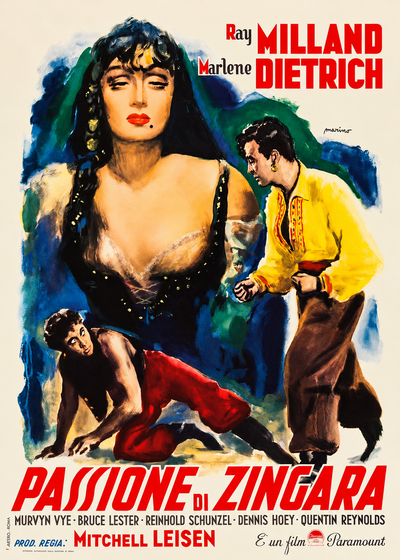
Golden Earrings (Mitchell Leisen, 1947)
The four-sheet poster for Golden Earrings (Mitchell Leisen, 1947) is dominated by Marlene Dietrich, whose face looms over two men fighting below. Her commanding presence heightens the sense of passion and rivalry, while the blue-green background adds to the dramatic tension. The composition shows how Marino could turn a star’s portrait into the centrepiece of a visual story.
The Life and Death of a Bohemian Painter
According to family recollections, Marino lived in the Via Appia greenhouse among numerous cats and with Gabriella, a woman he had met in difficult circumstances and taken into his home. She had lost a leg and wore a prosthesis. They never formalised their relationship, as the conventions of the time might have expected, and relatives regarded their arrangement as unconventional. More revealing than the anecdote itself is the independence it suggests: Marino appears to have lived largely outside the social rules of his day. The same spirit shaped his travels. When he wanted to visit relatives, he would leave Rome by bicycle, pulling a small trailer packed with a tent and a few essentials. It was more than an economical way to travel; it was a way of living entirely on his own terms. Even his attitude to food seemed to reflect a personal philosophy. Marino believed people should leave the table still a little hungry, arguing that a body never quite satisfied would retain its instinct for survival. The idea was probably not meant to be taken too literally, but it offers a glimpse of a man who saw deprivation not only as a hardship, but almost as a natural part of life. He maintained his habits into old age.
In 1978, at the age of seventy-eight, he was killed by a lorry. His life, spanning nearly eight decades of extraordinary change, had taken him from Istria to the sea, to Paris and Rome, and along the roads of Italy by bicycle. Yet his death did not consign his work to oblivion. His posters have steadily attracted renewed interest from collectors, appearing in specialist international catalogues and winning recognition as part of Italy's distinctive tradition of painted film posters.
Their historical significance lies in the meeting of two traditions: the European poster culture Marino encountered in Paris, and Italy's remarkable film poster industry, which developed its own pictorial language after the war, rooted in scale, spectacle and the transformation of actors into icons. Marino belonged to both worlds. He was already designing French film posters before the war; his return to Italy brought him into a period when posters were becoming a defining feature of the urban landscape. In his hands, cinema became painting: figures were enlarged, selected and simplified to create images that could be understood at a glance from the street.
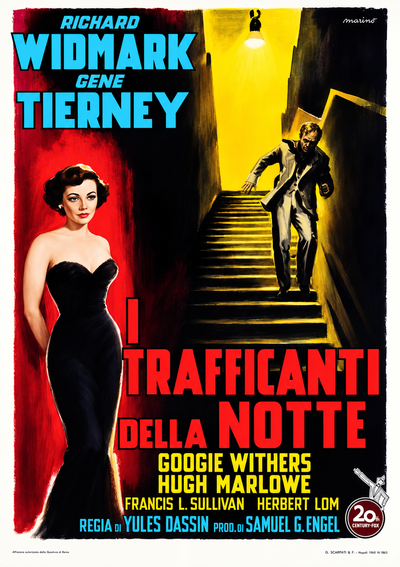
Night and the City (Jules Dassin, 1950)
The two-sheet poster for Night and the City (Jules Dassin, 1950) builds a powerful noir image from a palette dominated by yellow, red, black and brown. On the left, Gene Tierney leans against a wall, still and pensive; on the right, Richard Widmark runs down a steep, narrow flight of steps, caught in a blaze of yellow light. The contrast between the two figures gives the poster its dramatic rhythm and captures the film’s uneasy atmosphere.
Marino's Artistic Legacy
This approach is particularly clear in his posters for American films. Marino's Hollywood is not simply the Hollywood of official studio photographs and lobby cards, but one seen through the eyes of a European painter. Robert Mitchum becomes a monumental figure, Jane Greer a face filled with ambiguity, Gene Tierney an elegant yet troubled presence, and Marlene Dietrich an icon brought to life in paint. The poster becomes more than an advertisement: it offers another way of reading the film. For years, these images were probably regarded as little more than publicity material.
Seen together today, however, they reveal an artist who lived and worked at a turning point in the history of cinema and visual communication. Much about Marino remains to be discovered. We still lack a comprehensive archival biography, a full catalogue of his work and a systematic account of his careers in France and Italy. Yet the surviving evidence gives us a clear sense of his importance. His signature appears on posters held by the Bibliothèque nationale de France, while his works continue to attract interest at international auctions. Together, they point to a career far more extensive than the gaps in his biography might suggest. Rediscovering Marino's work means more than restoring a forgotten name to the history of film poster art. It brings us closer to an era when Italian film posters were still works of painting, interpretation and craftsmanship, rather than photographic reproductions. Marino was one of its most talented and compelling practitioners.
The works reproduced on this page come from the original prints of the period, recovered, photographed and digitally restored by Movie.it.
You may also like

Dante Manno, Powerful Figures between Classical Painting and Modern Graphic Art

Piero Ermanno Iaia, Between Figurative Art and Modernity