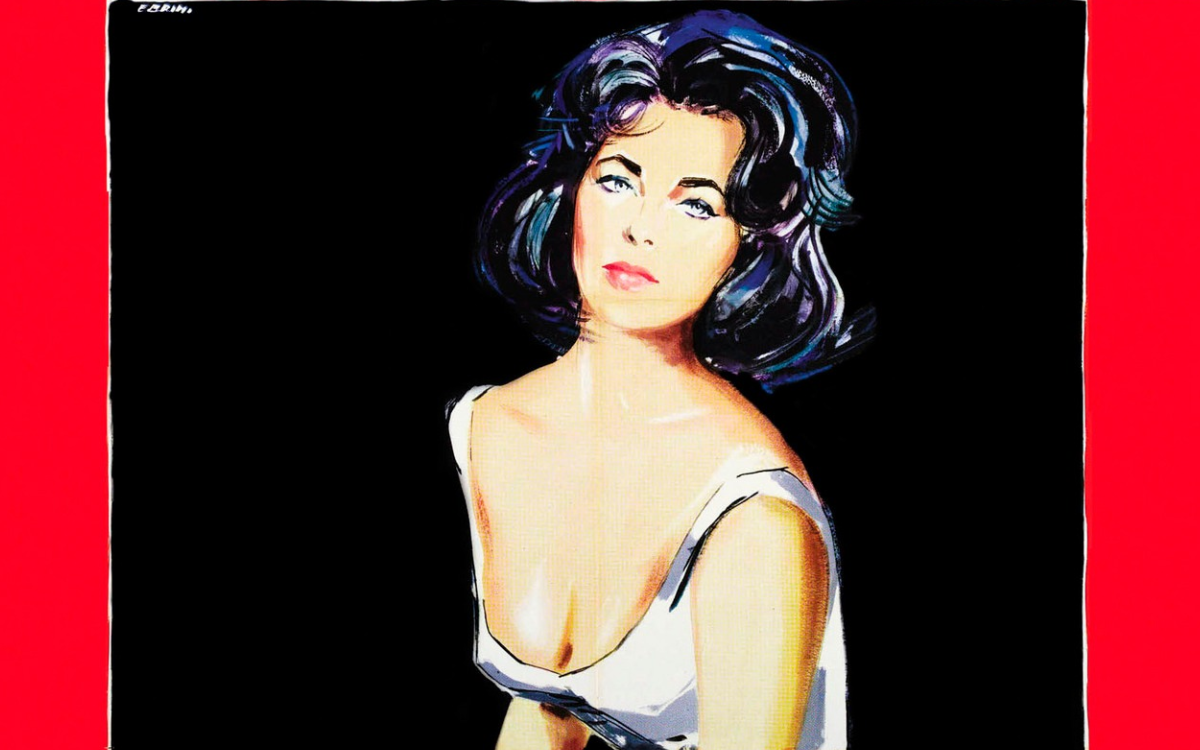
Elizabeth Rosemond Taylor was born in London on 27 February 1932 to American parents: her father was an art dealer, her mother a former stage actress. Shortly before the Second World War the family moved to Los Angeles. After a brief spell at Universal, she signed with Metro-Goldwyn-Mayer while still a child. Her blue eyes, often described as violet, and an extra row of eyelashes soon became part of her unmistakable image.
She won two Oscars, for Butterfield 8 (1960) and Who’s Afraid of Virginia Woolf? (1966). For Cleopatra she commanded a fee of one million dollars, unprecedented for an actress. She married eight times, to seven men, twice to Richard Burton. From the 1980s she lent her fame to the fight against AIDS; she also launched a fragrance line, collected extraordinary jewellery and was made a Dame in 2000. She died in Los Angeles on 23 March 2011, aged 79.
Across these seventeen period images, a pattern emerges. Italian poster painters often place Taylor at the centre, while the men appear at the edges, in smaller vignettes or in supporting roles. There are exceptions, but the recurring choice offers a way to trace both her screen career and the artists’ changing interpretations of her stardom over almost half a century.
A Girl, a Dog and a Wig
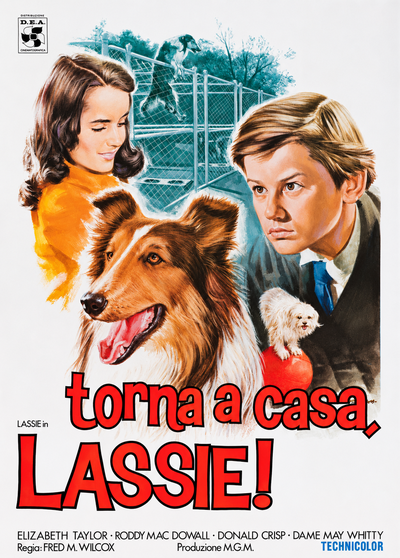
The poster by Ezio Tarantelli for Lassie Come Home (Fred M. Wilcox, 1943; later Italian release)
The centre belongs to Lassie, with Roddy McDowall as Joe beside her. Elizabeth Taylor, playing Priscilla, the Duke’s granddaughter, appears at the upper left in an orange jumper, wearing a polite smile. Her name, though, is already prominent: this poster comes from a later release, when the young performer had become a star. Lassie, incidentally, was played by a male collie called Pal.
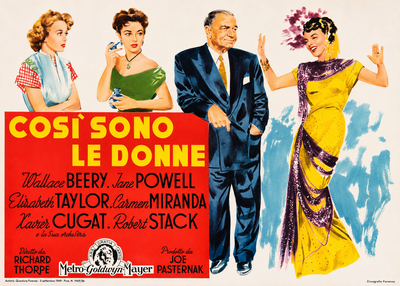
The fotobusta for A Date with Judy (Richard Thorpe, 1948)
At sixteen Taylor plays Carol Pringle, the wealthy, sophisticated rival of Jane Powell’s Judy. The illustrator arranges the cast in a group: Powell on the left, Wallace Beery in the centre and Carmen Miranda on the right. Taylor, in a green dress, raises a little blue bottle towards her face. It is an amusing detail in view of the fragrances she would launch decades later. More importantly, her features are already beginning to stand out in an ensemble composition.
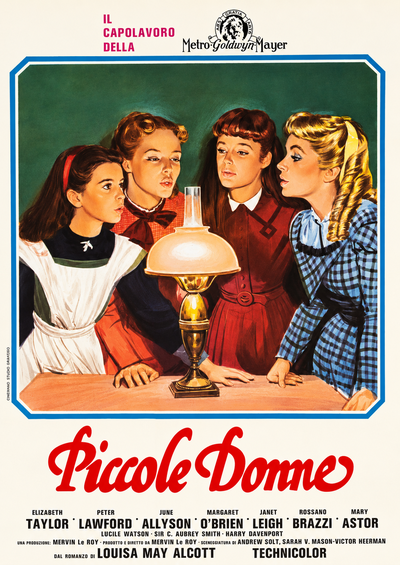
The poster by Mario Piovano for Little Women (Mervyn LeRoy, 1949)
To play Amy March, Taylor wore a wig of blonde curls. Mario Piovano gathers the four sisters around a lamp: June Allyson is Jo, Margaret O’Brien is Beth and Janet Leigh is Meg. The shared light brings them together, yet the blonde figure on the far right immediately catches the eye. Amy’s posture and expression suggest her ambition and vanity without needing to recount the plot.
Brides, Heiresses and Other Ceremonies
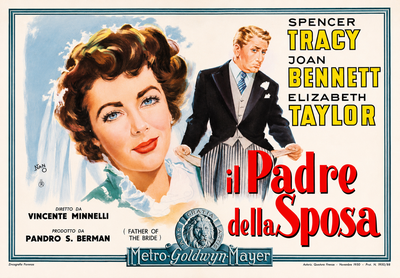
The fotobusta by Silvano Campeggi (Nano) for Father of the Bride (Vincente Minnelli, 1950)
In May 1950, as Father of the Bride opened in American cinemas, Taylor married Conrad ‘Nicky’ Hilton, heir to the hotel family. The timing could hardly have been better for the film’s publicity. Silvano Campeggi, known as Nano, divides the image in two: the bride’s face dominates the left, while Spencer Tracy, as the father faced with wedding expenses, turns out his pockets on the right. The bride takes the space, the father picks up the bill. The real marriage lasted less than a year.
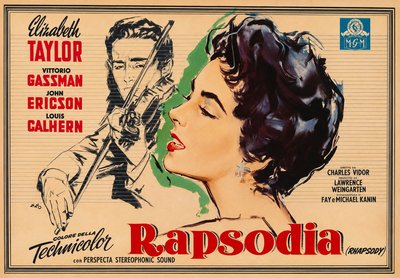
The fotobusta by Nano for Rhapsody (Charles Vidor, 1954)
Four years later Nano painted Taylor as Louise Durant, an heiress torn between a violinist and a pianist. Vittorio Gassman, as the violinist Paul Bronte, is sketched in black and white; the pianist played by John Ericson is absent altogether. All the colour belongs to Taylor’s profile, eyes closed and lips red. Rather than merely ranking the stars, the painting turns the melodrama into an image of longing and absorption.
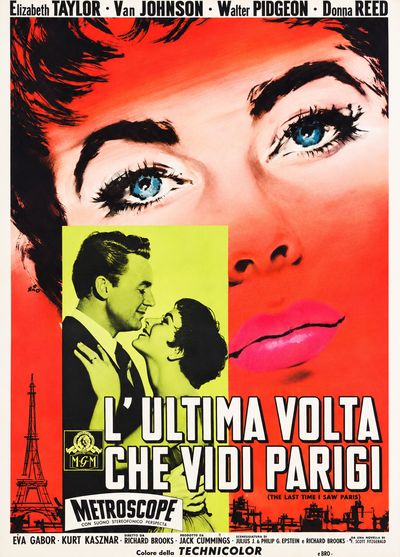
The poster by Nano for The Last Time I Saw Paris (Richard Brooks, 1954)
That same year Nano chose a still simpler design. Taylor’s face fills the sheet, suffused with red, her eyes looking directly at the viewer. The romance with Van Johnson’s character is reduced to a small yellow inset, and the Eiffel Tower is a faint suggestion in the background. Paris and the love story become clues; the portrait is the main attraction.
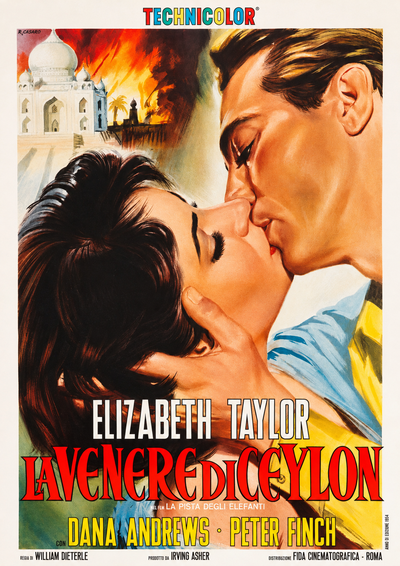
The poster by Renato Casaro for La Venere di Ceylon, a 1960s Italian re-release of Elephant Walk (William Dieterle, 1954)
During the making of Elephant Walk, Taylor replaced Vivien Leigh, who had to withdraw for health reasons. The story involves a tea plantation, an unhappy marriage, a possible lover and a herd of elephants. For the Italian re-release in the 1960s, retitled La Venere di Ceylon (‘The Venus of Ceylon’), Renato Casaro chose a close-up kiss and a house in flames. The elephants vanish. With the new title comes a new idea of what the poster should persuade audiences to see.
A Star, Many Interpretations
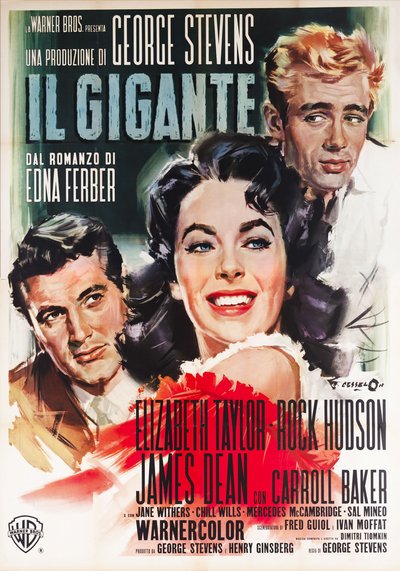
The poster by Angelo Cesselon for Giant (George Stevens, 1956)
In Giant Taylor plays Leslie Benedict in a story spanning decades of Texan life. Beside her are Rock Hudson as her husband Bick and James Dean as the future oil magnate Jett Rink. Dean died on 30 September 1955, before the film was released. Angelo Cesselon gives the three faces a clear hierarchy: Taylor smiles at the centre, Hudson sits lower left and Dean appears at the upper right, his gaze turned away. The poster captures the uneasy balance between the characters at a glance.
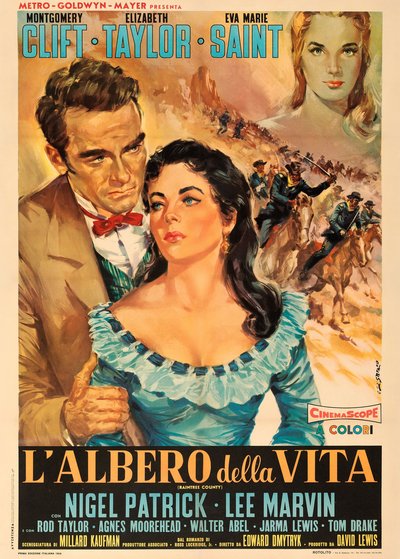
The poster by Giovanni Di Stefano for Raintree County (Edward Dmytryk, 1957)
During production, in May 1956, Montgomery Clift left a dinner at Taylor’s house and suffered a serious car accident. She was among the first to reach him, and filming stopped for weeks. In Giovanni Di Stefano’s picture Clift, as John Shawnessy, stands behind Taylor, who plays Susanna Drake. Her blue dress commands much of the space, while Eva Marie Saint, as Nell, is confined to the upper right. The artist compresses the romantic triangle into a single image, with the American Civil War in the background.
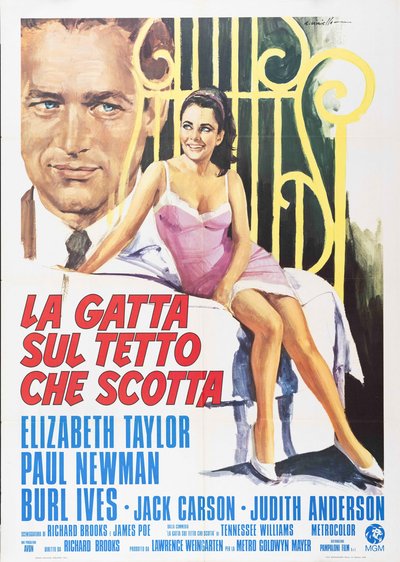
The poster by Averardo Ciriello for Cat on a Hot Tin Roof (Richard Brooks, 1958)
On 22 March 1958, during production, Taylor’s third husband, Mike Todd, was killed in a plane crash. She later returned to complete the role of Maggie, who struggles to reach an emotionally distant husband. Averardo Ciriello paints her sitting on a bed in a pink slip, framed by a yellow grille. To the left, Paul Newman’s large face looks away. The composition expresses the distance between the two characters without reproducing a scene from the film.
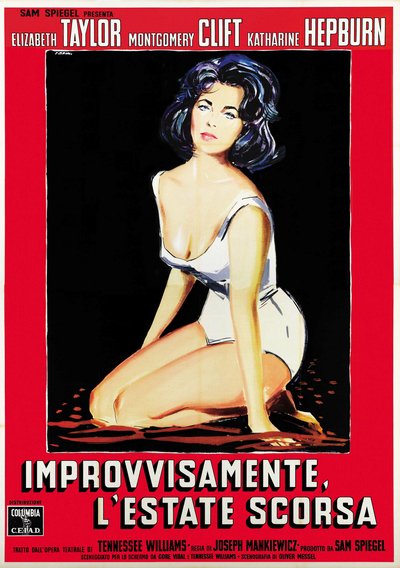
The poster by Ercole Brini for Suddenly, Last Summer (Joseph L. Mankiewicz, 1959)
Ercole Brini reduces the image to a few elements: Taylor in a white swimsuit, kneeling on reddish ground against black. Neither Katharine Hepburn nor Montgomery Clift appears. In the film the swimsuit is bound up with Sebastian’s use of Catherine to draw young men’s attention on the beach. Read in that light, the poster places the actress on display while her posture and expression suggest the character’s vulnerability.
Cleopatra, Then Burton
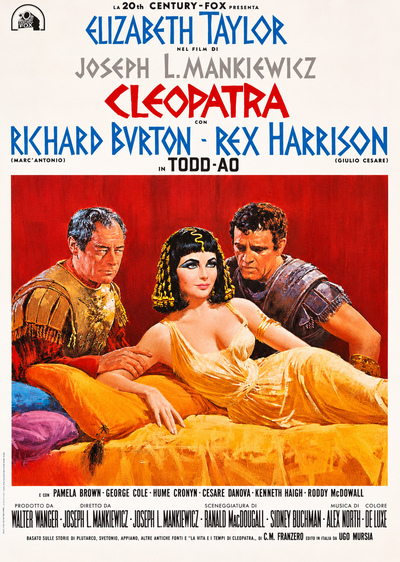
The poster for Cleopatra (Joseph L. Mankiewicz, 1963), based on artwork by Howard Terpning
Cleopatra was an enormously expensive production and a worldwide media event. Taylor and Richard Burton, both married to other people, began their relationship on the set in Rome. The image used for the Italian release reworks an illustration by the American artist Howard Terpning that also circulated internationally. Rex Harrison, as Julius Caesar, stands to the left; Burton, as Mark Antony, to the right. Both lean towards Cleopatra reclining in the middle. Here the men are literally at the edges, although it is the grandeur of the spectacle that governs the design.
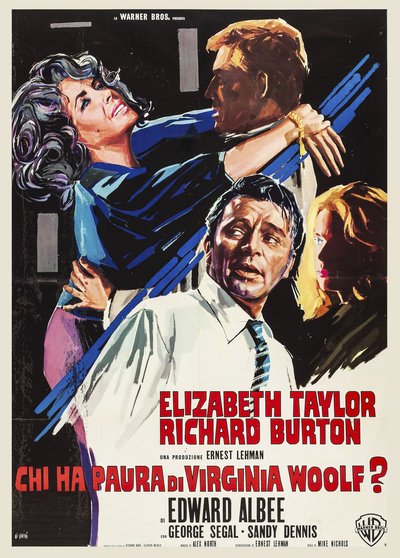
The poster by Ercole Brini for Who’s Afraid of Virginia Woolf? (Mike Nichols, 1966)
Three years later Brini painted a very different Taylor. To play Martha, the embittered wife of a university professor, she put on around two stone and adopted untidy grey hair. In the poster she laughs wildly, clinging to George Segal; Richard Burton, as her husband George, takes the foreground. Brini’s slanting brushstrokes and stark contrasts convey the strain of the story. Taylor won her second Oscar for the role, a performance in which she set aside the polished image of beauty that had helped make her famous.
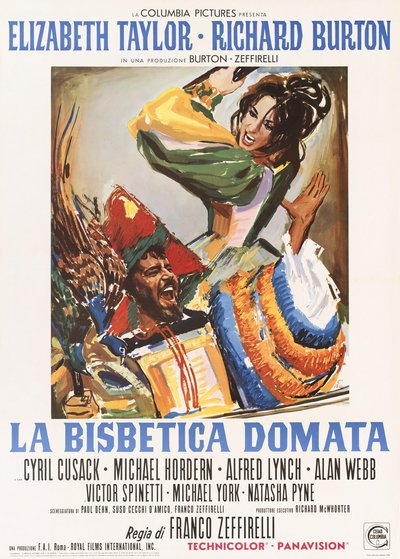
The poster by Ercole Brini for The Taming of the Shrew (Franco Zeffirelli, 1967)
The following year Taylor and Burton took on Shakespeare in Franco Zeffirelli’s first major international film success. Brini abandoned the conventional portrait for a swirl of broad strokes and colour. Katharina is above, her arm raised; Petruchio appears beneath her in a half-upended pose. The poster has the movement of a stage performance and makes the question of who dominates whom less straightforward than the title suggests. Seen together, Brini’s three posters show how readily he changed his visual language to match Taylor’s roles.
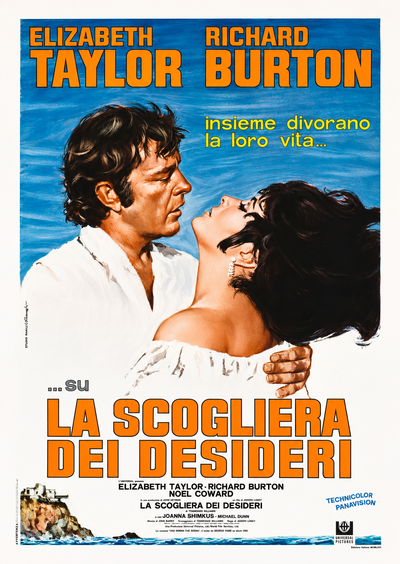
The poster by Rodolfo Valcarenghi for Boom! (Joseph Losey, 1968)
Boom!, released in Italy as La scogliera dei desideri, reunited Taylor and Burton. She plays Flora Goforth, a wealthy, dying woman living above the sea; he is Chris Flanders, an enigmatic visitor. The film was shot partly at Capo Caccia in Sardinia. Rodolfo Valcarenghi sets aside the story’s unease and paints the couple against blue sea and sky. It is an understandable promotional choice: their relationship was already a story audiences followed well beyond the screen.
The Raised Hands
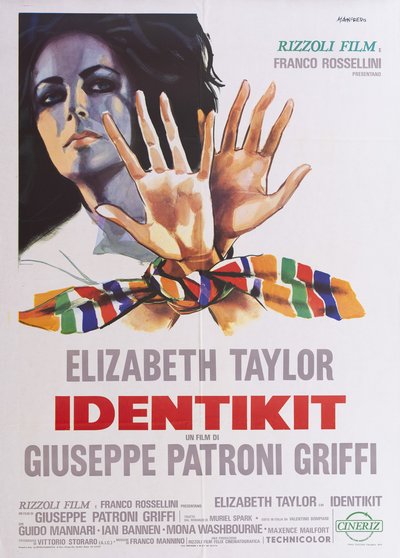
The poster by Manfredo Acerbo for The Driver’s Seat (Identikit; Giuseppe Patroni Griffi, 1974)
In The Driver’s Seat, adapted from Muriel Spark’s novel, Taylor plays Lise, a woman who arrives in Rome looking for a man for reasons the film reveals only gradually. Manfredo Acerbo depicts her face half in shadow, with both hands raised and open towards the viewer. The colourful scarf binding her wrists recalls the ending without explaining it. After so many close-ups designed to invite attention, this figure seems to be holding the viewer’s gaze at bay.
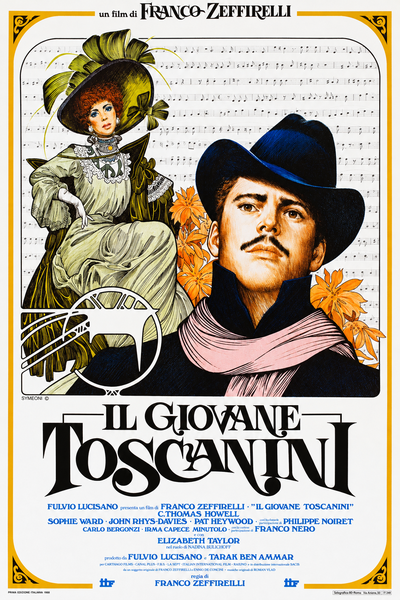
The poster by Sandro Symeoni for Young Toscanini (Franco Zeffirelli, 1988)
The final portrait comes fourteen years later. Taylor plays Nadina Bulichoff, a Russian soprano whom the young Toscanini, portrayed by C. Thomas Howell, tries to persuade to rehearse; Aprile Millo provides the singing voice. The film screened out of competition at the 1988 Venice Film Festival. Sandro Symeoni puts the conductor at the centre, while Taylor sits further back beneath a large feathered hat. The arrangement reverses many of the earlier posters, leaving the star a quieter but unmistakable presence.
From her early appearance beside Lassie to her final film with Toscanini, these posters reveal more than the changing image of Elizabeth Taylor. They also show how Italian film poster painters turned her face and her characters into images made to catch the eye on the street.
The works reproduced on this page come from period prints, recovered, photographed and digitally restored by Movie.it.
You may also like
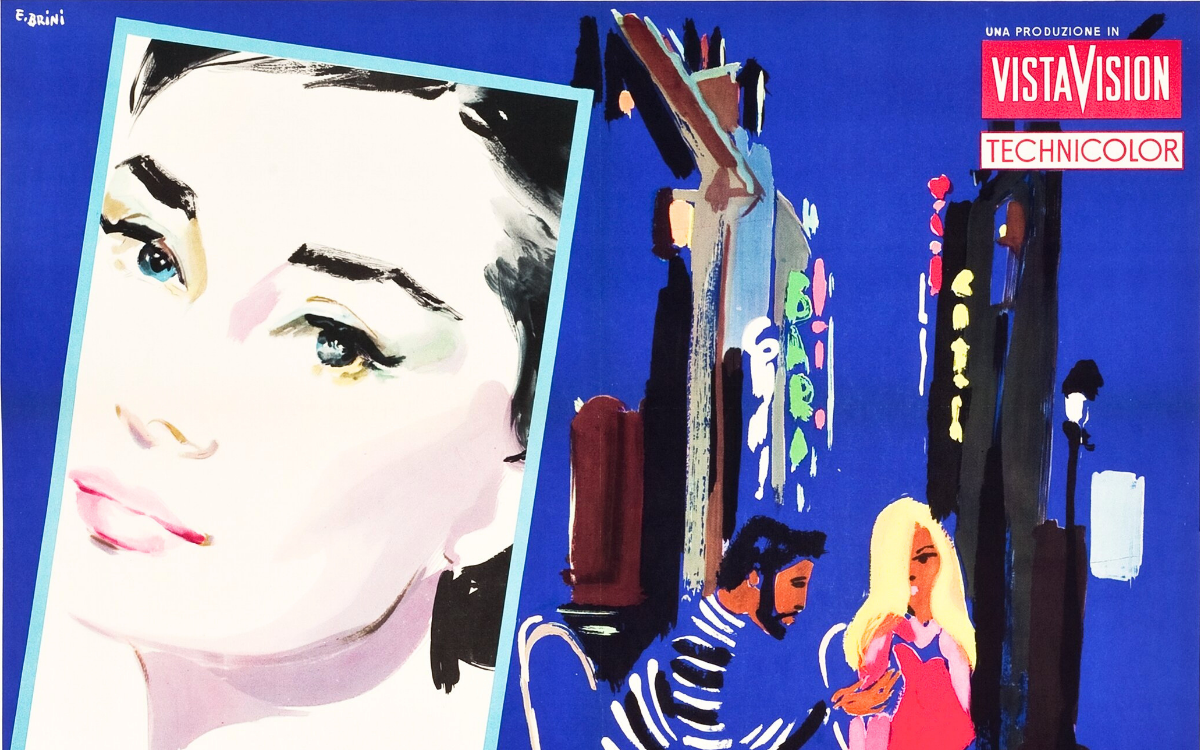
Ercole Brini, Master of the Watercolour Movie Poster
Gina Lollobrigida, the World's Most Beautiful Woman and the Men at Her Feet