Elio Petri, the Director Who Put Power on Trial
By Movie.it Editorial Team
October 21, 2026
Few film-makers caught Italy's journey from the economic boom to the "years of lead" as sharply as Elio Petri.
In just over twenty years, from his debut with The Assassin in 1961 to his death in 1982, he forged a political cinema like no one else's: grotesque yet rigorous, popular yet awkward, a cinema that put murderous police chiefs, worn-down factory hands and party bosses holed up in an underground retreat on the big screen. It was a cinema of ideas, with a face that kept coming back, Gian Maria Volonté's, and music you knew from the first few bars, Ennio Morricone's.
Petri was born in Rome on 29 January 1929, the only child of a family of artisans on Via dei Giubbonari. He would later recall an unhappy childhood and a strict Catholic upbringing, steered largely by his grandmother. While still very young he joined the Communist youth federation and began writing about film for the party paper l'Unità, before walking out of the party after the Soviet invasion of Hungary in 1956. In 1952 he did the legwork for Giuseppe De Santis's Rome 11:00, tracking down the women who had been queuing for a single typist's job when a staircase gave way beneath them. The lesson stayed with him for life: look hard at reality, document it, then turn it into a story.
His films were never easy to sum up in a single picture. Yet the painters working for Italian cinema found ways to capture their unease, and looking back at their choices today, one idea keeps surfacing: the fracture. Faces split between light and darkness, compositions cut in two, paint jostling with photography, bodies taken apart. It is the image of the neurosis critics would come to see in his work, and a portrait of a divided man: an artisan's son turned intellectual, a communist outside the party, a boy raised in the Church who grew up to make a savage film about the Catholic party in power. In these images you can read his distrust of every kind of authority, his fascination with desire that blinds, and the eye of a reporter who treated reality, to the very end, as a case to be cracked.
Success and Its Shadow
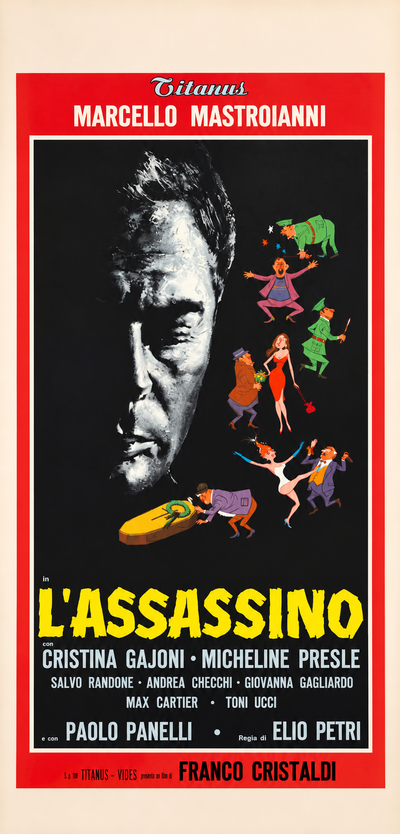
The "locandina" (Italian small format) by Maro for The Assassin (Elio Petri, 1961)
For his first feature, co-written with Tonino Guerra, Petri hauls Alfredo Martelli (Marcello Mastroianni), a smooth, social-climbing antiques dealer, into a police station on suspicion of murdering his mistress, Adalgisa De Matteis (Micheline Presle). As Inspector Palumbo (Salvo Randone) questions him, his glossy life returns in fragments and its moral emptiness shows through. Maro splits the "locandina" into two worlds. On the left, against black, Mastroianni's face is painted in greys and whites, half swallowed by shadow, one eye lost in the dark. Down the right tumbles a column of tiny cartoon figures: policemen in green uniforms beating some unfortunate, a suitor clutching flowers, a woman in red, a dancer, a man with a bottle and, at the bottom, a detective bent over a coffin with a magnifying glass. Petri's formula is already in place: the sombre portrait of a conscience and, right beside it, a caricature of the society around it, tragedy and farce in a single frame. And one detail now reads like the opening line of a long argument: the police with their truncheons. Here they interrogate a man of success. Nine years later, in Investigation of a Citizen Above Suspicion, the murderer would be the policeman.
The Good Life
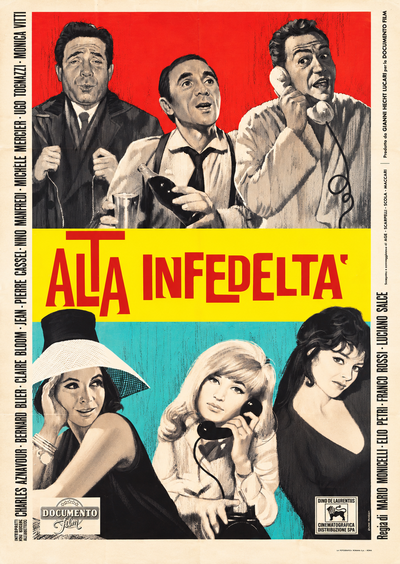
The poster by Piero Ermanno Iaia for High Infidelity (Mario Monicelli, Elio Petri, Franco Rossi, Luciano Salce, 1964)
An anthology comedy about marital infidelity, the film brought four directors together; Petri's contribution, Peccato nel pomeriggio, starred Charles Aznavour and Claire Bloom. Iaia lays the poster out like a spread from a gossip weekly: three men's faces along the top, three women's along the bottom, the title in between and two telephones linking them in a game of crossed lines. Phones, affairs, cover-star faces: this is precisely the world of affluence and appearances that Petri had eyed with suspicion in his early films, from The Assassin to The Teacher from Vigevano (1963). Even in a light comedy, the artisan's son was looking at the boom-time bourgeoisie from outside, like a passer-by at a shop window.
Murder as Entertainment
In a future where murder is a legal sport broadcast on television, the hunter Marcello Poletti (Marcello Mastroianni) and the huntress Caroline Meredith (Ursula Andress) stalk and seduce each other, while she plans to kill him live on camera as the climax of an advertisement. Based on a story by Robert Sheckley, the film was a solid box-office success. For the Italian poster, Mos reached for the oldest trick on the billboard: on the left, Mastroianni's face, bruised with violet, his eyes sliding sideways towards her; on the right, Andress sprawled across white sheets in a black bikini, with the huge red title slashed across the bottom like a smear of blood. At first glance, it is a pin-up. But it is exactly the pin-up Caroline is preparing in the film. Mos packages for Italian cinemagoers the very commercial his heroine packages for television viewers, and the poster becomes, almost literally, a scene from the film itself. It sells flesh and violence in the language of advertising, the very weapon Petri was taking aim at. Only Mastroianni's sidelong glance cracks the surface, leaving the film's real question hanging: who is the hunter, and who the prey? Petri would return to the idea again and again: spectacle, advertising and consumerism as power in disguise.
The Honey Trap
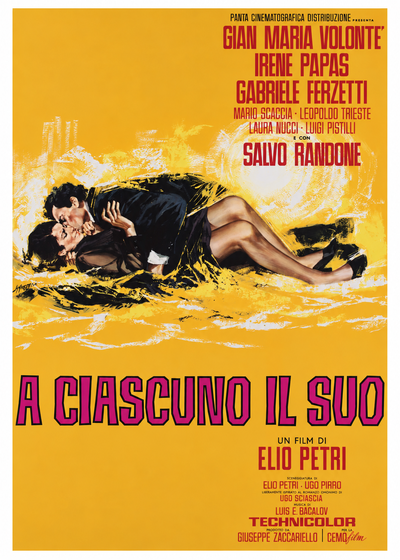
The poster by Sandro Symeoni for We Still Kill the Old Way (Elio Petri, 1967)
Adapted from Leonardo Sciascia's novel To Each His Own, the film marked Petri's first partnership with the screenwriter Ugo Pirro and with Gian Maria Volonté, here playing Paolo Laurana, a schoolteacher who looks into a double murder in a Sicilian town and stumbles on a web of Mafia, power and bourgeois respectability. Petri and Pirro took the best screenplay award at Cannes. Symeoni appears to leave the investigation out altogether: against a blinding ochre ground, scorched as if by the Sicilian sun, a man and a woman lock in a kiss, their outlines melting into the colour, caught somewhere between an embrace and a fall. In fact he has put his finger on how the story works. Laurana is brought down by his desire for the widow Luisa Roscio (Irene Papas), and those floating figures already tell us how it will end. In Petri's cinema, the intellectual who thinks he is chasing the truth is often the first to be caught in power's net, a suspicion the director, an intellectual himself, never spared himself.
Art for Sale
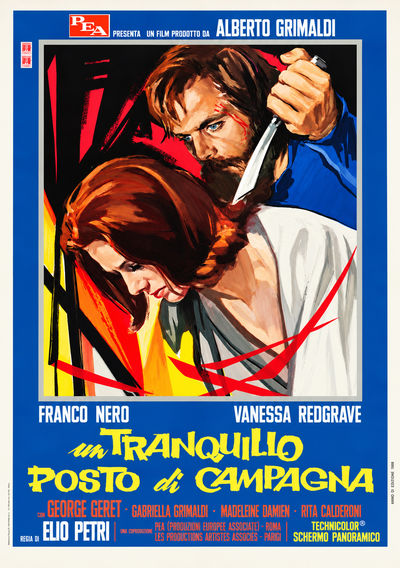
The poster by Manfredo Acerbo for A Quiet Place in the Country (Elio Petri, 1968)
This one wrong-footed anyone who had already filed Petri under political cinema. Produced by Alberto Grimaldi and scored by Ennio Morricone, who would work with Petri from then on, it follows the breakdown of a painter, Leonardo Ferri (Franco Nero), who retreats to a villa in the Veneto and becomes obsessed with the ghost of a young countess killed in the war; Vanessa Redgrave co-stars. It won the Silver Bear in Berlin. Acerbo builds his image on a menacing diagonal: a bearded man looms behind a stooping woman, his knife raised above her head, his stare close to madness. Behind them lies an abstract canvas torn by red streaks, like wounds of colour. The result is a strange hall of mirrors between the painter of the poster and the painter on screen. Petri had brought in a real artist, the American Jim Dine, to create the works seen in the opening titles, and his film is about a painter driven out of his mind because the market turns every canvas into a commodity. Acerbo, who made his living selling images to the film industry, answers with an abstract ground ripped open in red: painting itself becomes the scene of the crime. It is perhaps Petri's most personal film, the one where the man in the dock is the artist himself.
Above Suspicion
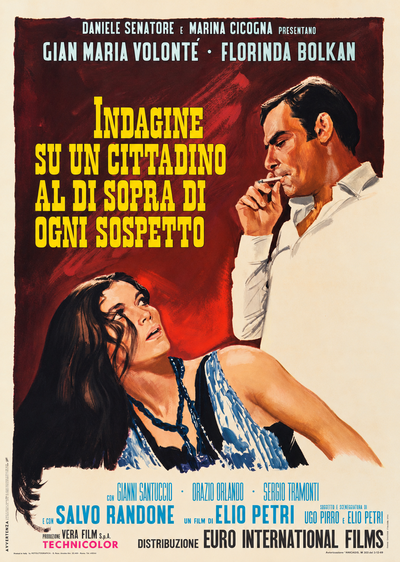
The poster attributed to Enrico De Seta for Investigation of a Citizen Above Suspicion (Elio Petri, 1970)
Volonté plays the head of Rome's homicide squad, freshly promoted to the political division, who murders his mistress Augusta Terzi (Florinda Bolkan) and then lays a trail of clues to himself, just to see how far his position puts him beyond the law. Released into an Italy still reeling from the Piazza Fontana bombing, it won the Grand Prix of the Jury at Cannes and the Oscar for Best Foreign Language Film. Against a brown ground streaked with blood-red brushwork, the whole image turns on a drop in height. Above, the man in a white shirt smokes, eyes lowered, detached and in total control; below, the woman lies thrown back, gazing up at him with parted lips. The painter puts us exactly where she is: at the bottom, looking up at a man who does not look back. That is the place of the citizen before power, and it is the feeling Petri wanted his audience to leave with. The yellow title, laid out like the heading on a case file, adds the final twist: this investigation is being run by the guilty man himself, who writes the reports and picks the evidence. Nine years earlier, on the "locandina" for The Assassin, the police were little cartoon figures. Here power has a face, and it wears the hero's white shirt.
Trust No One
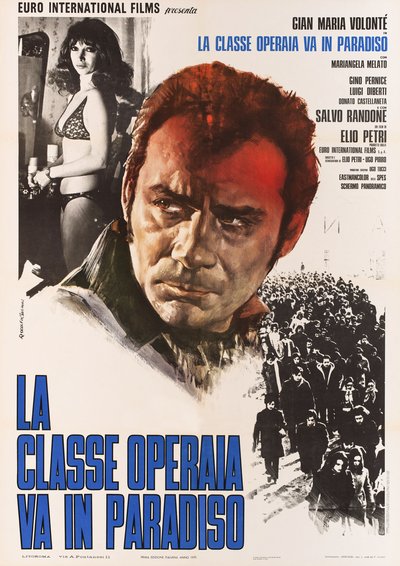
The poster by Rodolfo Gasparri for The Working Class Goes to Heaven (Elio Petri, 1971)
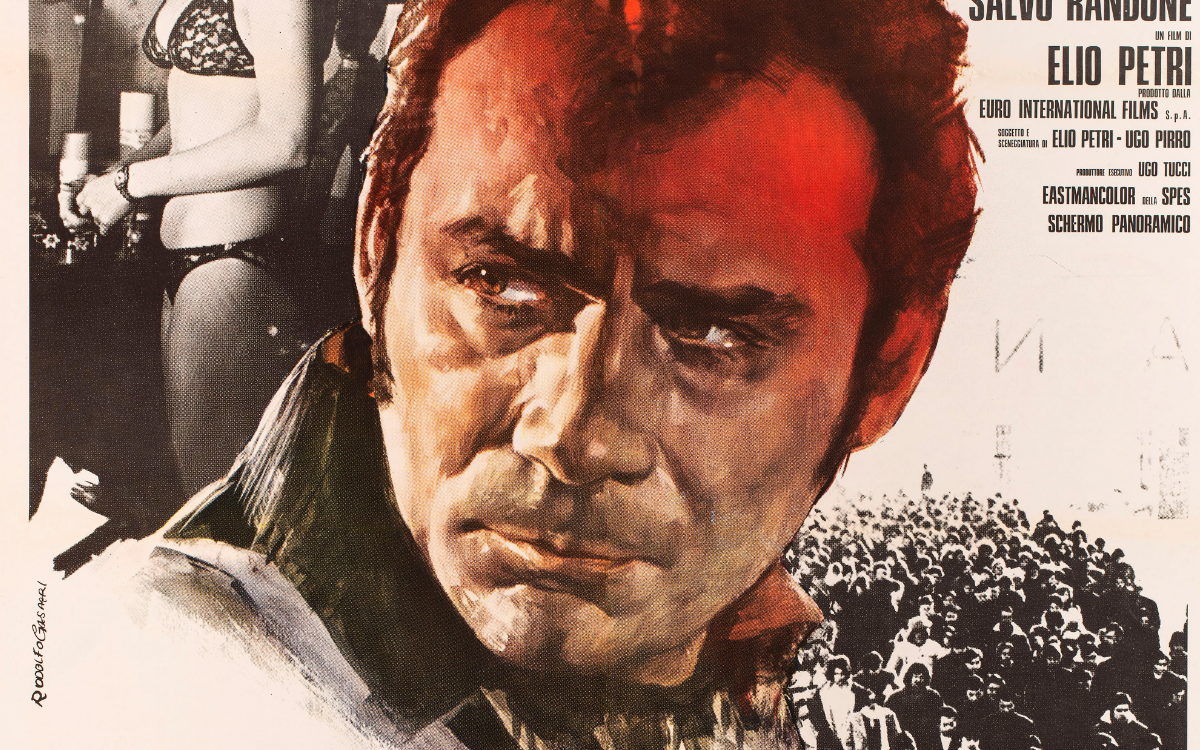
Volonté is Lulù Massa, a model piece-worker who loses a finger to his machine, wakes up to his own exploitation and lurches between union fury, the slogans of student radicals and an ever deeper isolation, with Mariangela Melato at his side. The film split the left, some of whom accused it of ambiguity, yet in 1972 it shared the Grand Prix International du Festival at Cannes with Francesco Rosi's The Mattei Affair. Gasparri sets paint and photography talking to each other. A large painted face fills the centre, hair and forehead blazing red; around it, two black-and-white photographs crowd in like thoughts he cannot shake off, a woman in her underwear above, a packed crowd marching below. Yet Lulù looks at neither. His eyes slide away to one side, full of suspicion. It is Petri's own position: a man who joined the Communist Party as a teenager, walked out after Hungary, and then made a film the left itself called ambiguous. Gasparri paints someone who trusts neither the bosses nor the people who want to set him free, and there is a good deal of the director in him.
Money and Manners
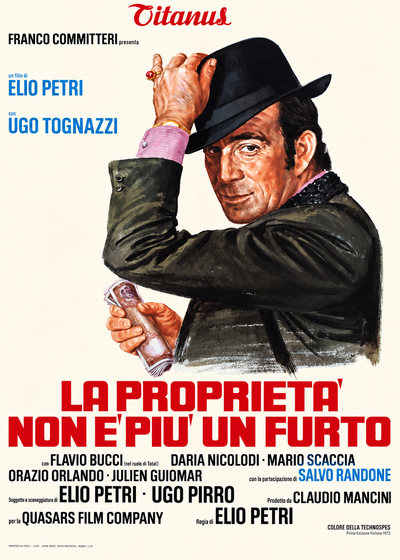
The poster by Maro for Property Is No Longer a Theft (Elio Petri, 1973)
The last part of what critics came to call Petri's trilogy of neurosis, the film follows Total (Flavio Bucci), a bank clerk who is allergic to money and decides to get even with a wealthy butcher (Ugo Tognazzi) by stealing everything he owns. Maro picks the victim, not the thief. On a white, almost empty ground, Tognazzi doffs his black hat with elaborate courtesy, a flashy ring on one finger and a fistful of banknotes in the other hand. The smile is polite and mocking at once. The red title sits at the foot of the poster like a sentence handed down, while Total, the actual protagonist, is shunted into the cast list. Maro puts the man of property centre stage, with his fine manners and his cash in hand: exactly the figure Petri meant to prosecute, a power that needs no uniforms and no party, only possessions to defend. With the police chief of Investigation, the factory worker of The Working Class Goes to Heaven and the butcher here, the trilogy has its three faces, power, labour and money, and the painters gave us all three. There is also a symmetry that only an archive can reveal. Twelve years earlier, Maro had painted the "locandina" for The Assassin, where the successful man lurked half in shadow. Now the bourgeois has nothing to hide: he raises his hat to us in broad daylight, money in hand.
Todo Modo
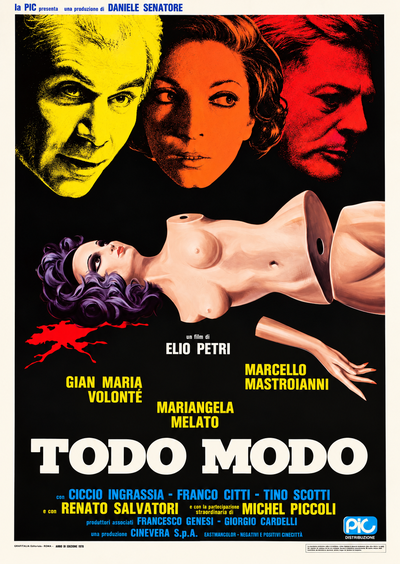
The poster by Renato Casaro for Todo modo (Elio Petri, 1976).
Petri went back to Sciascia for his most radical film. In an underground hotel that doubles as a hermitage, while a mysterious epidemic sweeps the country, the leading lights of the party that has ruled Italy for thirty years gather for a course of spiritual exercises led by Don Gaetano (Marcello Mastroianni), though what they are really doing is carving up power. Volonté gives the party president an uncanny resemblance to Aldo Moro. After Moro was kidnapped and murdered in 1978, the film all but vanished for years, until a restored version was shown at the Venice Film Festival in 2014. Two visual languages share the poster's total black. Across the top, three faces broken down into a mesh of dots and tinted yellow, orange and red loom out of the dark like grainy press photographs; below, painted with glossy precision, lies a dismembered female mannequin, torso severed from hips, a red stain spreading beside the head. The choice is all the more striking because it is Casaro's, one of the great realists of the Italian film poster: for Petri's most radical film he gives up the portrait altogether and turns to the language of the crime pages and a shattered artificial body. Those dotted faces speak the language Petri knew best, that of the newspapers where he had started out as a critic and reporter. The spiritual exercises behind the title, drawn from Saint Ignatius of Loyola, may also echo his own strict Catholic childhood, which makes his portrait of religion and political power all the more intriguing. Seen after 1978, the red stain beside the head carries a weight no one could have given it in 1976.
A Director on Paper
After Todo Modo, Petri adapted Jean-Paul Sartre's play Dirty Hands for television as Le mani sporche (1978), with Mastroianni, and made his last cinema feature, Good News (1979), with Giancarlo Giannini. He died in Rome on 10 November 1982, aged just 53.
Seen side by side, the period posters for his films show how rich and varied Italian film poster art was in the 1960s and 1970s: Maro's double register, Iaia's hatching, Mos's advertising flair, Symeoni's gestural brushwork, Acerbo's abstract canvas, Gasparri's muscular realism, Casaro's pop inventions. They belong to an era when painters freely offered their own work and distributors chose which designs would sell a film, often from several proposals for the same title. It is the era Maurizio Baroni charts in Pittori di Cinema, the essential book on this generation of artists.
Laid out in sequence, the nine posters also tell the story of a director and a man. From Mastroianni's face split between light and shadow in 1961 to the broken body of Todo modo in 1976, the painters returned, film after film, to the same fracture. Critics called it neurosis, and Petri hunted for it in his characters, the police chief, the factory worker, the man of property. But above all it was his own: the fracture of a film-maker who never stopped questioning power, even when it came dressed in the political and cultural colours closest to his own. And as the years went by, the painters increasingly spoke to him in the language of print: Iaia's magazine hatching, the case-file title of Investigation, Gasparri's photographic inserts, Casaro's halftone faces. For a director who had started out writing for l'Unità and knocking on doors for Rome 11:00, it was almost a homecoming. Each poster becomes an interpretation, and also the front page of a newspaper Petri never stopped writing.
The works reproduced on this page come from the original prints of the period, recovered, photographed and digitally restored by Movie.it.
You may also like

Otello Mauro Innocenti “Maro”, Colour and Storytelling in the Italian Movie Poster

Piero Ermanno Iaia, Between Figurative Art and Modernity