Charles Bronson, the Tough Guy's Other Face
By Movie.it Editorial Team
November 5, 2026
A Hard Face to Read
Hollywood thought it had Charles Bronson worked out at first glance. Clenched jaw, narrowed eyes, next to no dialogue: the ideal villain, and a saving on the script. Italy's film poster painters, who looked at faces for a living, were not always so sure. In their hands Bronson is a threat, a target, a man biding his time, a star ill at ease and, on at least one occasion, thoroughly pleased with himself. There is no "real Bronson" to rescue from the legend here. There is simply a face with more to say than its owner.
That face had come a long way, mostly upwards. Charles Dennis Buchinsky was born on 3 November 1921 in Ehrenfeld, a Pennsylvania mining town, the eleventh of fifteen children in a Lithuanian family. His father, a miner, died when he was ten, and Charles followed him underground, paid by the ton. The war put him aboard B-29s in the Pacific, a considerable change of air, and when it ended he took up acting. Hollywood filed him at once under boxers, henchmen, Native Americans and anyone else best kept an eye on. In 1954, with McCarthyism in full cry, a Slavic surname looked like a needless risk, and Buchinsky became Bronson.
In 1964 Sergio Leone offered him A Fistful of Dollars. Bronson read the script and said no, to the lasting gratitude of Clint Eastwood. He made his mark in The Magnificent Seven (1960) and The Dirty Dozen (1967), though always as one of a crowd. Stardom came from Europe, when he was nearly fifty and most Hollywood tough guys were eyeing retirement. The French called him "le monstre sacré"; the Italians, fondly, "il Brutto", the Ugly One. In 1972 the Hollywood Foreign Press named him the most popular actor in the world, and America caught up in its own good time two years later.
He married the actress Jill Ireland in 1968, made many films with her and lost her in 1990. He died in Los Angeles on 30 August 2003, aged 81.
Seven Posters, No Final Answer
A film poster has one job: to stop passers-by and get them into the cinema. To that end it exaggerates, enlarges and, when required, makes things up. With Bronson it had a free hand. A man who talks that little is unlikely to issue a correction.
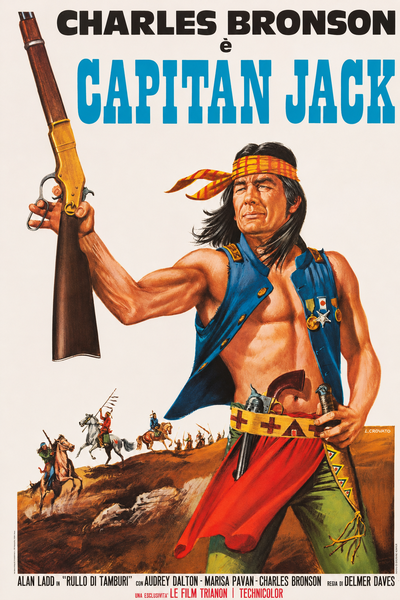
Luciano Crovato's poster for Drum Beat (Delmer Daves, 1954)
We begin with a coup. Drum Beat belongs to Alan Ladd, who stars in it and produced it through his new company. Yet the 1960 Italian reissue announces, in letters fit for a shopfront, "Charles Bronson è Capitan Jack". Ladd, alive, well and still a star, is packed off to the bottom line, and the title of his own film appears in inverted commas, as if someone were quoting it. Bronson was still years away from European fame, which makes it an odd bet: somebody evidently felt that face was a better prospect than the leading man.
Captain Jack was real. His name was Kintpuash, he was a Modoc leader and he was hanged in 1873. In the film he wears the coat of a dead officer. Crovato cuts it down to a sleeveless waistcoat, pins the medals to a bare chest and adds a smile of quiet satisfaction. The son of Lithuanians in a headband is enjoying himself enormously. Take a good look at that smile, because the next six posters will not be showing it again.
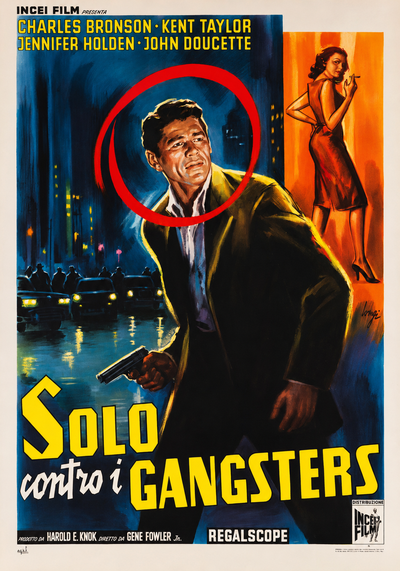
Carlantonio Longi's poster for Gang War (Gene Fowler Jr., 1958)
Night, a gun in his fist, a red ring around his head: the Bronson everyone expects, a killer. The film, a small black-and-white affair, has woken up in blue, orange and yellow, and its hero teaches maths. Alan Avery happens to witness a murder and makes the mistake of agreeing to testify. Longi bends him forward and sends his eyes sideways, and that ring starts to look a lot like a target. This is not a dangerous man. This is a man in danger.
The gangsters kill his pregnant wife. He smashes the piggy bank meant for the child who will never be born, buys a gun, tracks down the boss, climbs the stairs with the weapon drawn and finds him alone in the dark, in tears. He walks out and closes the door behind him. Remember that door. Sixteen years later much the same story will end very differently, and take a great deal more at the box office.
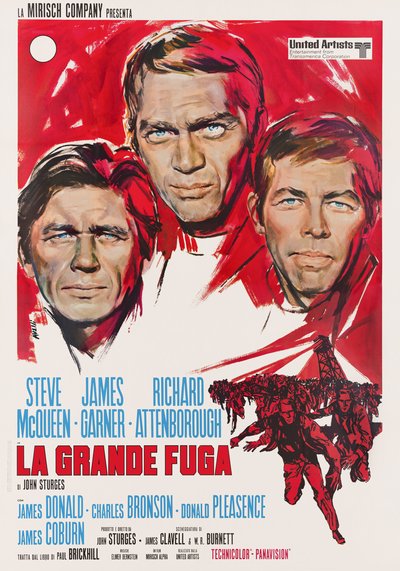
Agatino Avelli's poster for The Great Escape (John Sturges, 1963)
This one is a puzzle. In big letters, McQueen, Garner, Attenborough. Further down, among the supporting cast, Charles Bronson. And yet, of the three giant painted faces, the one on the left is his. This is the 1971 reissue, by which time he was a star in Europe: contracts can pin down names, but no contract covers faces. Attenborough, if he ever saw it, will have looked for his own in vain.
In the film he plays Danny, the "Tunnel King", who has dug seventeen tunnels and is terrified of them. Bronson knew the trade. He is said to have advised Sturges on how to shift the earth, and to have brought his character's fear with him from the mines. Avelli gives him all the air and red paint he could wish for, and not one yard of underground. Danny, after all, is one of only three escapers who get away. It was on this film that Bronson met Jill Ireland, then married to his co-star David McCallum. Five years later he married her, a development on which the poster is silent.
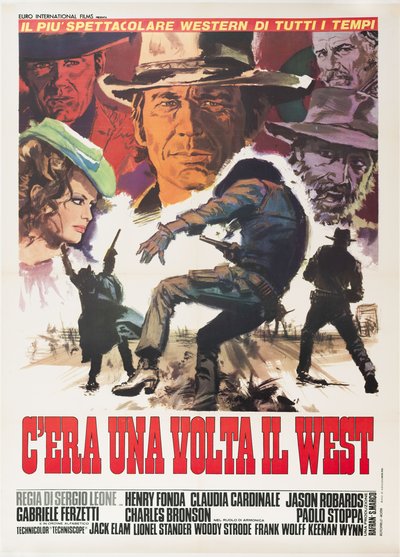
Rodolfo Gasparri's poster for Once Upon a Time in the West (Sergio Leone, 1968)
Four years after being turned down, Leone got his man, helped by the fact that Eastwood had now said no too. Leone later called him the greatest actor he ever worked with, and Gasparri converts the verdict into square inches. Henry Fonda may be first on the cast list, but he is stuck in a corner, tinted red, while that enormous head rises at the centre. Bronson is also the only name with a role attached, "nel ruolo di Armonica". Perhaps it seemed wise to explain: a man named after a musical instrument, with no name of his own and no past, needs some introduction.
And the harmonica? Not there. The instrument that gives him his name, and does most of his talking, has stayed at home. Around him guns are drawn and duels shape up, while he alone seems in no hurry. The face is split down the middle, one side lit orange, the other in shadow, which is precisely his position: for most of the film we know half of Harmonica, and the other half arrives with the final duel.
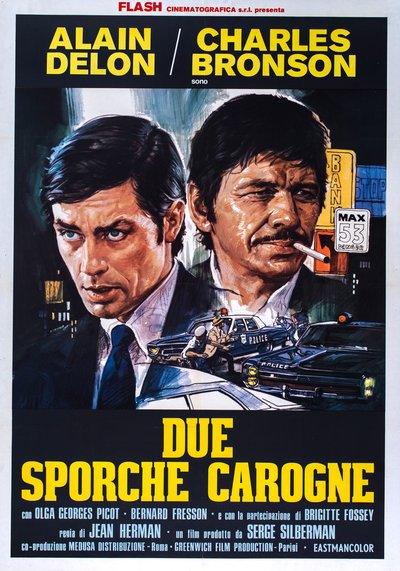
Renato Casaro's poster for Farewell, Friend (Jean Herman, 1968)
This is the film that made him a star in Europe, and it is set in Marseille and Paris. Casaro paints American police cars, officers taking cover and highway signs: "Bank", "Stop", "Max 53". Of France, not so much as a croissant. Adventure, evidently, needed the right number plates. As for "Max 53", it means nothing at all, although in 1974, the year America finally noticed him, Bronson did turn 53.
On the left Delon, pale eyes and immaculate tie; on the right il Brutto, shining with sweat, cigarette in the corner of his mouth. Beauty and the Ugly One, the complete set. They never look at each other, and there the poster is spot on: at the end of the film Bronson is arrested, asks Delon for a light and gets one from a man pretending not to know him. Until then his character has spent his time saying "yeah" and dropping coins into a full glass to see how many it will take before it overflows. As hobbies go, it is an unusual one for a tough guy, and it tells us more about him than the robbery does.
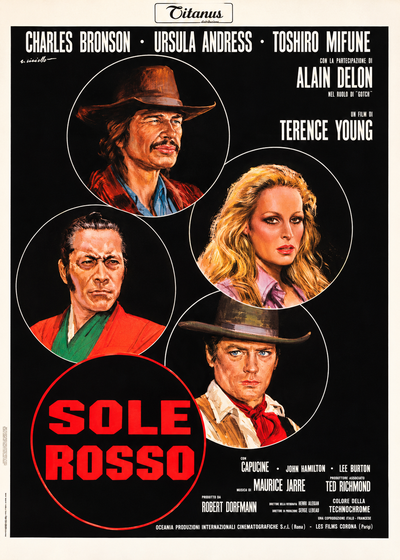
Averardo Ciriello's poster for Red Sun (Terence Young, 1971)
By Red Sun, in 1971, the takeover is complete. Bronson opens the line of names, ahead of Ursula Andress and Toshiro Mifune. Delon, now fourth and billed with a courteous "con la partecipazione di", has slipped to the medallion at bottom right. Ciriello lays everyone out in neat circles, like a coin collection, with a fifth red circle for the title doing duty as a Japanese flag. Bronson has the highest, right beside the painter's signature.
He has reached the top, though nobody seems to have told him. His hat shades his brow, his eyes slide away and his mouth is a straight line. The film sends an outlaw and a samurai down the same road in the Wild West, with a cast from four countries, and the world's most popular actor looks like a man waiting for the group photo to be over.
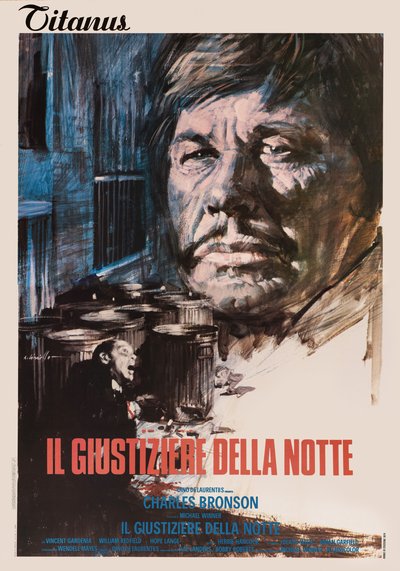
Averardo Ciriello's poster for Death Wish (Michael Winner, 1974)
Same painter, three years on, and the medallion has gone. The face is blue, pink and mud, the paint runs down it, and it takes up half the poster without asking anyone's permission. The summit has been reached, and it does not look much fun.
The oddest thing is what is missing. This is the film of the gun, the one that turned a New York architect into the most argued-over vigilante of the 1970s, and there is no gun to be seen. There is only a tiny man in a bow tie screaming among the dustbins, dressed as if he had come to the wrong party. The Italian title, Il giustiziere della notte, promises an executioner; Ciriello paints a man who does not seem at all sure he is one. Bronson, according to Michael Winner, had fewer doubts. Told that the film was about a man who goes out and shoots muggers, he replied: "I'd like to do that." "What, the film?" "No. Shoot muggers."
End of the Trail
In 1958 the maths teacher had the gun in his hand and closed the door. In 1974 the architect stays and fires, and the public, it seems, had been waiting for nothing else. In between come seven faces, no two quite alike: the show-off, the target, the stowaway on the billing, the man without a harmonica, the Ugly One beside the Beautiful One, the star who would rather be elsewhere, the avenger with no gun.
The owner of that face, meanwhile, remained unmoved. When Winner begged him to stay on and finish a scene, Bronson stuck to his contract and left: "Michael, it took me 40 years to become a star." Hard to argue. He had arrived late, and he had no intention of working overtime.
The works reproduced on this page come from the original prints of the period, recovered, photographed and digitally restored by Movie.it.
You may also like

Carlantonio Longi, the Versatile Painter
The Art of Renato Casaro, the Last Master of Cult Movie Posters