
Alessandro Biffignandi, Master of Chiaroscuro
By the Movie.it Editorial Team
July 3, 2026
Alessandro Biffignandi, born in Rome on 8 October 1935, began drawing very young and made his debut at just seventeen on the comic-strip pages of Capitan Walter. A few years later he entered the workshop of Averardo Ciriello and the Nistri brothers as an apprentice, and within a year he was called up by Augusto Favalli, one of Italy's leading producers of film posters.
It was in that studio that the young Roman sharpened his hand and learned the craft of the great Italian poster painters. At the end of the 1950s he sought new horizons, first in England and then in Milan, where he drew cover artwork for comic titles aimed at the British market.
In the 1980s, he returned to Rome, having already established himself as a film poster artist and comic-book illustrator. In the latter field, he became a true master, renowned for the elegance and precision of his line and for his ability to combine simplicity, imagination and refinement.
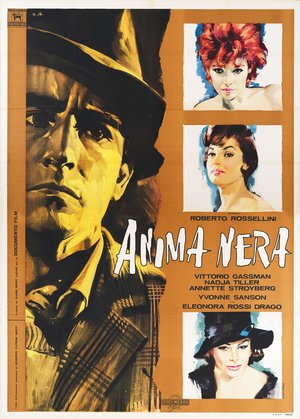
Dark Soul (Roberto Rossellini, 1962)
The poster for Dark Soul, a drama adapted from Giuseppe Patroni Griffi’s play and starring Vittorio Gassman, is one of the finest examples of Biffignandi’s monochromatic chiaroscuro. Against a tobacco-coloured background, the entire left half is dominated by Gassman’s face beneath the brim of his hat, modelled in vivid yellow against deep black, one hand resting on his lapel and his checked scarf only lightly suggested. On the right, three small female portraits, framed in white and enlivened with touches of blue, sum up the cast: a red-haired woman with teased hair, a brunette, and a woman in a black hat with a fur collar. The title is brushed on in a rough, gestural white. The entire composition derives its force from the dramatic close-up and from the bold reduction to just two tones, yellow and black, which visually translate the darkness evoked by the title.
From Ciriello's Workshop to the Favalli Studio
His training under Ciriello and his entry into the Favalli Studio were decisive. In those years the poster painters enjoyed considerable autonomy: each one signed his own work and kept authorship of it, and the original sketches, apart from their promotional use for a film's release, as a rule remained the property of the painter. Biffignandi absorbed this culture of the signature and of authorial identity, and carried it with him throughout his career. When the young Roman entered the trade, Italian film graphics were dominated by established masters such as Anselmo Ballester, Luigi Martinati and Angelo Cesselon: a demanding company, which he held his own against by quickly finding a personal voice. Even his early works reveal a confident brushstroke, a talent for synthesis and a feeling for portraiture that would become his hallmark.
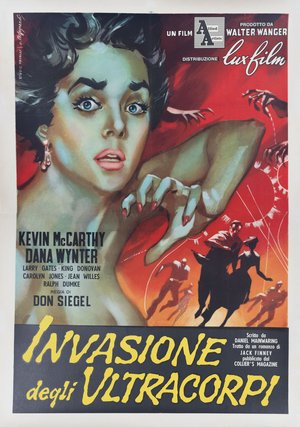
Invasion of the Body Snatcher (Don Siegel, 1956)
The poster for Invasion of the Body Snatcher, the paranoid science-fiction classic known in the original as Invasion of the Body Snatchers, shows the young Biffignandi still tied to soft, blended volumes. In the foreground is the face of a terrified woman with large blue eyes and a livid complexion, while a red-nailed hand claws at her shoulder. The background is a field of fiery red fading into orange, crossed at the lower right by a tide of fleeing black figures and outstretched, hooked hands. The contrast between the heroine's cold flesh and the blaze behind her turns into paint the dread of the film, in which humanity is silently replaced by alien copies.
The Evolution of a Style: From Soft Line to Graphic Synthesis
Biffignandi's painting underwent a profound evolution. From his early work, marked by soft lines and compact yet blended volumes, as in the sketch for Invasion of the Body Snatchers or the portraits of Giovanna Ralli and Marcello Mastroianni for Il momento più bello, he moved gradually towards a more modern and essential style, enriched by a strong graphic synthesis. In these works one senses the influence of the post-war Anglo-American illustrators and of Carlo Jacono's illustrations, in tune with the push towards graphic modernity that in those same years also drove a colleague like Sandro Symeoni. At the height of his activity, Biffignandi combined the role of illustrator with that of graphic designer: his hand, sure and effective and backed by excellent technique, allowed him to tackle any subject, from portraits to the most complex scenes.
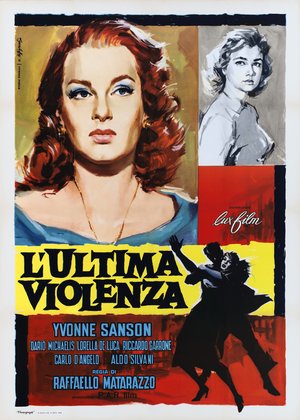
The Last Violence (Raffaello Matarazzo, 1957)
In the poster for The Last Violence, a noir melodrama starring Yvonne Sanson, Biffignandi plays on two opposing registers within a single composition. On the left Sanson's face dominates at life size, her coppery hair rendered in free, vibrant strokes, her dress blue, her gaze proud. At the upper right a second female portrait is barely sketched in almost pencil-like black and white, while lower down a fleeing couple is reduced to a dramatic black silhouette running against a red field. Yellow title bands and red fields break up the sheet with graphic force. It is a clear example of how the artist alternated full colour and monochrome to separate the planes of the story, from the posed portrait to the rush of the action.
Monochrome Chiaroscuro: His Trademark
A distinctive feature of his style is the use of monochrome chiaroscuro, often played out tone on tone. The face of James Dean in The James Dean Story (Robert Altman, 1957), rendered entirely in greys, and that of Vittorio Gassman in Anima nera, built up in yellow and black with a bold, dramatic framing, are perfect examples of this approach. To this he added a further personal invention: a chiaroscuro technique applied to the finished work, made of long brushstrokes resembling pencil hatching, capable of lending freshness and vitality to the image. It is a detail that many collectors learn to recognise at a glance, a kind of hidden signature within the signature.
Moulin Rouge (John Huston, 1952)
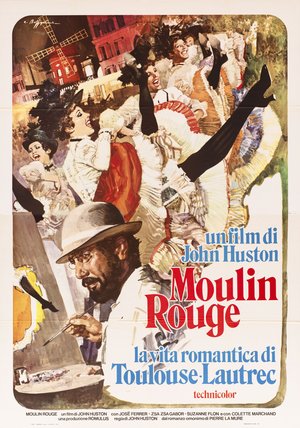
The poster for Moulin Rouge, the fictionalised life of Toulouse-Lautrec, here in its Italian re-release, is a tour de force of the crowd scene. The upper half is a whirl of can-can dancers, ruffled skirts, black stockings and legs flung into the air, with the red windmill turning against the night sky of Montmartre. At the lower left, in the foreground and wearing a bowler hat, the painter watches the scene with his brush in hand before his palette, while on the right the title opens onto a pale ground. Biffignandi marshals dozens of figures in motion without ever losing legibility, conveying at once the euphoria of the hall and the melancholy of the man who paints it.
Irony, Portrait and Scene: The Range of a Complete Artist
His work is not without irony. In The Law Is the Law, Totò and Fernandel come forward in close-up with their characteristic expressions, against a background simplified in tones of ochre and blue and split by a zig-zag graphic that sums up the clash between the two characters. It is proof of his flexibility: able to move from film noir drama to comedy, from the intense portrait to the crowd scene, without ever losing coherence of style. This versatility explains why his name recurs on films as different as Matarazzo's melodrama and the American auteur picture, the historical epic and science fiction.
Sissi: The Fateful Years of an Empress
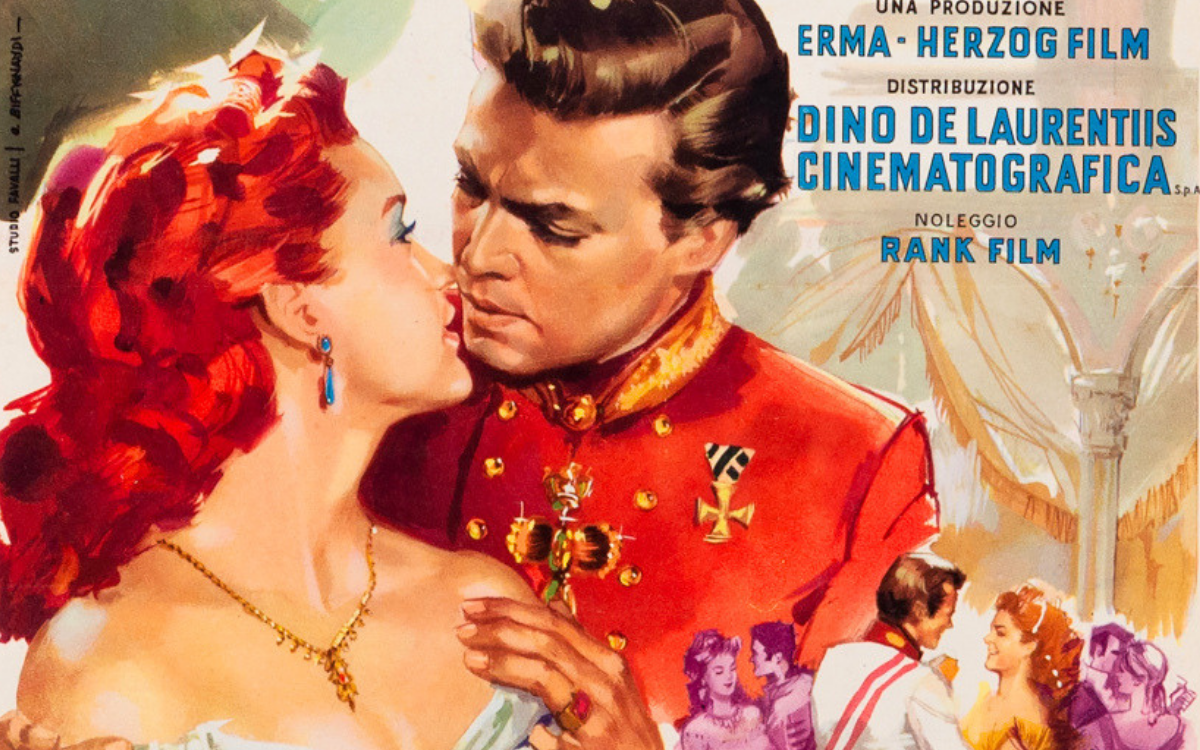
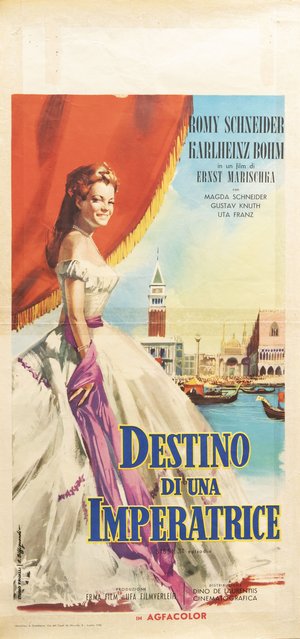
The "locandina" (Italian small format) for Sissi: The Fateful Years of an Empress, the third episode of the celebrated Sissi saga starring Romy Schneider, shows Biffignandi's luminous, scenic side. The young empress is portrayed in profile, smiling, in a sumptuous white ballgown with a lilac sash, while behind her a heavy red drape fringed with gold serves as a backdrop. To the right opens a panorama of Venice with the bell tower of St Mark's, the Doge's Palace and gondolas crowding the lagoon, rendered in soft blues and pastel skies. The title runs in large blue letters edged in yellow. This locandina concentrates all the period-postcard sweetness of the series, with a colour scheme that runs from the warm red of the drape to the cool transparency of the water.
An International Rediscovery
Biffignandi's story has a curious epilogue. For decades his name remained familiar above all to Italian collectors, but in recent years his art has been rediscovered abroad: in 2016, only months before his death, the British publisher Korero Press devoted the monograph Sex and Horror: The Art of Alessandro Biffignandi to him, turning his covers into a cult object for a new generation of enthusiasts. The Cineteca di Bologna also invited him, within its Pittori di cinema series, to talk about his work alongside his own original sketches, with the participation of collector Maurizio Baroni: recognition that restored to the poster painter the full dignity of an artist. Biffignandi died in Rome on 21 January 2017, at the age of eighty-one, leaving an indelible mark on the history of graphic art and the cinema poster.
The works reproduced on this page come from the original prints of the period, recovered, photographed and digitally restored by Movie.it.