
Luigi Martinati, Master of the Italian Movie Poster
By Movie.it Editorial Team
June 3, 2026
Luigi Martinati was born in Florence to a noble family. After attending the Accademia di Belle Arti, where he refined his pictorial training under the masters Ludovico Tommasi and Giovanni Fattori, a name that would resurface in the final chapter of his life, he made his first mark on the public scene as early as 1910: he entered and won a competition for a poster on the theme Oggi si vola (Today We Fly), revealing from the outset a talent for immediate and effective visual communication. In 1911, barely eighteen years old, he moved to Rome to take part in the organisation of the International Exhibition of Fine Arts, held to mark the fiftieth anniversary of Italian Unification.
It was on this occasion that he came into contact with Federico Ballester, father of his future colleague Anselmo, who introduced him to the new lithographic printing works of Enrico Guazzoni, the same man who would soon become the director of the monumental Quo Vadis (1913), one of the first blockbusters in cinema history. Martinati started from the very bottom: his task was to transfer the designs of others onto heavy stone slabs, one slab for each colour, ready for printing. A craft apprenticeship that taught him to think of colour analytically, one layer at a time, before ever considering the final chromatic whole.
Through the 1920s and 1930s his work as a poster artist expanded in every direction: commercial advertising, tourist promotion and sports events, including the poster for the 1934 FIFA World Cup, and, inevitably, regime propaganda. From his studio in Via Emanuele Filiberto 190 in Rome, shared with the colleague Tito Corbella, he produced work in these years for Warner Bros., MGM and the Ente Nazionale Industrie Cinematografiche: this was the beginning of a long and fruitful partnership with the seventh art.
Studio BCM and the Golden Age of the Italian Film Poster
In the years after the Second World War, Martinati abandoned commercial advertising entirely to devote himself exclusively to cinema. In the mid-1940s, together with Anselmo Ballester and Alfredo Capitani, he founded Studio BCM: a small Renaissance-style workshop at the service of the big screen, specialising in the production of film posters in a realist vein. The house style, and Martinati's in particular, was instantly recognisable: a large portrait dominating the foreground, often in dialogue with a narrative scene in the background, the whole held together by a controlled palette, pictorially constructed light and lettering that respected the overall composition.
These were the years in which much of his output was selected by the Warner Bros. publicity department, for which Martinati produced virtually the entire Italian poster output until 1958. Among his most celebrated works of this period are the posters for Casablanca (1946, Italian release), Captain Blood and The Big Sleep: masterpieces of balance between narrative power and visual seduction, designed to work on the passer-by like an irresistible promise.
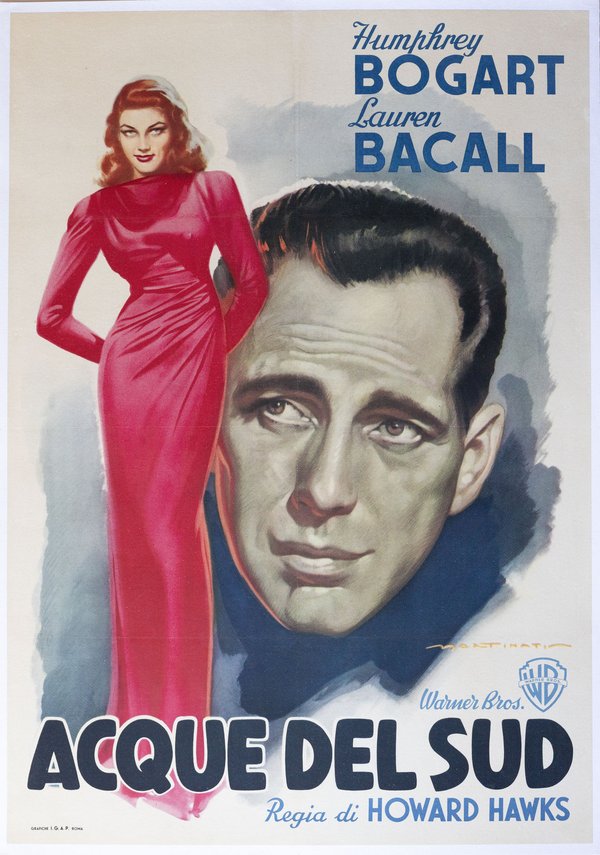
To Have and Have Not (Howard Hawks, 1944)
The Italian movie poster for To Have and Have Not, released in Italy as Acque del Sud and directed by Howard Hawks in 1944, is among the most memorable achievements of Martinati's career and one of the most sought-after vintage film posters among Italian collectors. Martinati creates an image with a deliberately inverted visual hierarchy: the full-length figure of Lauren Bacall, draped in a long crimson dress of sartorial elegance, occupies the foreground with a poised and seductive bearing, while the face of Humphrey Bogart opens out in the background like a memory or a dream. The bold block lettering at the bottom closes the composition with the typographic rigour that Warner demanded. A poster, in the noblest sense of the term, capable on its own of conveying the film's erotic charge.
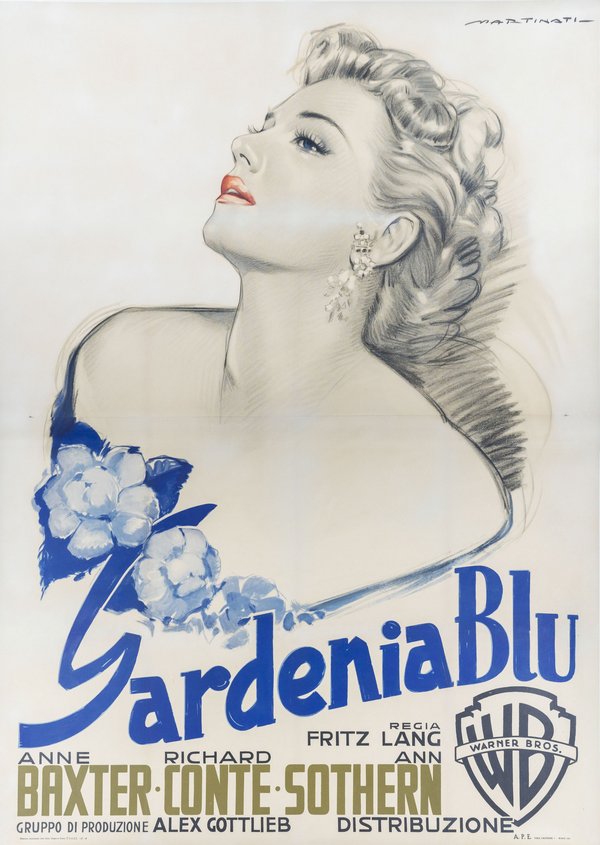
The Blue Gardenia (Fritz Lang, 1953)
In the poster for The Blue Gardenia, released in Italy as Gardenia Blu and directed by Fritz Lang in 1953, Martinati experiments with a solution of refined minimalism that sets him apart from his contemporaries. The background is near-white; the technique is mixed, pencil and watercolour; colour is used selectively and restricted to the protagonist's red lips and the blue petals of the flower. The result achieves great poetic elegance, perfectly attuned to the nocturnal and ambiguous atmosphere of Lang's noir. The discreet signature in the top right corner confirms a personal style that always placed the subject at the centre, never the author.
The Legend of the Poster Artist Who Destroyed His Sketches
Among all the episodes that mark Martinati's biography, one has passed into the legend of film poster collectors and reveals much about the man's character. When his long collaboration with Warner Bros. came to an end in 1958, Martinati left the studio without taking his original sketches with him. This was not unusual: the work of film poster artists was often selected directly by printers or by the distributors' publicity departments, and the sketches would remain with the printer or simply be lost. But Martinati, so the story goes, went further: after closing the studio, he is said to have torn apart with his own hands even the sketches and roughs that remained, refusing to allow those sheets to circulate without having been fully finished by him.
Whether this was an act of professional rigour, artistic modesty or existential weariness, it is hard to say. What is certain is that it helps explain the extraordinary rarity of his original works on the market, and the prices that the few surviving examples fetch at auction.
The Italian poster for Casablanca, a four-sheet work printed by the APE press in Rome in 1946, is considered by collectors worldwide to be among the most beautiful ever produced for that film, despite the many international versions that exist. It is also the only known copy to have survived from the Italian post-war release: a circumstance that has made it a cult object.
In an interview given in 1978, by then long estranged from the world of cinema, the master spoke of his bitterness towards colleagues who had failed to support his project for the ANAPUC, the Associazione Nazionale Artisti Pubblicitari Cinematografici, which had come to nothing due to internal disputes within the profession. That disappointment, he said, had been one of the reasons that drove him away.
The Years of Maturity: from Kazan to Hammer, between Painting and Experimentation
In the second half of the 1950s and into the early 1960s, Martinati's output opened up to new horizons, both in terms of the variety of distributors that commissioned his work, among them Cineriz, Euro International, Universal, Columbia, Lux and Filmar, and in terms of a style that grew increasingly free and personal.
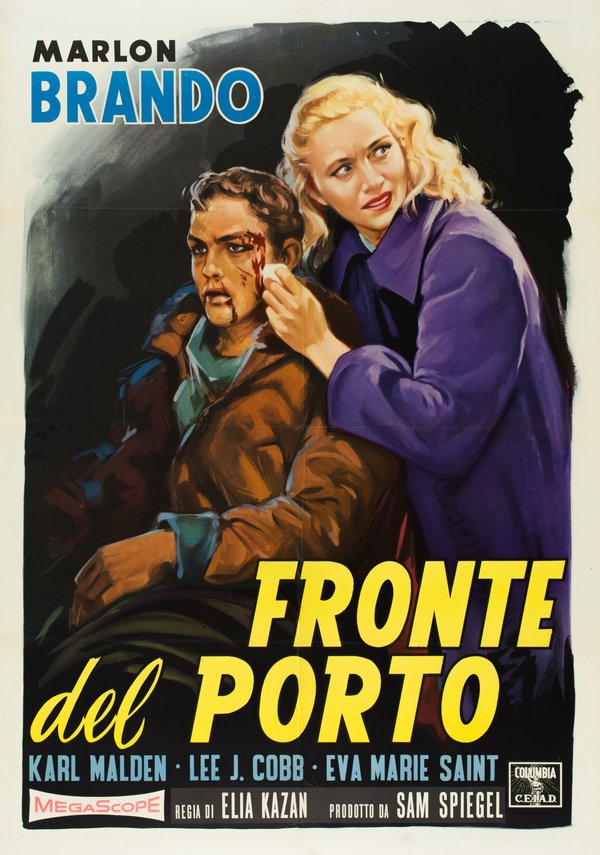
On the Waterfront (Elia Kazan, 1954)
The Italian movie poster for On the Waterfront, distributed in Italy as Fronte del Porto by Columbia/C.E.I.A.D. in 1954, is one of the most intense works of Martinati's mature period. Marlon Brando with a bloodied face, supported by Eva Marie Saint, is rendered with thick, violent brushstrokes, in a dark and murky palette in which the blue of the woman's coat stands out as the only note of cold colour against the warm turbulence of the scene.The large yellow lettering, bold and angled, gives the poster a graphic force that is difficult to match.
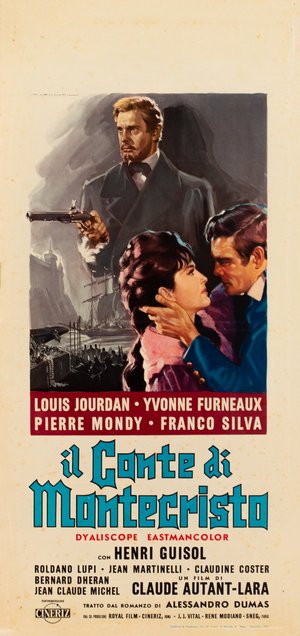
The Count of Monte Cristo (Claude Autant-Lara, 1961)
The "locandina" (Italian small format) for The Count of Monte Cristo, directed by Claude Autant-Lara in 1961 and based on Alexandre Dumas's novel, offers a layered and deliberately narrative reading. At the top, Louis Jourdan as the Count stands as an imposing and menacing figure, pistol in hand; in the foreground, a romantic scene between two figures in nineteenth-century dress captures the other soul of the novel. The warm palette of reds and browns, broken by the turquoise lettering, gives the whole a painterly quality that sets it apart from the more synthetic style of his contemporaneous posters for American cinema: Martinati knew how to shift register according to the tone of each film.
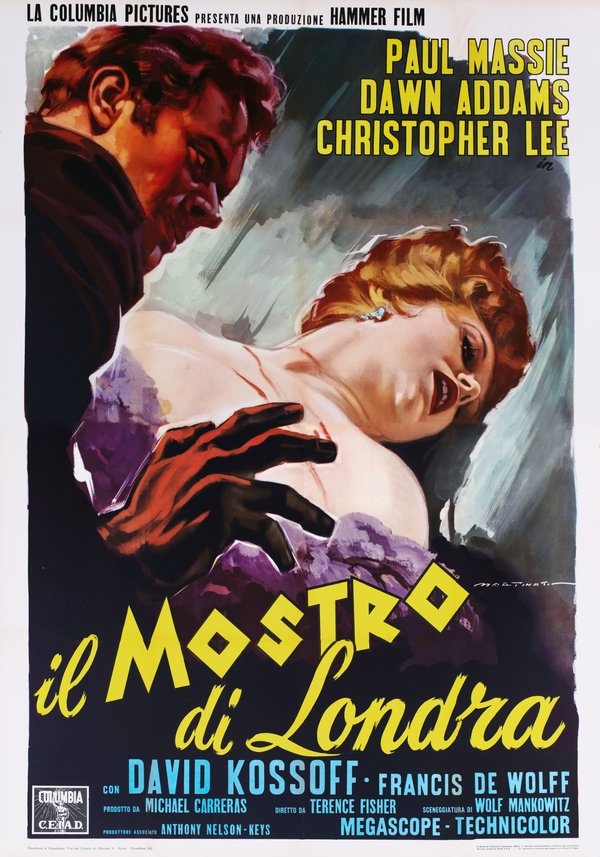
The Two Faces of Dr. Jekyll (Terence Fisher, 1960)
The Italian movie poster for The Two Faces of Dr. Jekyll, released in Italy as Il Mostro di Londra and directed by Terence Fisher in 1960, a Hammer Film production for Columbia, marks a further step in Martinati's stylistic evolution. The composition shows a dark figure looming over a woman stretched out in a sickly greenish light: the male figure is reduced to a black silhouette without recognisable features, while the woman's body is rendered in luminous, unhealthy whites. Martinati chooses insinuation over explicitness, leaving the precise nature of the danger to the viewer's imagination. The palette has grown more saturated and visionary, the mark more violent: this is a Martinati in full command of his craft.
In 1952, at a moment of full professional recognition, his colleagues celebrated the fortieth anniversary of his career as a poster artist, and Martinati promoted the establishment of the Premio Spiga Cambellotti, an annual award for the most deserving film poster artist of the year: the name recalled the wheat-sheaf signature of the painter Duilio Cambellotti. A gesture that spoke of a deep conviction that cinema painters deserved artistic and cultural recognition, not merely to be regarded as tradesmen.
Retirement and Return to Origins: the Macchiaioli as a Final Harbour
In 1967 Martinati decided to bring his career as an illustrator to a close and effectively disappeared from public view for nearly a decade. When he re-emerged, it was to speak of painting: no more film posters, no more films to draw inspiration from, but canvases executed in complete freedom, inspired by the Macchiaioli movement and in particular by his old master Giovanni Fattori. In the Tuscan light and the landscapes of the Maremma he rediscovered the same tension between form and atmosphere that had always driven his graphic work: attention to the quality of natural light, the synthesis of form, the rejection of decorative excess.
He died in Rome on 31 December 1983, on the exact day of his ninetieth birthday. He left behind a legacy that, decades later, continues to be rediscovered and reassessed: by collectors who compete for his film posters at auction, by exhibitions dedicated to the painters of cinema, by specialist literature and international auction houses. His figure illuminates an unrepeatable season of Italian applied graphic art, one in which an academically trained artist could place his talent at the service of a popular medium, the movie poster, without this being seen as a compromise but rather as a conscious and proud artistic choice.
The works reproduced on this page come from the original prints of the period, recovered, photographed and digitally restored by Movie.it.