The Western, a brief history of a cinema legend
By the Movie.it Editorial Team
July 29, 2026
The Western is the great American story and at the same time one of the most universal genres cinema has ever invented: the frontier, the duel, the law and the desert speak to every audience, from Los Angeles to Rome to Tokyo. Few other genres have accompanied the history of cinema itself for so long: born with its first steps, it has crossed a century of screens, changing its skin with every generation, from Hollywood to Europe and back. This is its story.
From the Frontier to the Screen: The Birth of the Western
The Western was born practically together with narrative cinema. In 1903 The Great Train Robbery by Edwin S. Porter, twelve minutes of train hold up produced by Edison's company, was one of the landmarks of early narrative cinema and includes the image that would become iconic: the bandit aiming his revolver straight at the audience and firing. In the silent era the genre became Hollywood's daily bread, with stars like Tom Mix and William S. Hart embodying the cowboy for millions of moviegoers. The frontier had been declared closed just over a decade earlier: cinema arrived just in time to turn it immediately into myth.
John Ford and Hollywood's Golden Age
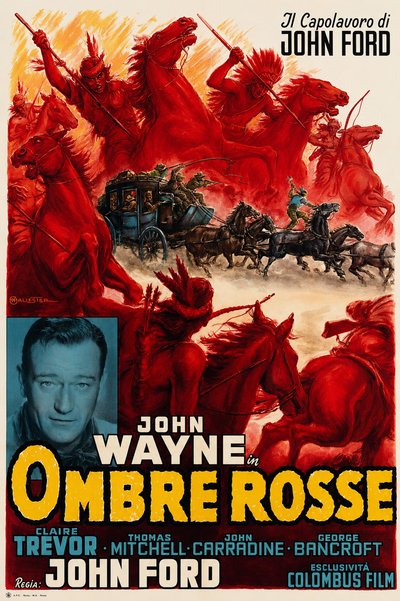
The poster for Stagecoach (John Ford, 1939), painted by Anselmo Ballester for an Italian re release. The charge of the warriors, painted as a fire red wave engulfing the galloping stagecoach, turns the Italian title, which means Red Shadows, into pure image, with John Wayne's portrait set in a blue panel. The film that made the Western great cinema, interpreted here by one of the absolute masters of the first generation of Italian poster painters.
The postwar years were the golden age. Ford signed the cavalry trilogy and then, in 1956, The Searchers, the most influential Western ever made, with a dark, obsessed Wayne. Howard Hawks answered with Red River and with Rio Bravo, his anti High Noon: a sheriff who does not beg the townspeople for help but chooses his own men. Fred Zinnemann, with High Noon produced by Stanley Kramer, pushed the genre toward real time tragedy and gave Gary Cooper his second Academy Award; George Stevens sculpted the melancholy gunfighter of Shane; Anthony Mann, paired with James Stewart from Winchester '73 onward, invented the psychological Western. Alongside the masterpieces, specialized producers like Nat Holt turned out solid action Westerns with iron leading men like Randolph Scott: the industrial fabric that kept the genre alive, film after film, season after season.
In Italy these films passed through the great title workshop of the national distributors. Rio Bravo became Un dollaro di onore, A Dollar of Honor; Canadian Pacific became Amore selvaggio, Savage Love: the distributors knew their audience and knew that honor, dollars and passion worked better than a literal translation.
Stagecoach (John Ford, 1939)
In 1939 John Ford gave the Western a new artistic stature. Stagecoach, produced by Walter Wanger, placed nine characters inside a stagecoach and sent them across Monument Valley, which from that film onwards became one of the genre’s defining landscapes. A perfectly constructed moral drama disguised as an adventure film, it made John Wayne a star and demonstrated that the Western could also be great cinema.
Rio Bravo (Howard Hawks, 1959)
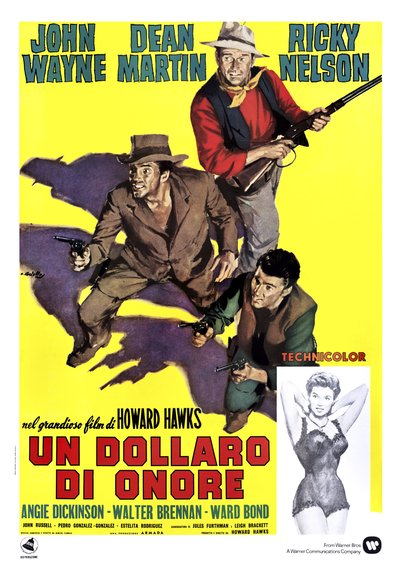
The poster for Rio Bravo (Howard Hawks, 1959), painted by Averardo Ciriello. Against a blazing yellow background, John Wayne, Dean Martin and Ricky Nelson advance guns in hand inside a single great shadow. It is Hawks's answer to High Noon: a sheriff who does not ask the townspeople for help but chooses his own men, in one of the best loved Westerns of all time.
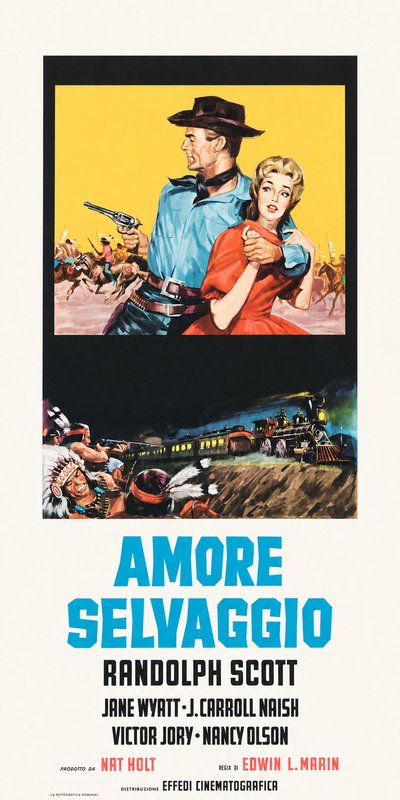
Canadian Pacific (Edwin L. Marin, 1949)
The "locandina" (Italian small format) for Canadian Pacific (Edwin L. Marin, 1949), painted by Piovano. The format left blank space where each theatre printed its name and showtimes, while the artwork derived from the design created for the largest Italian promotional poster, the 140x200. Above, Randolph Scott protects his woman; below, the train pushes through the night under attack. A railroad adventure about the building of the great Canadian line, a perfect example of the action Westerns produced by Nat Holt that audiences all over the world devoured.
Sergio Leone: Europe Reinvents the West
In 1964, just as Hollywood was beginning to write the genre off, its rebirth arrived from the other side of the ocean. A Roman director shot a film between Spain and Cinecittà, on a shoestring budget and with an American television actor not yet established as a film star, Clint Eastwood: it was called A Fistful of Dollars. The bet was placed by two producers, Giorgio Papi and Arrigo Colombo of Jolly Film. And one detail captures the spirit of the time better than any analysis: convinced that audiences would never take seriously a Western shot by Europeans, Sergio Leone signed the direction as Bob Robertson, and with him almost the entire crew hid behind American pseudonyms. While waiting to sign with its own name, the European Western pretended to be American.
The success was worldwide, and the hiding did not last long. With For a Few Dollars More and The Good, the Bad and the Ugly, produced by Alberto Grimaldi, destined to become one of the great names of international cinema, Leone imposed a new Western: extreme close ups and dilated silences, Ennio Morricone's music as a second screenplay, dirty heroes and unforgettable villains like the Gian Maria Volonté of the first two chapters. In 1968 Once Upon a Time in the West closed the circle and returned physically to the origins, shooting between Spain and Ford's own Monument Valley, with a surprising Henry Fonda cast as the villain: a twilight work about the end of the West, signed by a European and now part of the heritage of world cinema.
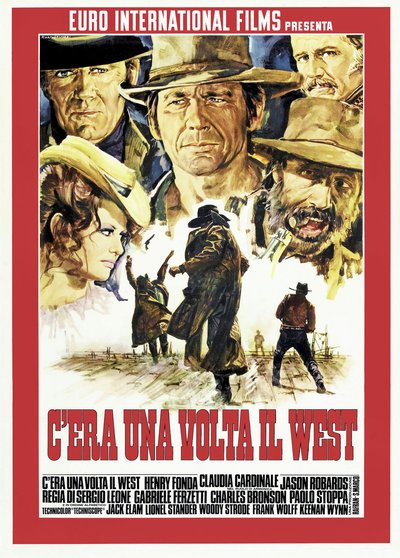
Once Upon a Time in the West (Sergio Leone, 1968)
The poster for Once Upon a Time in the West (Sergio Leone, 1968), painted by Rodolfo Gasparri. The faces of Henry Fonda, Charles Bronson, Jason Robards and Claudia Cardinale composed like an overture around the duel, in a construction that breathes with the film itself. It is today one of the most celebrated images in the entire history of the genre, worthy of the masterpiece it announced.
The Boom: A Genre Without Borders
In Leone's wake, the Western became a worldwide industry again, but with its engine in Europe. In little more than a decade, co productions between Italy, Spain, France and Germany turned out hundreds of titles, shot between Almería and Cinecittà and sold on every continent. Sergio Corbucci, with Django, handed Franco Nero a character so legendary that it spawned dozens of unofficial sequels around the world; Sergio Sollima and Duccio Tessari brought politics and irony into the current; and the genre attracted American stars like Lee Van Cleef, relaunched by Leone and turned into an absolute star, or unexpected guests like William Shatner, Star Trek's Captain Kirk, who ventured into the European Western.
It was a cinema afraid of nothing, not even of experimenting: there were Gothic Westerns, psychedelic Westerns like Matalo!, Westerns in which the genre looked at itself in the mirror and deformed. A disorderly, generous vitality that audiences rewarded and that kept theatres lit up across half the world.
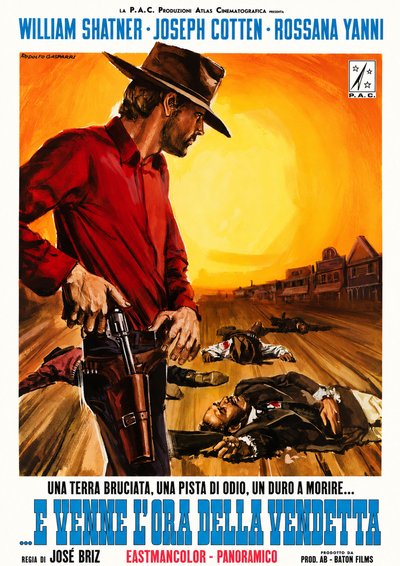
White Comanche (José Briz, 1968)
The poster for White Comanche (José Briz, 1968), painted by Rodolfo Gasparri. The gunman in the red shirt against the enormous disc of the sun, the bodies stretched out on the deserted street: a composition that condenses the whole liturgy of the duel into a single scene. Starring William Shatner alongside a veteran like Joseph Cotten, in a curious European co production now sought after by fans.
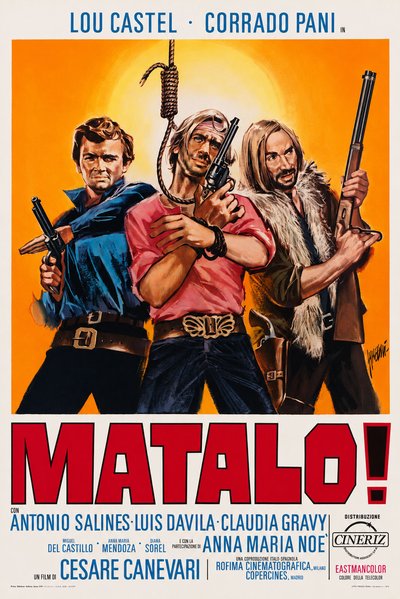
Matalo! (Cesare Canevari, 1970)
The poster for Matalo! (Cesare Canevari, 1970), painted by Sandro Symeoni. The three outlaws lined up against the burning orange of the sunset, with the noose hanging ominously at the center. The film is one of the most radical experiments of the whole current, a psychedelic Western with electric guitars and boomerangs instead of guns, which over the years has become a small international cult.
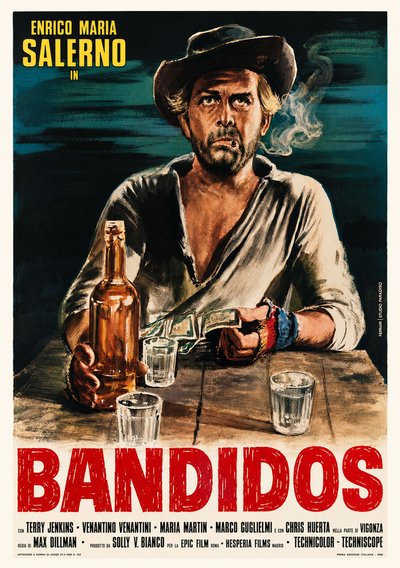
Bandidos (Max Dillman, 1967)
The poster for Bandidos (Max Dillman, alias Massimo Dallamano, 1967), painted by Mafé. Enrico Maria Salerno at a saloon table, among the bottle, the glasses and the dollars, in a still, tense portrait closer to drama than to adventure. Salerno had already given much to the Western without being seen: his was the Italian voice of Clint Eastwood in Leone's trilogy. And behind the pseudonym Max Dillman hides Massimo Dallamano, director of photography on Leone's first two Westerns, here directing one of the most admired titles of the current.
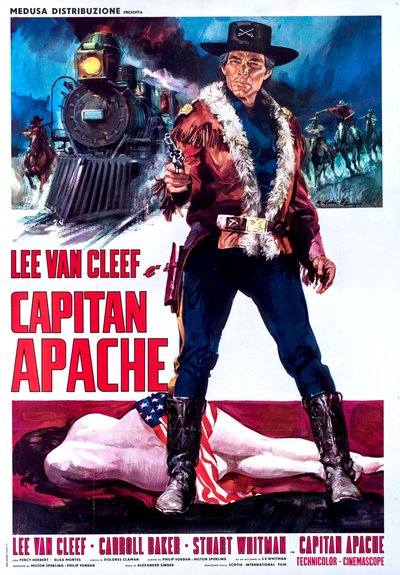
Captain Apache (Alexander Singer, 1971)
The poster for Captain Apache (Alexander Singer, 1971), painted by Averardo Ciriello. Lee Van Cleef standing firm, the locomotive bursting through the night and the woman wrapped in the flag at his feet: a concentrate of Western iconography built around the star's sharp features. Van Cleef, consecrated by Leone's films, had become a guarantee for audiences all over the world.
The Comic Turn: Trinity and his Brothers
At the beginning of the Seventies the Western reinvented itself one last time, and it did so laughing. The duo of Terence Hill and Bud Spencer turned brawls and beans into a phenomenon that broke box office records across half of Europe, and the Italian Western, born in the age of gunfights and duels, entered its last great popular phase with slapstick punches. Behind the camera was Enzo Barboni, who signed with the pseudonym E.B. Clucher: the last echo of that old habit of American names, by now a mannerism more than a necessity.
In 1972 Man of the East, produced by the same Alberto Grimaldi who had bet on Leone's dollars, took the formula out of the dusty West, dispatching an impeccable English gentleman into the wild frontier: audiences flocked to it, and Terence Hill's smile became one of the best loved faces of popular cinema, at home and abroad.
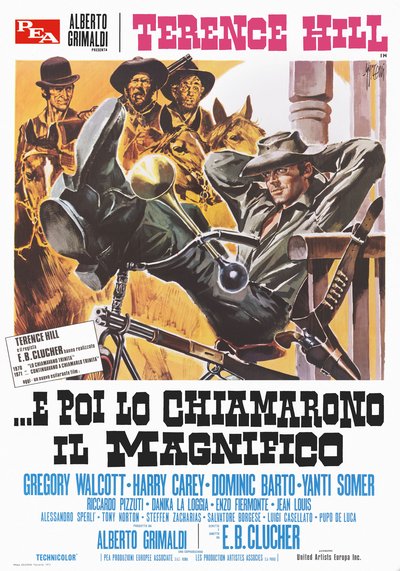
Man of the East (E.B. Clucher, 1972)
The poster for Man of the East (E.B. Clucher, 1972), painted by Sandro Symeoni. Terence Hill leaning back in his chair, feet resting on the velocipede, wearing the smile of a man in no hurry, while the thugs on horseback behind him are left open mouthed: the image alone tells the whole tone of the comedy. A picture that still draws a smile before the film begins.
Twilight and Rebirths: The Modern Western
While Europe laughed, America reckoned with its own myth. In 1969 Sam Peckinpah, with The Wild Bunch, staged the most violent and magnificent funeral of the old West: aging outlaws, machine guns, an era dying in a slow motion bloodbath. In the Seventies the revisionist Western reread the conquest from the point of view of the defeated, with films like Arthur Penn's Little Big Man, and the genre, now grown up, learned to put its own legend on trial.
Then, just when everyone had given it up for dead, the Western came back to win everything. In 1990 Kevin Costner's Dances with Wolves took seven Academy Awards; two years later Clint Eastwood, the actor the world had discovered in films shot in Europe, closed the circle of his own career and of the whole genre with Unforgiven, four Academy Awards including Best Picture and Best Director, dedicated to his masters Sergio Leone and Don Siegel. Since then the Western has kept being reborn with every generation, from the Coen brothers to Quentin Tarantino, while Morricone's music and the shots of Ford and Leone are quoted all over the world. The lone rider, the duel at sunset, the frontier town now belong to universal visual culture: the Western is not a closed chapter in the history of cinema, it is its founding myth, always ready to return.
The works reproduced on this page come from the original prints of the period, recovered, photographed and digitally restored by Movie.it.