
Niso Ramponi "Kremos", Italian Movie Poster Artist behind "Miracolo a Viggiù" and "I'm All Right Jack"
By the Movie.it Editorial Team
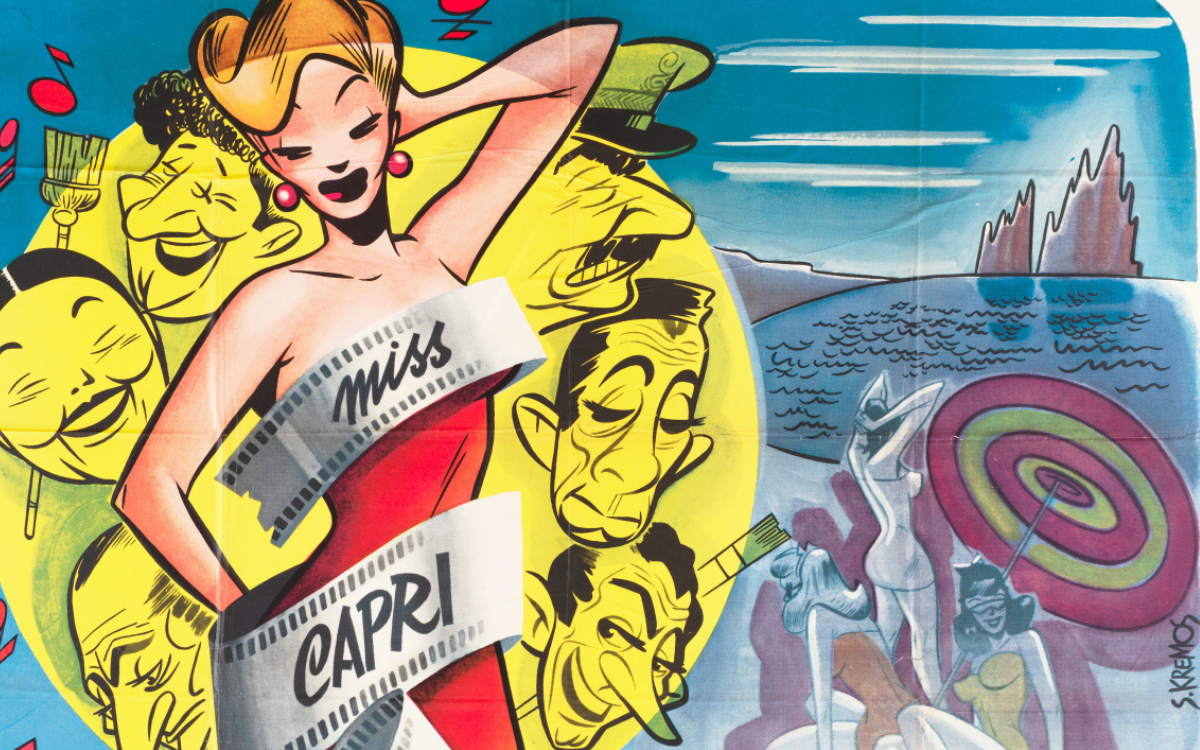
August 24, 2026
For once, this series is not about rescuing a name from obscurity, but about rediscovering a neglected side of an artist's career. Niso Ramponi, known to everyone as Kremos, is something of a minor celebrity in Italian graphic art, the "King of the Little Ladies" of Il Travaso's covers, rediscovered in the United States through a two-volume monograph. What almost nobody tells you is that those very same girls, in the Fifties, stepped down from the covers of weekly magazines and ended up on the walls of Italian cities, on movie posters. This page exists to tell the story of Kremos the poster artist.
Fellini, the Soldiers and the Birth of Kremos
Born in Rome in 1924, Ramponi began working in animation at a very young age, at Incom and Nettunia Film, where he even worked on a cartoon scripted by Federico Fellini that was never finished. With Fellini he also shared a legendary episode of liberated Rome: the Funny Face Shop, a caricature shop catering to Allied soldiers, where Ramponi painted backdrops of Roman views against which Fellini caricatured the soldiers posing in front of them, alongside colleagues such as Enrico De Seta and Rinaldo Geleng , two more artists in this series. Even his pen name was born of a comic device: called up for military service and barred from freelance work, Ramponi had his friend Sandro Cremo act as an intermediary to secure assignments, and signed his drawings Kremos to keep up the ruse. By the time he was discharged, the name had come to be worth more than his own, and it stuck.
The King of the Little Ladies
From 1948 Kremos was the signature that sold Il Travaso, Rome's celebrated humorous weekly: his curvaceous, smiling girls on the cover sent circulation soaring, and more than one issue was even seized for indecency, which, as far as publicity goes, never hurt. His colleagues crowned him King of the Little Ladies; his editors nicknamed him the Scarlet Pimpernel for his gift of vanishing whenever a deadline loomed. In the 2015 American monograph, cartoonist Jerry Carr compared his work with that of several major American cartoon and pin-up artists: the same elegance of line, the same sense of physical comedy, and an originality that was entirely his own.
The Little Lady Walks into the Cinema
In those same years Kremos also worked as a poster artist for major American distributors then active in Italy. And what he brought to the trade was distinctive: where traditional poster art aimed for grandeur, Kremos brought humour. No star portraiture, no melodrama: what appeared on the poster was caricature, visual gags and magazine-style pin-ups, with the flat colour fields and elastic line of an animator. It was the exact opposite of the portraitist’s school, and it suited comedy and musical revue perfectly, the very genres post-war Italy consumed by the bucketload: audiences knew at a glance that here was a film meant to make you laugh. In that territory Kremos had few rivals, and the five works on this page, spanning the post-war years through the end of the 1950s, prove it one by one.
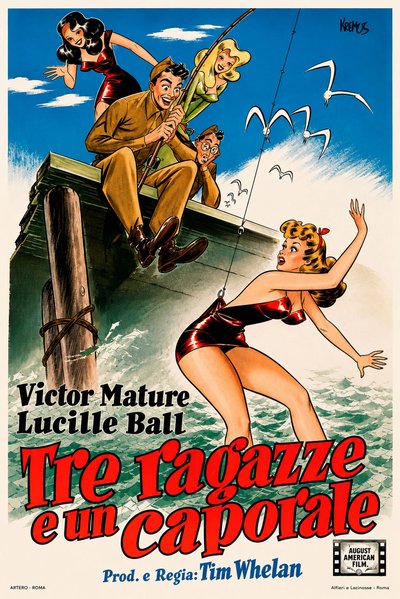
Seven Days' Leave (Tim Whelan, 1942)
The poster for Seven Days' Leave (Tim Whelan, 1942). Released in Italy as Tre ragazze e un caporale: the corporal fishes a bather in a red swimsuit off the pier, amid banknotes and seagulls sketched in ink: the American comedy with Victor Mature and Lucille Ball, released in Italy after the war, already entirely in the spirit of the cartoon.
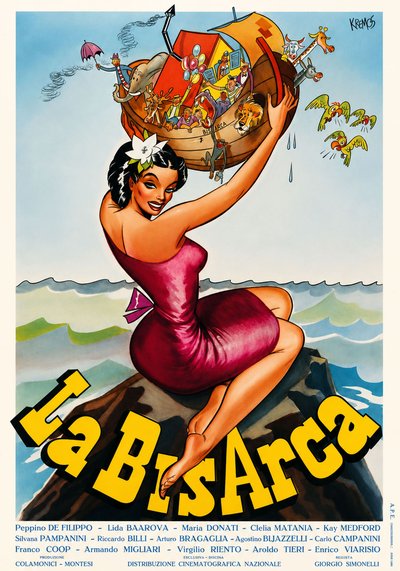
La bisarca (Giorgio Simonelli, 1950)
The poster for La bisarca (Giorgio Simonelli, 1950). A girl in a purple dress holds a whole Noah's Ark of caricatured cast members, animals included, over her head: the Travaso girl lent to the cinema, with a smile in place of stardom.
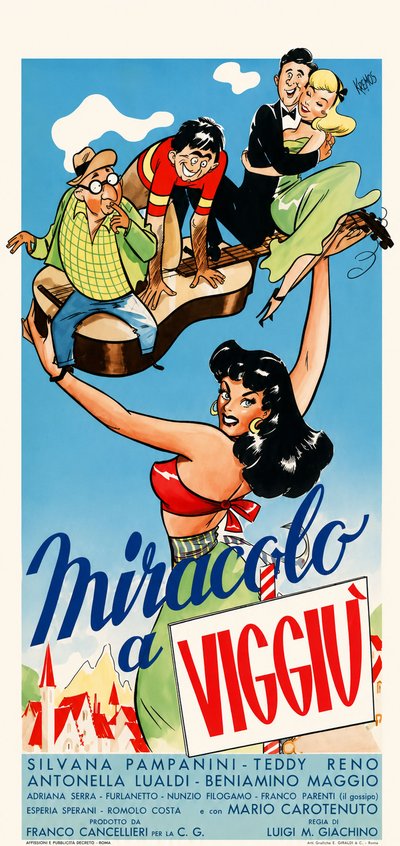
Miracolo a Viggiù (Luigi M. Giachino, 1951)
The "locandina" (the small Italian format) for Miracolo a Viggiù (Luigi M. Giachino, 1951). A dark-haired dancer holds aloft a guitar with the comedians and the elegant couple perched on it, above the red rooftops of the town: a musical revue distilled into a single revue-style flourish.
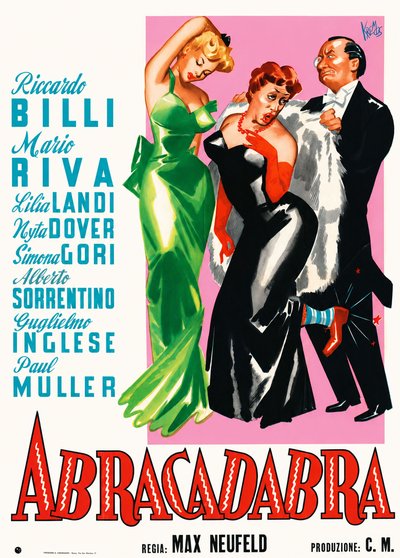
Abracadabra (Max Neufeld, 1952)
The poster for Abracadabra (Max Neufeld, 1952). The blonde in the green gown, the startled lady, and the gentleman in tails with a red shoe peeking from under his coat: a small theatre of caricatures on a pink ground, the title crackling like a magic trick.
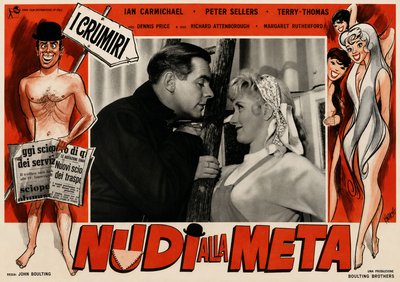
I'm All Right Jack (John Boulting, 1959)
The "fotobusta" (the Italian lobby card format) for I'm all right jack (John Boulting, 1959). The photographic scene sits at the centre, framed all around by drawn figures, with the striking worker in a bowler hat, covered only by his newspaper, and girls peeking in from the margins: the British comedy with Peter Sellers, in a format where drawing and photography now lived side by side.
(Fu) Kremos
His farewell to the poster and to Il Travaso came gradually, and with one last flourish worthy of the man: in 1957 Sandro Cremo raised a dispute over Ramponi's use of the Kremos pseudonym, and Ramponi, in reply, signed himself for a while "(Fu) Kremos", "the late Kremos", before settling on plain Niso. From 1962 he devoted himself to teaching animation and to television, where in 1972 he won the Bagatto d'Oro for a Carosello commercial, having already co-created with his colleague Gibba the celebrated animated sequence featuring Renato Rascel in Attanasio cavallo vanesio. Even in his poster years, the most overlooked and perhaps the most delightful chapter of his career, every image remained unmistakably his own: among Italy's movie-poster artists, Kremos is the one who never stopped making people laugh, and for a decade the walls of Italian cities were his biggest magazine of all.
The works reproduced on this page come from the original prints of the period, recovered, photographed and digitally restored by Movie.it.