Mario Ferrari "Mafè", Italian Movie Poster Artist Behind "An American in Rome" and "The Uncanny"
By the Movie.it Editorial Team
August 28, 2026
Not every master of movie poster art left behind an archive, interviews or a monograph. Some left little more than the work itself, an abbreviated signature in a corner and the name of a studio printed along the edge. Mario Ferrari was one of them. He signed his work Mafè and spent years working with Rome's Studio Paradiso. More than anything else, this page is an attempt to restore a name to the images.
A Name Behind the Signature
For decades, Ferrari remained little more than a signature. Almost everything we know about him comes from the works themselves and the surviving material associated with them. Original designs painted in tempera on cardboard, often measuring around 35 × 50 centimetres, have resurfaced at specialist auctions in Rome in recent years. Among them are signed works for the 1967 Christopher Lee film The Torture Chamber of Dr. Sadism and for The Uncanny, released in Italy as Artigli, in 1977.
Together, they document a career spanning at least a decade and extending to the end of the 1970s, across horror, thrillers, comedy and reissues of major classics. Movie.it has already recovered 283 posters by Mario Ferrari "Mafè", most of them signed by the artist and the remainder attributed to him in published sources: a substantial body of work for an artist who has come down to us with almost no biography at all.
Mario Ferrari, Mafè and the Graphic Studios
To understand Ferrari, one must first understand the system in which he worked. At the height of demand, when every season required hundreds of new advertising campaigns, celebrated individual artists worked alongside graphic studios: collective workshops able to provide speed, continuity and a recognisable visual identity. Studio Favalli, closely associated with Rodolfo Gasparri, was one of the best-known examples.
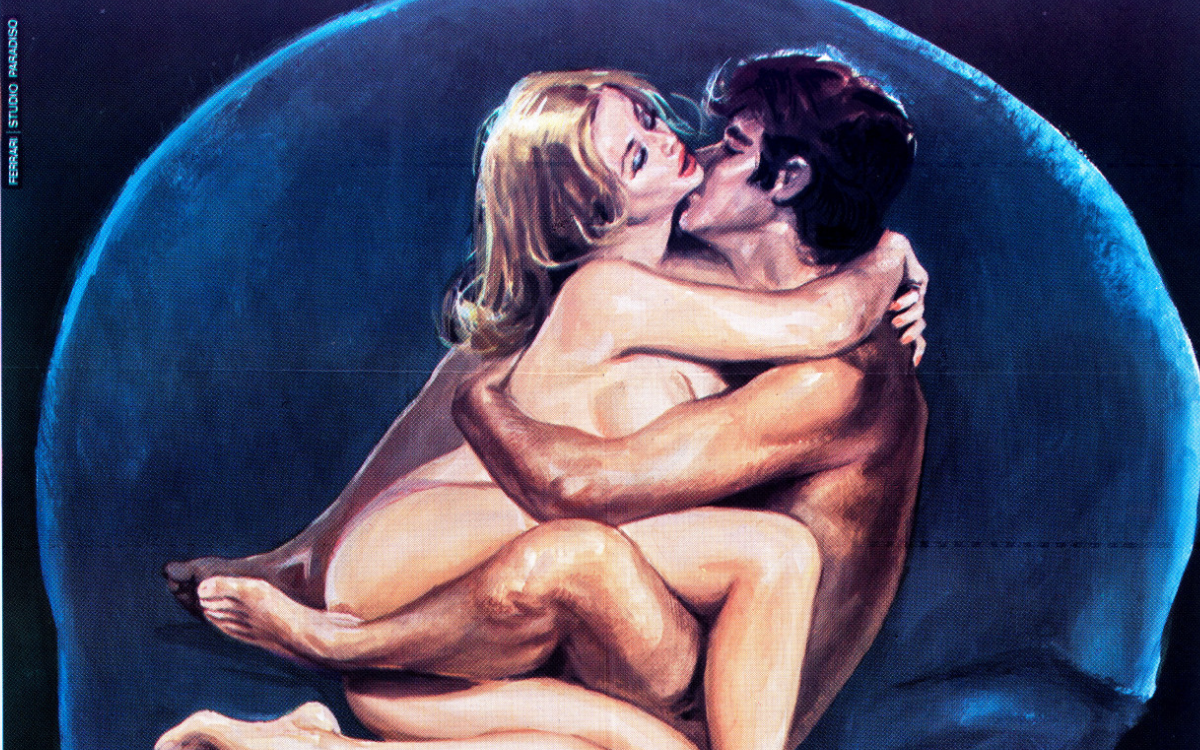
Studio Paradiso belonged to the same world. The credit Ferrari | Studio Paradiso, printed along the edge of some posters, is characteristic of the period: the artist's name survives, but within the identity of the studio responsible for the campaign. Ferrari also collaborated with other studios, as shown by the credit Ferrari – Studio Piovano on a later edition of An American in Rome. Yet even within this collective system, Ferrari's signed works retain a distinctive visual identity of their own.
The Decade of Fear
One of the areas in which Ferrari was at his most compelling was 1970s horror, a field also explored during those years by artists such as Sandro Symeoni and Enzo Sciotti. His poster for The Uncanny, released in Italy as Artigli, is a masterclass in visual economy: no painted cast, no montage of scenes, just a single nocturnal idea pushed to its limit, with black consuming almost the entire surface and colour erupting in only two violent accents.
For Robert Altman's Images, promoted in Italy beneath the line "One hundred minutes of fear", Ferrari created one of the decade's most modern and unsettling posters. Its visual language feels closer to the cover of an experimental science-fiction novel than to conventional film advertising of the period.
Another Side of Ferrari
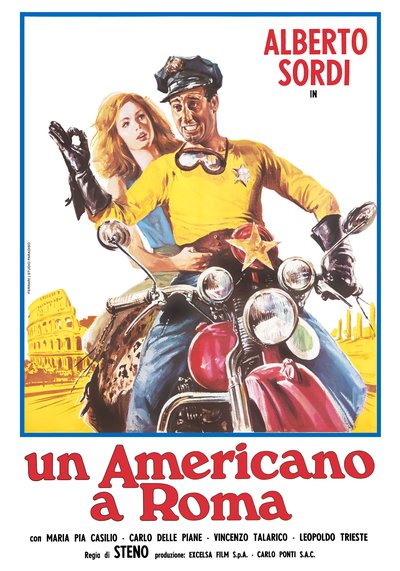
His other works make it clear that Ferrari was far more than a painter of horror. When Steno's classic An American in Rome returned to Italian cinemas in the 1970s, Ferrari created new artwork for a later edition of the film, credited jointly with Studio Piovano. Its bright, immediate comic energy could hardly be further removed from the darkness of his horror imagery.
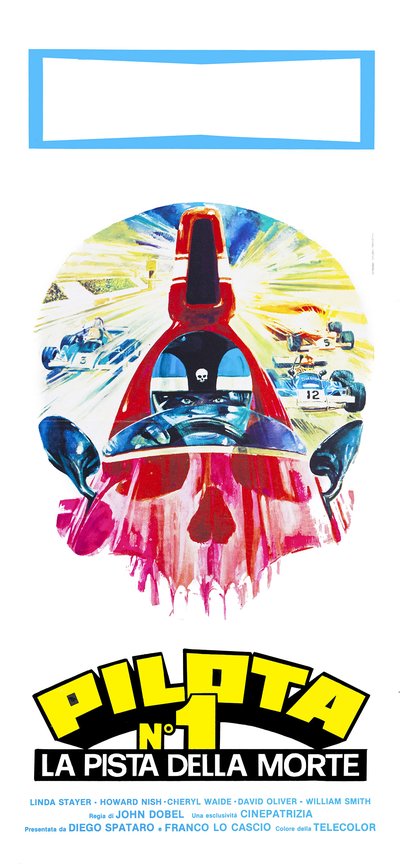
The Italian "locandina" (Italian small format) for Daredevil Drivers reveals the same inventiveness at work on a much less celebrated title. Rather than falling back on the familiar montage of racing scenes, Ferrari builds the entire composition around a single macabre idea, simple enough to be grasped instantly and powerful enough to be remembered.
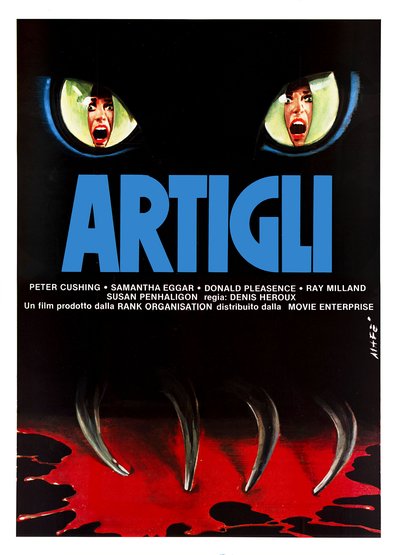
The Uncanny (Denis Héroux, 1977)
The poster for The Uncanny (Denis Héroux, 1977), shows two cat’s eyes emerging from the darkness, with the victims’ screaming faces replacing the pupils as claws sink into a pool of blood: one of Ferrari’s most striking pieces of 1970s horror imagery. The original artwork, signed Mafè, resurfaced at auction in Rome in 2023.
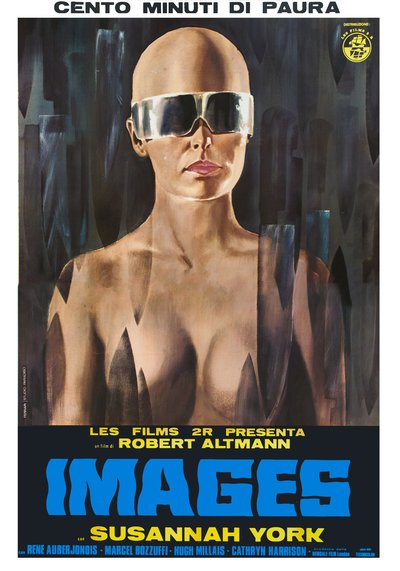
Images (Robert Altman, 1972)
The poster for Images (Robert Altman, 1972), shows a bald figure in mirrored glasses standing motionless between blades of shadow beneath the line “One hundred minutes of fear”: Altman’s psychological thriller distilled into an image of startling modernity.
An American in Rome (Steno, 1954)
The poster for An American in Rome (Steno, 1954), created by Mario Ferrari “Mafè” for an Italian reissue in the 1970s, shows Alberto Sordi riding his motorcycle in front of the Colosseum in a bright, immediately readable composition that gives one of the great classics of Italian comedy a new visual identity for a new generation of moviegoers.
Daredevil Drivers (Yasuhiko Kawano, 1978)
The locandina for Daredevil Drivers (Yasuhiko Kawano, 1978), created by Mario Ferrari “Mafè”, shows racing cars tearing through the outline of a skull, with the driver positioned at its centre like a pupil; above them, a blank panel was reserved for local screening details such as dates and showtimes. On the locandina, the director is credited under the pseudonym John Dobel.
We still do not know Mario Ferrari's face, his training or the year of his death. But the works remain, and they speak for him: a versatile and visually sophisticated artist who could move effortlessly from the scream of horror to Alberto Sordi's smile. He deserves a place within the broader tradition of Italy's pittori di cinema, the movie poster artists whose work Maurizio Baroni has done so much to bring back to public attention. Restoring Ferrari's full name to that history is the least this series can do.
The works reproduced on this page come from original period prints recovered, photographed and digitally restored by Movie.it.