Giovanni Alessandri “Aller”, from Movie Posters to Calendars
Edited by Paolo Zelati, Editorial Director
August 4, 2026
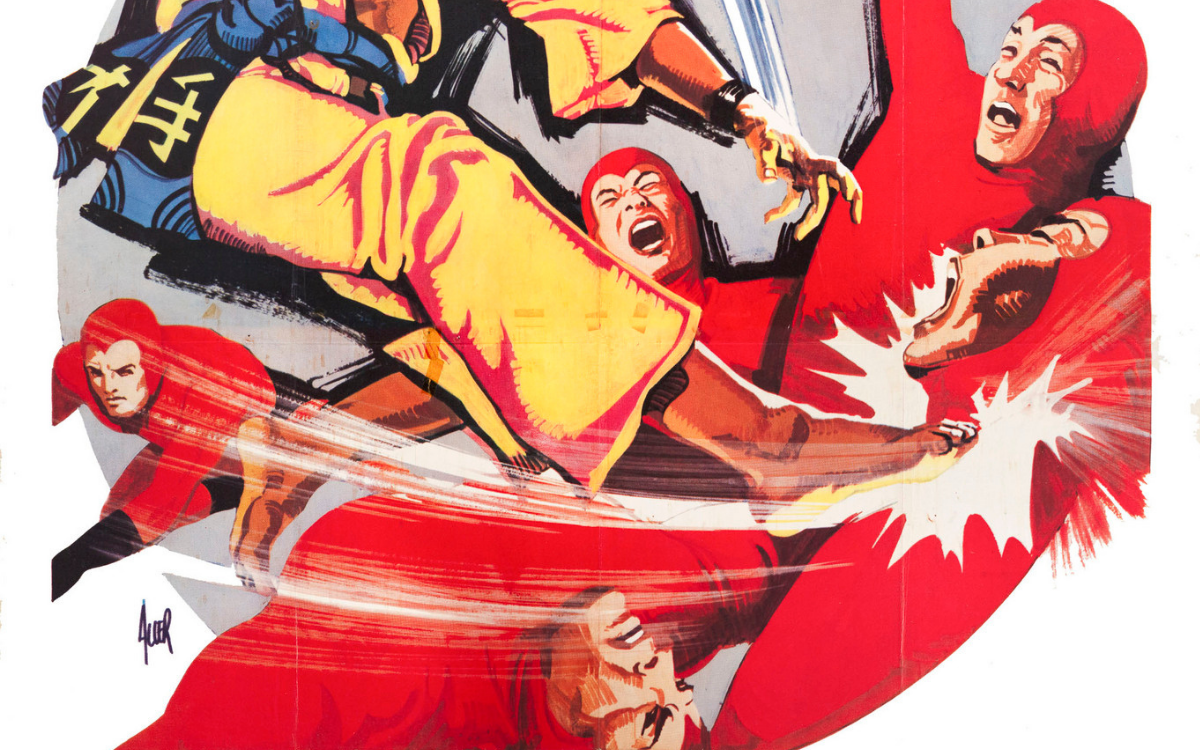
For decades his signature remained a small mystery in the corners of movie posters: five letters, Aller, beneath Giuliano Gemma's knee or beside Franco Nero's revolver. Behind that signature is Giovanni Alessandri, born in Rome on January 1, 1946, one of the Pittori Cartellonisti, the Italian painters of the movie poster, whose story had never been told: this biography is the first.
From the Print Shops of Rome to Studio Paradiso
His road began on the opposite side of the trade: not with the brush, but with the printing press. After vocational school, in the early Sixties the young Alessandri went to work in Roman print shops, Policrom and Rotolito, where the sheets of movie posters passed through every day. That is where the spark caught: watching the images hand painted by the artists of the cinema come to life in print won him over and he understood that this, not typography, was his path.
His way in was Studio Paradiso, one of the Roman workshops where the craft was learned by working side by side. There he met Mario Piovano and over the years he also worked alongside Renato Casaro and Franco Picchioni, known as P. Franco. A Renaissance workshop education: you watch, you copy, you learn, inside that rivalry and mutual knowledge among painters that helped make the Italian school one of the great traditions of film-poster art.
Sketches Chosen by the Great Distributors
In time his sketches began to be chosen. First by smaller film companies, then, between the second half of the Seventies and the Eighties, by major names of international distribution: Dear Film, M.G.M., C.I.C., United Artists. His work ranged across the genres that had defined the golden age of the painted film poster, starting with the Western, a genre mastered by poster artists such as Rodolfo Gasparri and Sandro Symeoni, where Aller signed images of lean efficiency: Giuliano Gemma crouched over the pierced silver dollar, Franco Nero firing straight out of the white sheet.
The height of his fame came with the most international cinema in existence: James Bond. For the first Italian release, in 1977, of The Spy Who Loved Me, produced by Albert R. Broccoli for United Artists, Aller composed a great spectacular machine of submarines, jet skis and silhouettes in evening dress: the kind of image that must promise an entire world in a single glance.
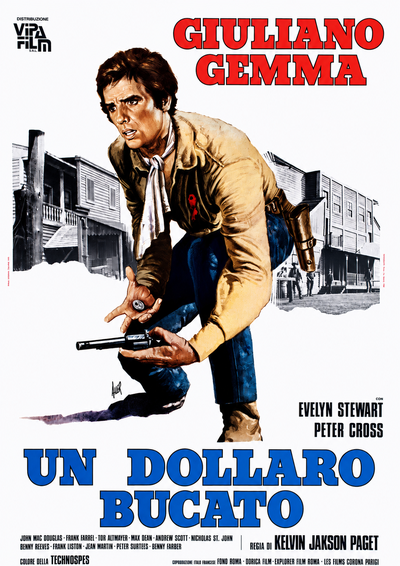
The poster for Un dollaro bucato (Giorgio Ferroni, 1965)
Giuliano Gemma crouched in the dust discovers the pierced dollar that saved his life, with the Western town in black and white behind him: the color figure standing out against the neutral background is a stroke of painterly direction. One of the hits that crowned Gemma the king of the romantic, popular Western.
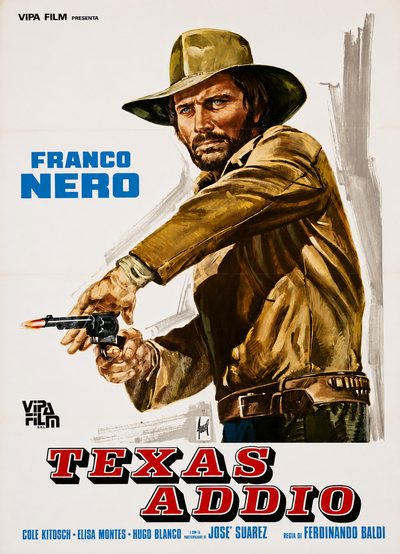
The poster for Texas, Adios (Ferdinando Baldi, 1966)
Franco Nero fires straight out of the sheet, isolated against a white background barely scratched with grey: no setting, no scene, only the star and the muzzle flash. Shot right after Django, the film rode Nero's golden moment, and the poster tells it with an almost graphic economy.
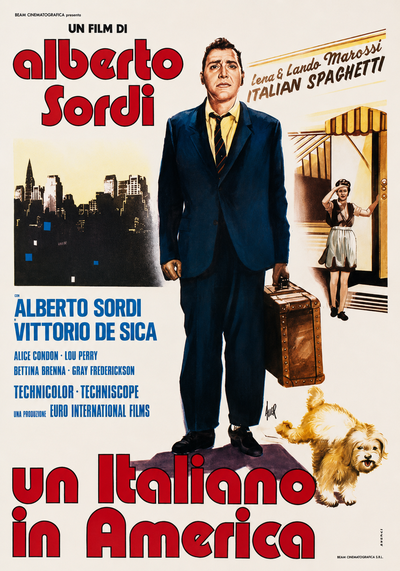
The poster for An Italian in America (Alberto Sordi, 1967)
Sordi in a blue double breasted suit, suitcase in hand and bewilderment on his face, between the New York skyline and the Italian Spaghetti sign: the wide eyed emigrant facing the American dream. Directed by and starring Sordi alongside Vittorio De Sica, one of his bittersweet fables about an Italy chasing America.
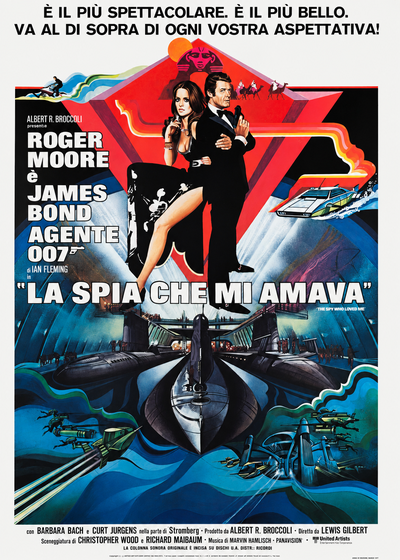
The poster for The Spy Who Loved Me (Lewis Gilbert, 1977)
Roger Moore in a tuxedo and Barbara Bach entwined above a world of submarines, jet skis and sphinxes at sunset: the image promises the entire catalogue of 007's wonders, and delivers. For many the best of Moore's Bond films, produced by Albert R. Broccoli.
Beyond Cinema: Book Covers, the Circus and the Padre Pio Calendar
Like many colleagues of his generation, Aller did not work for the cinema alone. He illustrated covers for several publishing houses, from La Scuola to Ediperiodici to Curcio, and devoted part of his output to the world of the circus, another great territory of popular poster art.
Incredibly, however, perhaps the most widely circulated work of Aller's entire career is the Padre Pio Calendar. After taking over from Salvatore Spataro, Aller spent years creating the illustrated plates that thousands of Italian families around the world kept on their walls, without ever knowing the name of the artist who created them.
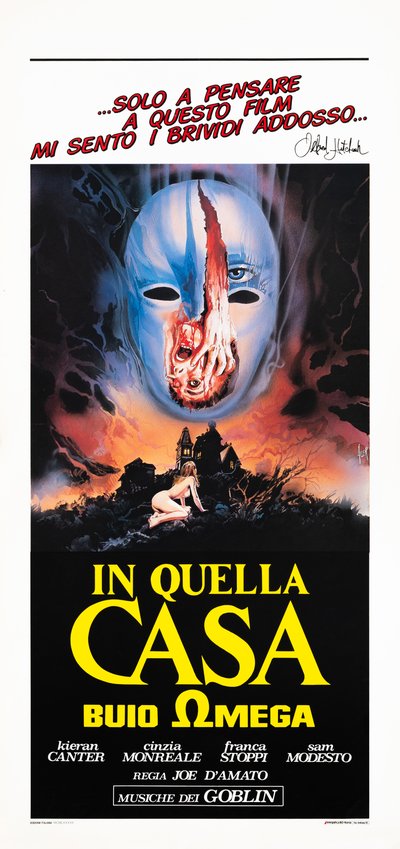
The "locandina" (Italian small format) for Beyond the Darkness (Joe D'Amato, 1979)
The livid, torn mask looming over the burning house, the music by Goblin announced below and, at the top, the launch quote attributed to Alfred Hitchcock: just thinking about this film gives me shivers. One of the most extreme titles of Italian horror, today a cult object among collectors of the genre.
The Final Years and the Legacy
Giovanni Alessandri spent the final years of his life in Torvaianica, on the coast south of Rome, where he died on June 11, 2022. He belonged to that generation of Pittori di Cinema, the Painters of Cinema as Maurizio Baroni has called them, who lived the full arc of the painted movie poster: the workshop apprenticeship, the great international distributors, the movie stars and the calendars, down to the twilight of the trade. His story, until now written only in the corners of his paintings, enters the gallery of the Maestri Pittori Cartellonisti Italiani, the great Italian masters of the painted movie poster: a signature everyone has seen, which finally has a face.
The works reproduced on this page come from the original prints of the period, recovered, photographed and digitally restored by Movie.it.