
Donelli, Italian Movie Poster Artist for "Cortile" and "Vivre sa vie"
By the Movie.it Editorial Team
August 19, 2026
This page, too, begins with a single certainty, a legible signature in the corner of five posters, and an almost total silence around the name attached to it. Public sources hand down no dates for Donelli, no training, not a single anecdote: what remains are the works, and they alone trace the outline of a decade of activity, running from the mid-Fifties to the early Sixties, poised between Neapolitan comedy, English horror cinema and the French Nouvelle Vague.
An Unusually Wide Range
If one thread ties the five works on this page together, it is how far apart they stand from one another. Within the same decade Donelli painted the working-class Naples of the De Filippo brothers, an Ealing Studios thriller, an Italian-Spanish seafaring drama, a Hollywood small-town comedy and, finally, one of the high points of European cinematic modernity, the film with which Jean-Luc Godard turned Anna Karina into an icon. Few Italian poster artists could move this naturally between such different worlds: the mark of a solid craftsman, able to adjust his line to the register of each film rather than force a single recognisable style onto every subject.
The Portrait as Narrative
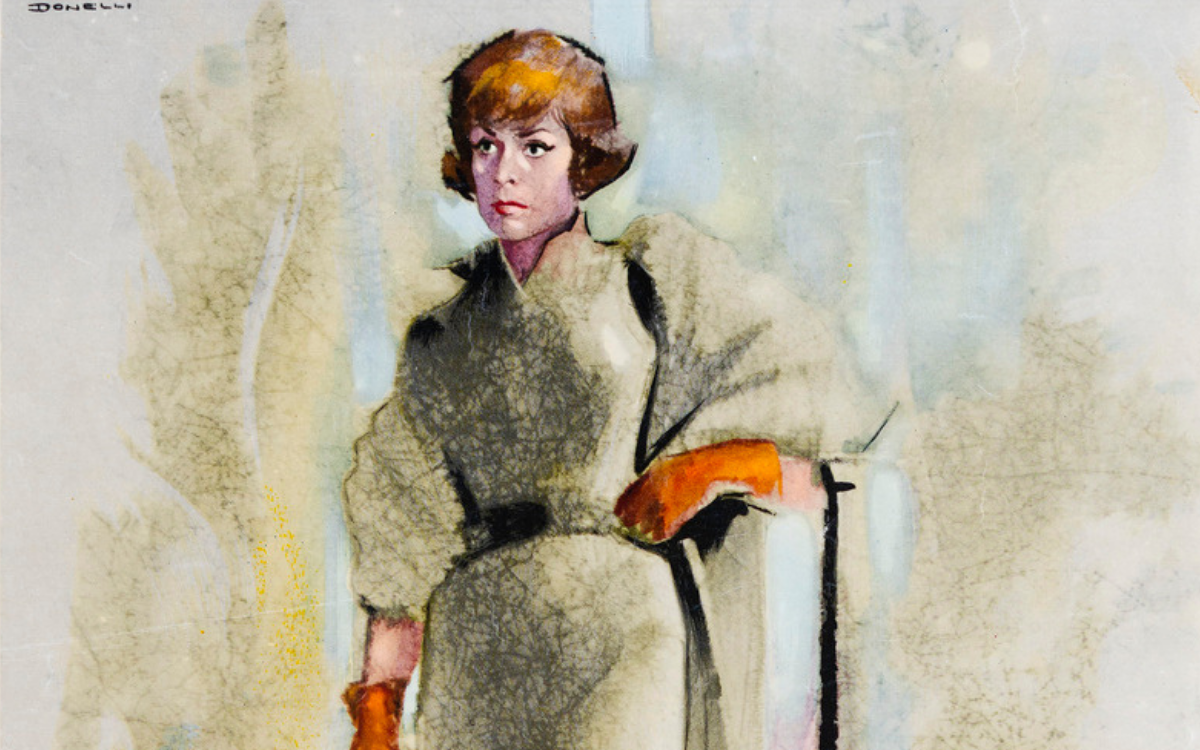
What the five posters share is, if anything, a method: Donelli builds the image around a single face, or a pair of faces, brought right up to the front and loaded with the full emotional weight of the film, leaving the surrounding context, where there is any, to a small vignette or minor scene in the background. It is an art of psychological, rather than narrative, compression: the terror visible in an actress's eyes, another's distant stare, is enough to tell the film's story better than any action scene could. Even in the most sophisticated case on this page, the softly blurred, almost watercolour portrait for Godard's film, the choice is the same: a single face, isolated from its context, standing in for an entire new cinema.
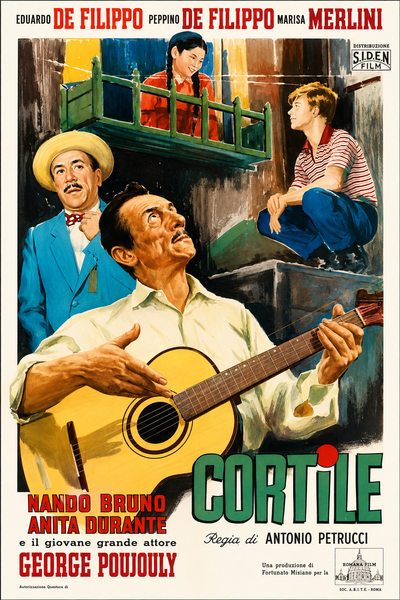
Cortile (Antonio Petrucci, 1955)
The poster for Cortile (Antonio Petrucci, 1955). Eduardo and Peppino De Filippo among the hanging laundry and the voices of a Neapolitan back alley, with young George Poujouly perched on a ledge above: the ensemble comedy set around a working-class courtyard, rendered as a sequence of exchanged glances.
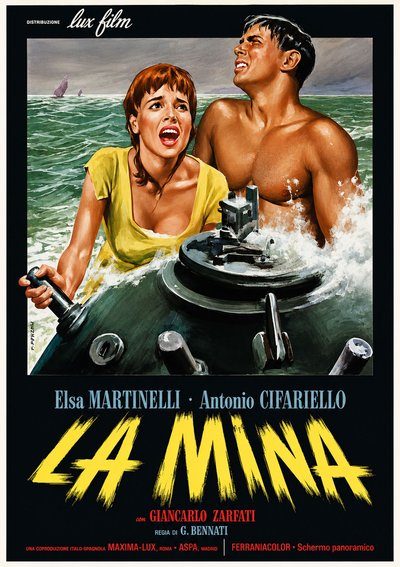
La mina (Giuseppe Bennati, 1958)
The poster for La mina (Giuseppe Bennati, 1958). Elsa Martinelli and Antonio Cifariello clinging to a floating mine in the open sea, their faces tense against a grey sky: the Italian-Spanish co-production distilled into a single image of fear, in widescreen format.
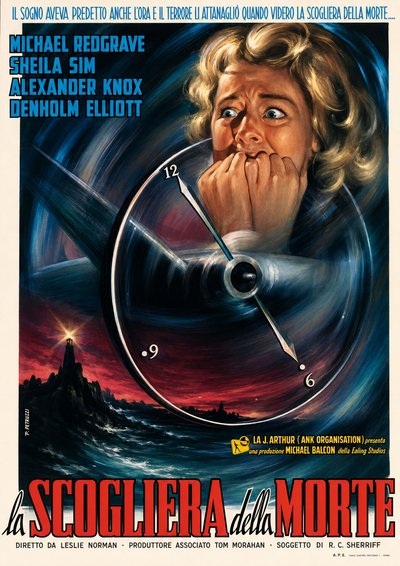
The Night My Number Came Up (Leslie Norman, 1955)
The poster for The Night My Number Came Up (Leslie Norman, 1955). Sheila Sim's face contorted with terror behind an aircraft propeller transformed into a clock: released in Italy as La scogliera della morte, the Ealing Studios thriller condensed into the nightmare of a premonition coming true.
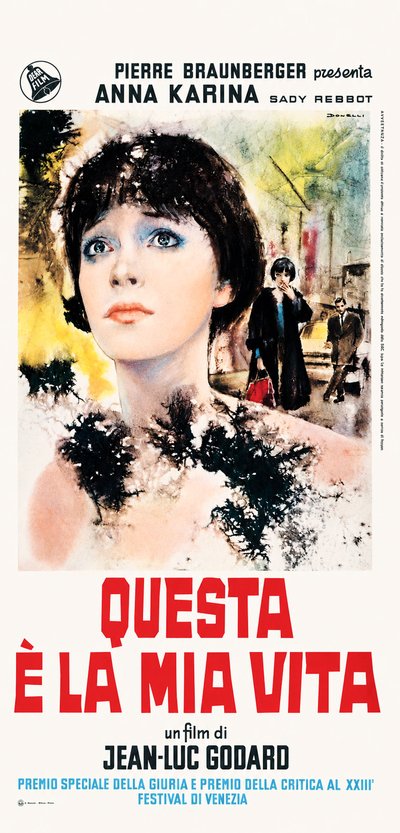
Vivre sa vie (Jean-Luc Godard, 1962)
The "locandina" (the small Italian format) for Vivre sa vie (Jean-Luc Godard, 1962). Anna Karina’s softly blurred face, almost rendered in watercolor, with a scene of Paris by night behind her: the film that earned Godard the Special Jury Prize at Venice, distilled into a single image in the small vertical format, forgoing any visual effects and relying solely on the power of the portrait.
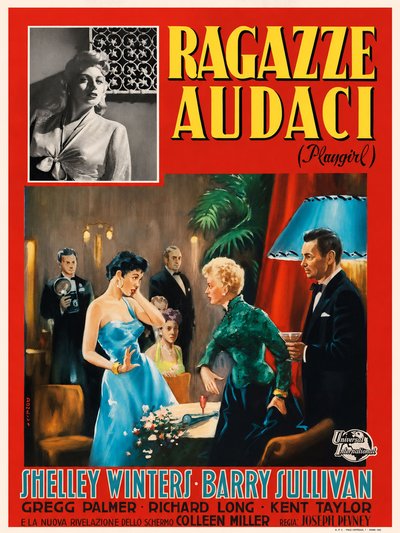
Playgirl (Joseph Pevney, 1954)
The poster for Playgirl (Joseph Pevney, 1954). Shelley Winters in a photographic close-up in the upper panel, with a painted society scene unfolding below across the full sheet, amid evening gowns and the burst of a camera flash: Universal’s comedy Playgirl, where the full poster format allows the two registers to coexist—the photograph of the star and the painted scene.
A Name Worth Verifying, a Body of Work Worth Keeping
It is often precisely the most versatile poster artists, those never tied to a single genre or distributor, who prove the hardest to document. Without a recognisable specialism, they are less likely to have a monograph or a body of scholarship preserving their memory. Donelli belongs to this category, and recovering his name before his works become permanently detached from their authorship is exactly the task this series set itself from the start. Like every other artist featured here, he treated each image as an individual work of authorship, deserving to be traced back to the person who created it rather than left anonymous. Within the community of artists Maurizio Baroni has called the Pittori di Cinema, Donelli is today little more than a signature. The five works gathered here are a first step towards restoring to him the place he deserves.
The works reproduced on this page come from the original prints of the period, recovered, photographed and digitally restored by Movie.it.