
Arnaldo Aldo De Amicis, Italian Movie Poster Artist for "Forbidden Games" and "This Island Earth"
Edited by Paolo Zelati
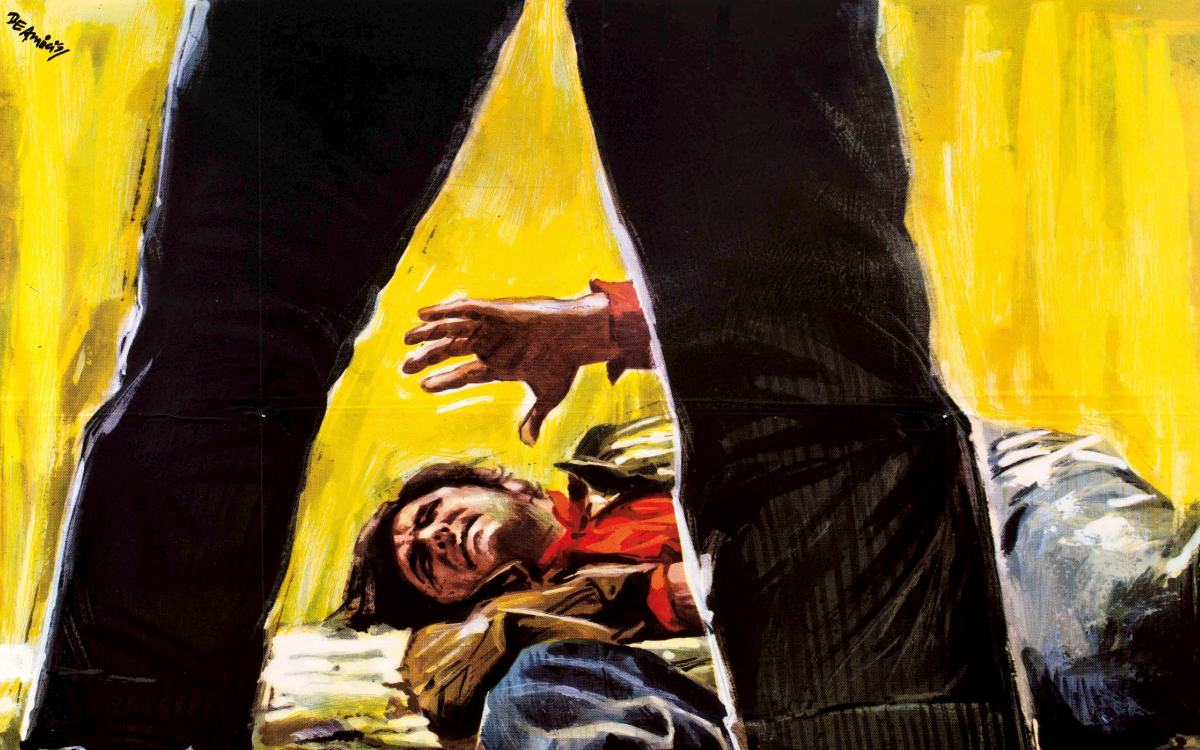
August 18, 2026
Among the leading figures of this series, Arnaldo Aldo De Amicis stands out as a true pioneer. Born in Rome in 1904, he shares with Anselmo Ballester the status of a founding father of the Italian film poster; yet, his career spanned a remarkable four decades, stretching all the way to the Spaghetti Western and the auteur cinema of the late 1960s. Few can boast such professional longevity, and fewer still can claim, with equal merit, a place of honour among the great masters of Italian cinematic sci-fi.
An Unusual Road to the Movies
His story begins far from the easel. Trained as an accountant, De Amicis worked as a clerk first for ATAG, Rome's public transport company, and then for ENIC, the state-backed organisation established in 1935 and active primarily in film distribution and exhibition. A future poster artist raised, ironically, inside the public machinery of cinema. A self-taught painter, in the mid-Thirties he left the security of a salaried job to devote himself to graphic art, and spent the years from 1936 to 1940 in Paris, illustrating weekly magazines, painting oil portraits of prominent figures of the day, and even working as a portraitist for the American Red Cross. The outbreak of the war destroyed a collaboration already under way with a major American sports publication, along with an invitation to move to New York. Fate, and history, brought him back to Rome.
Il Vittorioso and a Technique of His Own
From 1940 to 1958 De Amicis drew for Il Vittorioso, the celebrated Italian illustrated weekly for young readers, signing sixteen comic stories alongside pillars of Italian illustration such as Franco Caprioli and the Cossio brothers. For nearly twenty years his pages entered the homes of a generation of Italian children every week: an apprenticeship in visual storytelling that would prove invaluable before the giant format of the movie poster. It was in these years that he perfected the trait that makes his work recognizable at a glance: charcoal and grease-pencil shading laid down on embossed paper, giving the drawing a stippled, almost lithographic grain that he himself considered his own invention. That grain remains his secret signature to this day. Comics scholars use it to attribute his pages, and anyone looking at his posters will find it everywhere, in the night skies, in the flesh tones, in the soft shadows of the faces.
Forty Years of Posters
Alongside his editorial work, and throughout his life, De Amicis was a movie poster artist. He made his debut during the war years, with sheets such as the one for Campo de' fiori (1943), and continued without interruption into the Seventies, working alongside colleagues such as Averardo Ciriello and Angelo Cesselon, within that extraordinary community of artists that Maurizio Baroni has called Pittori di Cinema. His catalogue touches every genre and every national cinema: French film, Hollywood classics, Italian comedy, costume adventure. But it is on two opposite territories, science fiction and the cinema of feeling, that his brush gives its very best.
The Painter of Science Fiction
In the Fifties, science fiction arrived in Italy as B-movie material, and it found in De Amicis the artist capable of turning it into adventure painting. These were the years when flying saucers filled the newspapers and the second-run theatres, and for many Italian moviegoers the first encounter with the genre happened precisely in front of these sheets, which often promised more wonders than the screen could deliver. For the Universal classics he produced posters now coveted by collectors the world over: Creature from the Black Lagoon (1954), with the scaled creature rising from the dark waters, and This Island Earth (1955), released in Italy as Cittadino dello spazio, where a silver spaceship streaks through yellow explosions above a lunar landscape. The trilogy is completed by the Japanese superhero Spaceman in I satelliti contro la terra (1961), the Italian edition of the Super Giant series, arms raised against a violet sky crossed by missiles. Three images that alone define an imaginary world, and that make him the Italian poster artist who, more than any other, gave shape to the space dreams of that decade.
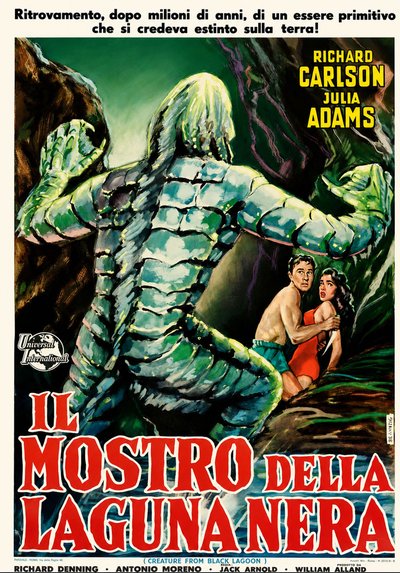
Creature From the Black Lagoon (Jack Arnold, 1954)
The poster for Creature From the Black Lagoon (Jack Arnold, 1954). The creature rises from the dark waters towards its prey: one of Universal's great monster classics of the 1950s in its most celebrated Italian version, where the soft charcoal grain gives the scales an almost tactile texture.
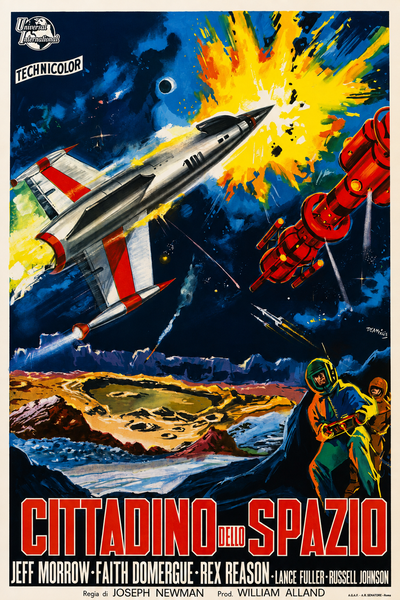
This Island Earth (Joseph Newman, 1955)
The poster for This Island Earth (Joseph Newman, 1955, reissue poster). The silver spaceship streaks through explosions above a devastated planet, while below two suited figures watch the duel: Universal science fiction transformed into grand adventure painting.
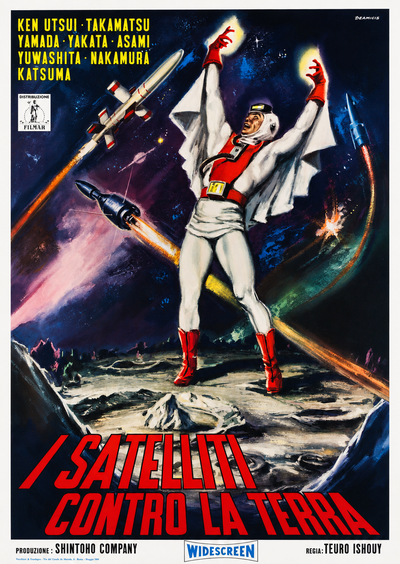
Super Giant (Teruo Ishii, 1958; Italian release 1961)
The poster for Super Giant (Teruo Ishii, 1961). Spaceman with arms raised over a lunar landscape, in a violet sky furrowed by missiles: the Japanese superhero as imagined by a Roman painter, in a sheet that distils the adventurous innocence of the whole series.
From Tenderness to Modern Cinema
To reduce him to science fiction, however, would be unfair. His sheet for René Clément's Forbidden Games (1952), the Golden Lion winner about the war seen through the eyes of two children, reveals his most tender register: little Brigitte Fossey in a yellow dress, clutching her doll and holding the gendarme's hand, while the boy stays behind with his flowers. It is one of the most moving images in all of Italian poster art of the Fifties. And at the end of his career De Amicis proved he could also speak the language of the new cinema: the poster for Roberto Faenza's Escalation (1968), with its double portrait and nervous, almost graphic line, and the "locandina" (Italian small format) for the western Quintana (1969) confirm an artist capable of renewing himself to the very last. It is no small achievement: of the painters who had started out in the Forties, very few were still at work while the Spaghetti Western was still in full swing.
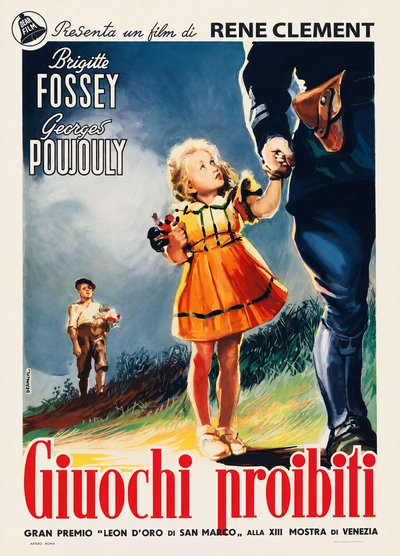
Forbidden Games (René Clément, 1952)
The poster for Forbidden Games (René Clément, 1952). On the sheet the title appears in its period Italian spelling, Giuochi proibiti: the little girl in a yellow dress, her doll clutched to her chest, holds the gendarme's hand, and Clément's masterpiece finds its definitive image.
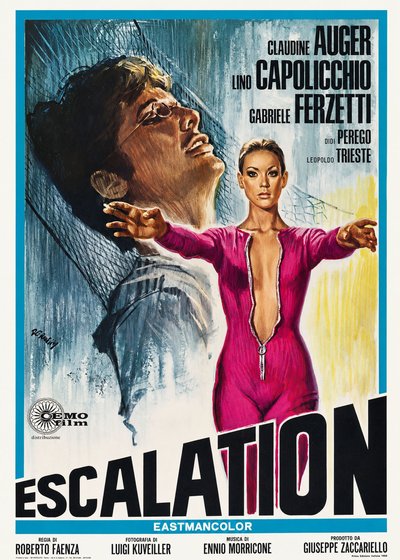
Escalation(Roberto Faenza, 1968)
The poster for Escalation (Roberto Faenza, 1968). The tilted face behind the net and the figure in a magenta jumpsuit with open arms make up one of his most modern sheets, set to the music of Ennio Morricone.
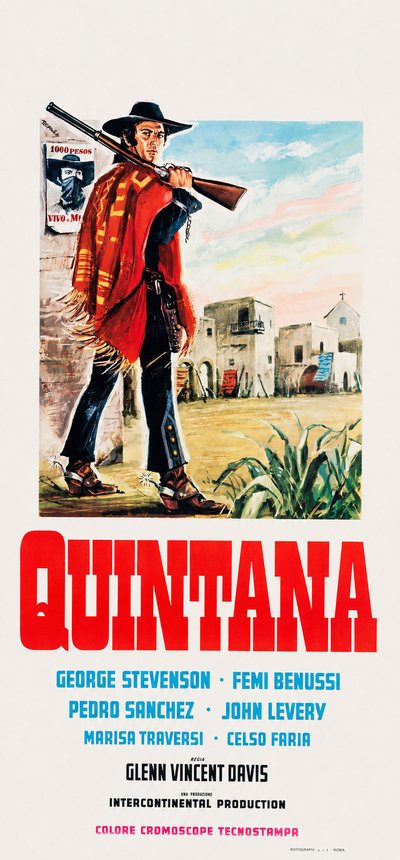
Quintana (Vincenzo Musolino, 1969)
The locandina for Quintana (Vincenzo Musolino, 1969). The gunman in a red poncho turns beside his own wanted poster: the small vertical Italian format in the service of the Spaghetti Western, the final chapter of a very long career, with the thousand-peso bounty painted as a poster within the poster.
In forty years of work his method never changed: whatever materials and information were available, often limited, each image remained an autonomous creation by the artist, filtered through the sensibility of an illustrator and portraitist shaped between Rome and Paris. When De Amicis passed away in his native city in April 1978, Italy lost one of the veteran masters of its great generation of movie poster artists, the man who had painted both the monsters of outer space and the hand of a little girl.
The works reproduced on this page come from the original prints of the period, recovered, photographed and digitally restored by Movie.it.