Italian Horror: the story of the genre that taught cinema how to fear
From Mario Bava's gothic to Dario Argento and Lucio Fulci: the cinema of fear between Italy and the world
July 28, 2026
Few genres have shaped our collective imagination like horror. For more than thirty years, from the Gothic films of the early Sixties to the blazing colors of the Eighties, horror cinema became a major force in Italy: first with its own directors, from Mario Bava to Dario Argento to Lucio Fulci, celebrated today all over the world, then with the great American titles renamed for the Italian audience. This is its story.
Italian Gothic: fear that spoke english
Italian horror took its first steps in the late 1950s with Riccardo Freda's I Vampiri, released in 1957, before gathering real momentum in the following decade with the Gothic cycle: castles and crypts, candles and fog, beautiful and unsettling women, and atmospheres steeped in dark Romanticism. Above all, Mario Bava's Black Sunday, produced by Galatea in 1960, brought this imagery to international attention and introduced Barbara Steele to audiences around the world; with her enormous, enigmatic eyes, she became the defining face of Italian Gothic horror. Alongside Bava stood Riccardo Freda, the genre's other great founding father, while Antonio Margheriti completed a small school of craftsmen of fear capable of turning minuscule budgets into unforgettable atmospheres.
The difficulty of persuading audiences to take an openly Italian horror film seriously also explains one of the most curious features of the period. Directors, screenwriters, producers and technicians frequently adopted English-sounding pseudonyms to give their films a more international identity: The Horrible Dr. Hichcock, for example, was directed by Riccardo Freda under the name Robert Hampton, while producers Luigi Carpentieri and Ermanno Donati were both credited as Louis Mann. Even the doctor's surname alters Hitchcock's by a single letter, instantly evoking the master of suspense. Italian Gothic thus presented itself under an English disguise while, film by film, developing a distinctive imagination of its own. Bava himself would return to the Gothic in anthology form with Black Sabbath, with one of horror's greatest icons, Boris Karloff, serving as master of ceremonies.
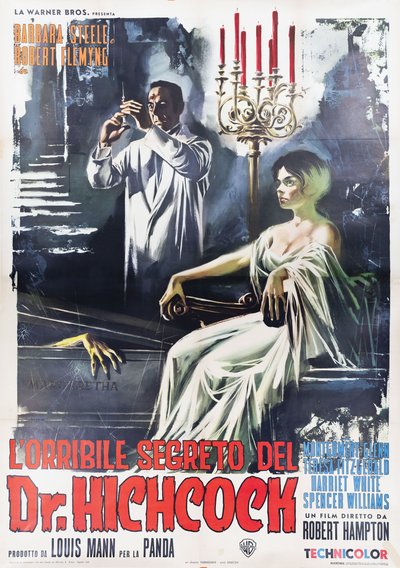
The Horrible Dr. Hichcock (Robert Hampton, 1962)
The poster for The Horrible Dr. Hichcock (Robert Hampton, alias Riccardo Freda, 1962). The lit candelabrum, the woman in white lying on the coffin and the hand emerging from the dark compose a perfect scene of Gothic theatre. Barbara Steele, the queen of Italian horror, stars in one of the founding titles of the cycle, a story of necrophilia and conjugal madness that defied every censor of its time.
Poe arrives in Italy: imported gothic
Alongside the national production, Italian theatres in those same years welcomed American Gothic and in particular the cycle that Roger Corman dedicated to the tales of Edgar Allan Poe, with Vincent Price in the leading roles. It was produced by American International Pictures, the independent company of James H. Nicholson and Samuel Z. Arkoff that specialized in genre cinema: refined, gloriously colorful films, shot in widescreen and Technicolor, which found a devoted audience in Italy.
The Poe cycle, launched in 1960, combined literature and spectacle with a scenographic flair that carried on a long distance dialogue with Italian Gothic: the two currents exchanged actors, themes and atmospheres throughout the decade. Vincent Price was its soul, flamboyant and elegant, able to make even the executioner magnetic and for a generation of Italian filmgoers his face became a synonym for fear itself on the screen.
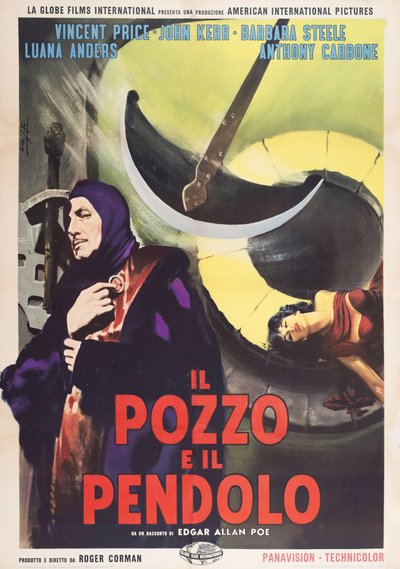
The pit and the pendulum (Roger Corman, 1961)
The poster for The pit and the pendulum (Roger Corman, 1961). Vincent Price hooded in purple, the blade of the pendulum looming and the victim sprawled in the pit: the whole composition literally revolves around the instrument of torture, pulling the eye into a spiral. Based on Edgar Allan Poe, it is one of the peaks of Corman's cycle and an absolute classic of Sixties Gothic.
The golden age: Argento, Fulci and the masters of fear
The seed had been planted, once again, by Mario Bava, who laid the foundations of the Italian giallo with The Girl Who Knew Too Much and Sei donne per l'assassino. In the Seventies Dario Argento gathered that seed and brought it to perfection: he made his debut in 1970 with The Bird with the Crystal Plumage and in 1975 signed Deep Red, the summit of the genre, with the obsessive score by Goblin, a camera that moves like a probing eye, Turin transformed into a labyrinth. Two years later, with Suspiria, the first chapter of the Three Mothers trilogy, the passage to supernatural horror was complete and the Italian cinema of fear had become an international phenomenon.
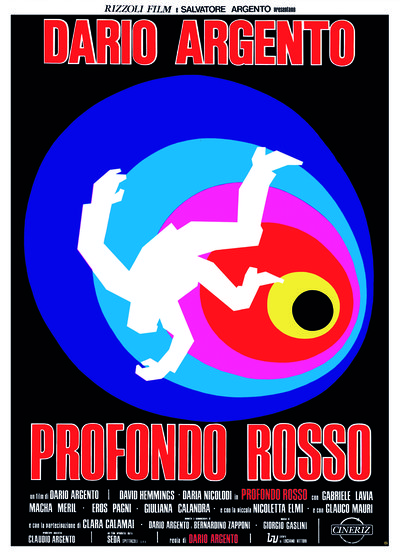
Deep Red (Dario Argento, 1975)
The poster for Deep Red (Dario Argento, 1975), painted by Sandro Symeoni. The white figure plunging through concentric circles of color, down to the black pupil at the center, is pure graphic terror: no scene from the film, only its vertigo. An image closer to abstraction than to illustration, perfect for Argento's most celebrated giallo and one of the boldest inventions in all of Italian film poster art.
Alongside Argento, Lucio Fulci built a universe entirely his own. After years of professional work in every genre, between the late Seventies and the early Eighties he directed a series of visionary nightmares, from Zombie Flesh Eaters to City of the Living Dead to The Beyond, produced by Fabrizio De Angelis, which made him an international cult auteur. There is also a commercial coup behind his consecration: Zombie Flesh Eaters was conceived to ride the success of George A. Romero's Zombi, presenting itself as a sequel despite having no connection to it, and ended up conquering a worldwide audience of its own.
In the Eighties the genre lived its most prolific season. Lamberto Bava took up the legacy of his father Mario, directors and producers worked side by side, as with Argento producing Demons, and Italian horror became an export in demand everywhere.
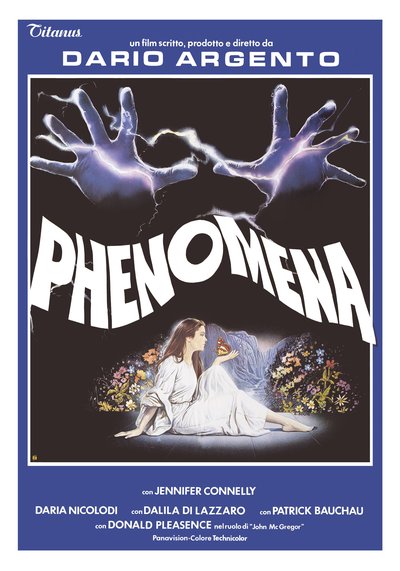
Phenomena (Dario Argento, 1985)
The poster for Phenomena (Dario Argento, 1985), painted by Enzo Sciotti. The electric hands descending over the title and the very young Jennifer Connelly seated among the flowers tell the double soul of the film, fairy tale and nightmare at once. Argento portrays a girl able to communicate with insects in a dark, feverish Switzerland and the poster translates that contrast into one of the most recognizable images of Eighties horror.
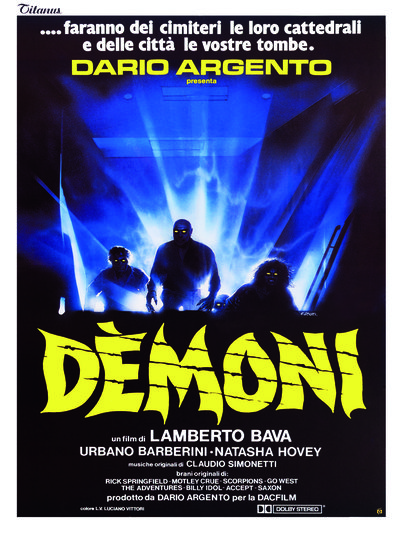
Demons (Lamberto Bava, 1985)
The poster for Demons (Lamberto Bava, 1985), painted by Enzo Sciotti. The silhouettes with glowing eyes advancing through the projector beam turn the movie theatre itself into a threat. Produced by Dario Argento, the film locks its audience inside a cinema that becomes an infernal trap, driven by a rock soundtrack and a furious pace: one of the emblematic titles of Italian horror in that decade.
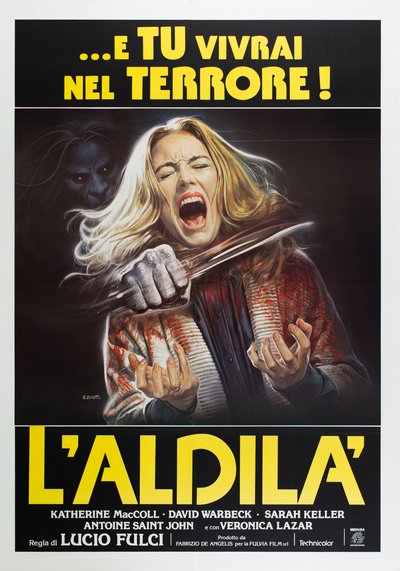
The Beyond (Lucio Fulci, 1981)
The poster for The Beyond (Lucio Fulci, 1981), painted by Enzo Sciotti. The scream in extreme close up, the ghostly face surfacing from the dark and the promise of the launch campaign's promise, "And you will live in terror", make it an image of rare power. The film, today considered Fulci's masterpiece, throws open the gates of hell in an old Louisiana hotel and has become an object of international cult devotion.
American Horror, renamed for the italian audience
There is also an entirely Italian chapter in the history of horror: the one written by the titles reinvented for the national market. The Texas Chain Saw Massacre became Non aprite quella porta, literally Do Not Open That Door, a command that is already a shiver, launched with a hammering slogan: it is not just a film, it really happened. Sam Raimi's The Evil Dead arrived in Italy as La Casa, The House, and its success was such that in the following years distributors christened La Casa 3 and onward a series of films that had no production link whatsoever with the original: a striking example of how much, in Italy, a title and its image could count as much as the film itself.
These were the years of American horror's new wave, from John Carpenter with Halloween to Wes Craven with A Nightmare on Elm Street, and Italy embraced it en masse. Behind the rewritten titles lay a precise knowledge of the audience: distributors knew that a command, a prohibition, a cursed house worked better than a literal translation and those films entered everyday language under names often more famous than the originals, so firmly that many Italian filmgoers still struggle to recognize them under their original titles.
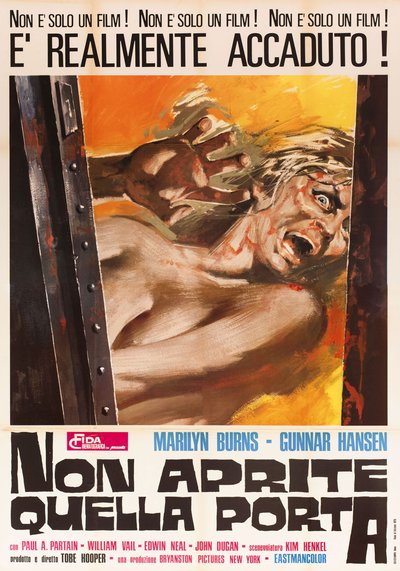
The texas chain saw massacre (Tobe Hooper, 1974)
The poster for The Texas Chain Saw Massacre (Tobe Hooper, 1974). The hand clawing at the victim's head behind the metal door, the face deformed by terror, the thick, almost expressionist brushwork: everything conveys the dry violence of a film that changed horror forever. An image utterly remote from the photographic style of the American materials, and all the more sought after for it.
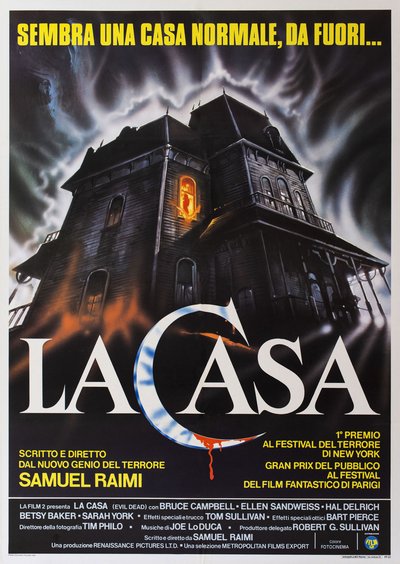
The Evil Dead (Sam Raimi, 1981)
The poster for The Evil Dead (Sam Raimi, 1981). The house twisting against the black sky, its single lit window like an eye and the crescent moon bleeding beneath the title, promises exactly what the film delivers. In Italy The Evil Dead was released under a new name and this image helped build a genuine theatrical legend for the audiences of the time.
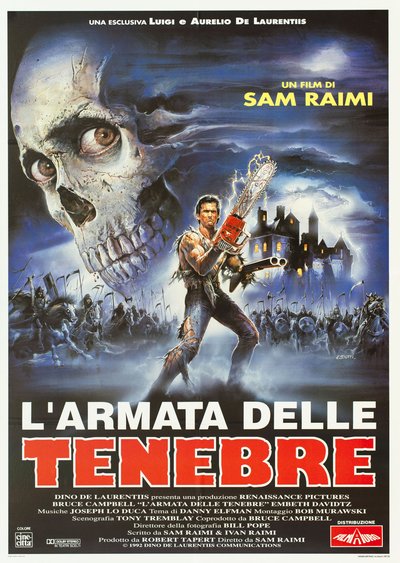
Army of Darkness (Sam Raimi, 1992)
The poster for Army of Darkness (Sam Raimi, 1992), painted by Enzo Sciotti. Bruce Campbell with chainsaw and shotgun before a colossal skull, while the army of the dead advances on the castle: the image condenses the spirit of the third chapter of the saga that began with La Casa, where horror finally veers into adventure and black comedy.
A genre that never dies
After years of relative neglect, Italian horror was rediscovered. Directors around the world have publicly acknowledged their debt to it, international festivals and retrospectives celebrate its titles, and restorations and new editions keep bringing back into circulation films that for years had survived only in the memory of their audiences. The Gothic of Bava and Freda, the giallo of Argento, the nightmares of Fulci are today studied in film schools, as well as the object of a cult that shows no sign of fading.
And the genre as a whole has never been more alive: horror, long dismissed as B movie fare, now sits at the center of world production, courted by festivals and capable of winning prizes and topping charts. Within that global story, the Italian chapter remains one of the most influential: proof that fear, when crafted as art, does not age.
The works reproduced on this page come from the original prints of the period, recovered, photographed and digitally restored by Movie.it.