
Rome at 6 Frames per Second
How the Eternal City became the world's most beloved film set — and why its vintage posters are still the most beautiful way to keep it at home
May 21, 2026
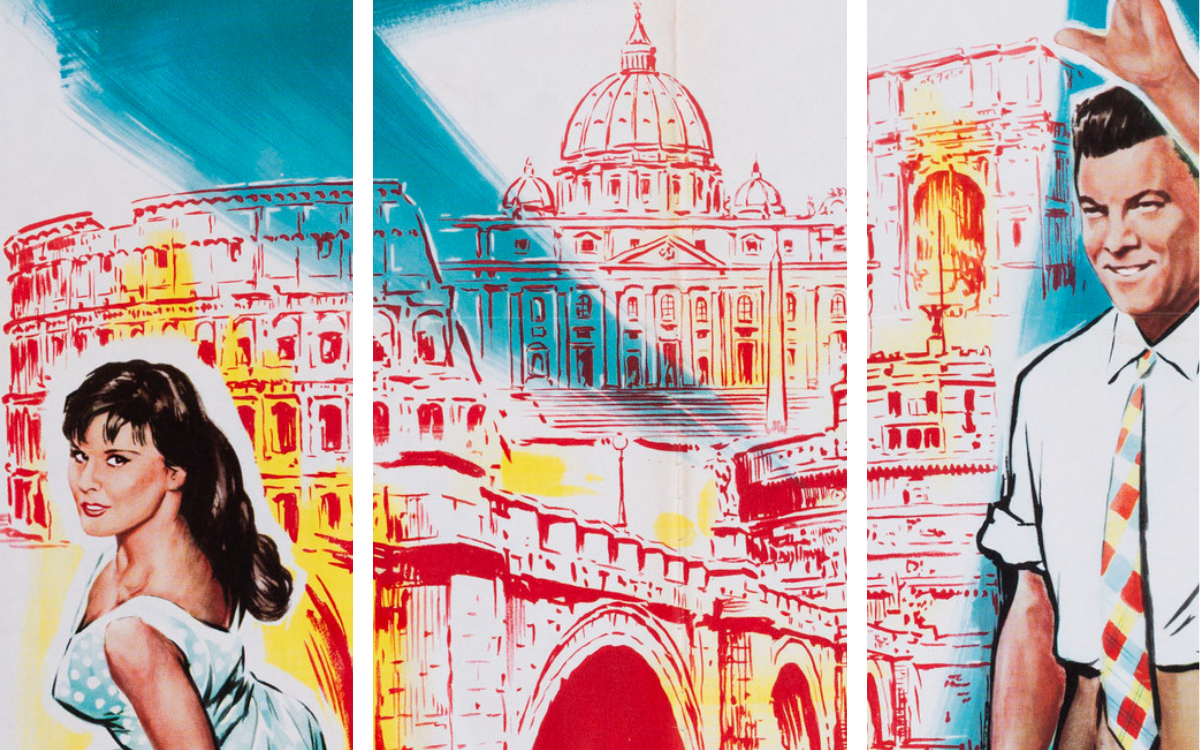
There is a precise moment when Rome stops being a city and becomes a character. It happens on screen, when the camera lingers on the cobblestones of Piazza di Spagna or follows the trail of a Vespa along the golden Tiber at sunset. From the postwar years through the 1960s, the greatest Italian directors and many from beyond chose Rome not as a backdrop, but as protagonist. The result is an unrepeatable catalog of films, witnessed by posters that are, in every sense, autonomous works of art.
This guide gathers the essential titles of that season, with particular attention to the posters that accompanied them: because anyone who collects film posters knows that behind every one lies a parallel story made of anonymous illustrators and that distinctly Italian ability to turn advertising into visual poetry.
The Roots: Neorealism and a City Rebuilding Itself
Before Rome became glamorous, it was a wounded city. Neorealism looked it straight in the face without beautifying it and that is precisely why its Rome is the most authentic. The stories unfold in working-class neighborhoods, among weathered faces and fragile hopes.
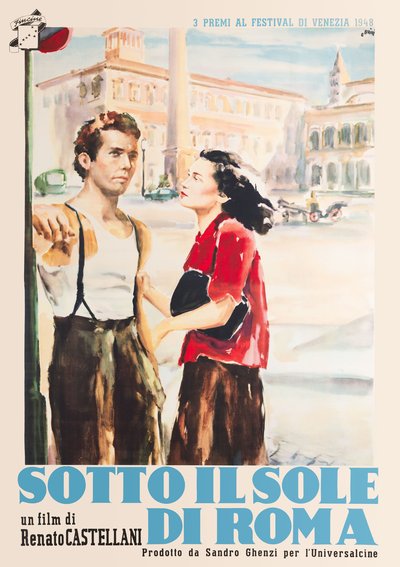
Under the Sun of Rome
Renato Castellani, 1948
The Resistance seen through the eyes of a working-class teenager. Castellani shoots almost entirely on location, in the alleyways of Trastevere and Testaccio, and achieves something rare: the scent of postwar Rome, with its mixture of relief and uncertainty.
The period poster shown here plays on the orange of the sun and on young faces in close-up a deliberate visual optimism that contrasts with the harshness of the story.
Piazza di Spagna and Surroundings: Love as Geography
In the 1950s, certain Roman squares became genuine recurring characters. The Spanish Steps, the Trevi Fountain, the riverbanks at dusk — every director staked a claim on their favorite corner of the city.
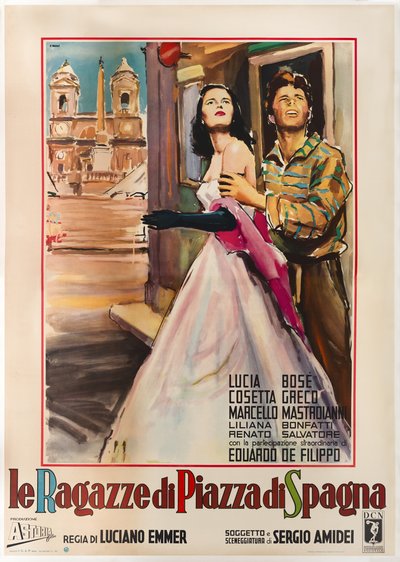
The Girls of Piazza di Spagna
Luciano Emmer, 1952
Three seamstresses, three different dreams, one square that runs through them all. Emmer builds a delicately observed portrait of young Roman womanhood, free of any rhetoric. The staircase is not a backdrop: it is the place where life is decided.
The original poster is among the most sought-after of its era: three stylized female figures on a warm background, with that graphic quality that Italian illustrators of the 1950s could bring even to minor productions.
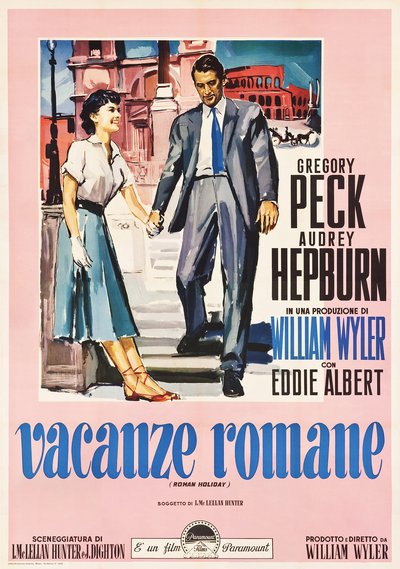
Roman Holiday
William Wyler, 1953
Princess Ann escapes protocol and discovers Rome with an American journalist. Wyler shoots on real locations the Colosseum, Castel Sant'Angelo, the Mouth of Truth and transforms the city into a romantic labyrinth. Audrey Hepburn won the Oscar, but Rome won the film.
The Italian poster, different from the American version, is built around the Vespa: an object that from that moment became a universal symbol of urban freedom. It is worth tracking down an original copy for that iconographic detail alone.
The Italian Comedy: Monicelli and the Elegance of the Everyday
If neorealism had photographed poverty with dignity, the Italian comedies of the 1950s chose to laugh but without ever sacrificing intelligence. Mario Monicelli is the undisputed master of this balance.
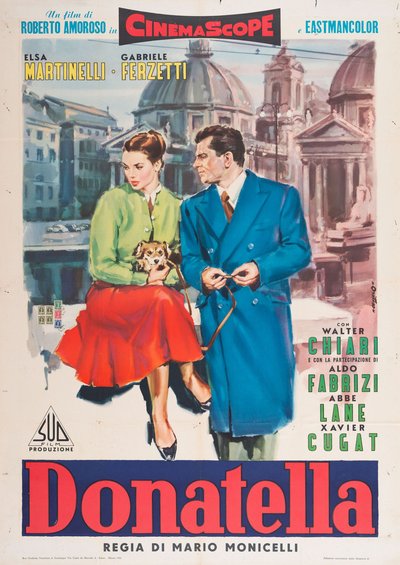
Donatella
Mario Monicelli, 1956
A girl from the provinces arrives in Rome with a vague dream and finds herself thrown into an adventure larger than herself. Monicelli builds around her a festive and slightly chaotic Rome that of Via Veneto and the luxury dressmakers with a tenderness that never tips into sentimentality.
Via Veneto and Hollywood on the Tiber
Between 1950 and 1965, Rome becomes the world capital of cinema. Cinecittà runs at full capacity, major American productions rent its soundstages, and Via Veneto is their drawing room. It is the era of the sweet life, even before Fellini immortalized it with irony.
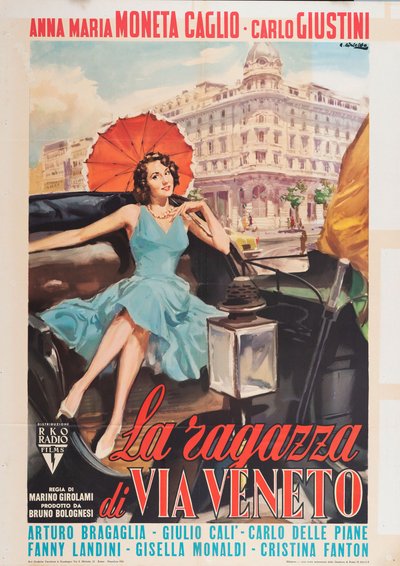
The Girl from Via Veneto
Marino Girolami, 1955
A precious visual document of that elegant, cosmopolitan microcosm. The film captures the atmosphere of the cafés and carriages that sense of a city reinventing itself as the stage of the world.
Rome in Music: Street Songs, Fountains, and Ensemble Comedies.
Alongside the dramatic films and the comedies of manners, there exists a more festive, musical cinematic Rome. These are films made for popular audiences, with songs that get stuck in your head and stay there.
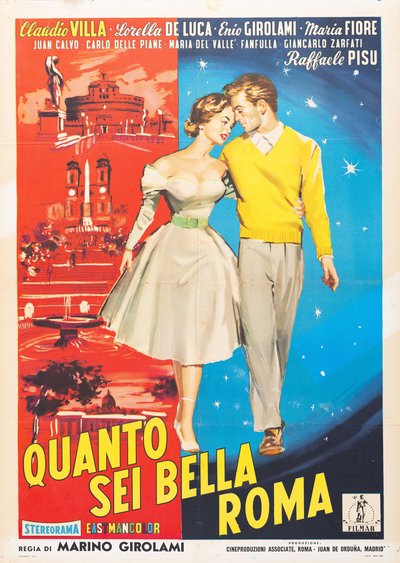
How Beautiful You Are, Rome
Marino Girolami, 1959
From the same tradition: Rome as an explicit object of love, sung and shown with pride. These films may seem naïve today, but they preserve a genuine urban joy that of a city that had every desire to celebrate itself.
Why Collect These Posters Today
Italian film posters from the 1950s and 1960s were never meant to last. They were paper for the hoardings, torn down and replaced week after week. Those that survived are rare objects telling two stories at once: the story of the film they advertised, and the story of Italian commercial illustration at its most vital.
The Pittori Cartellonisti of that era — Anselmo Ballester, Averardo Ciriello, Silvano Campeggi known as "Nano" — worked with tempera and brushes, with a compositional freedom that photography did not allow. They chose what to show and what to leave out, exaggerated the colors, and built a visual promise that was often more interesting than the film itself.
To keep one of these posters at home today is to preserve a piece of Italian visual culture that cannot be replicated. It is not nostalgia: it is recognition.