
Manfredo Acerbo, the Painter Between Abstraction and Expressionism
By Movie.it Editorial Team
June 11, 2026
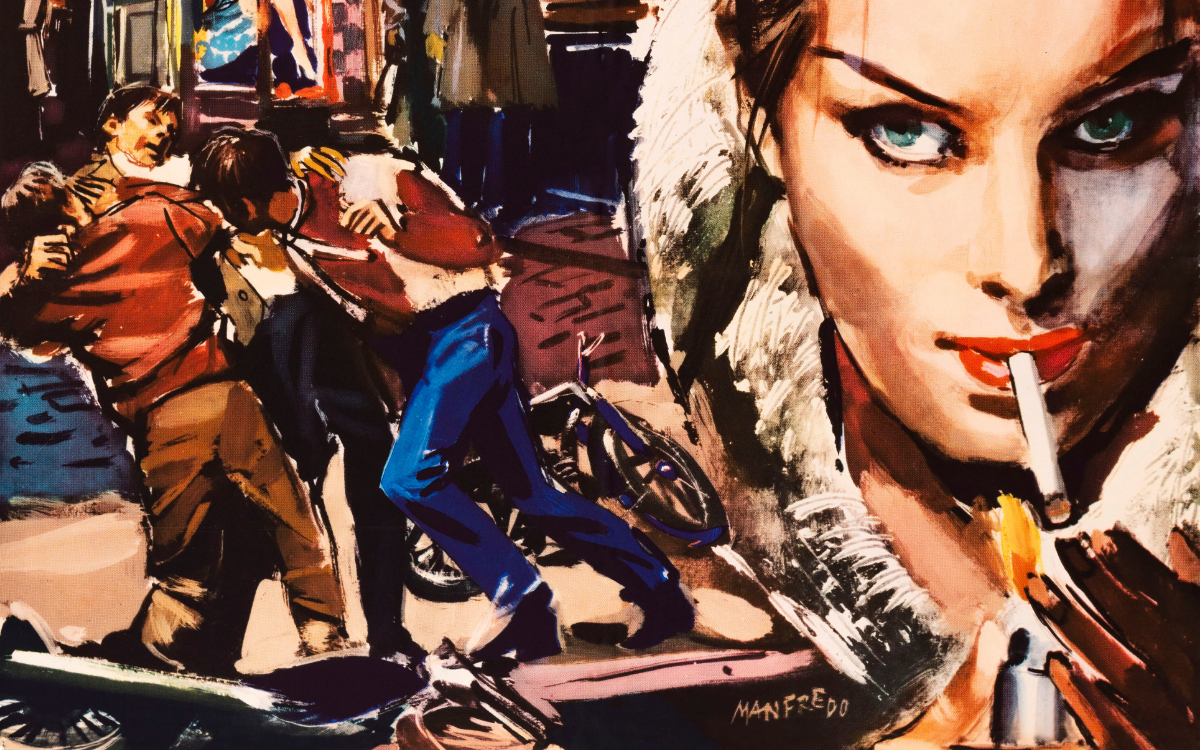
Born in Pescara, Roman by adoption, trained at the academy and irregular by temperament, he moved through forty years of Italian and international cinema leaving on every poster an unmistakable mark: fast, vibrant, often surprising, always alive. In a landscape dominated by the descriptive realism of the Roman school painters, Manfredo chose a riskier and more interesting path, that of someone who does not narrate the film but conveys its emotional energy through the painterly gesture.
Pescara, Rome, the Academy and the Street
Born in Pescara in 1913, Manfredo Acerbo moved to Rome at a young age, studied at the Academy of Fine Arts and built a composite and curious professional profile: painting teacher, graphic artist, cinema painter. His early works show a synthetic sensibility and a language close to illustration: clean lines, essential figures, a compositional sense that owes much to the commercial graphic art of the 1930s and 1940s. But beneath that ordered surface something more restless was simmering, destined to surface in the following decade.
Rome, Cinema, and the Workshop: Being a Movie Poster Artist in Postwar Italy
In postwar Rome, as Cinecittà returned to full production and the city rediscovered its passion for cinema, poster artists like Manfredo Acerbo became invisible protagonists of the film industry. Working from only a few reference materials, they created striking images capable of capturing the attention of passersby and conveying the essence of a film at a glance. Surrounded by workshops and fellow artists, they combined craftsmanship with artistic vision, blending the Italian pictorial tradition with European influences ranging from Expressionism to Constructivism, helping to create one of the most distinctive schools of cinematic poster art in the world.
While graphic and photographic styles were becoming dominant in the United States, Italy preserved a painterly tradition rooted in the nineteenth century. Manfredo belonged to this tradition, yet approached it with an eye toward Europe and the artistic avant-gardes.
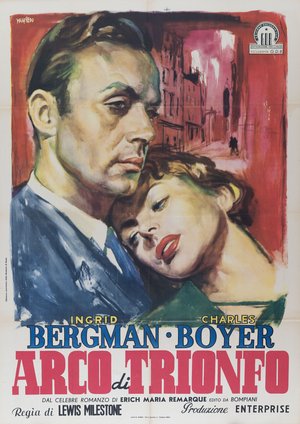
Arch of Triumph (Lewis Milestone, 1948)
The poster for Arch of Triumph, based on Erich Maria Remarque's celebrated novel with Ingrid Bergman and Charles Boyer, is one of the most balanced works of Manfredo's painterly season. The two faces brush together in a melancholy embrace, rendered with dense brushstrokes and a chromatic range that shifts towards greens, reds and nocturnal blues. In the background, the streets of Paris are barely sketched, smoky and uneasy like the story they frame. There is nothing consoling in this image: the tenderness of the two protagonists is already fractured by something that cannot be named, and Manfredo says so with colour before he says it with composition.
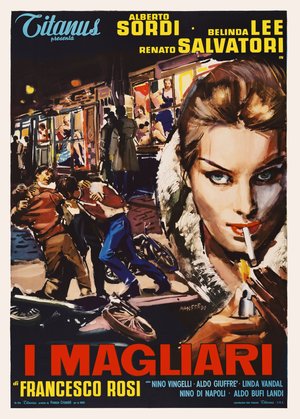
The Swindlers (Francesco Rosi, 1959)
With the poster for The Swindlers by Francesco Rosi, with Alberto Sordi, Belinda Lee and Renato Salvatori, Manfredo achieves one of the most complex results of his career. The composition is articulated on two registers: on the right, in extreme close-up, the face of Belinda Lee with a cigarette in her mouth, her cold clear eyes fixing the viewer with an almost provocative directness; on the left, a nocturnal street scene with lit-up shacks and figures in motion, rendered with rapid brushstrokes and an artificial light that exudes poverty and danger. The contrast between the refinement of the portrait and the raw realism of the background is the heart of Rosi's film, and Manfredo understood it perfectly.
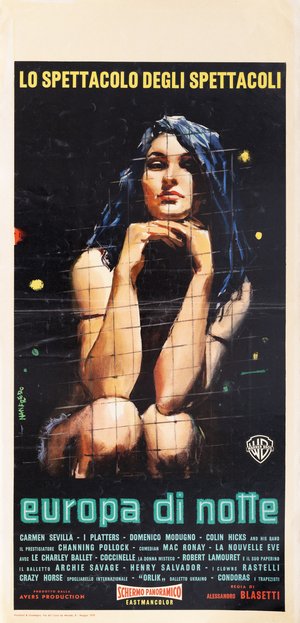
Europe by Night (Alessandro Blasetti, 1959)
The "locandina" (Italian small format) for Europe by Night by Alessandro Blasetti is perhaps Manfredo's most courageous and modern work as a cinema painter. Against a total black background, a semi-nude female figure crouching is crossed by a grid of graphic lines that fragment her without erasing her, as if we were looking through a mesh or a screen. The blue hair, the red lips, the yellow dots scattered across the darkness: everything combines to create an image of urban nocturnal sensuality with very few precedents in Italian film poster art of the 1950s. This playbill looks to the future, anticipating certain solutions of the psychedelic graphic art of the 1960s, and demonstrates that Manfredo was not simply a cinema painter but an artist who used cinema as a pretext for experimentation.
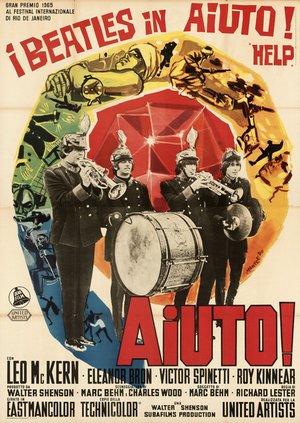
Help! (Richard Lester, 1965)
The poster for Help!, directed by Richard Lester in 1965 and Grand Prize winner at the International Film Festival of Rio de Janeiro, is a historical document as well as a graphically vivid work. Manfredo chooses a hybrid, painterly-photographic solution: the four Beatles in military band uniform are photographed at the centre of the image, surrounded by a vortex of action scenes painted in yellow, red and green that swirl around them like a psychedelic comic strip. The large red ruby at the centre and the flying figures all around perfectly capture the surreal and frenetic tone of the film. It is one of the Italian film posters of the 1960s in which the fusion of photography and painting produces a genuinely original result, impossible to confuse with anything else.
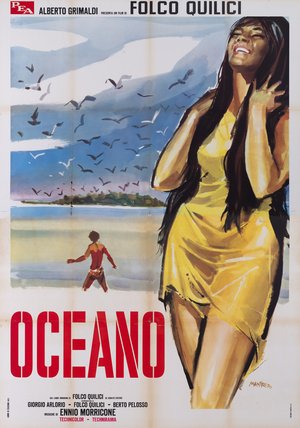
Oceano (Folco Quilici, 1971)
The poster for Oceano by Folco Quilici, with music by Ennio Morricone, marks Manfredo's final creative season as a cinema painter and shows his full maturity. The female figure in a yellow dress occupies the entire right side of the image with an immediate and sunny physical presence, rendered with broad and luminous brushstrokes that make light itself the true subject of the poster. In the background, the seascape with islands, cloudy sky and gulls in flight is treated with an almost watercolour lightness that contrasts pleasantly with the pictorial density of the foreground figure. The small male figure in the background, almost lost in the vastness of the landscape, adds a note of poetic solitude that lifts the poster above simple promotional communication.
The Legacy of Manfredo Acerbo
Manfredo Acerbo died in Rome in 1989, after a career that had moved through expressionism and graphic art, neo-realism and comedy, art cinema and genre cinema, always with that fast and recognisable signature that had become his hallmark. Alongside his film posters, he had continued to exhibit his paintings in Italy and abroad, keeping alive that dialogue with contemporary artistic movements that made his eye increasingly free and personal. He leaves a set of work that is both historical document and artistic research: the testimony of a painter who never stopped asking how to say more with less, how a fast brushstroke could be worth more than a careful portrait, how gesture could contain more truth than description. Questions that belong to great painting, not to poster art. And that Manfredo knew how to pose, and answer, on billboard paper.
The works reproduced on this page come from the original prints of the period, recovered, photographed and digitally restored by Movie.it.