
Giorgio Olivetti, the Elegant Irony of a Bolognese Painter
By Movie.it Editorial Team
June 9, 2026
There is a category of artists that official art history has systematically overlooked, not because their talent was inferior to that of colleagues hanging in museums, but because their medium was billboard paper destined for city walls. Giorgio Olivetti is one of them: a painter of solid training and refined visual culture, capable of spanning more than three decades of Italian and international cinema history and leaving on every poster an unmistakable mark, made of irony, elegance and a mastery of colour that few of his contemporaries could match.
Bologna, Futurism and the Lesson of the Avant-Gardes
Born in Bologna in 1908, Olivetti grew up in an extraordinarily fertile cultural climate. Early twentieth-century Italy was swept by currents that reshuffled every aesthetic certainty: Futurism celebrated speed and synthesis, Russian Constructivism reduced figures to pure geometry, Leonetto Cappiello revolutionised visual communication with flat fields of colour and images that hit like a fist. Olivetti’s work reveals echoes of these influences with the curiosity of someone not seeking ideological allegiance but an expressive tool. Clean lines, compositional order, the courage to simplify down to the essential: these are the avant-garde lessons that would reappear, inflected in an entirely personal way, throughout his subsequent work.
His earliest works reveal a softer, more atmospheric side: delicate glazes, nuanced watercolours, a handling of light reminiscent of certain Belle Époque painters. In Cat People the roaring beast and the young woman with dishevelled hair are placed diagonally in the foreground as if merging into one another, in an ambiguous and unsettling embrace rendered with great pictorial refinement. This is an Olivetti still in search of his definitive language, but already capable of building emotional tension with very few elements.
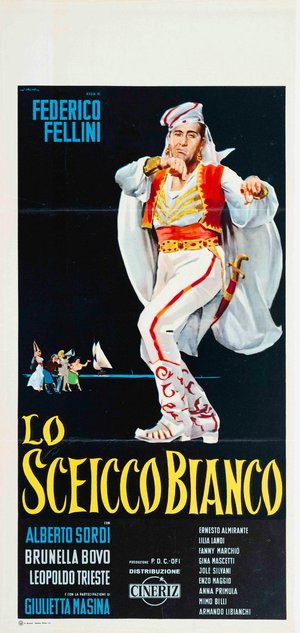
The White Sheik (Federico Fellini, 1952)
The second edition of the "locandina" (Italian small format) for The White Sheik, Fellini’s first solo directorial feature, is one of Olivetti's most entertaining and accomplished works. Alberto Sordi in sheik costume takes over the entire image with an irresistible comic energy: the character seems to burst out of the poster, his pose theatrical and ridiculous at the same time. Olivetti captures perfectly the nature of the film, a comedy about naivety and self-delusion: no realism, no gravity, just the grotesque silhouette of a man who believes himself the hero of a photo-romance. The black background sets off the colours of the white and red costume, turning the whole thing into an image of almost circus-like power.
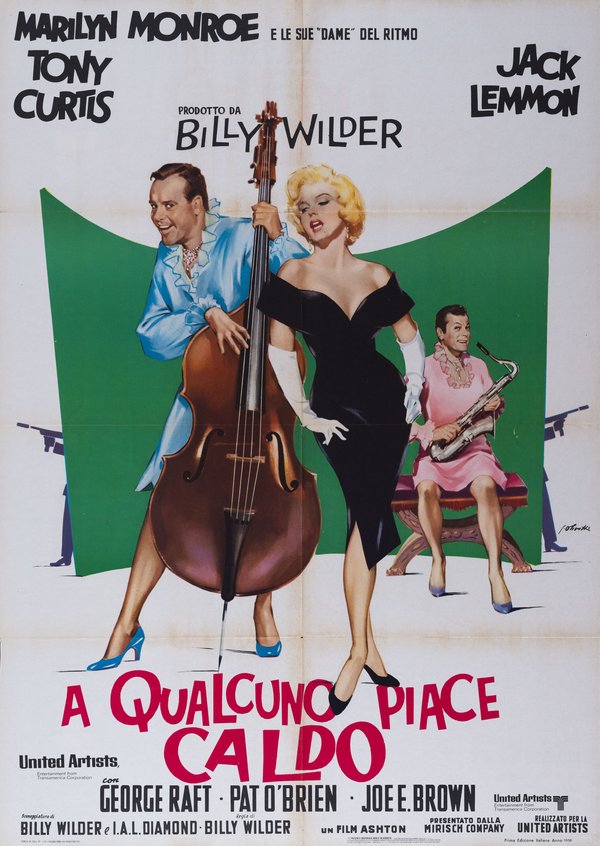
Some Like It Hot (Billy Wilder, 1959)
Among Olivetti's most vivid creations, the poster for Some Like It Hot is a small masterpiece of balance between comedy and sensuality. Tony Curtis and Jack Lemmon, disguised as women, flank Marilyn Monroe at the centre of the composition, irresistible in her low-cut black dress. The three address the viewer directly as if on a stage, with an awareness of their own scenic presence that Olivetti captures with a light and precise touch. The palette plays on blues, white, yellow and black, with synthetic but realistic shading. In the background, ironic caricatures of gangsters and skyscrapers complete an image that manages to be brilliant without ever being vulgar: exactly like Wilder's film.
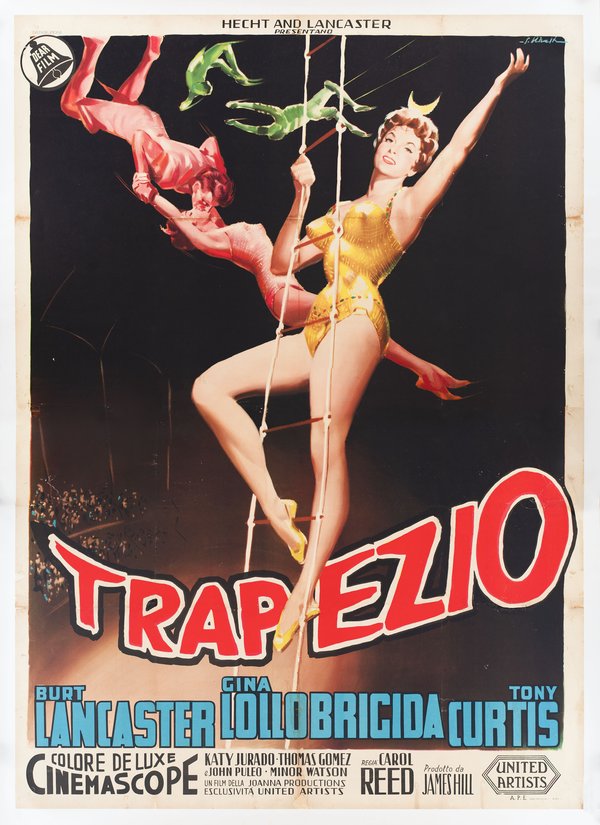
Trapeze (Carol Reed, 1956)
The poster for Trapeze is an exercise in compositional virtuosity. Burt Lancaster, Gina Lollobrigida and Tony Curtis are reduced to acrobatic figures suspended in mid-air, coloured in an almost surreal way, pink and green against black, with the circus crowd hinted at below like a stage flat. Olivetti abandons realistic actor portraits and chooses pure synthesis: what matters is not recognising faces but feeling the movement, the danger, the vertigo. The curved red title follows the line of the ropes as if it too were flying. It is a poster that lives on dynamism and demonstrates how thoroughly Olivetti had made his own the Futurist lesson of form in motion.
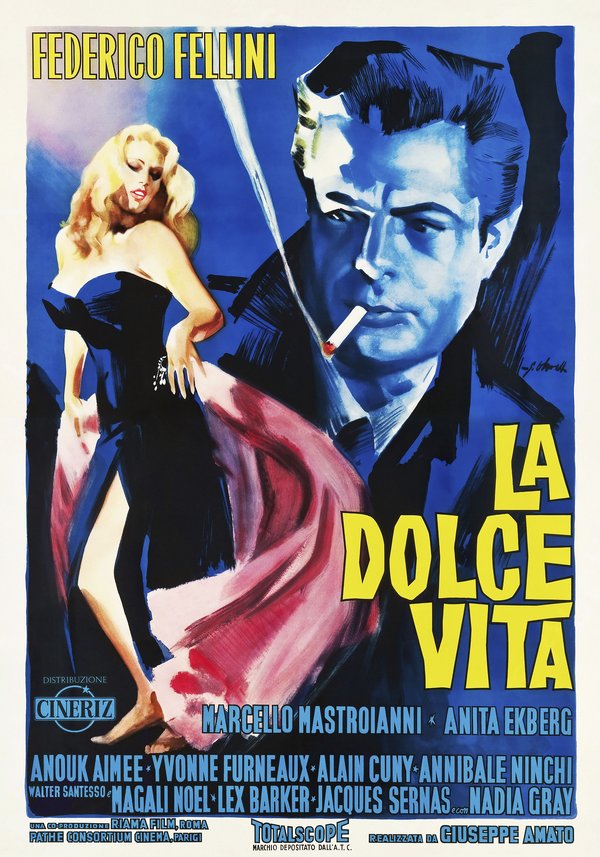
La dolce vita (Federico Fellini, 1960)
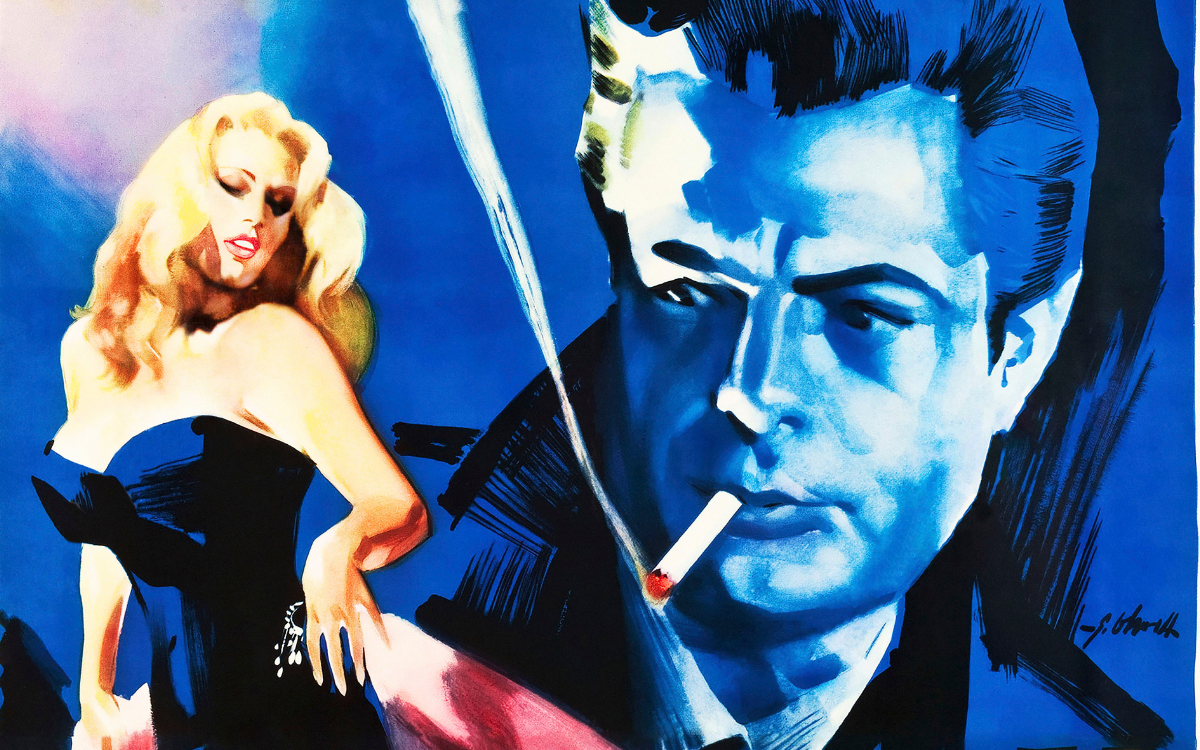
If there is one poster that alone is worth a career, for Olivetti it is La dolce vita. Anita Ekberg in a black dress, sinuous and magnetic, wrapped in a billowing pink scarf that gives her an almost unreal sense of motion, dominates the foreground with the ease of someone who knows she is an icon without needing to prove it. Behind her, Marcello Mastroianni's face, sculpted in a refined play of blue light and shadow, smokes with the existential weariness that is the film's emotional keynote. The deep blue background unifies the composition in a nocturnal, suspended atmosphere that is in itself a poetic statement. Olivetti achieves here what only the great cinema painters knew how to do: not illustrate a story but condense an entire emotional universe into a single image. That poster is La dolce vita before you have seen a single frame of the film. It is Italy in 1960 in all its contradictions of glamour and melancholy, of lightness and unease. It is no surprise that it has become one of the most replicated and celebrated images in the history of Italian cinema.
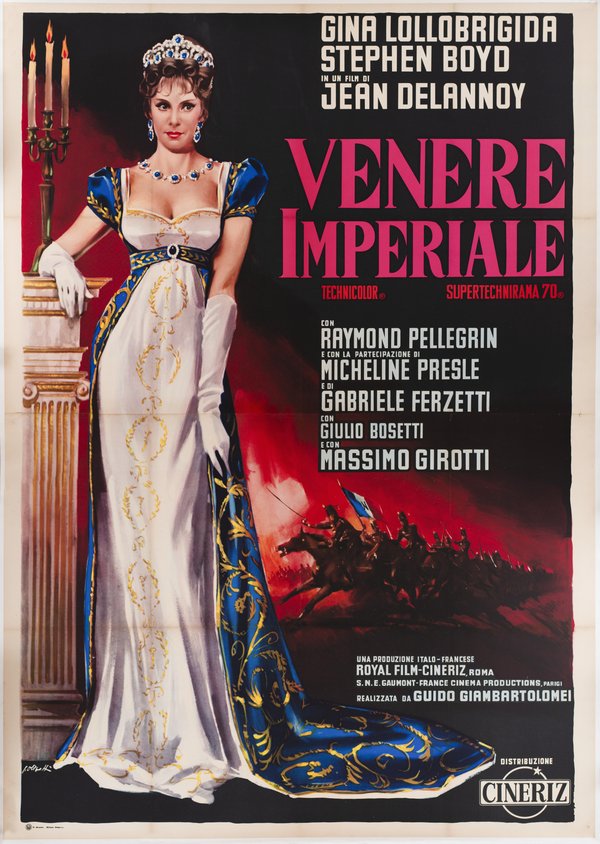
Imperial Venus (Jean Delannoy, 1962)
The poster for Imperial Venus shows a different side of Olivetti: the large-format history painter, capable of conveying the grandeur and monumentality of the costume epic. Gina Lollobrigida as Pauline Bonaparte occupies almost the entire surface of the poster, in a white and blue imperial-style gown embroidered in gold, with tiara and long gloves completing the portrait of a woman who wields her beauty as a form of political power. In the lower right background, a cavalry charge against scarlet red recalls that this is also a story of war and ambition. The composition is more conventional than Olivetti's more audacious solutions, but the pictorial quality is exceptionally high: the draping of the gown, the rendering of the jewels, the light that models the face all reveal the hand of a genuine painter, not merely a poster artist.
The Legacy of Giorgio Olivetti
Giorgio Olivetti traversed the history of the Italian film poster with a stylistic consistency and versatility that rarely go hand in hand. He knew how to be ironic without being superficial, elegant without being cold, synthetic without being sparse. He moved through neo-realism and Italian comedy, through Fellini and Hollywood, adapting his language each time to the tone of the film without ever losing the thread of his own visual identity. In an era when the film poster was considered little more than a promotional tool, he treated it for what it was: an autonomous work of art, inspired by a film but capable of living its own life. The visual memory of post-war Italian cinema owes a great deal to that ironic and elegant man from Bologna who could put wit and beauty into the same image, with the naturalness of someone who is simply telling the truth.
The works reproduced on this page come from the original prints of the period, recovered, photographed and digitally restored by Movie.it.