
Erotic posters and 'red-light' playbills: desire painted on the walls.
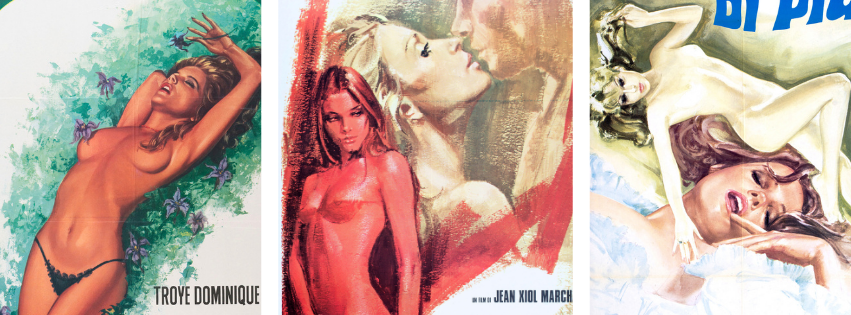
Even before entering the auditorium, the viewer was touched, provoked, almost called by name by those immense images that heralded promises greater than the film itself.
April 25, 2026
There was a time when cinema did not end with the closing credits. It continued outside, on the streets, on the façades of buildings, in newsagents' shops, on the peeling walls of suburban areas, and in the corridors of train stations. Even before entering the cinema, viewers were touched, provoked, almost called by name by those immense images that heralded promises greater than the film itself.
Italian erotic posters from the 1960s, 1970s and 1980s belong to this lost civilisation of the gaze. They were not mere advertisements: they were a form of popular theatre, a staging of desire conveyed through painting.
Between censorship, irony and imagination.
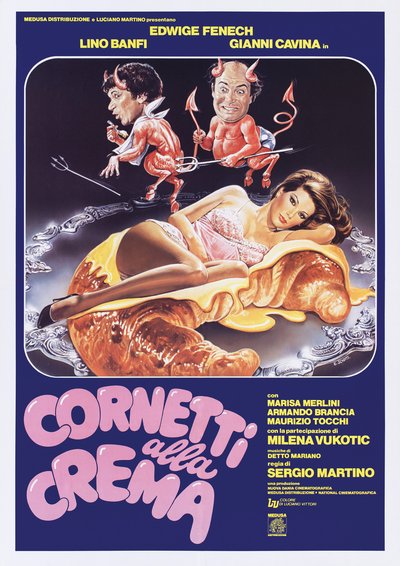
During those years, Italy, a country of obsessive censors and extremely curious spectators, developed a unique balance between mischief and discipline. Nothing could truly be shown, and precisely for this reason, everything had to be better suggested. At that time, the female body appeared as the deities once did on Baroque ceilings: veiled enough to be contemplated, revealed enough to be followed with the eyes.
The sexy comedies starring Edwige Fenech or Gloria Guida did not peddle scandal, but rather a cheerful, domestic fantasy, where eroticism still had the light-footed quality of farce. Alongside them, Lino Banfi embodied the Italian male, always caught just a moment before becoming ridiculous. In those films, desire was already a caricature of itself.
The Art of the Poster and the Power of Excess.
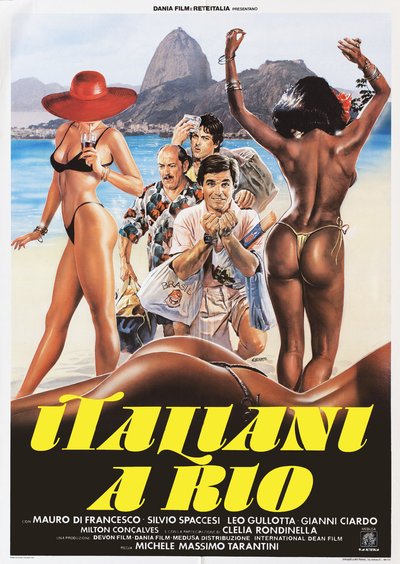
Yet the posters often outlasted the films they advertised. While the film sometimes aged quickly, the poster remained. The great Italian poster designers, above all Enzo Sciotti, knew that their task was not to reproduce a scene, but to create a sense of anticipation. A poster did not illustrate: it seduced.
That is why many of those images still possess an unexpected power today. Their colours are too bright, their poses too studied, their expressions too eloquent. Yet it is precisely in that excess that their truth resides: when desire is channelled through advertising, it always becomes a bit of a myth.
Then there was censorship, which in Italy did not destroy: it corrected. It added knickers, removed curves, and toned down necklines. And so the poster became a dual object: half artwork, half act of repentance.
From the end of an era to today’s value
Towards the end of the 1980s, photography arrived, and with it, the end of all this. The image ceased to interpret and began simply to show. The pleasure of allusion, which is always more subtle than the obvious, was lost.
Today, those posters survive as fragments of a contradictory Italy, simultaneously moralistic and voyeuristic, repressed and theatrical. In the Movie.it collection, they speak again: not about sex, but about the imagination that a country was able to build around it.Translated with https://laratranslate.com