
Enrico De Seta, the centenarian painter between irony and modernity
By Movie.it Editorial Team
June 5, 2026
Enrico De Seta was one of them. Born in Catania in 1908 and raised in Rome from the age of three, painter, illustrator and satirical cartoonist, De Seta brought to everything he touched a rare quality: lightness. Not superficiality, but the ability to handle things without weighing them down, to tell even a tragic story with a barely visible smile.
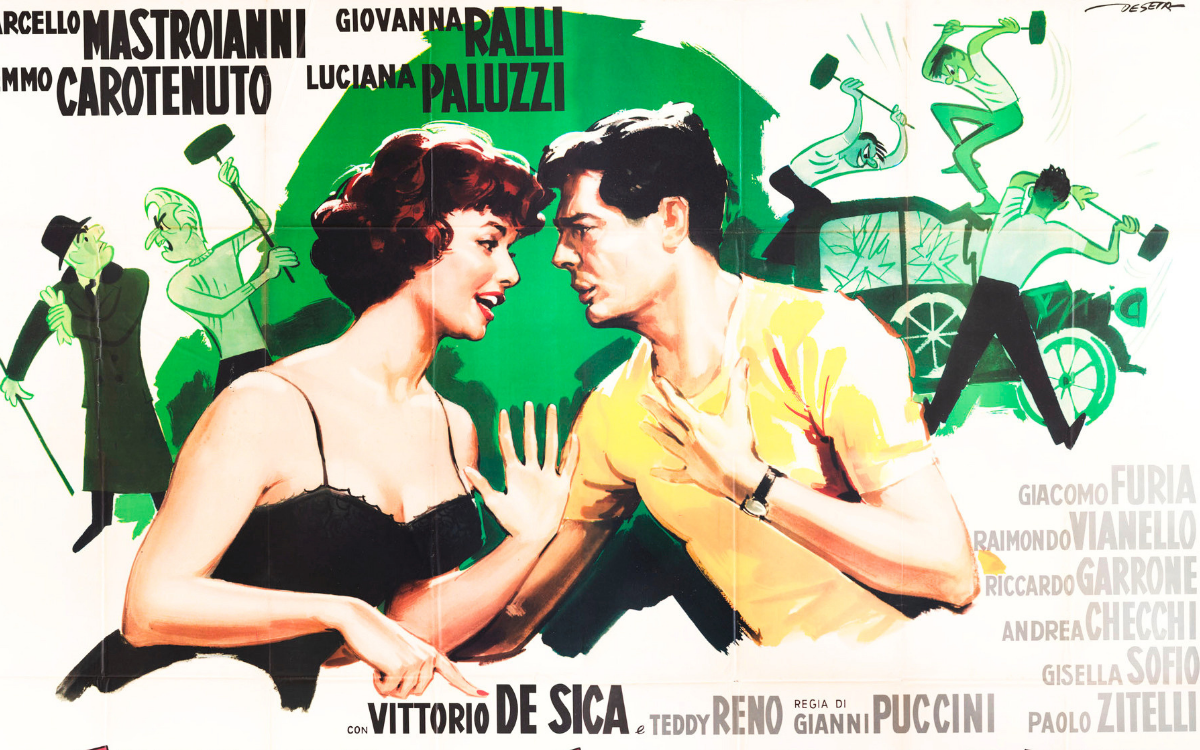
His formation took place in a lively and contradictory Rome, shaped by the cultural tensions of the Fascist era yet capable of producing, in its margins and crevices, a satirical graphic tradition of real quality. De Seta found his place in that world naturally, sharpening his pen on the most irreverent publications of the time: Il Cerino, Il Tifone, Il Travaso, and Corriere dei Piccoli. It was during those years that he created Mago Bacù, a comic character that became enormously popular, and developed a recognisable style: the quick line, the synthetic gesture, the eye for the ridiculous or revealing detail. A visual education he would never forget, even when the canvas expanded to the dimensions of a movie poster.
The Move to Cinema
When De Seta turned to the movie poster at the end of the 1930s, the field was already in full bloom. Italy had developed a tradition of painterly poster art with no equal in the world: the Maestri Cartellonisti, Ballester, Martinati, Capitani and many others, had turned posters and "locandina" (Italian small format) and sometimes other promotional material into works of art and every film arriving in cinemas came with original paintings. De Seta entered this world bringing something of his own: the ironic sensibility and gift for synthesis he had developed in satirical illustration, which set him apart from the start.
It is worth remembering how this system generally worked in Italy. Painters often prepared sketches independently, knowing that a film was due for release and hoping that their work would be selected. In the vast majority of cases, what they granted was only the right to use the artwork for the film’s theatrical promotion. The work itself remained theirs. This explains why so many of these masterpieces survived in archives and private collections, kept by the artists themselves or their families.
He worked under several pseudonyms, Veseta and Agal among the most frequent, a habit common among painters in the field, often working across several fronts at once. The multiplication of pseudonyms also reflects a multiplication of styles: De Seta had not one register but many and moved between them with the ease of someone who had learned to see the world from many different angles.
Fellini and Postwar Rome
His relationship with Federico Fellini was not merely professional: it was a personal and professional relationship also rooted in a shared sensibility for humour and the surreal undertow that runs through the best of Italian postwar culture. Those were fertile and chaotic years in Rome: the city was rising from the rubble, Italian cinema was living through an extraordinary season, the cafés of Via Veneto and the sets of Cinecittà were filled with the same faces. De Seta belonged fully to that world, shared its rhythms, its conversations, its contradictions.
It was in this context that some of his finest work was born. His collaboration with Fellini produced posters and "locandina" (Italian small format) that reflect a deep affinity: not faithful illustrations of the films, but personal interpretations, filtered through a sensibility that had much in common with the director's own. Both loved irony, both distrusted sentimentality, both understood that truth is better caught from an angle than head on.
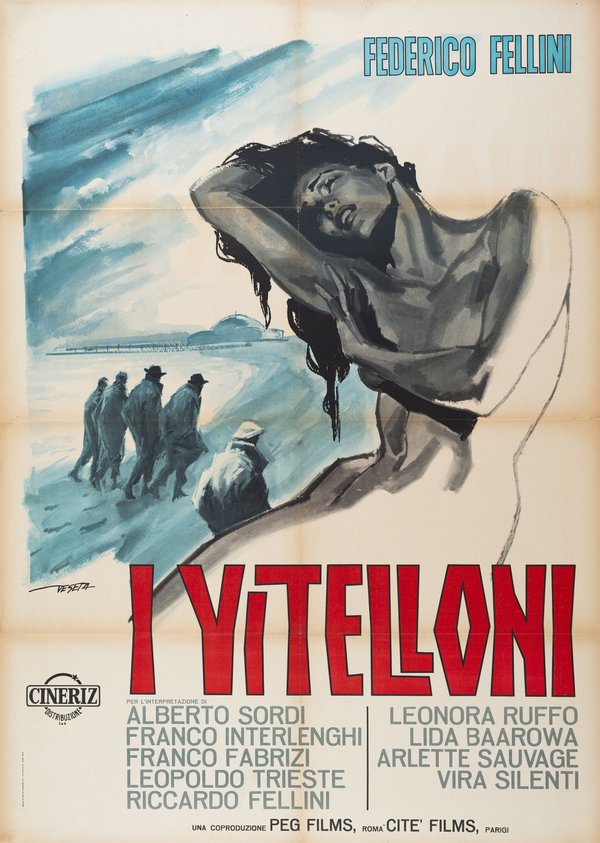
I Vitelloni, 1953 - directed by Federico Fellini
Unexpectedly classical and romantic for a painter known for irony. A female figure dominates the composition in cool greys and blues; the young protagonists walk away along the winter beach, backs turned, the future ahead. No smile, no artifice. A poster that conveys a dignified melancholy, perfectly anticipating the tone of the film.
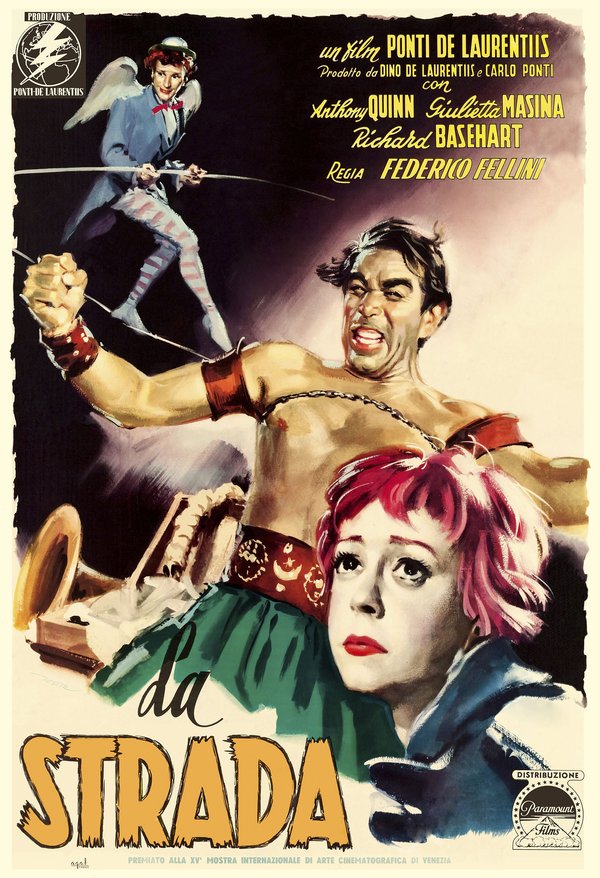
La Strada, 1954 - directed by Federico Fellini
The poster captures the poetic essence of the film through a soft, watercolour palette. Zampanò dominates the scene with his brute physicality, but it is Gelsomina's lost expression, her red fringe and bewildered eyes, that holds the gaze. Above, almost suspended, the acrobat walks the tightrope. De Seta chooses fable over realism, atmosphere over drama. A deeply personal reading of a masterpiece.
The Great War and the Golden Lion
One of the absolute pinnacles of his work is the poster for Mario Monicelli's 1959 film The Great War, winner of the Golden Lion at Venice and one of the absolute masterpieces of Italian cinema. The film miraculously brings together comedy and tragedy, the grotesque nature of war and its ferocity. De Seta responds with a visual choice that is both unsettling and convincing at the same time.
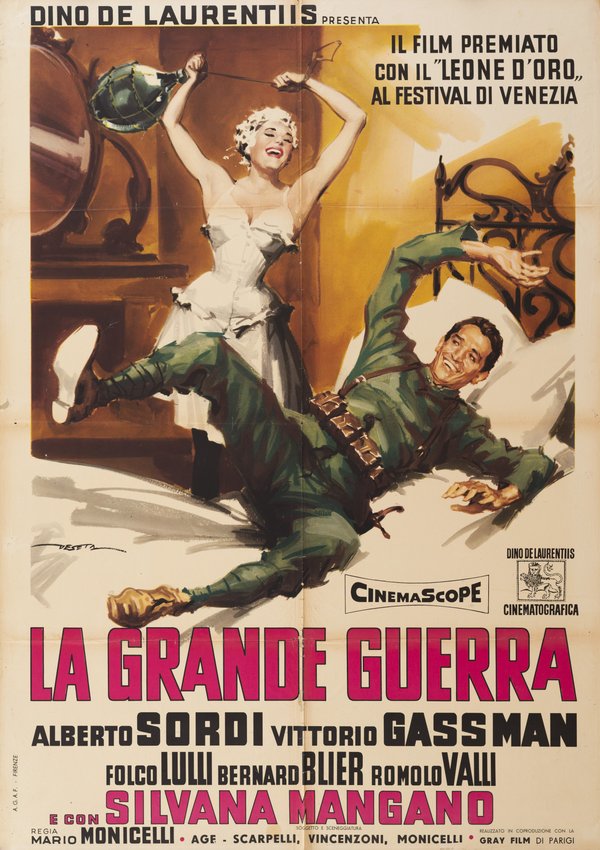
The Great War, 1959 - directed by Mario Monicelli
De Seta chooses comedy to tell a tragedy. In this poster Gassman in uniform laughs sprawled on a bed, while Silvana Mangano brandishes a helmet like a trophy. The image is light, almost farcical, yet anyone who knows the film understands that behind that smile something far more bitter lies concealed. A poster that holds the entire moral ambiguity of Monicelli's masterpiece in a single scene.
The Sixties and a Dialogue with European Modernity
With the new decade De Seta evolved further, opening his language to the influences of the most advanced European graphic design. These were the years in which Italian cinema was distributing more and more quality foreign films, the French Nouvelle Vague, German cinema, British cinema, and the Italian painters found themselves engaging with entirely new visual worlds. De Seta welcomed the challenge with curiosity, without losing his own identity. While poster design elsewhere was increasingly embracing photography and modern graphic techniques, in Italy the tradition remained strongly rooted in painting: a line, a brushstroke, a chromatic choice that no mechanical printing process could have replaced.
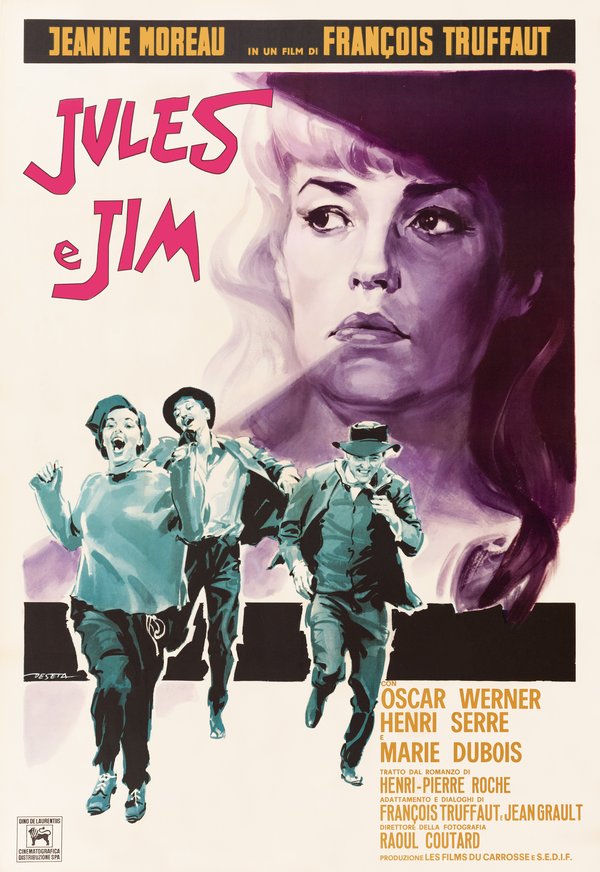
Jules and Jim, 1962 - directed by François Truffaut
A poster split into two distinct visual registers that coexist with complete naturalness. Above, Jeanne Moreau's enigmatic face in violet and grey, dominant and elusive. Below, the three protagonists run with vital energy, almost cartoon-like in their teal stylisation. De Seta speaks the language of European modernity without abandoning his own.
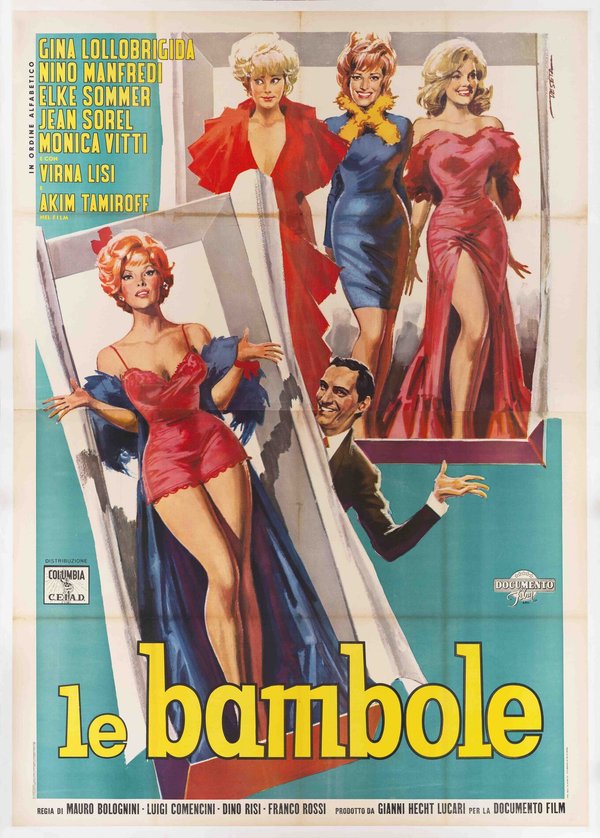
Le Bambole, 1965 - directed by Mauro Bolognini, Luigi Comencini, Dino Risi, Franco Rossi
A return to full figurative painting vibrant and colourful as the film's spirit. In the poster the four female leads, Lollobrigida, Vitti, Lisi, Sommer, emerge on a teal background in a riot of red and blue. Nino Manfredi peers slyly from behind a picture frame. De Seta celebrates, with affectionate irony, the spirit of the age.
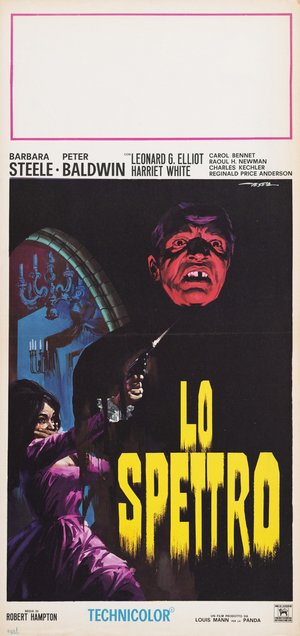
The Ghost, 1963 - directed by Riccardo Freda (credited as Robert Hampton)
No irony this time: De Seta enters horror cinema with full awareness of the genre. The villain's monstrous face looms from above in deep red and purple, a terrified figure in the foreground, the title dripping in yellow on black. A locandina that knows exactly what it needs to communicate and does so with immediate force.
Recognition and Legacy
In 1995 the Italian Republic appointed him Commendatore: a belated honour, arriving when De Seta was already eighty-seven, but a fitting tribute to a career that had spanned six decades of Italian cinema and beyond. He passed away in Rome in 2008, at the age of one hundred. A century lived with the same ironic and curious gaze with which he had looked at the world from the beginning, that of an artist who never stopped smiling and making those who looked at his works smile.
The works reproduced on this page come from original period prints, recovered, photographed and digitally restored by Movie.it.