
Dante Manno, Powerful Figures between Classical Painting and Modern Graphic Art
Edited by Paolo Zelati, Editorial Director
June 10, 2026
A Rome born painter with academic training, Dante Manno created some of the most powerful vintage Italian movie posters of the postwar era. A master who worked in the shadows, finally told. There are artists who choose the hardest path: not that of the salons, not that of the galleries, not that of the critics ready to applaud, but that of the walls. Dante Manno was one of them. Born in Rome in 1911, he chose to devote his career to cinema painting at a time when this meant working in the shadows, delivering masterpieces to printers who reproduced them on paper destined to be torn down after a few weeks, and doing so with the same seriousness and care that an academic painter brought to a canvas meant for posterity. The result is a body of work that collectors around the world now compete for, and that constitutes one of the most fascinating chapters in the visual history of Italian cinema.
Studies, Cambellotti and the Formation of a Cinema Painter
After studying at the Academy of Fine Arts in Rome, Manno had the good fortune to enter the orbit of Duilio Cambellotti, master and pioneer of art applied to the film poster, whose wheat-sheaf signature had already become a mark of distinction in Italian graphic art. From Cambellotti, Manno learned something fundamental: that visual communication is not a minor branch of painting, but a discipline requiring the same technical skills and compositional intelligence as any other art form. A lesson he would put to use for forty years, through some of the most fertile and contradictory seasons of Italian and international cinema.
His preferred technique was watercolour and tempera, with a predilection for dense and substantial colours, deep dramatic shadows, and a light built on contrasts that gave his figures an almost sculptural presence. Not the nuanced virtuosity of some of his colleagues, nor the graphic synthesis of others: something more direct and powerful, a painting that looked classical tradition in the eye without fear and approached modernity without anxiously chasing it.
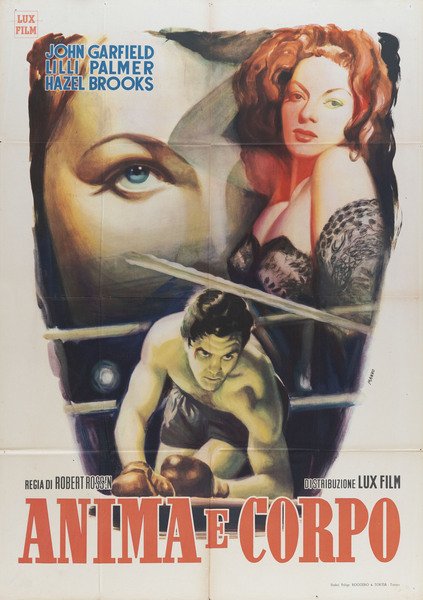
Body and Soul (Robert Rossen, 1947)
The Italian poster for Body and Soul, directed by Robert Rossen in 1947 with John Garfield, Lilli Palmer and Hazel Brooks, is one of Manno's first mature works and already defines his language. The composition is articulated on multiple levels: at the bottom, the boxer in the ring, tense and focused, rendered with a dense and muscular brushstroke; at the top, the faces of the two women emerge from the shadow like visions, with an enlarged eye dominating the scene with an almost surrealist effect. It is a film poster that speaks of obsession and emotional entrapment before it speaks of boxing, and demonstrates that Manno had already understood his task was not to describe the plot but to convey the emotional atmosphere of a film.
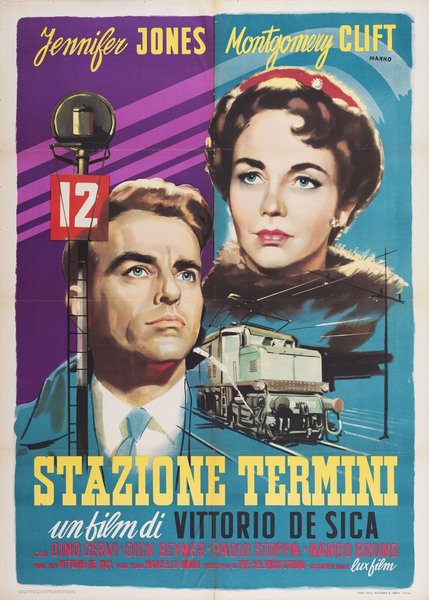
Indiscretion of an American Wife (Vittorio De Sica, 1953)
With the poster for Indiscretion of an American Wife by Vittorio De Sica, with Jennifer Jones and Montgomery Clift, Manno achieves one of the most balanced results of his career. The two actors' troubled faces are framed by the then brand-new and futuristic architecture of Rome's main station, with a locomotive in the background that introduces a sense of movement and imminent escape. The composition is divided vertically into two chromatic fields, violet and blue, that separate the two protagonists and visually underline the distance and impossibility of their love. The white title lettering at the bottom closes the image with the force of a verdict.
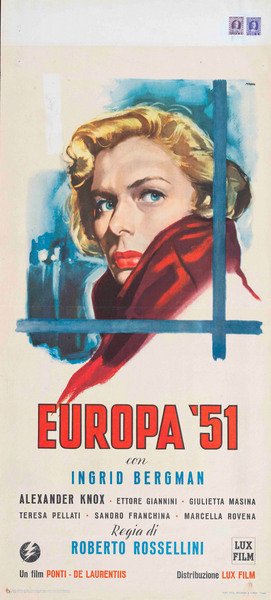
Europa '51 (Roberto Rossellini, 1952)
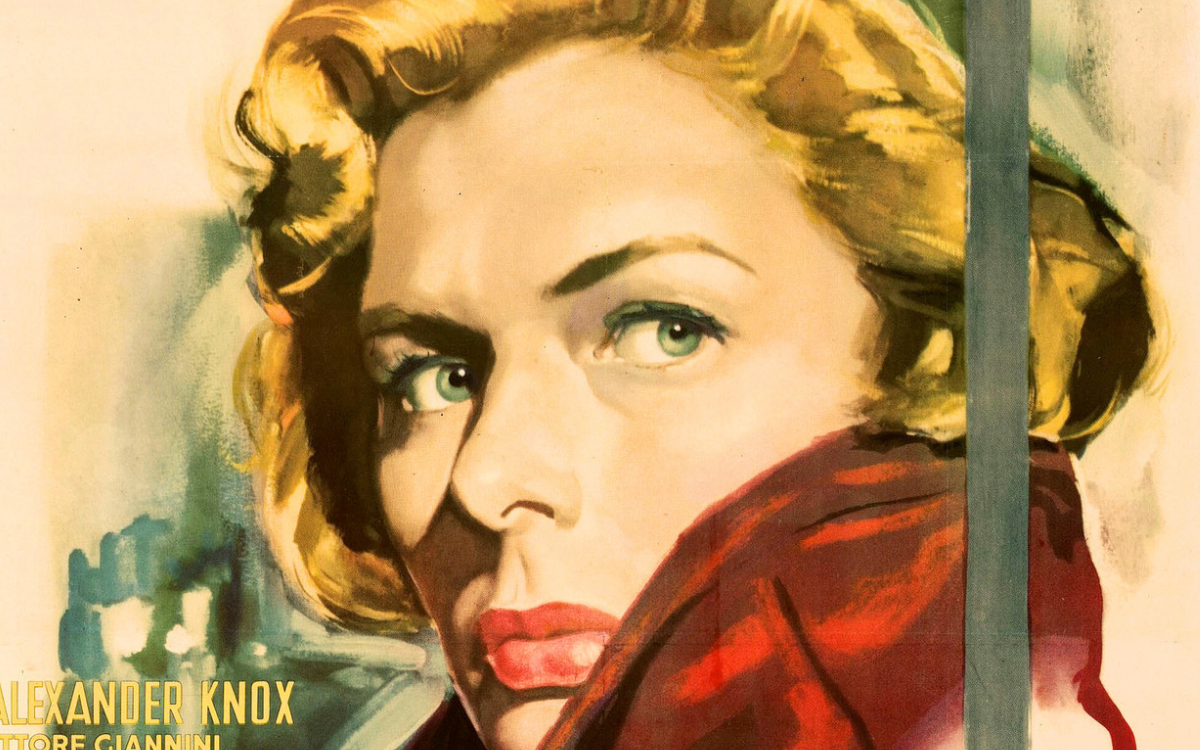
The "locandina" (Italian small format) for Europe '51 by Roberto Rossellini, with Ingrid Bergman, is one of Manno's most intense and concentrated works. The smaller format does not diminish the force of the image: Bergman's dramatic portrait occupies almost the entire surface, her face slightly turned, her clear and troubled eyes looking beyond the frame as if searching for something that isn't there. The red scarf is the only warm note of colour in a composition dominated by the cold blues and greys of the city in the background. Manno captures in this work the essence of the character: a woman who has lost her way and no longer knows how to return. Few strokes, no redundancy, everything necessary.
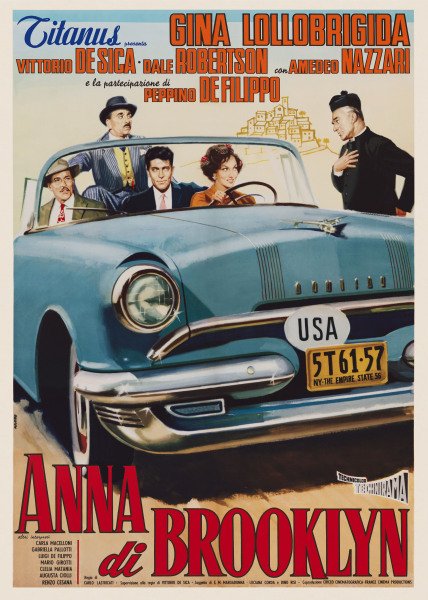
Fast and Sexy (Reginald Denham and Carlo Lastricati, 1958)
The poster for Fast and Sexy, with Gina Lollobrigida, Vittorio De Sica, Dale Robertson and Peppino De Filippo, shows a different side of Manno: the painter capable of lightness and comedy. The American blue car in the foreground, with its gleaming chrome details and New York number plate, is rendered with an almost photographic precision that contrasts pleasantly with the characters on board, portrayed with a caricatural and affectionate touch. Lollobrigida at the wheel is radiant and smiling, De Sica and the others provide a festive chorus. In the background, the houses of the Italian hilltop village recall where the protagonist comes from. It is a film poster that tells the story of the Italian-American dream of the 1950s with irony and nostalgia in equal measure.
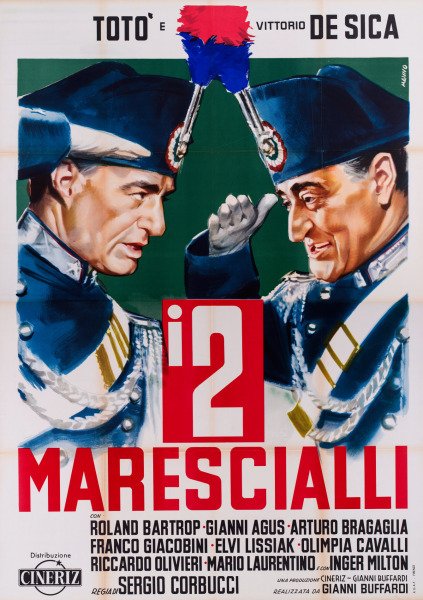
The Two Marshals (Sergio Corbucci, 1961)
The poster for The Two Marshals by Sergio Corbucci, with Totò and Vittorio De Sica, is an exemplary case of how Manno could adapt his language to the genre and tone of the film. The two actors in carabinieri uniform face each other in profile, the plumes of their hats crossing at the top like sabres in a duel, their faces expressing that mixture of dignity and comic awkwardness that was the hallmark of both. The neutral green background concentrates all attention on the two protagonists, rendered with solid and recognisable painterly technique. There is respect and affection in this poster, as well as craft: Manno knew that Totò and De Sica were already icons and treated them accordingly.
The Legacy of Dante Manno
Dante Manno died in Rome in 1996, after a career that had crossed neo-realism, Italian comedy, art cinema and genre cinema, black and white and colour, the era of the great studios and that of independent production. His body of work is a faithful and passionate mirror of half a century of Italian cinema history, seen through the eyes of a painter who never settled for the minimum. Every film poster he signed is both a historical document and a work of art: the story of a film, certainly, but also the story of an era, a taste, a way of looking at the world that belongs to an unrepeatable time, and that Manno captured on paper with the precision and passion of someone who knew that sooner or later, those images would be looked at with very different eyes.
The works reproduced on this page come from the original prints of the period, recovered, photographed and digitally restored by Movie.it.