
Brigitte Bardot: The Diva Who Lived Twice
By Paolo Zelati, Editorial Director
September 29, 2026
Some actresses belong to the history of cinema. Others, almost without meaning to, become part of the history of popular culture itself. Brigitte Bardot belonged to both, though it is perhaps the latter that best explains what made her so extraordinary. Bardot was never simply a movie star. She represented a radical shift in perspective. At a time still governed by rules, good manners and respectability, she arrived looking like a young woman who had never bothered to read the rulebook.
And yet there was nothing particularly scandalous about the beginning of her story. Born into a bourgeois Parisian family in 1934, Brigitte studied dance from childhood and attended the prestigious Conservatoire. As a teenager, she began modelling almost by chance and, at fifteen, appeared on the cover of Elle. That photograph changed the course of her life. Roger Vadim, then a young assistant and aspiring filmmaker, noticed her and soon became a decisive figure in both her personal life and her emerging career.
1956: "...And God Created Woman" Brings Stardom
Cinema followed in 1952, but the real earthquake was still to come. It arrived four years later with ...And God Created Woman, released in Italy as Piace a troppi, and directed by Vadim himself. Bardot's Juliette bore little resemblance to the carefully constructed divas audiences were used to. She was sensual, capricious, free, completely at ease in her own body. Most strikingly of all, she seemed to be enjoying herself.It was that naturalness, even more than her beauty, that unsettled audiences. Society was simply not prepared for Bardot's magnetic, unconventional appeal, on screen or off.
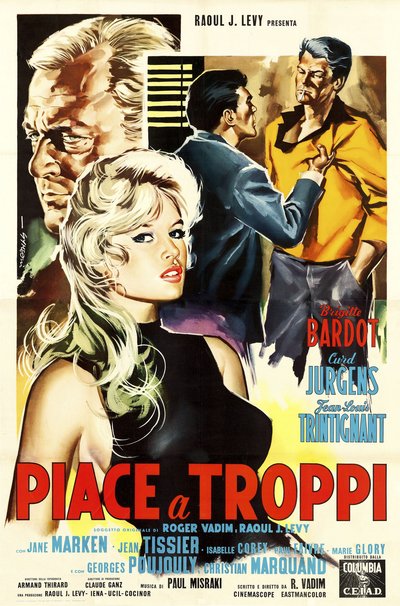
...And God Created Woman (Roger Vadim, 1956)
Sandro Simeoni's colourful, almost Expressionist style defines this poster for the first Italian release of ...And God Created Woman, the film that propelled Bardot into the firmament of international stardom. Wearing a tight black top and an unmistakably provocative expression, she dominates the foreground, while three male figures appear behind her.
The film also turned Saint-Tropez into a place of myth and Bardot into an international phenomenon. Bikinis, swept-up hair, gingham dresses, bare shoulders: suddenly, the way she dressed had become a language of its own. Even Repetto's celebrated ballet flats were connected to her. The French maison adapted a dance shoe specially for Bardot and turned it into a street shoe, the Cendrillon.This was more than fashion. It was an attempt to capture the effortless lightness of one young woman and transform it into a style that millions of others could recognise and make their own. Few actresses in the history of cinema have exerted such a profound influence on popular culture across generations and continents. Bardot was one. Audrey Hepburn was another.
Brigitte Bardot Becomes an Icon
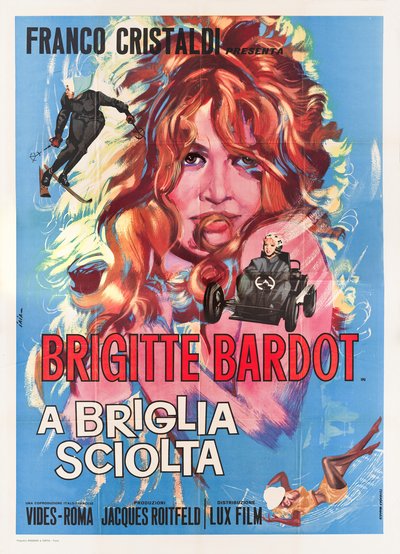
Please, Not Now! (Roger Vadim, 1961)
The four-sheet poster for the first Italian release of Please, Not Now! (1961) perfectly captures Piero Ermanno Iaia's exuberant, freewheeling style. Bardot's half-length portrait occupies the centre of the composition, her expression dreamy against a pale blue background. Her flowing hair becomes a visual thread linking a series of smaller figures in motion around her. It is, quite literally, a poster in movement, wonderfully effective at conveying the vitality and restless energy promised by its star.
Throughout the 1950s and 1960s, Bardot seemed to be everywhere. Photographers pursued her, newspapers turned her into a global image, musicians regarded her as a muse. Bob Dylan dedicated one of his earliest compositions to her. John Lennon idolised her to such an extent that he kept a photograph of her in his bedroom. When they finally met in 1968, Lennon was reportedly so nervous that he took LSD beforehand. The encounter was brief and almost comical: he was hopelessly out of sorts, while she appeared distinctly unimpressed.
And then there was Serge Gainsbourg.Their affair was brief and combustible, but it produced a song that would become legendary: Je t'aime... moi non plus. Gainsbourg originally recorded it with Bardot, who, alarmed by the scandal it might cause and the possible repercussions for her public image, asked him not to release it. The song would later become famous in the version recorded with Jane Birkin. Bardot nevertheless remained an indelible presence in Gainsbourg's imagination. In 1968, he wrote Initials B.B. for her.
Meanwhile, her filmography gradually moved beyond the image of the scandalous young woman who had first made her famous. She worked with Clouzot, Louis Malle, Godard and other major filmmakers. In La Vérité, she took on one of the most demanding roles of her career; in Contempt, she became part of the visual language of European cinematic modernism itself.The paradox was obvious. The harder Bardot tried to prove that she was an actress, the more the public seemed determined to see only the pop icon.
Contempt: Brigitte Bardot Meets Jean-Luc Godard
It was against this background that her personal and professional encounter with Jean-Luc Godard, then perhaps the most radical filmmaker in Europe, took on an almost symbolic significance. Producers Carlo Ponti and Joseph E. Levine wanted Godard to display Bardot as sensually as possible. Bardot, by contrast, wanted an auteur to give her the chance to prove that she could truly 'act'. Caught between them was Godard, who had no intention of satisfying either demand.He was largely uninterested in 'directing' Bardot in any conventional sense. What interested him was how her presence itself might be used cinematically. He later recalled learning not to ask her for anything that did not come naturally. When a spontaneous gesture worked, he wanted her to repeat it exactly. The moment she tried to 'act' the same gesture, something was lost.
Bardot played Camille, the wife of screenwriter Paul Javal, in a role far more complex than her celebrity might initially suggest. Godard constantly filmed her as an image, a body, a physical presence, while at the same time trying to prise her away from the cliché of the sex symbol. Although much was sadly lost when Carlo Ponti re-edited the Italian version, seen in its original cut Contempt absorbed and reworked the moods and tensions of its time into a film of extraordinary fascination, with unmistakable autobiographical undercurrents. Godard turned Bardot's celebrity and mass appeal into a means of exploring cinema's relationship with the body, desire and the machinery of the film industry itself.
On set, perhaps inevitably, the relationship between a global sex symbol and a director determined to dismantle the myths of cinema was not exactly harmonious. Yet that tension, and the energy it generated, became an essential part of the film's extraordinary chemistry.
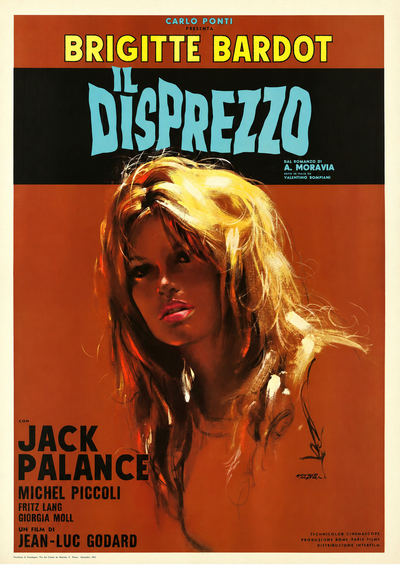
Contempt (Jean-Luc Godard, 1963)
The four-sheet poster for the first Italian release of Contempt (1963) was painted by Giuliano Nistri, who brilliantly captured the enigmatic, seductive quality of Brigitte Bardot's expression in a striking close-up. The composition is completed by an unsettling brown background and the lightly sketched outline of her upper body. Above her, the blue title sits against a black band. The image has since become an international icon in its own right.
When Fame Becomes a Prison: Leaving Cinema Behind
Bardot's home in Saint-Tropez, La Madrague, was supposed to provide sanctuary, but photographers and sightseers followed her even there. Her private life had become a public spectacle. She bought the property in 1958 and gradually turned it into her own private corner of the world.One story captures the extravagance of those years perfectly. Determined to win her over, Gunter Sachs arranged for an aeroplane to shower the house with roses. It sounds like a scene invented for a flamboyant biopic, but it actually happened. Bardot, by all accounts, was not especially overwhelmed.
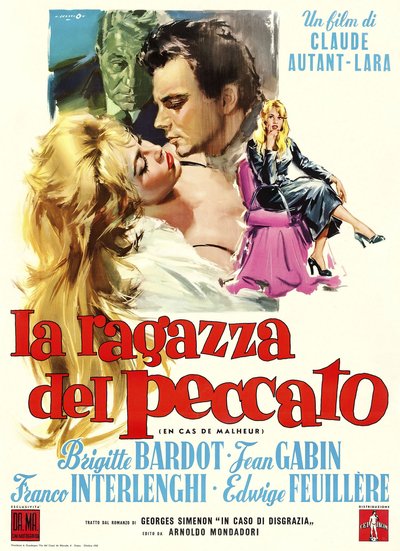
Love Is My Profession (Claude Autant-Lara, 1958)
The two-sheet poster for the first Italian release of Love Is My Profession (1958) showcases Angelo Cesselon's remarkable gift for portraiture. He concentrates the action on the left-hand side of the composition: two lovers embrace romantically while, behind them, a metaphorically green Jean Gabin seethes with rage. At the centre sits a small but unmistakably sensual Brigitte Bardot. The entire right-hand side is taken over by the teasing title in blazing red.
Amid all the frenzy surrounding her, Bardot nevertheless proved unwilling to remain a prisoner of the character the world had created for her. In 1973, at just 39, she walked away from cinema for good. It was one of the most radical decisions of her life: voluntarily abandoning a level of fame that many actresses would have spent an entire career trying to preserve.She retreated to Saint-Tropez and increasingly devoted herself to animal welfare, eventually establishing the foundation that bears her name.
At that point, the image of Bardot, the global superstar, the enfant terrible, changed completely. The woman once photographed in a bikini on Mediterranean beaches became an almost reclusive figure, surrounded by dogs and cats and increasingly distant from show business and society life.Her appearance changed too, and she showed remarkably little interest in artificially preserving the image of eternal youth. In one of her later interviews, she summed up that distance perfectly: looking at photographs of her younger self, she said she could see a beautiful girl, but no longer recognised herself in her.
Saint-Tropez and the Enduring Legacy of Brigitte Bardot
Perhaps that is the most compelling aspect of Bardot's story. She did not merely create an image. At a certain point, she found the courage to leave it behind.First she embodied sexual freedom. Then absolute celebrity. Finally, escape from celebrity itself. She passed through cinema, fashion, music and popular culture, leaving a mark on each that never entirely faded.
That is also why the myth endures. Not because Bardot remained forever young, but because her youth eventually became a symbol independent of the woman herself. The Bardot of the 1950s still exists in films, photographs, songs, collective memory and, of course, movie posters, not least in the magnificent and evocative Italian four-sheet created by Ermanno Nistri for IContempt. The woman who came afterwards chose a radically different life.
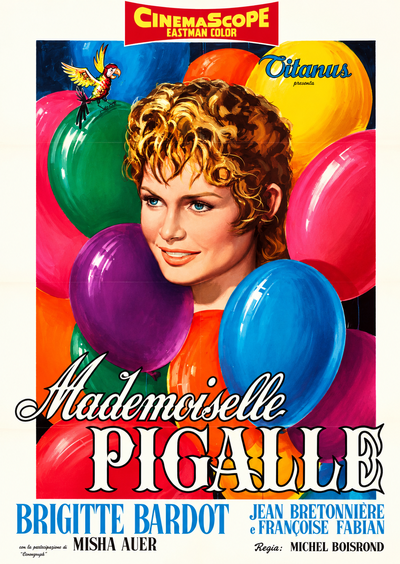
Naughty Girl (Michel Boisrond, 1956)
Rodolfo Gasparri's four-sheet poster for the first Italian release of Naughty Girl (1956) takes a playful, symbolic approach. Brigitte Bardot's short-haired head peeks out from a sea of brilliantly coloured balloons. It is the kind of poster that could hardly have gone unnoticed.And perhaps the most striking paradox lies here. The young woman the entire world demanded to look at spent much of the second half of her life trying to escape a relentless, insatiable gaze that probably took far more from her than it ever gave.The star who had captivated everyone ended up fiercely protecting her small refuge in Saint-Tropez. A woman turned into an emblem of freedom ultimately chose the most difficult freedom of all: the freedom no longer to have to play 'Brigitte Bardot'.
She died peacefully on December 28, 2025, in her beloved Saint-Tropez, leaving behind the enduring myth of a woman who, in every sense of the phrase, managed to live twice.
The artworks reproduced on this page come from original period prints recovered, professionally photographed and digitally restored by Movie.it.