
Alfredo Capitani, the film poster artist who painted for himself
Edited by Paolo Zelati, Editorial Director
June 4, 2026
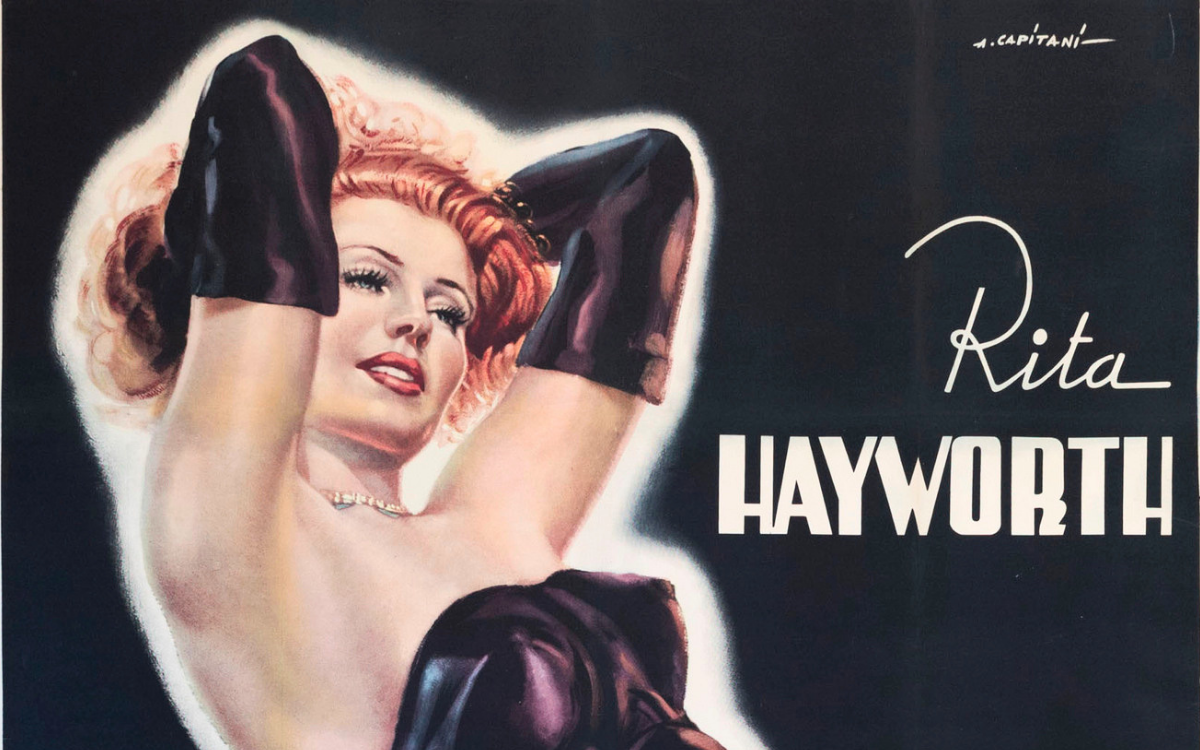
Some artists paint for the world. Others paint for themselves. Alfredo Capitani did both: for decades he created legendary Italian movie posters for major Hollywood films, then chose silence. No exhibitions, no sales. Just canvases kept privately until the end. But his posters, from Gilda to Moby Dick, still speak for him.
Alfredo Capitani (Ciampino, 3 March 1895 – Rome, 9 September 1985) was one of the greatest Italian film poster artists of the twentieth century. Over the course of his long life, he left an indelible mark on the visual culture of Italian cinema, creating posters that are still considered absolute masterpieces of visual communication and twentieth-century graphic art. It is worth stating clearly from the outset that these were not mere advertising tools, printed on paper and pasted onto walls: they were advertising works created for a film’s theatrical campaign, yet capable of becoming autonomous artistic interpretations and major pictorial achievements in their own right.
His training was solid and wide-ranging: he attended the Accademia Inglese di Belle Arti in Rome, where he graduated in set design, and immediately began working as a graphic designer, theatre set designer and exhibition designer for cinema screenings. Even before graduating, he had entered the Cines studio as a young studio assistant, in the era of the Italian cinema pioneers Enrico Guazzoni and Filoteo Alberini: an experience that allowed him to understand the language of cinema from the inside, long before he would be called upon to interpret it through painting.
In 1919 he opened his own studio devoted to advertising posters. In 1926, together with Luigi Martinati, he founded MARALCA, a company specialising in film promotion; in 1945, with the arrival of Anselmo Ballester, the company became the celebrated B.C.M., named after the initials of their surnames and one of the leading forces in postwar Italian film-poster art. Major Italian and American companies, including Cines, Titanus, Fox, Paramount and Columbia, relied on the three artists’ work for the Italian campaigns of their films.
The Painter Who Never Exhibited
Among the most touching details of Alfredo Capitani's life, there is one that makes him still more fascinating and, in certain respects, mysterious. In the 1930s the artist married Paola Francioli but was soon left a widower. The bereavement marked him deeply: he moved to the San Giovanni neighbourhood of Rome, where he resumed work with renewed intensity. In the years that followed, he would create some of the most celebrated posters of his career, from Gilda to Moby Dick, from My Darling Clementine to Only the Valiant.
But perhaps the most singular aspect of his personal story came in the 1960s. When the great season of cinema poster art began to decline, Capitani made a radical decision: he abandoned poster work entirely to devote himself exclusively to painting. So far, nothing extraordinary. What is striking is something else: he never exhibited his paintings, never sold them, never sought recognition.
He painted for himself, in silence, until the end. His pictorial work is today preserved in the family archive, kept alive by his heirs. A gesture of absolute coherence, or perhaps of extreme modesty, on the part of a man who for decades had worked to make others visible and who in the end chose deliberately to remain in the shadows.
The Unmistakable Style of Alfredo Capitani
Capitani's hallmark is recognisable at a glance: brilliant colours blended with extraordinary mastery, pictorial effects of great emotional intensity and dynamic compositions that break with traditional academic conventions. His approach to the picture surface was never descriptive or banally illustrative: each poster was a powerful visual synthesis, capable of capturing the viewer and communicating in a few instants the emotional essence of an entire film.
His visual language is often compared to that of Anselmo Ballester, with whom he shares an aesthetic of bold chromatic fields, monumental figures and an almost theatrical handling of light. Capitani does not fear the most courageous choices: unusual diagonals, chromatic overlaps, nocturnal backgrounds that set off his subjects with effects that are almost dreamlike. The lettering, in many of his works, is executed in rapid and vigorous brushstrokes, almost like a sketch, conferring on the posters an immediate and distinctive visual energy.
The Most Celebrated Posters
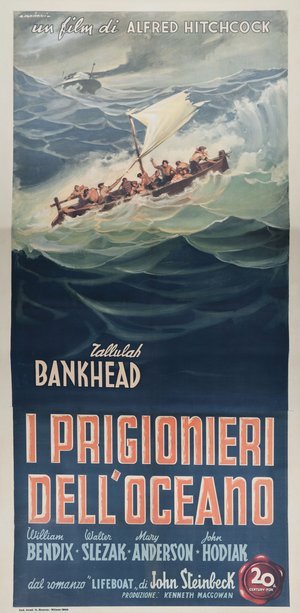
Lifeboat (1944) – Hitchcock in the Storm
For Alfred Hitchcock’s Lifeboat, starring Tallulah Bankhead, Capitani chooses a low-angle shot that heightens the sense of danger: a lifeboat buffeted by the waves in a stormy sea, with its sail billowing and a menacing ship in the background. The palette of blues, greys and whites immediately conveys the sense of isolation and survival that lies at the heart of the film.
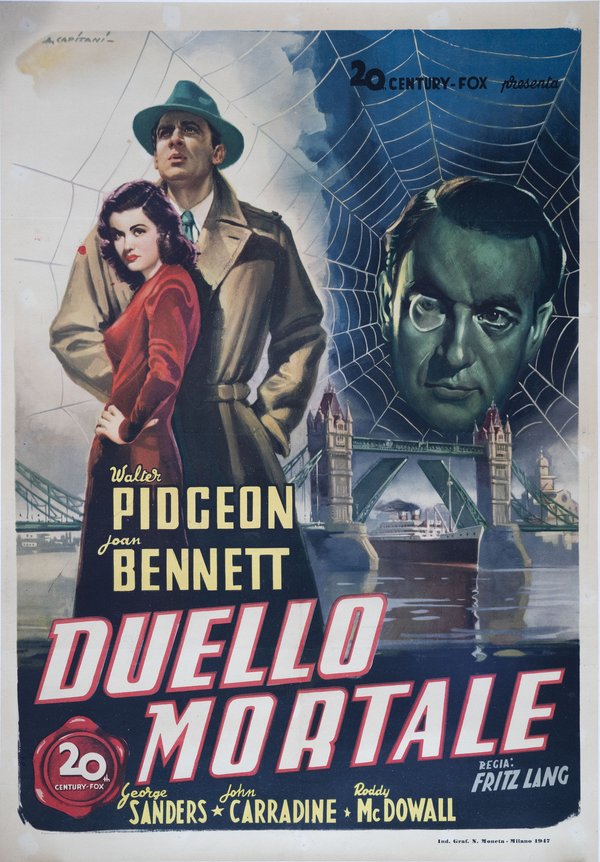
Man Hunt (1941) – Noir, Fritz Lang Style
For Fritz Lang's Man Hunt with Walter Pidgeon and Joan Bennett, Capitani uses the spider's web as a visual metaphor for the trap, superimposing it over the greenish face of the villain and the London skyline of Tower Bridge. An image of rare effectiveness, perfectly in tune with the poetics of the German director.
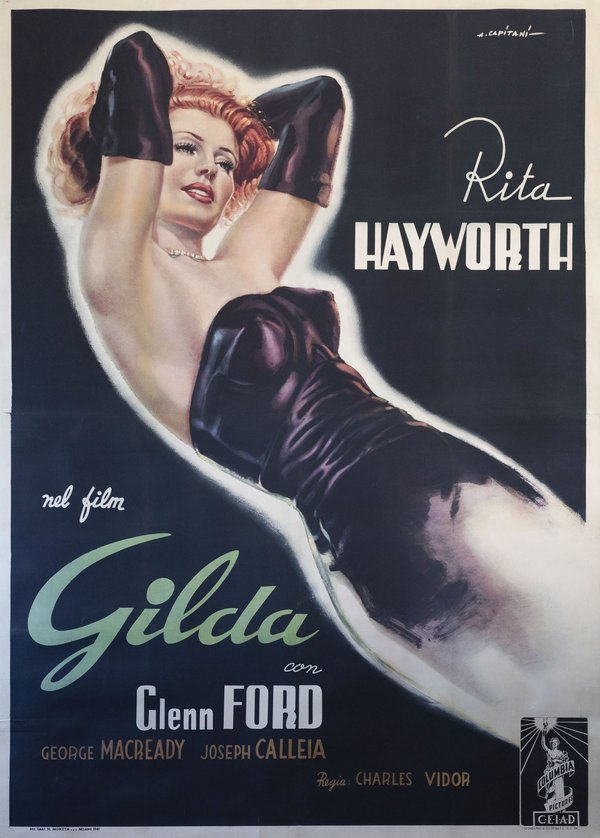
Gilda (1946) – The Absolute Masterpiece
If there is one work that consecrated Alfredo Capitani among the greatest poster artists of all time, it is the Italian poster for Gilda, the noir with Rita Hayworth and Glenn Ford directed by Charles Vidor.
The composition is brilliant in its simplicity: Rita Hayworth occupies the entire surface of the poster, wrapped in a purple dress and bathed in a luminous halo that lifts her away from the dark background. The body is set at a diagonal, arms raised in a gesture of sensual abandon. The face is barely visible, yet the figure dominates everything with an irresistible magnetic force.
Nothing distracts the eye from the protagonist: no intrusive title, no superfluous surrounding element.
This compositional choice, bold for the period, transforms the poster into a work of art: it is a visual icon of world cinema, the defining symbol of the Hollywood femme fatale and the golden age of American noir. It is still reproduced, quoted and paid homage to all over the world today.
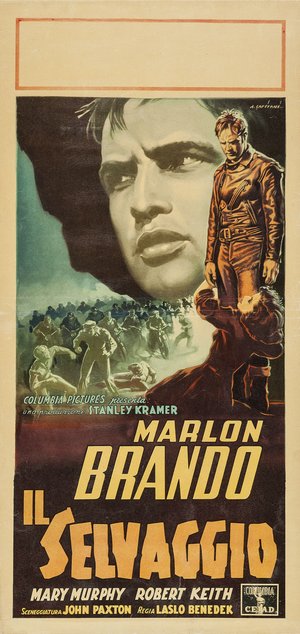
The Wild One (1953) – Marlon Brando in Italy
The "locandina" (Italian small format) for The Wild One with Marlon Brando is another example of Capitani's ability to capture the essence of a character. Brando's face emerges in the foreground with all its rebellious ambiguity, while the full-length figure in a leather jacket looms over the crowd below in a play of scale that underlines both solitude and narrative centrality. A poster that perfectly anticipates the cultural myth that Brando was building in those years.
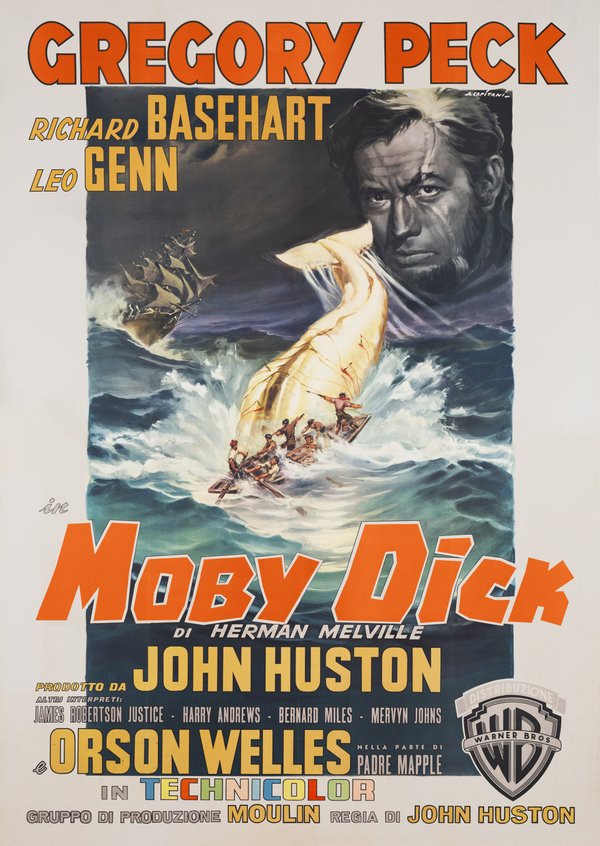
Moby Dick (1956) – An Epic at Sea
For the film adaptation of Herman Melville's masterpiece directed by John Huston, with Gregory Peck as Captain Ahab, Capitani chooses a composition on two narrative registers. At the top, Peck's monumental face in black and white, austere and obsessed. Below, a marine scene of dynamic fury: whalers in a longboat overwhelmed by waves, while the tail of the white whale rises menacingly. The chromatic contrast between the solemn grey of the face and the stormy blues of the sea creates a narrative tension that tells the story of the film before a single frame has been seen.
The Legacy of Alfredo Capitani
Capitani’s posters were not merely advertising tools: they were also autonomous visual narratives, capable of condensing into a single image the atmosphere, characters, and emotions of an entire film. In an era when the poster was the cinema’s primary promotional medium - well before online trailers, social media, and digital campaigns - Capitani elevated this language into an art form in its own right, free from academic conventions and able to engage in dialogue with the avant-garde movements of his time.
Today his original posters are highly sought-after collector's items, featured in international auctions and exhibitions dedicated to cinema poster art. The Gilda poster in particular is considered one of the most iconic in the entire history of cinema. In 2018 the Cineteca di Bologna devoted an exhibition to him at the Il Cinema Ritrovato festival, presenting him as ‘A Precursor of Painting for Cinema’ and recognising him, alongside Ballester and Martinati, as one of the great artists at the origins of painted cinema advertising.
Alfredo Capitani lived and worked in a unique period in the history of cinema. His posters, from Gilda to Moby Dick, from Hitchcock to Fritz Lang, are open windows onto a golden age, testimony to the extraordinary ability of an artist to capture the soul of a film on a single sheet. And that final choice to paint in silence, never exhibiting, never selling, makes him still greater: a master who had no need of applause to know who he was.
The works reproduced on this page come from the original prints of the period, recovered, photographed and digitally restored by Movie.it.