
Agatino Avelli, Master of Watercolour and Grace
By the Movie.it Editorial Team
July 6, 2026
Agatino Avelli, born in Tripoli in 1938, trained at the art school of Catania before moving to Rome, the city where he still lives and works. He began his career alongside the great watercolour master Ercole Brini and it was from that school that Avelli developed his taste for transparency, for light pictorial matter and for the glazes that would become his signature. His work reveals a strong bond with graphic design and a marked preference for watercolour: Avelli never seeks full colour or an even, flat application, but builds evanescent images, delicate figures that, through their slender structure, evoke moods and situations rather than describe them.
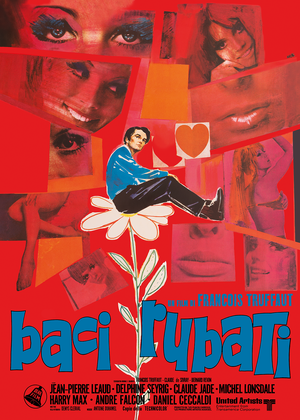
Stolen Kisses (François Truffaut, 1968)
The poster for Stolen Kisses, the third chapter of Antoine Doinel's adventures and known in the original as Baisers volés, is one of Avelli's most openly pop works. Against a bright red field he arranges a grid of tilted photographic fragments, eyes, mouths and female faces toned in reds and magentas, with a single stylised heart as the only symbolic sign. At the centre, cut out and almost suspended, Jean-Pierre Léaud in a blue jumper sits cross-legged on a large white daisy rising from below. The title is set in rounded, lower-case blue type. The effect is an ironic, sentimental collage, in which the hero seems lost among the thousand images of female desire.
Training Between Catania and Rome
The formative years, between Sicily and the capital, were decisive in defining Avelli's sensibility. In Rome he breathed the atmosphere of the great Italian poster painters and developed a personal language of lightness and understatement, far from the emphatic line of many colleagues. In those years the cinema painters enjoyed considerable expressive and narrative freedom and each one signed his own work, giving it a recognisable identity: Avelli chose the path of rarefaction, a poetics of subtraction that sets him clearly apart in the world of the poster. For this reason his images, though made to promote a film, retain an autonomous quality, closer to independent illustration.
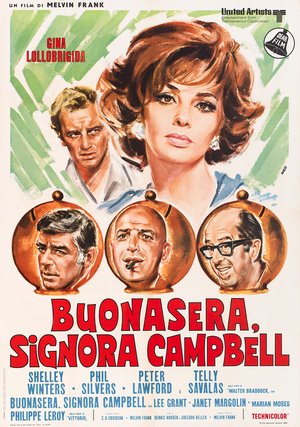
Buona Sera, Mrs. Campbell (Melvin Frank, 1968)
The poster for Buona Sera, Mrs. Campbell , an American comedy set in Italy and starring Gina Lollobrigida, shows Avelli's bright, light-hearted side. Lollobrigida's expressive face dominates the top, her hair coppery and full, against a ground of quick green and blue strokes, flanked by the frowning face of one of her suitors. Below, three male leads are portrayed as if inside three golden alarm clocks, each with his own comic touch, from cigar to spectacles. The title runs in large red letters. Everything works towards a witty, festive image, built to promise the viewer a breezy comedy of mistaken identities.
Watercolour and Cold Tones: Avelli's Hallmark
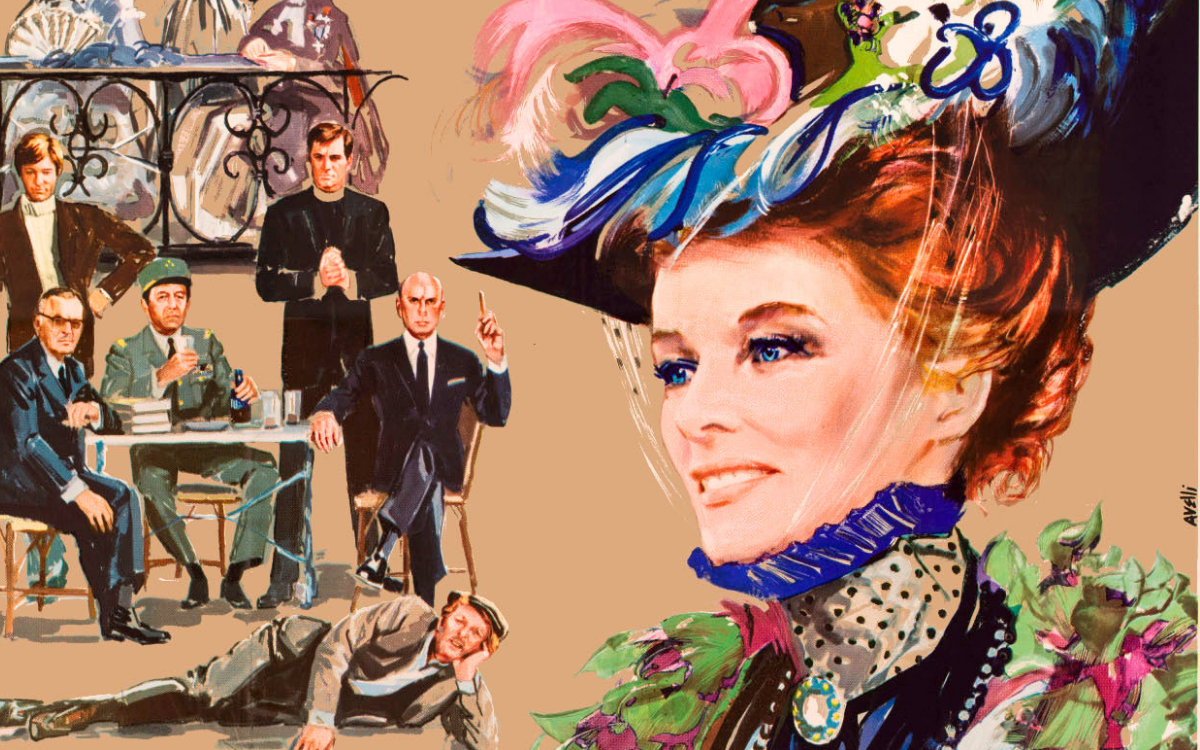
In the poster for The Madwoman of Chaillot by Bryan Forbes, Avelli chose to convey soft, refined atmospheres. Katharine Hepburn, though at the centre of the scene, appears with discretion, never overwhelming the viewer, while in the background other narrative elements summarise the plot. Here recur the artist's favourite tones: pale, soft and strictly cold pastels. A similar approach returns in Strano incontro, where the two embracing lovers, rendered in a rarefied and almost symbolic white, seem to float and dissolve into a landscape of pale-blue buildings. It is in such works that one measures Avelli's distance from the louder poster tradition: his aim is not to strike, but to suspend the gaze in a kind of waking dream.
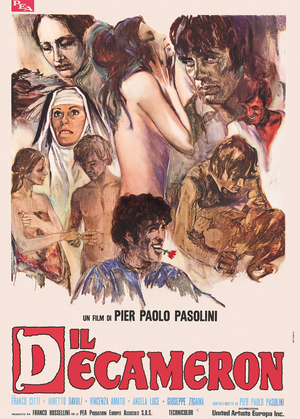
Il Decameron (Pier Paolo Pasolini, 1971)
The poster for Il Decameron, the first film in Pasolini's Trilogy of Life, is a perfect example of Avelli's collage technique. The composition gathers into a single whole a crowd of faces and bodies drawn from Boccaccio's tales: a wide-eyed nun, embracing lovers, a smiling young man with a red rose between his teeth, nude figures barely blurred in. The line is the rapid, nervous one of a sketch from life, the warm, earthy colours tending towards monochrome. The scenes melt into one another in an almost dreamlike narrative that conveys the film's episodic structure and its earthy, sensual spirit.
Collage and Storytelling in Fragments
A constant in Avelli's work is the collage technique, juxtaposing images and faces to suggest parallel situations. In the sketch for Il Decameron the structure unfolds in overlapping episodes, as if echoing the very form of Boccaccio's storytelling. In Les femmes the line becomes essential and recalls the style of a fashion plate, while in Topkapi the interest returns in the juxtaposition of several narrative planes within a single image. This ability to assemble different fragments into a coherent composition brings Avelli closer to the language of the graphic designer and the director than to that of the traditional portraitist and explains why so many collectors recognise his posters at a glance.
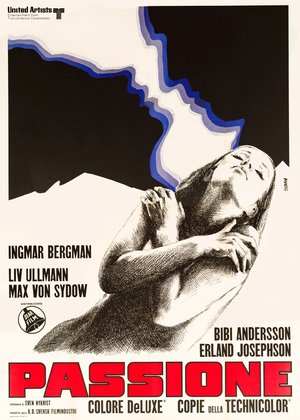
The Passion of Anna (Ingmar Bergman, 1969)
The poster for The Passion of Anna, a drama by Ingmar Bergman released in the original as En passion, is among Avelli's most modern and graphic works. The lower half is taken up by a figure folded in on itself, arms crossed, rendered in dense black-and-white pen hatching that sculpts its volume. Above, a large black field with a jagged edge and a wavy blue line break up the white ground, like a crack or a flash of lightning. The almost total renunciation of colour and the tension of the drawing translate the film's mood of anguish and emotional cold, where the mark itself becomes expression.
Between Drama and Comedy: Expressive Force
Of great intensity is the poster for The Devils by Ken Russell: in the foreground the heroine, wrapped in a drape that heightens the drama of her pose, while behind her looms the powerful figure of Oliver Reed and the absolute white background amplifies the tragic feeling. A wholly different register appears in Stolen Kisses by François Truffaut, where the graphic and photographic composition, the female faces in tones of red and pink and the ironic pose of the protagonist build an openly pop image. The same flexibility returns in light comedies such as Buona Sera, Mrs. Campbell, the mark of an artist able to move with equal sensitivity between drama and comedy, without ever losing an elegant and unmistakable touch.
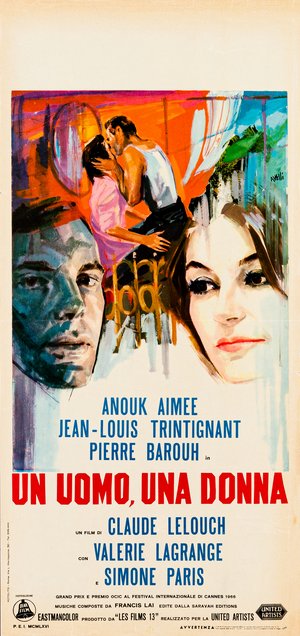
A Man and a Woman (Claude Lelouch, 1966)
The "locandina" (Italian small format) for A Man and a Woman, Claude Lelouch's celebrated love story, winner of the Grand Prix at Cannes and known in the original as Un homme et une femme, sums up Avelli's sentimental grace. At the top, against a bright orange ground, the two lovers kiss in an interior barely suggested with rapid strokes. Below, on this locandina the two large portraits of the leads face each other: on the left the face of Jean-Louis Trintignant, modelled in cold blues, on the right the luminous, melancholy face of Anouk Aimée. The contrast between the warmth of the scene and the chill of the portraits tells at a glance the story of a love marked by memory and difficult rebirth.
From Bergman to Bowie: The Directors and the Legacy
Avelli's career intertwines with that of some of the greatest directors of the twentieth century. He created Italian poster art for films by Robert Altman, Michael Cimino, Ingmar Bergman and Ken Russell. And to him we also owe one of the Italian posters most sought after by collectors, that of The Man Who Fell to Earth by Nicolas Roeg, with David Bowie in the role of the alien: an image that lingers in the imagination as much as the film itself. One detail captures the artist's temperament well: in his later years Avelli created a complete deck of Tarot cards, twenty-three oil-pastel plates in which he rediscovered the freedom of pure illustration, far from the demands of a film. It confirms a path in which painting was never a mere trade, but a personal quest. With his poetics of lightness, made of light lines, cold tones and suspended atmospheres, Agatino Avelli left an unmistakable mark on the history of the Italian cinema poster, proving that even an image born for the screen can aspire to the dignity of visual poetry.
The works reproduced on this page come from the original prints of the period, recovered, photographed and digitally restored by Movie.it.