
Silvano Campeggi "Nano", The Hollywood Movie Post Artist
Edited by Paolo Zelati, Editorial Director
June 18, 2026
There is a detail that says more than a thousand words about the relationship between America and Italy in the closing years of the Second World War: a young Tuscan artist in his early twenties who, while Europe still lay in ruins, was commissioned by the American Red Cross to paint portraits of soldiers awaiting their discharge. This is how Silvano Campeggi, destined to go down in history by the nickname "Nano", came into contact with the music, cinema and culture of the United States. From that first encounter would grow one of the most extraordinary and least publicly known careers in the history of the film poster: more than three thousand works for Hollywood, created by a Florentine artist who remained deeply rooted in his native city throughout his life.
Florence, His Father's Print Shop, Rosai and Soffici
Born in Florence in 1923, the son of a printer and typesetter, Campeggi grew up breathing the smell of ink and watching the printing presses at work: an informal education in graphic art that accompanied him from childhood. He attended the Istituto Statale d'Arte in Porta Romana, where he studied under two exceptional masters, Ottone Rosai and Ardengo Soffici: names that say a great deal about the quality of Florentine artistic training in those years, and that explain why, even in his most popular and commercial works, Campeggi's art always reveals a solidity of drawing and a freedom of brushwork that come from far away.
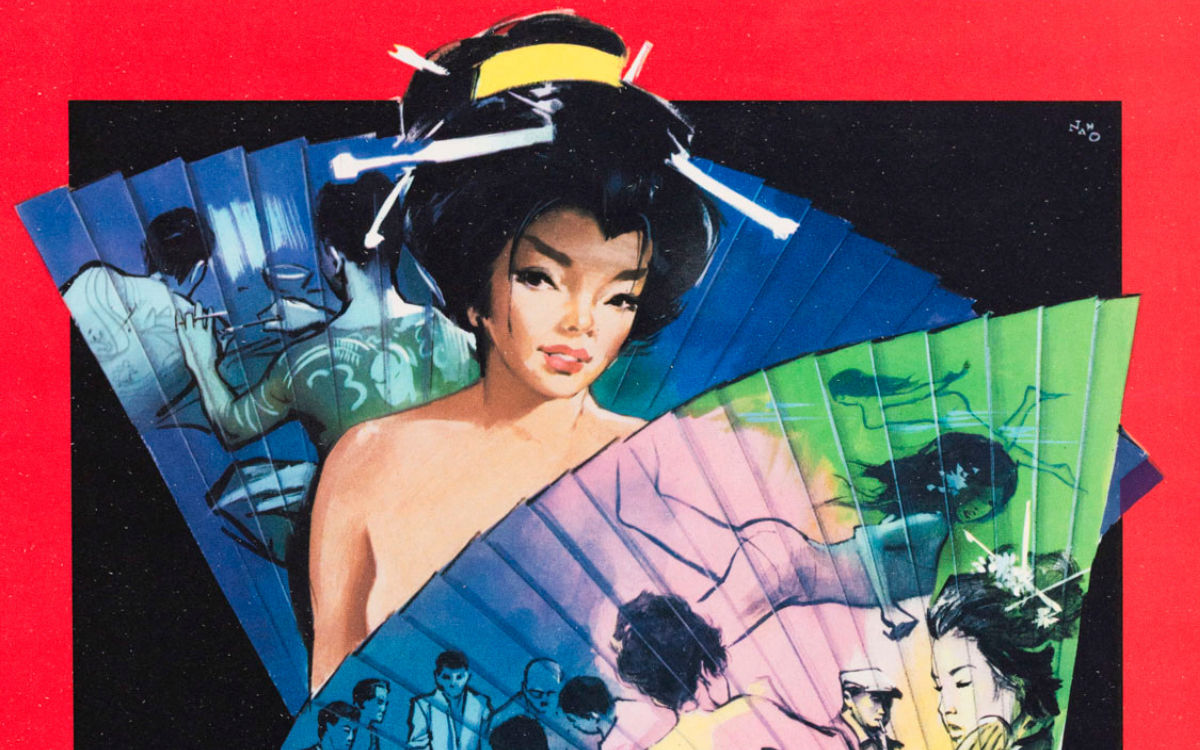
His style is founded on synthesis: line prevails over mass, and every brushstroke possesses a fast, vibrant energy capable of defining figures and movement with the fewest possible marks. In some cases the forms seem to dissolve, leaving room for a background that becomes an integral part of the composition, almost an extra character. The colours, sometimes laid out in flat fields, sometimes modelled into compact volumes, sustain this essential dynamic, while gradations remain light and rare. It is a language that carries within it that humour so typical of Tuscany, an intelligent lightness that never lapses into superficiality.
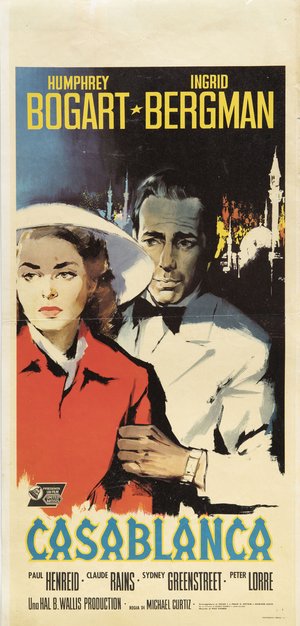
Casablanca (Michael Curtiz, 1942)
The Italian poster for Casablanca, starring Humphrey Bogart and Ingrid Bergman, is one of Campeggi’s most famous and widely reproduced works. The two protagonists are portrayed in close-up: she wears a vivid red dress that immediately draws the eye, while he appears in a white dinner jacket, with the enigmatic expression that made him immortal. In the background, the faint outlines of Casablanca’s Moorish architecture emerge from the darkness like a mirage. The title, rendered in blue lettering against a pale background, has an almost calligraphic quality that evokes the exotic atmosphere of North Africa. The image achieves its effect through restraint: two faces and a single color are enough to convey the film’s entire emotional tension.
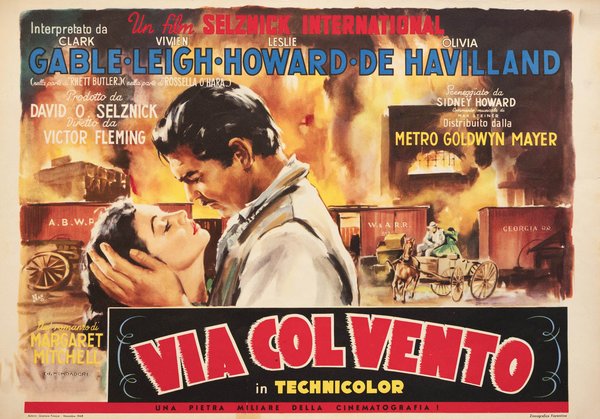
Gone with the Wind (Victor Fleming, 1939, edizione italiana)
If there is one image that alone sums up Campeggi's career, it is this "painted fotobusta" (Italian lobby card) for Gone with the Wind. Scarlett O'Hara and Rhett Butler are portrayed in a passionate embrace, their faces lit by a warm light that isolates them from the chaos of the flames of Atlanta in the background. It is an image steeped in poetry and emotion, capable of conveying in a single glance the entire sentimental epic of Margaret Mitchell's novel: the war, the destruction, but also the passion that withstands everything. It is no surprise that it became one of Campeggi's most recognisable images of the cinema, here he does not illustrate a scene but conveys a universal feeling.
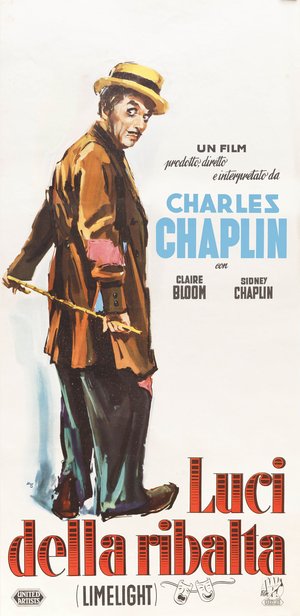
Limelight (Charles Chaplin, 1952)
With the "locandina" (Italian small format) for Limelight, Campeggi tackles a completely different subject and demonstrates his versatility. Charlie Chaplin, in frock coat and yellow bowler hat, is portrayed in profile as he turns to look at the viewer with an expression both melancholy and comic, his cane in the hand behind his back. The background is almost entirely white, and this minimalist choice concentrates all attention on the figure: nothing distracts from the character, from his slightly uncertain gait, from his clownish sadness. It is a portrait more than a poster: Campeggi knew well the iconic value of Chaplin and chose to add nothing that might diminish him.
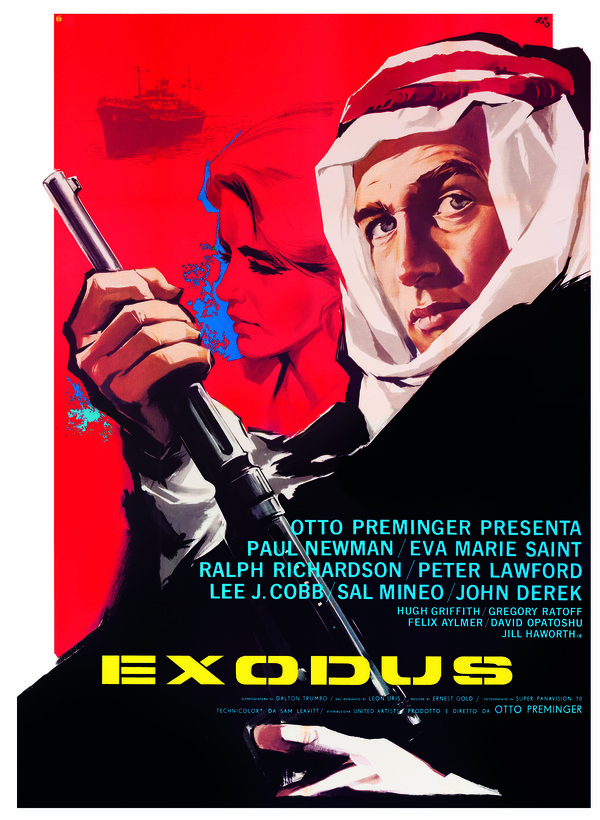
Exodus (Otto Preminger, 1960)
The poster for Exodus shows Campeggi grappling with a historical and political epic of great complexity. The composition plays on an intense red background and two figures: in the foreground, the face of Paul Newman wrapped in a red and white headdress, his gaze steady and determined; behind him, the profile of a woman blends into the blue silhouette of the promised land, while a barely sketched ship crosses the sea above. Here too returns what is perhaps Campeggi's trademark: the ability to translate into an image not only the plot but the deep theme of a film, in this case the birth of a nation and the weight of history on the shoulders of those who live through it.
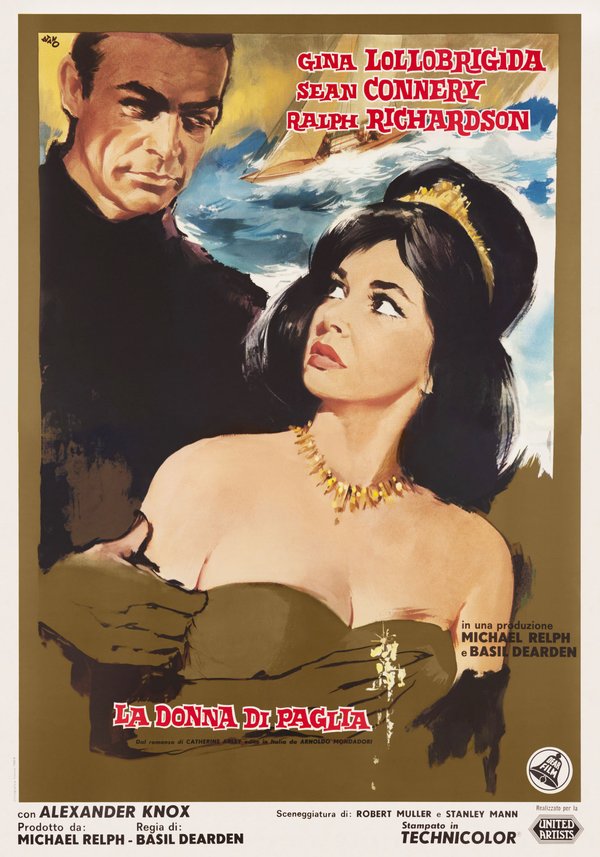
Woman of Straw (Basil Dearden, 1964)
In the poster for Woman of Straw, with Gina Lollobrigida and Sean Connery, Campeggi returns to a softer, more painterly register. Lollobrigida's face, luminous and sensual, dominates the composition with her gaze turned upward, while behind her the figure of Connery, in shadow, watches with an ambiguous expression somewhere between protection and suspicion. In the background, a stormy sea and a sailing boat introduce an element of adventure and danger. The golden and brown palette gives the image an almost Mediterranean warmth, perfectly in keeping with the romantic-thriller tone of the film.
The Legacy of "Nano": Florence, Hollywood and Back
Between 1945 and 1972 Campeggi worked for the major American production companies, from MGM to Paramount, from Universal to RKO, signing the posters of some of the most celebrated films in cinema history: in addition to those already mentioned, Ben-Hur, Singin' in the Rain, An American in Paris, West Side Story, Breakfast at Tiffany's, Gigi. Some of his images became true visual icons, transcending the films they were originally created to promote: the four white horses on a red background for Ben-Hur became one of the most recognisable graphic symbols of the costume epic, the Gigi soundtrack album, featuring Cmpeggi's image of Leslie aron, even appears on the cover of Pink Floyd's Ummagumma, a sign of how far those images had transcended their original promotional function.
When, at the end of the 1960s, the great season of the painted film poster entered its decline under the pressure of photography and new advertising techniques, Campeggi returned to Florence and devoted himself to painting and portraiture, without ever stopping work. In 1988 an exhibition at Palazzo Medici Riccardi, "Il cinema nei manifesti di Silvano Campeggi", reawakened public interest in his work and was later replicated in Paris and New York, the beginning of a long season of recognition that would accompany him to the end.
Campeggi died in Florence in 2018, at the age of ninety-five. Carrying forward the memory of his work today is his wife Elena, who accompanied him throughout his life and who continues to preserve and promote that heritage of images with the same dedication and affection of a whole life spent together, between Florence and Hollywood, between the concreteness of his father's print shop and the luminous dream of American cinema. Looking at his posters today, one understands why: in each of them there is the same lightness, the same elegance, the same loving gaze upon the world that "Nano" Campeggi must have had every day of his life.
The works reproduced on this page come from the original prints of the period, recovered, photographed and digitally restored by Movie.it.