
Nicola Simbari, Painter and Movie Poster Artist, Mediterranean Light and Colour
By Movie.it Editorial Team
June 29, 2026
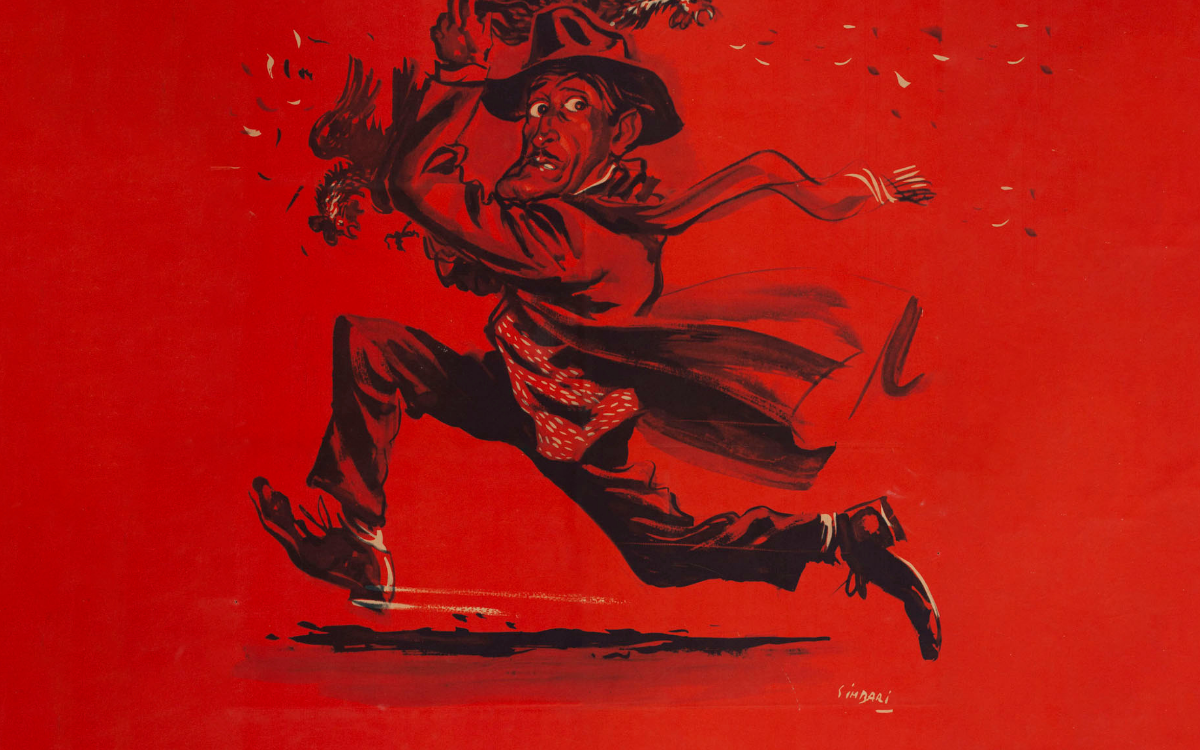
Among the Italian cinema painters, Nicola Simbari is perhaps the most anomalous and, in a sense, the most illustrious: not a poster artist by trade, but a true easel painter of international fame, whose works are held in major museum, private and corporate collections around the world, including the Christian Dior Collection in Paris and the Bank of Tokyo. His occasional ventures into film-poster art brought the unmistakable language of an easel painter to the cinema: Mediterranean light, brilliant colour, thick palette-knife impasto and rapid, Impressionistic brushwork. In his relatively few works for the cinema, creative freedom and the emotional power of colour take precedence over conventional illustration: these are posters conceived first and foremost as paintings.
From San Lucido to Via del Babuino: The Vocation of a Painter
Nicola Simbari was born in San Lucido, in Calabria, on 13 July 1927, in that landscape of sea and light that would forever mark his palette: the blues of the water and the sky, the bright tones of the flowers. While he was still a child, the family moved to Rome, where his father worked as an architect for the Vatican. It is a detail that would weigh on his art: his early exposure to the world of architecture would leave him with a taste for geometric forms and structures, which we find as a hidden framework in almost all his paintings. Struck by the masterpieces of the Eternal City, at just thirteen he decided he would be a painter and enrolled at the Accademia di Belle Arti in Rome, training also in his father's architecture studio. At twenty-two he opened his first atelier, in Via del Babuino, in the artistic heart of the city.
His early works were devoted to childhood memories: gypsies, cafés, fishing villages, the Italian countryside. Success came almost at once. In 1953 he won an award for his production design for Camillo Mastrocinque’s musical film Tarantella napoletana, and after a solo show in London he was even commissioned to paint a cycle of murals for the Italian Pavilion at the 1958 Brussels World's Fair. His famous exhibition "Le Cirque" would be acclaimed in Paris, New York, Chicago and Los Angeles. "When I paint, I'm like a writer," he liked to say, "I must have something to say. My paintings are like entries in a diary, because they are all reactions to things I have seen or felt." His work for the cinema belongs to these same years of rapid emergence as a painter: unlike Otello Mauro Innocenti or Mario De Berardinis, film posters were never his principal trade, but an occasional parallel activity into which he brought the full freedom of his painting.
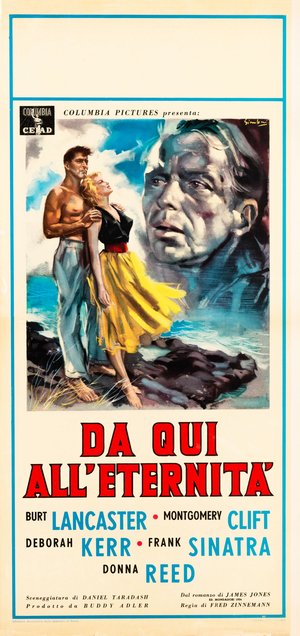
From Here to Eternity (Fred Zinnemann, 1953)
The "locandina" (the small Italian format) for From Here to Eternity, Fred Zinnemann's celebrated drama awarded eight Oscars, shows Simbari's hand in its most lyrical form. Executed in watercolour, the design sees a pair of lovers, Burt Lancaster and Deborah Kerr, standing out against the infinite blue of the Hawaiian sea, while from above looms, in a spectral monochrome green, the great face of a man who dominates and overhangs the scene. The watercolour lightness, the fusion of the figures with the marine landscape, the bold chromatic contrast between the yellow of her dress and the blues of the water: everything reveals the touch of a painter who thinks in masses of colour and light rather than in illustrative detail.
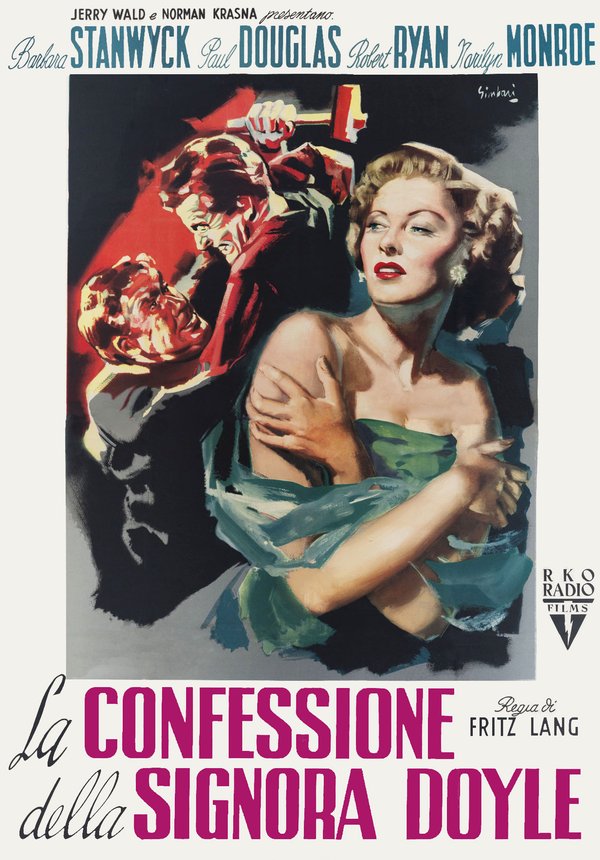
Clash by Night (Fritz Lang, 1952)
In the poster for Clash by Night, Fritz Lang's film noir with Barbara Stanwyck and a young Marilyn Monroe, released in Italy as La confessione della signora Doyle, Simbari builds a drama made of violent contrasts. On the right emerges the sensual face of a woman wrapped in a sea-green veil, while in the background, in a theatrical play of red lights and black shadows, a male figure menacingly brandishes a hammer. The brushwork is broad, nervous, almost Expressionist; the colour does not describe but evokes, igniting the scene with a dramatic tension built through pure fields of light. It is proof that even in the noir genre Simbari never gave up his pictorial freedom.
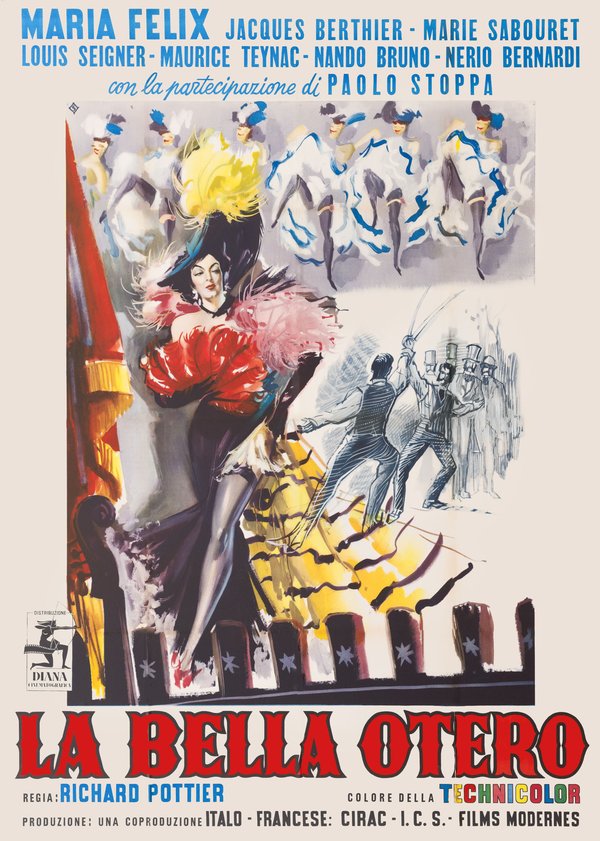
The Beautiful Otero (Richard Pottier, 1954)
The poster for The Beautiful Otero, a Technicolor biography of the legendary Belle Époque dancer and courtesan played by María Félix, released in Italy as La bella Otero, is a feast of colour and movement. Simbari portrays the diva at the centre of the scene in a whirling costume of red and yellow feathers, sheathed in black, while in the background, barely sketched with rapid, almost abstract touches, the can-can dancers and a duelling scene stir into life. Here his nature as an Impressionist painter explodes: the composition is all rhythm and verve, a choreography of brushstrokes that conveys the energy of the spectacle rather than its outlines. A poster that is already, to all intents and purposes, a gallery painting.
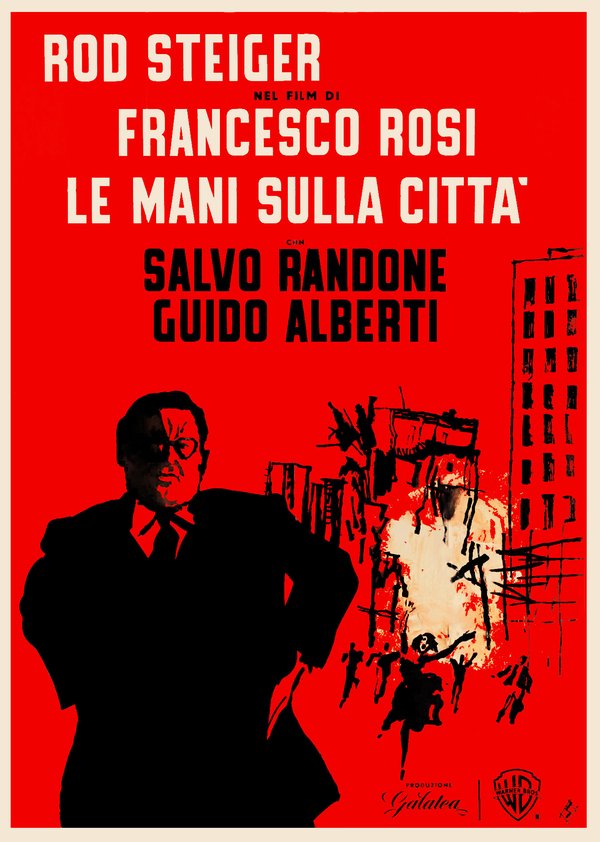
Hands over the City (Francesco Rosi, 1963)
With the poster for Hands over the City, Francesco Rosi's hard-hitting investigative film awarded the Golden Lion, released in Italy as Le mani sulla città, Simbari reaches the height of synthesis. Against an absolute, alarming red background, the black, massive silhouette of the unscrupulous developer played by Rod Steiger rises in the foreground, mute and threatening; beside him, reduced to nervous strokes of India ink, emerge the broken outlines of buildings and architectural ruins, with a flash of figures plunging down. It is a strikingly modern poster, almost a political statement in the graphic sense of the term, in which the architectural rigour inherited from his father becomes visual denunciation. Few elements, only two colours, and all the speculative violence of the film.
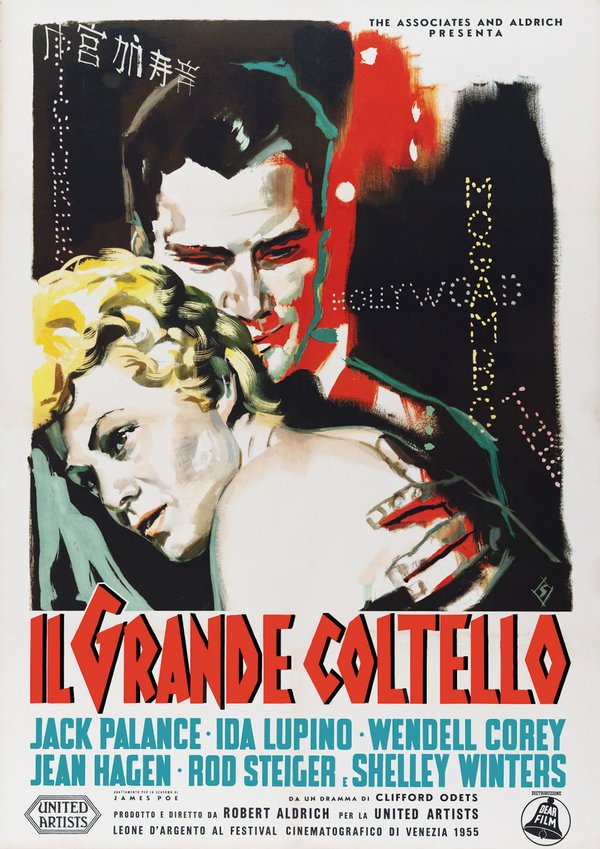
The Big Knife (Robert Aldrich, 1955)
In his poster for The Big Knife, Robert Aldrich’s Hollywood drama, winner of a Silver Lion at the 1955 Venice Film Festival, released in Italy as Il grande coltello. Nicola Simbari turns Robert Aldrich’s drama into an image of intense emotional tension. Jack Palance’s monumental face looms over the female figure in the foreground, while deep blacks, vivid reds and sudden strokes of turquoise break across the surface with an almost Expressionist energy. Portraiture and abstraction merge in a strikingly modern image that perfectly captures the film’s oppressive atmosphere.
Simbari’s style: colour as emotion
What sets Simbari apart from all the other cinema painters is his identity as an artist in the fullest sense. While masters such as Anselmo Ballester or Luigi Martinati had made the poster their entire professional life and while a Renato Casaro would carry the trade towards hyperrealism, Simbari always remained, first and foremost, the semi-abstract, Impressionist painter of the international galleries. He favoured the palette knife, loaded with impasto, alternated with lighter touches or watercolour glazes; he loved to set intense, bright, luminous colours side by side with a boldness few poster artists allowed themselves. His designs and paintings reveal an immediate freshness, as in the famous Le ragazze di San Frediano or in the refined Nanà, executed in gouache with a lively alternation of scenes and colours of an almost burlesque flavour.
In each of his works for the cinema one senses this double nature: the architectural rigour of the structure, inherited from his father, and the explosive freedom of Mediterranean colour. Not the faithful illustration of the film, but its translation into pure chromatic emotion.
Simbari’s legacy
Nicola Simbari died in Frascati on 11 December 2012, considered by many one of the most important Italian artists of his time. His pictorial work lives on today in museums and private and corporate collections around the world, from Christian Dior to the Bank of Tokyo, from Liberty of London to the great American corporations. His film posters, few but precious, occupy a special place in this journey: they are the mark of the passage of a great painter through the popular world of the cinema, the testimony of how the street and the gallery, high art and mass art, could meet in a single, luminous brushstroke. At a time when the poster was considered ephemeral art, Simbari demonstrated, simply by continuing to be himself, that a film design could possess the same dignity as a painting destined for a museum.
The works reproduced on this page come from the original prints of the period, recovered, photographed and digitally restored by Movie.it.