
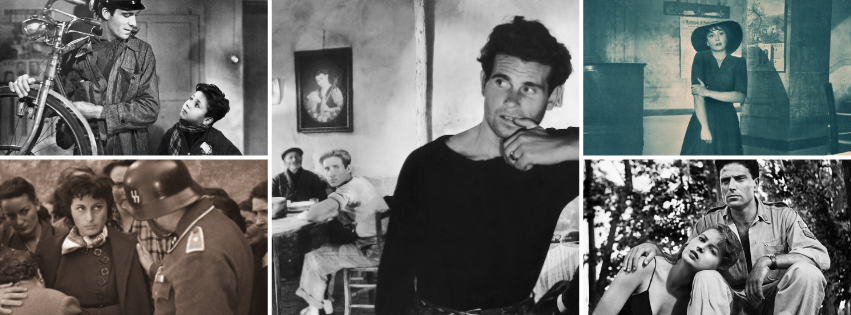
There was a moment in the history of cinema when reality took the place of fiction, when the streets, ordinary people, and everyday struggle moved to centre stage. That moment was Italian Neorealism.
Born in the darkest years of the Second World War and coming into full bloom in its aftermath, Neorealism was never merely a cinematic movement. It was a genuine revolution in how the world was seen: life shown as it truly was, unfiltered and unmasked, as though cinema itself had become truth in motion.
A Cinema Rooted in Reality
In a war-torn Italy, cinema, by necessity as much as by fate, stepped outside the confines of the studio and out into the streets. The rubble itself became the backdrop for a life that admitted no pretence; ordinary people, the poor, and the marginalised became its actors and its protagonists.
Everyday life became the greatest story ever told, and this was never simply an artistic choice: Cinecittà was partly damaged and occupied by displaced people, with many of its studios unusable. Filming on location was no longer a matter of preference but of necessity, and out of that necessity a new language was born, one destined to reshape world cinema.
Stories that captured the heart of Italy:
- Poverty
- Work
- Dignity
- Hope
- Reconstruction
The films that made history
A handful of films became the defining symbols of this era:
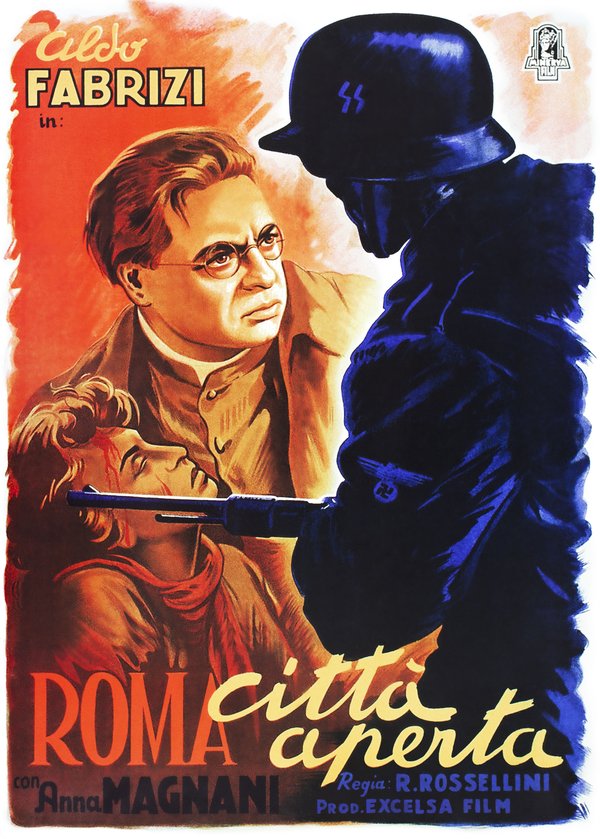
Rome, Open City by Roberto Rossellini
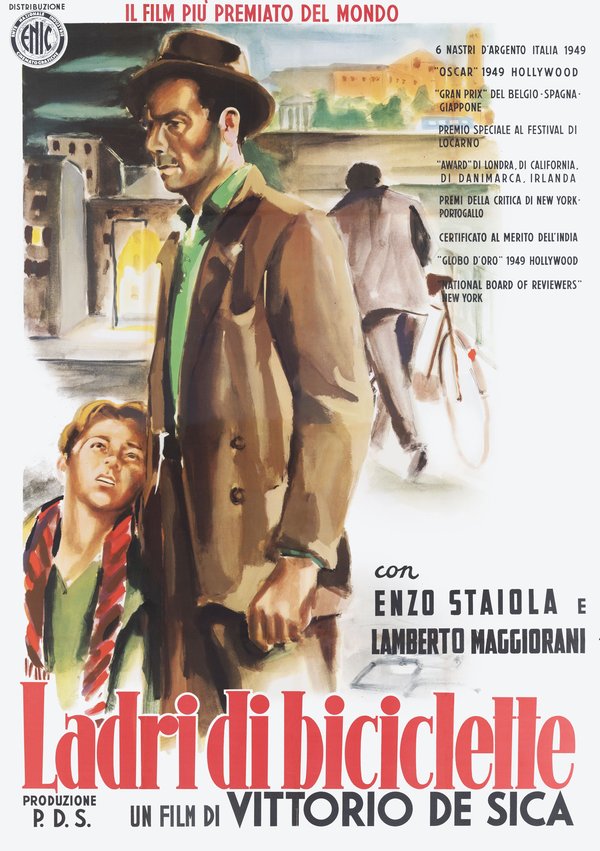
Bicycle Thieves by Vittorio De Sica
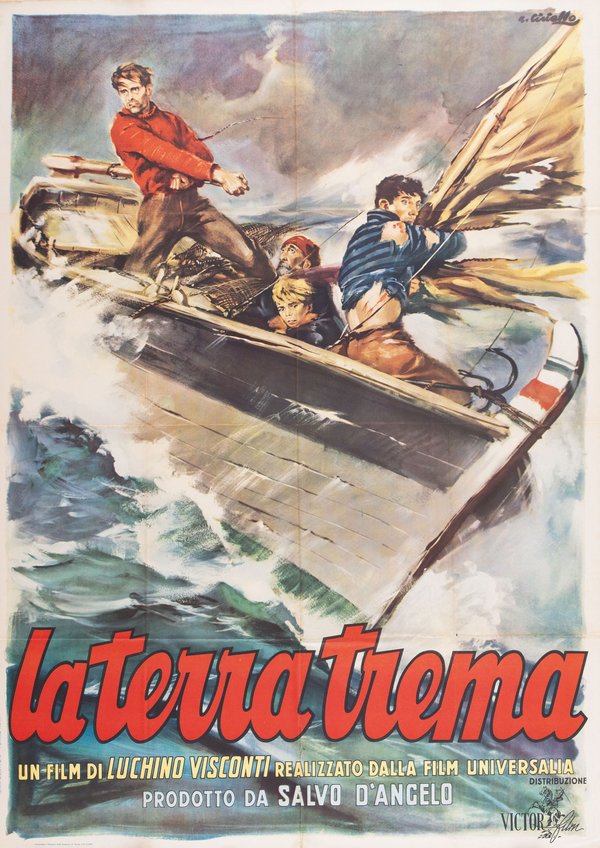
La terra trema by Luchino Visconti
These are not simply films. They are monuments to an era: the Resistance, the postwar years, the lives of the last and the least, those history had pushed to its margins. They are a mirror held up to Italy, a country finally looking itself in the eye and recognising what it saw.
Even the Posters Told the Story of Reality
There is one aspect too often overlooked, yet essential to understanding the true spirit of Neorealism: the film poster. In Italy, more than in many other countries, posters were never merely advertising tools.
They were genuine works of art. Italy’s great poster painters, artists of enduring stature, reinterpreted these films through paint, transforming harsh, unadorned stories into images of extraordinary dramatic power, charged with an evocative force that only art can carry.
It is precisely this ability to blend reality with artistic interpretation that makes the posters of that era so captivating, sought-after and, in a sense, timeless.
A Movement that Transcends Time
Neorealism has no ending. It is not a fire that burns itself out, but a flame that keeps burning, fed by the truth of life.
By the 1950s, Italian cinema had already begun to shift in tone, growing lighter, drifting from the dramatic intensity that had once defined it.
Yet that vision of reality, that particular way of observing the world, has never stopped shaping directors, screenwriters, and audiences alike. More than a style, Neorealism became a way of looking at reality, a lens through which the world continues to be seen: attentive, human, rooted in the everyday.
Neorealism Today, Between Cinema and Collecting
Today, those films and those images live on, not least through their posters. Each one is at once:
- a piece of historical testimony
- an artistic interpretation
- a fragment of cinema itself
At Movie.it, you can rediscover these unique pieces, each telling the story not only of a film, but of an entire cultural era.
Special thanks to Sebastiano Cannavò for his invaluable collaboration.
The works reproduced on this page come from the original prints of the period, recovered, photographed and digitally restored by Movie.it.