
Dracula (1958): The Hammer Masterpiece Returns in 4K with Restored Censored Footage
Edited by Paolo Zelati, Editorial Director
May 29, 2026
There is something profoundly cinematic about what is about to happen. Almost seventy years after its release in British cinemas, those cinemas where, according to contemporary accounts, some audience members fainted during the screening, Dracula the Vampire (1958) is preparing to return. Restored in 4K. Uncut. With everything the censors had torn away. This is cinema being reborn. And art history coming back to breathe.
The News: Hammer Films announces the definitive restoration
On May 26, 2026, World Dracula Day, chosen deliberately to also mark Peter Cushing's birthday, Hammer Films announced the definitive restoration of one of the most influential horror films ever made. Carried out in 4K from the best archival materials sourced worldwide, the restoration reintegrates sequences believed lost for over six decades, footage previously seen only by audiences in Japan back in 1958.
The missing scenes had not disappeared forever: they were buried in the Warner Bros. archive, waiting for someone determined enough to find them. Fisher's complete director's cut lay there, forgotten, in a warehouse near Los Angeles that has housed materials dating back to the 1920s.
The new edition will include over three minutes of previously unseen footage, removed by distributors and censors of the time. The recovered scenes relate primarily to Dracula's final death, the sequence censors had deemed too gruesome and some of the more sensual scenes that the British Board of Film Censors had ordered cut before granting the distribution certificate.
The film will return to cinemas in autumn, in time for Halloween.
1958: the year Dracula made audiences faint
To understand why this restoration is a cultural event and not merely a cinematic one, we must return to the atmosphere of 1958. Horror cinema had existed for decades, but had always operated within certain aesthetic boundaries: the black and white of German Expressionism, the threatening shadows of Universal films from the Thirties, monsters suggested rather than shown
In 1958, Hammer Films changed horror cinema forever the moment Christopher Lee's unmistakable silhouette appeared at the top of a darkened staircase and announced, "I am Dracula." Audiences had never seen anything like it: a Dracula who was tall, physically imposing, sexually threatening, fangs dripping vivid red blood in Technicolor, the first Dracula film made entirely in colour.
Newspaper accounts from the period report that some audience members fainted in their seats as Lee's vampire lunged at his victims' throats, fangs glistening with blood. Scenes judged, at the time, simply too much to bear.
Lee's performance redefined the vampire on screen for generations, introducing the bloodshot eyes, predatory fangs and visceral physicality that became the template for modern vampire mythology, whose influence is still visible in horror cinema today.
The Poster: painting, fear and the Italian School
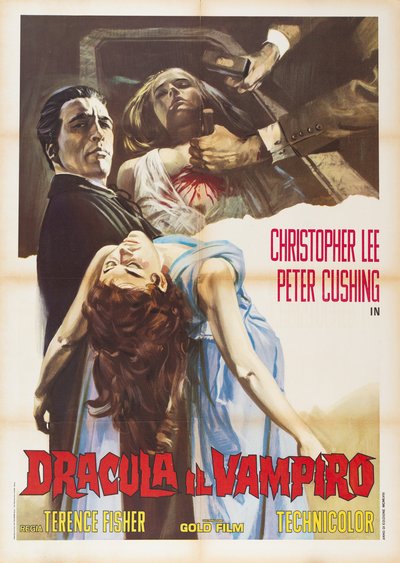
The poster (1970 reissue) you are looking at was created for the film’s 1970 re-release, following its original theatrical release in Italy in 1958.
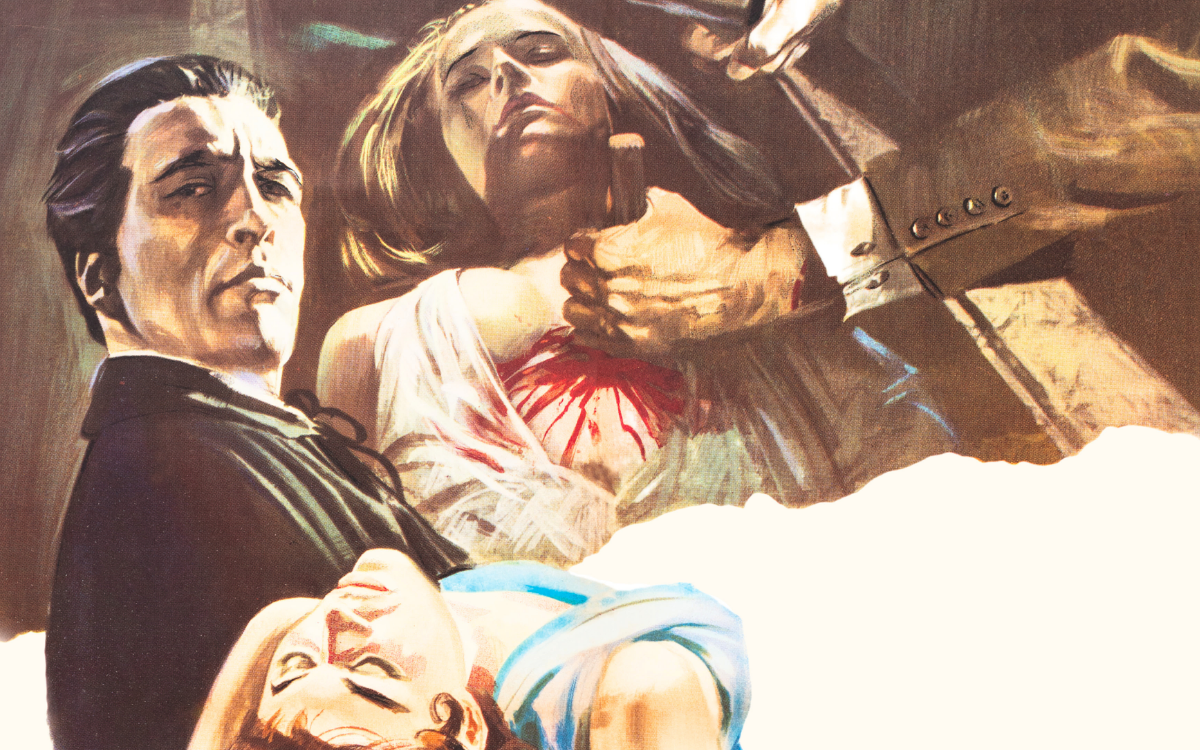
Working within the tradition of postwar Italian film poster painting, the illustrator translated the film's tensions into a composition of extraordinary dramatic force. The scene builds along a dynamic ascending diagonal: at the bottom, the victim, hair loose, held limp in Dracula's arms; at the centre, a second female figure already struck, blood on her chest; at the top, an anonymous hand gripping a stake. That vertical progression pulls the eye upward, generating continuous narrative tension.
All of this set against a background that moves from deep brown to white, creating that sense of emerging from darkness that is the visual heart of the entire Hammer tradition.
The lettering of the title "Dracula il vampiro", rendered in blood-red three-dimensional type, together with the prominent billing of Christopher Lee and Peter Cushing as a mark of quality, reflects a highly sophisticated promotional strategy in which the poster was not merely advertising, but the film’s first act of storytelling.
Christopher Lee and Peter Cushing: a legendary partnership
Dracula the Vampire marked only the second on-screen encounter between horror legends Peter Cushing and Christopher Lee, cementing one of the most celebrated rivalries in cinema history.
On one side Lee: the Count. Physical, sensual, terrifying. Capable of conveying danger with a single glance. On the other Cushing: Doctor Van Helsing. Methodical, determined, deeply human. Their opposition is not merely narrative; it is visual, physical, almost philosophical. Instinct against reason. Darkness against light.
It would be the first of many collaborations. Christopher Lee would go on to play Dracula in six further Hammer films, becoming the face of the vampire for an entire generation of European audiences.
Why this restoration matters (for poster lovers too)
The restoration of Dracula the Vampire isn't an isolated event: Hammer is carrying out a rolling 4K restoration programme across its archive.
For lovers of classic cinema and vintage posters, this moment matters for another reason too: every time a classic film comes back into the light, so does the work of the painter who once brought it to the street. The 1958 Italian poster you see in this article isn't just a historical document, it's a door, and behind it stands an entire artistic tradition that deserves to live again.
Italy's poster painters translated the emotions of a film most audiences hadn't yet seen into a single image. They had to render fear, attraction, the thrill of it all, in brush and paint, on a sheet that would hang on city walls for a few weeks before being torn down and replaced.
Few of those posters truly survived. What remains exists partly in a handful of museum archives, and mostly in private collections: objects nearly invisible now, worn by folds and time, evidence of an art that survives hidden, when it survives at all.
Dracula on your wall: from the 1958 poster to the object of 2026
Hammer restores the film in 4K. The Movie.it project recovers and restores the poster for you.
When you order the 1958 Dracula the Vampire poster, one of tens of thousands in the archive, it's digitally restored and produced just for you: every painterly detail, every shade of colour, every brushstroke brought back into the light before printing. The same care Silver Salt Restoration gave to the restoration of Fisher’s film, we give to the printed sheet that once papered the walls of Italian cities in 1958.
The result, printed on paper, canvas, or whatever material you choose, is never a simple reproduction. It's a piece of cinema history brought back to life on your wall, truer to the painter's original execution than the era's flimsy billposting paper could ever manage, and free of the damage that paper inevitably picked up along the way.
Order the Dracula the Vampire poster and receive at home a perfect work that unites painterly art and the emotion of cinema.
The works reproduced on this page come from original period prints, recovered, photographed and digitally restored by Movie.it.