
Giuliano Nistri, the Painter of Drama in the Painted Movie Poster
By the Movie.it Editorial Team
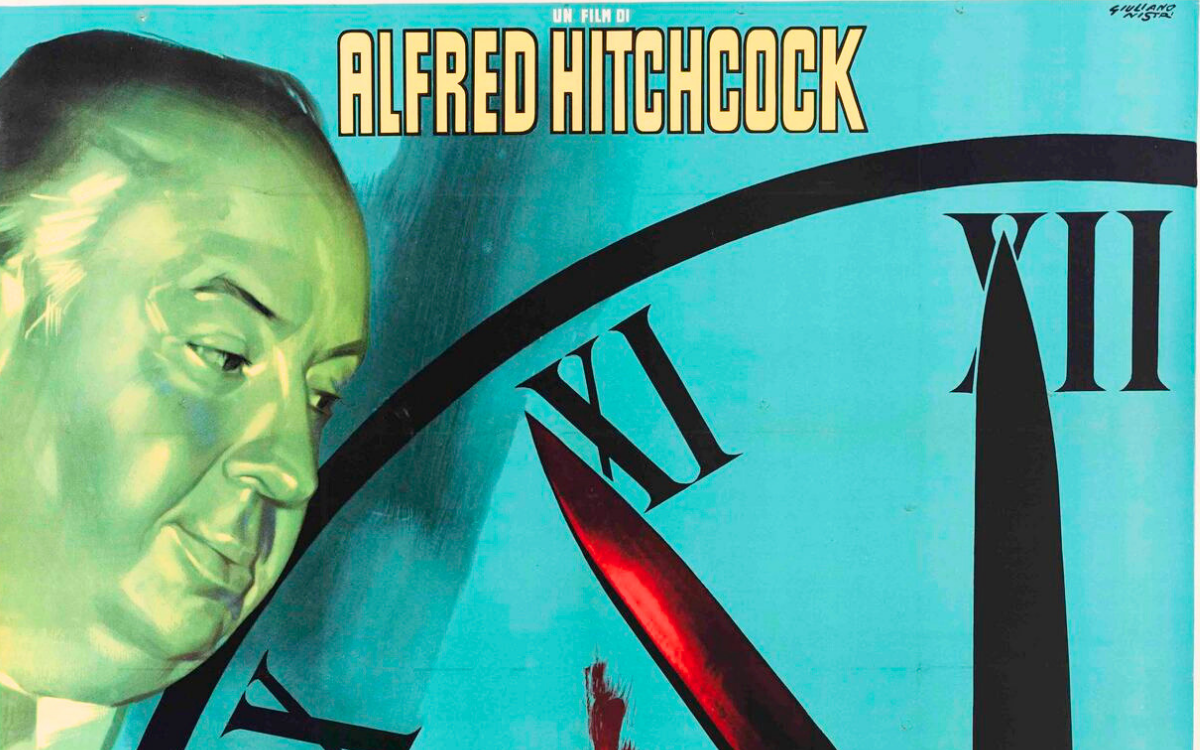
July 1, 2026
Among Italy's "cinema painters," Giuliano Nistri is the master of drama in chiaroscuro: an artist able to freeze a scene at the climax of its action, sculpting faces and bodies with sudden shafts of light. His is a painting of strong emotional impact, capable of turning even the sunniest comedies into dark, powerful images. The author of some two thousand five hundred posters across more than thirty years of work, Nistri signed some of the most memorable images of Italian and international cinema, from Hitchcock's thrillers to the masterpieces of Antonioni and De Sica. His elegant signature, tucked into a lower corner, is today one of the most sought-after in twentieth-century film advertising art.
From "Il Travaso" to the Cinema: The Satirist Who Became a Poster Painter
Giuliano Nistri was born in Rome in 1926. After graduating from the art lyceum on Via Ripetta, he made his name very young as a painter, illustrator and satirical cartoonist, contributing to humour magazines such as "Il Travaso delle idee" and, later, "Il Borghese," and even winning the Golden Palm at the International Humour Salon of Bordighera. It was while working as a caricaturist, at the end of the 1940s, that the cinema noticed him: the American major RKO had the intuition, and his first poster was for Les Anges du péché, Robert Bresson's debut feature, released in Italy as La conversa di Belfort.
From there his career took off. Like the other cinema painters, Nistri presented his artwork in the hope of seeing it chosen and paid for, solely for the film's promotional exploitation in theatres, and he then remained the owner of the works for any other use. He worked for the leading Italian and American houses, from Warner Bros. and Paramount to Titanus, Lux and Ponti-De Laurentiis. There is one detail that captures the singularity of the family: his elder brother too, Lorenzo, known as Enzo (1923-2008), was a leading poster painter, the author among others of the celebrated artwork for Breakfast at Tiffany's and Notorious. The two Nistris pursued careers so parallel and so alike that they were sometimes confused with one another, much as happened, at the opposite end of the stylistic spectrum, to colleagues such as Sandro Symeoni and Carlantonio Longi.
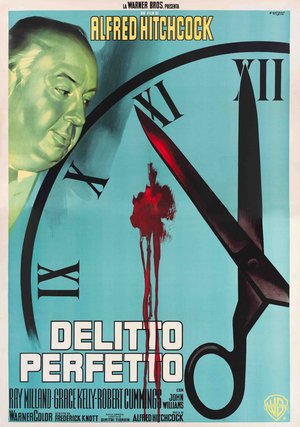
Dial M for Murder (Alfred Hitchcock, 1954)
The poster for Dial M for Murder is one of Nistri's most brilliant feats in the art of synthesis. Against a turquoise ground, the artist sums up the entire film in just three objects: the face of the master Alfred Hitchcock, lit by a livid green glow, peering in from the corner like a demiurge of suspense; a huge clock dial with Roman numerals, an allusion to the timed precision of the "perfect" crime; and a gigantic pair of open scissors, the murder weapon, from which a trickle of scarlet blood runs down. The renunciation of any human figure in favour of pure symbol is a choice of rare graphic modernity, one that makes this poster a small emblem of Hitchcockian cinema.
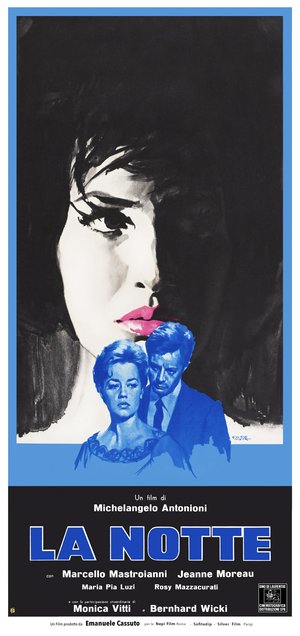
La Notte (Michelangelo Antonioni, 1961)
The "locandina" (the small Italian format) for La notte shows Nistri at his most lyrical and painterly. Dominating the narrow vertical sheet is the large face of Monica Vitti, painted in a nervous, material black and white, with the single chromatic accent of her pink lips: a melancholy, suspended gaze that perfectly embodies the film's sense of non-communication. Below, in a cold shade of blue, appear the couple formed by Moreau and Marcello Mastroianni, close together yet distant. It is an image that translates the bourgeois unease of Antonioni's masterpiece into paint, with a refinement that concedes nothing to advertising effect. This locandina is also proof of how comfortably Nistri could move from symbolic graphic design to pure portraiture.
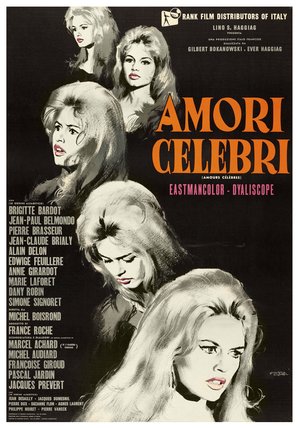
Famous Love Affairs (Michel Boisrond, 1961)
In the poster for Famous Love Affairs, an episode film by the Frenchman Michel Boisrond, Nistri builds a veritable gallery of female faces. Against a deep black ground there cascade several studies of the face of Brigitte Bardot, rendered almost in monochrome with his customary mastery of chiaroscuro and lit only by the strong pink of the lips. Sensuality is suggested rather than displayed, entrusted to the billowing hair and the gaze. Alongside the French star, the poster parades a stellar cast, from Belmondo to Delon to Simone Signoret. It is a perfect example of that motif, recurrent in Nistri, of the composition built as a constellation of portraits.
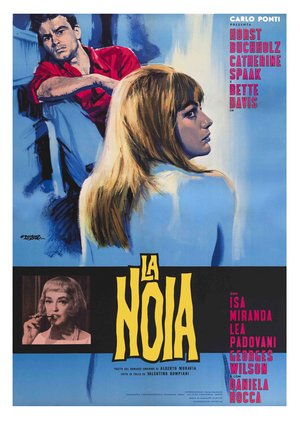
The Empty Canvas (Damiano Damiani, 1963)
The poster for The Empty Canvas, adapted from Alberto Moravia's novel, plays entirely on a refined chord of blues. At upper left, Horst Buchholz, in a red shirt that bursts out as the only warm note, stares at the viewer with a tormented air; at the centre, seen from behind, the young Catherine Spaak turns her face in profile, her long blonde hair and bare shoulder embodying the object of desire. Below, a photographic inset tints the face of Bette Davis sepia, a cigarette holder between her fingers. Nistri orchestrates the film's erotic and psychological tension with a few knowing contrasts.
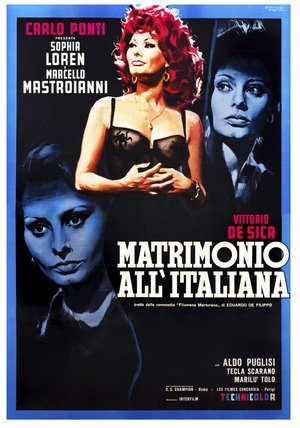
Marriage Italian Style (Vittorio De Sica, 1964)
The poster for Marriage Italian Style is likewise a triptych of faces, this time devoted to Sophia Loren. At the centre, against a black ground, the star emerges with overflowing sensuality, her hair a flaming red and her slip black, her hands gathered at her breast. All around, two further portraits, tinted a lunar blue, convey her shifting moods, from mischief to melancholy, hinting at the complexity of the character of Filumena. This is the most pop and theatrical Nistri, able to make the glamour of the star coexist with the depth of the Eduardo De Filippo play on which the film is based.
Nistri's Style: Chiaroscuro as Drama
What makes Nistri unmistakable is his use of marked chiaroscuro, chromatic contrasts and intense lighting effects that recall, in certain respects, the lesson of Caravaggio. In his posters the scene freezes at the climax of the action, while the background, often uniform, is designed to make the figures explode into the foreground. In other works the composition is built from clean, stylized brushstrokes that together form and dissolve the figures, heightening the narrative tension.
This dramatic vein reaches its peak in Mario Bava's La maschera del demonio (released abroad as Black Sunday), where the shaft of light slicing the face of Barbara Steele in two generates an almost tactile unease: a poster that has entered the legend of Italian gothic, alongside those signed by colleagues such as Marcello Colizzi and Averardo Ciriello. Yet Nistri could also change register: for George Cukor's My Fair Lady he adopted a delicate, soft-focus style, portraying Audrey Hepburn in the white gown designed by Cecil Beaton. Graphic rigour and painterly freedom coexist in him with ease, the sign of an uncommon versatility.
Nistri's Legacy
Giuliano Nistri died in Anzio in November 2022, after a lifetime devoted to the brush, much of it spent in the studio overlooking the sea between Anzio and Nettuno. Alongside his roughly two thousand five hundred film posters, he left an intense body of work as a satirical cartoonist and illustrator, including for the Italian Carabinieri. In recent years his work has come back to light from the cellars where it lay gathering dust, thanks in part to the documentary that director Fabio Micolano devoted to his figure and to a now-vanished profession.
His legacy is that of an artist who managed to fuse drama and irony, graphic power and painterly finesse, giving the dignity of art to a craft that lasted only as long as a film's run. Rediscovered today by scholars and collectors alongside the other great cinema painters, Nistri remains one of the most intense and original interpreters of that unrepeatable era when the walls of Italian cities were open-air art galleries.
The works reproduced on this page come from the original prints of the period, recovered, photographed and digitally restored by Movie.it.