
Francesco Fiorenzi, Master of Movie Poster Photomontage
By Movie.it Editorial Team
June 24, 2026
In the great age of the Italian cinema painters, made of brushes, tempera and palettes, there was an artist who chose a different, almost heretical path: instead of painting, he cut. Instead of inventing a face, he started from a photograph. Francesco Fiorenzi was a master of cinematic collage, making photography central to a distinctive visual language at a time when the great Italian film-poster tradition was still dominated by painting. His is the story of a visionary self-taught artist who, with scissors and glue, foresaw how film posters would one day be made.
From Carqueiranne to Rome: A Self-Taught Artist in the World of Cinema
Francesco Fiorenzi was born in 1923 in Carqueiranne, on the Mediterranean coast of France, to Italian parents. His was an itinerant childhood: he lived first in Turin, then in Genoa, until, in 1935, the family settled in Rome. It was in the capital, the beating heart of the Italian film industry, that the young Fiorenzi found his way. With no academic training behind him, entirely self-taught, he made his way into the circles of the cinema painters, that community of artists who in the postwar years created the works that announced films in the streets and squares of Italy.
Fiorenzi soon earned a place among the masters of the trade, so much so that he is today numbered among the twenty-nine "cinema painters" gathered in the great surveys devoted to this unrepeatable Italian artistic current, alongside names such as Ballester, Brini, Campeggi and Capitani. But unlike most of his colleagues, his signature was not the brush: it was photography. From his earliest works, Fiorenzi produced numerous posters characterised by an innovative use of the photographic image, to which he added pictorial or chromatic touches to bind the various elements of the composition together. It was an approach that set him clearly apart from the traditional poster artists and that, in hindsight, appears prophetic.
Scissors, Glue and Production Stills: The Invention of a Method
To understand Fiorenzi's revolution, one must picture his worktable in an age devoid of any digital tool. No Photoshop, no digital photo editing: only scissors, glue and photographs. And it is here that his choice becomes even more surprising. One tends to imagine that the cinema painters had rich reference materials at their disposal, but the reality was quite different: only rarely did they receive a photographic "kit" from the production, and this happened even more rarely for foreign films. Almost never, moreover, could the artist see the film before setting to work: the prints were struck at the last moment, according to the number of simultaneous releases, while the preparatory sketches for the poster and the "locandina" (the small vertical Italian format) had to be ready much earlier.
In this context of scarcity, Fiorenzi's work with photography takes on even greater value. He managed to obtain photographic images, cut them out, juxtaposed them, combined them, inventing a form of poster founded on juxtaposition and montage. He was, in a sense, an editor of the printed page: just as a director constructs meaning by juxtaposing shots, Fiorenzi constructed the emotion of the poster by juxtaposing faces, bodies, fragments of scenes. And where the photographs were not enough, he intervened with colour and brushwork, fusing the pieces into a coherent image. This handcrafted collage technique, made by hand in an analogue age, anticipates with lucidity the graphic solutions that from the 1980s onward would supplant the traditional painted poster.
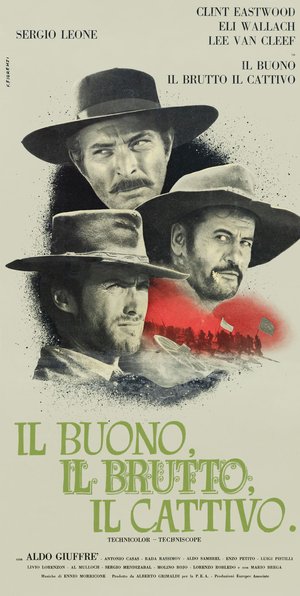
The Good, the Bad and the Ugly (Sergio Leone, 1966)
The locandina for Sergio Leone's masterpiece is perhaps Fiorenzi's most famous image. Three close-up photographs of the protagonists, Lee Van Cleef, Clint Eastwood and Eli Wallach, are juxtaposed and fused together with touches of airbrush and dark spatters, while at the centre a small blood-red battle scene introduces the backdrop of the civil war. It is the emblematic poster of the spaghetti western, and it shows Fiorenzi's method at its best: not to illustrate, but to montage the faces together as in a single shot.
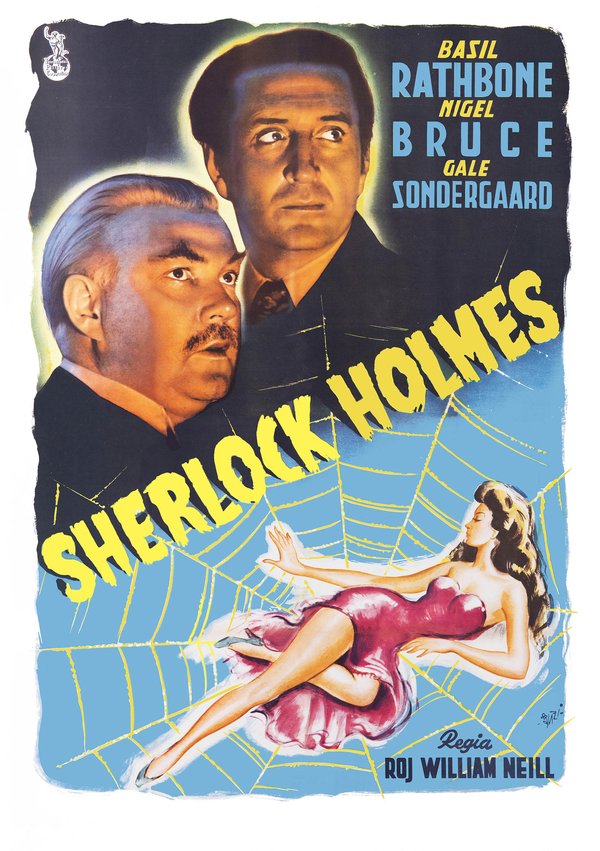
The Spider Woman (Roy William Neill, 1944)
In this poster for a film in the Basil Rathbone cycle, Fiorenzi approaches the classic mystery with a more pictorial, atmospheric language. The faces of the two protagonists, Rathbone and Nigel Bruce, emerge from the darkness above, lit by a phosphorescent halo, while below a woman in a red dress lies trapped in a great yellow spiderweb that stands out against the blue background. The spider's web, symbol of the intrigue, becomes the graphic element that organises the whole composition. An example of Fiorenzi's versatility, able to adapt his language even to genre cinema and the mystery film.
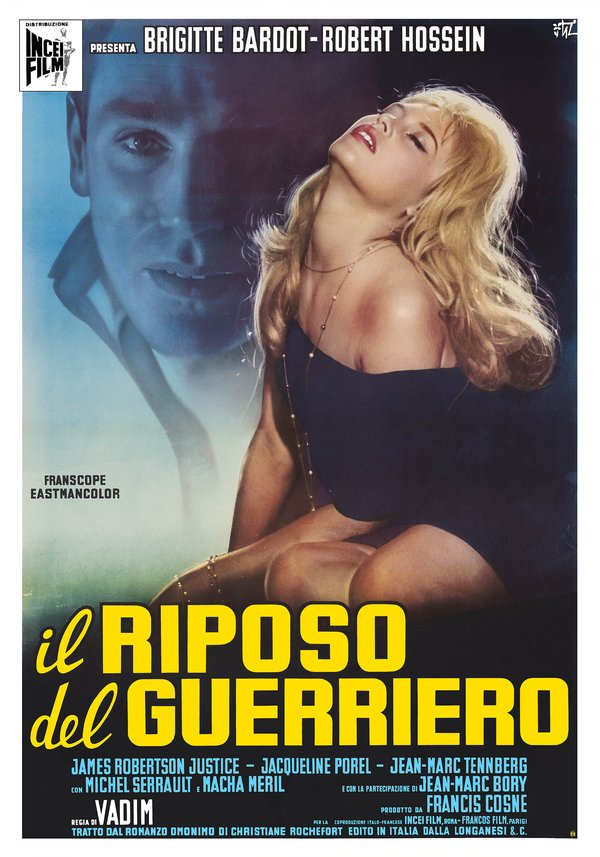
Love on a Pillow (Roger Vadim, 1962)
In this poster for Roger Vadim's film with Brigitte Bardot, released in Italy as Il riposo del guerriero, Fiorenzi shows his unmistakable signature: photography as the absolute protagonist. The body of Brigitte Bardot, photographed in colour in a pose of sensual abandon, in a black dress with loose blonde hair, dominates the composition, while on the left the male face of Robert Hossein emerges in transparency from a cold, bluish tone. The contrast between the warmth of the female figure and the coldness of the background creates all the erotic and dramatic tension of the film. A perfect example of how Fiorenzi could "edit" two photographs into a single emotional image.
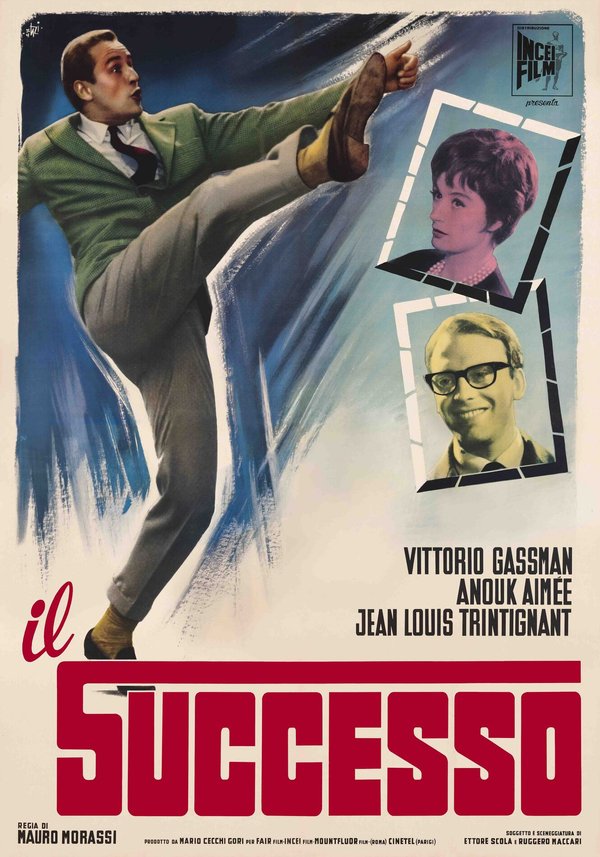
Il successo (Mauro Morassi, 1963)
For this comedy with Vittorio Gassman, Fiorenzi plays with dynamic montage between painting and photography. The figure of Gassman, portrayed in an exuberant, almost acrobatic pose with his leg thrust forward, is set against a background painted in broad blue brushstrokes, while on the right two tinted snapshots, the faces of Anouk Aimée and Jean Louis Trintignant, are set into broken graphic frames. It is a poster that visually translates the rising energy of the comedy, fusing the painterly gesture with the photographic fragment in a balance of great modernity.
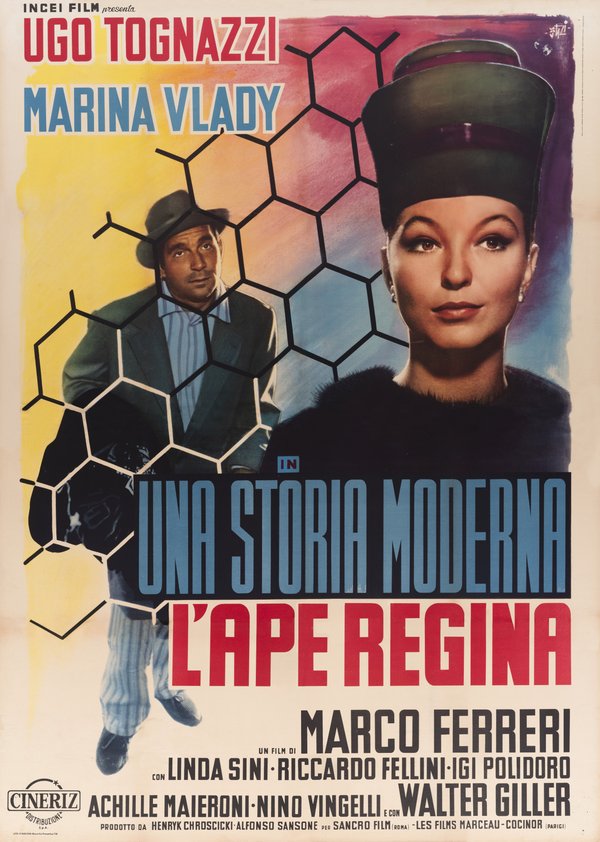
The Conjugal Bed (Marco Ferreri, 1963)
The poster for Marco Ferreri's film with Ugo Tognazzi and Marina Vlady, is perhaps the most conceptual of those gathered here. Fiorenzi builds the image around the metaphor of the title: a large graphic structure of hexagonal honeycomb cells is superimposed over the figures, imprisoning Tognazzi like a drone and crowning Marina Vlady, the queen bee, with a headdress that takes the shape of a hive. The photographic face of Vlady, haughty and magnetic, is set against fields of bright colour, from yellow to magenta. An image that sums up with graphic intelligence the ferocious theme of the film on marriage and female dominance.
The Legacy of Fiorenzi: The Prophet of Photomontage
Fiorenzi's most famous posters remain probably those created for Sergio Leone's films. Besides The Good, the Bad and the Ugly, for For a Few Dollars More he adopted an essential black-and-white style to portray Clint Eastwood, setting beside him a marked red brushstroke that evoked a bloodstain. His too is the locandina for The War of the Worlds, enlivened by pictorial touches of colour, as well as the posters for The Mark of Zorro and Bread, Love and Dreams.
Looking at Fiorenzi’s work today, it is clear just how far ahead of his time he was. While the great poster artists were celebrating the apotheosis of cinematic painting, he was already looking elsewhere, sensing that the future of visual communication would be photographic. With his scissors and glue, Francesco Fiorenzi did not merely illustrate films: he developed a distinctive language of auteur photomontage that anticipated many of the solutions that would become widespread in film-poster design in the decades that followed. For this reason, he deserves a special place in the history of the Italian movie poster, as a bridge between the great painterly tradition and modern photographic graphic design.
The works reproduced on this page come from the original prints of the period, recovered, photographed and digitally restored by Movie.it.